The answer might be right in front of you
flight sChool
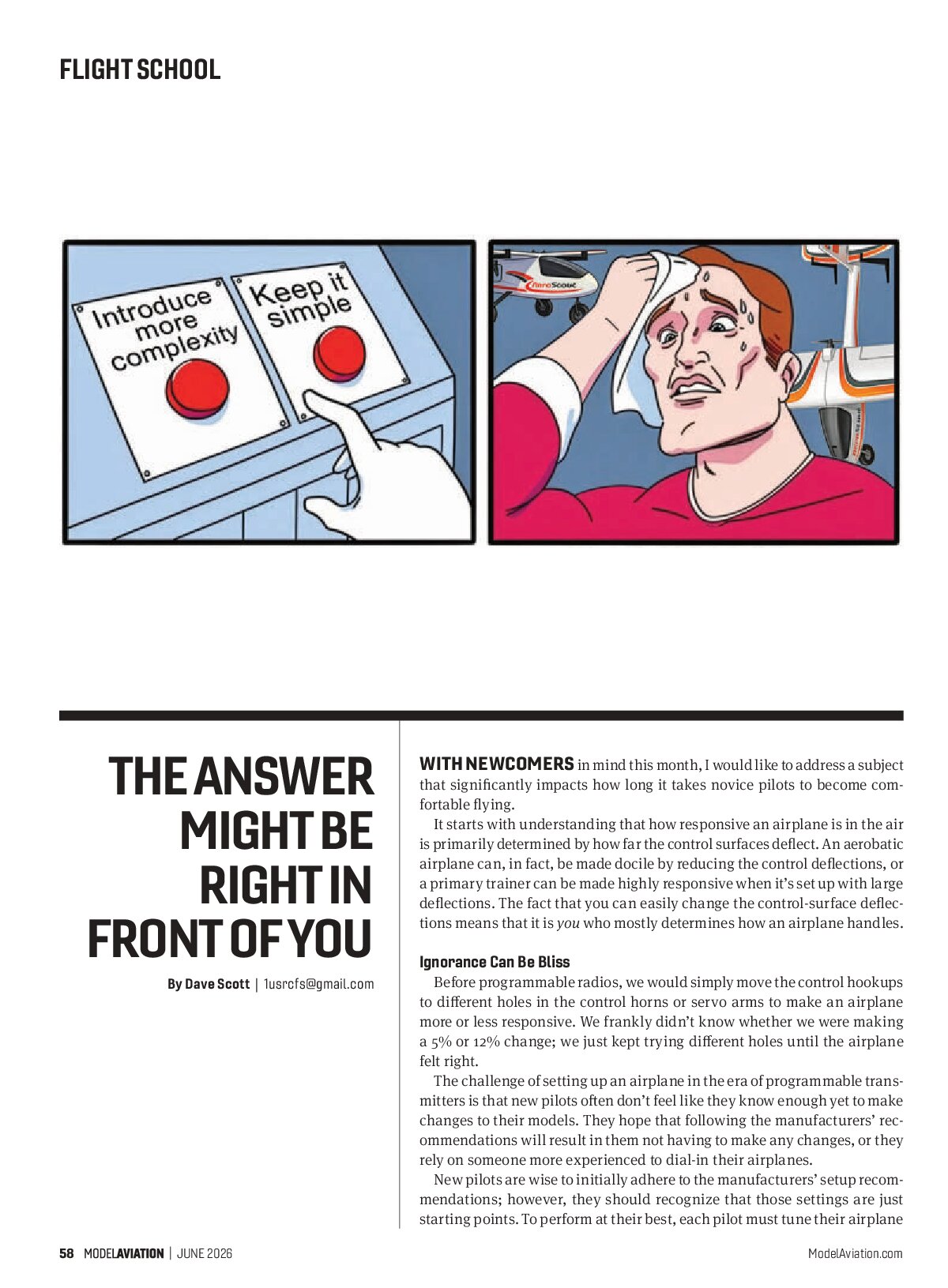
With newcomers in mind this month, I would like to address a subject that significantly impacts how long it takes novice pilots to become comfortable flying.
It starts with understanding that how responsive an airplane is in the air is primarily determined by how far the control surfaces deflect. An aerobatic airplane can, in fact, be made docile by reducing the control deflections, or a primary trainer can be made highly responsive when it’s set up with large deflections. The fact that you can easily change the control-surface deflections means that it is you who mostly determines how an airplane handles.
Ignorance Can Be Bliss
Before programmable radios, we would simply move the control hookups to different holes in the control horns or servo arms to make an airplane more or less responsive. We frankly didn’t know whether we were making a 5% or 12% change; we just kept trying different holes until the airplane felt right.
The challenge of setting up an airplane in the era of programmable transmitters is that new pilots often don’t feel like they know enough yet to make changes to their models. They hope that following the manufacturers’ recommendations will result in them not having to make any changes, or they rely on someone more experienced to dial-in their airplanes.
New pilots are wise to initially adhere to the manufacturers’ setup recommendations; however, they should recognize that those settings are just starting points. To perform at their best, each pilot must tune their airplane to their comfort level. Those settings will then likely change again as a pilot’s confidence and repertoire increases.
Control throws that feel fine to an experienced pilot can feel too responsive to a newcomer; hence, despite the lack of experience, the newcomer is the one who should be determining whether the airplane is handling to their liking. That means they must overcome any lack of confidence in their ability to determine what adjustments need to be made if they are going to fly their best and experience the most enjoyment.
Think of an RC airplane as being similar to a race car. Race car drivers don’t concern themselves with the intricacies of how the car works. They give the team feedback, which is used to make adjustments to improve the car’s handling and, ultimately, make the driver more comfortable. A losing strategy would be to tell the driver that the setup is how their teammate likes it or to tell them to get used to it the way it is!
Believe it or not, an RC pilot’s gut is a “precision instrument” that is often more useful than a degree in aerodynamics or experience. The reality is that new pilots don’t know enough to be dangerous yet, and, therefore, they have an innate ability to sense in their gut how the airplane feels. Pilots who have received a lot of advice over time tend to jump to conclusions and thereby lose their ability to listen to their gut.
The Answer Is Found in Asking the Question
With all of that said, the fact remains that many newcomers are afraid to change control-surface travels, even when they sense things are not the way that they would like them to be. I deal with this each week in my RC flight school when I am flying students’ airplanes. After the initial trimming and setup adjustments, I’ll see that a pilot would benefit from less aileron or elevator, but when I ask them if they’d like to change anything, they’ll either tell me it’s fine or say that they trust me to determine the best setup.
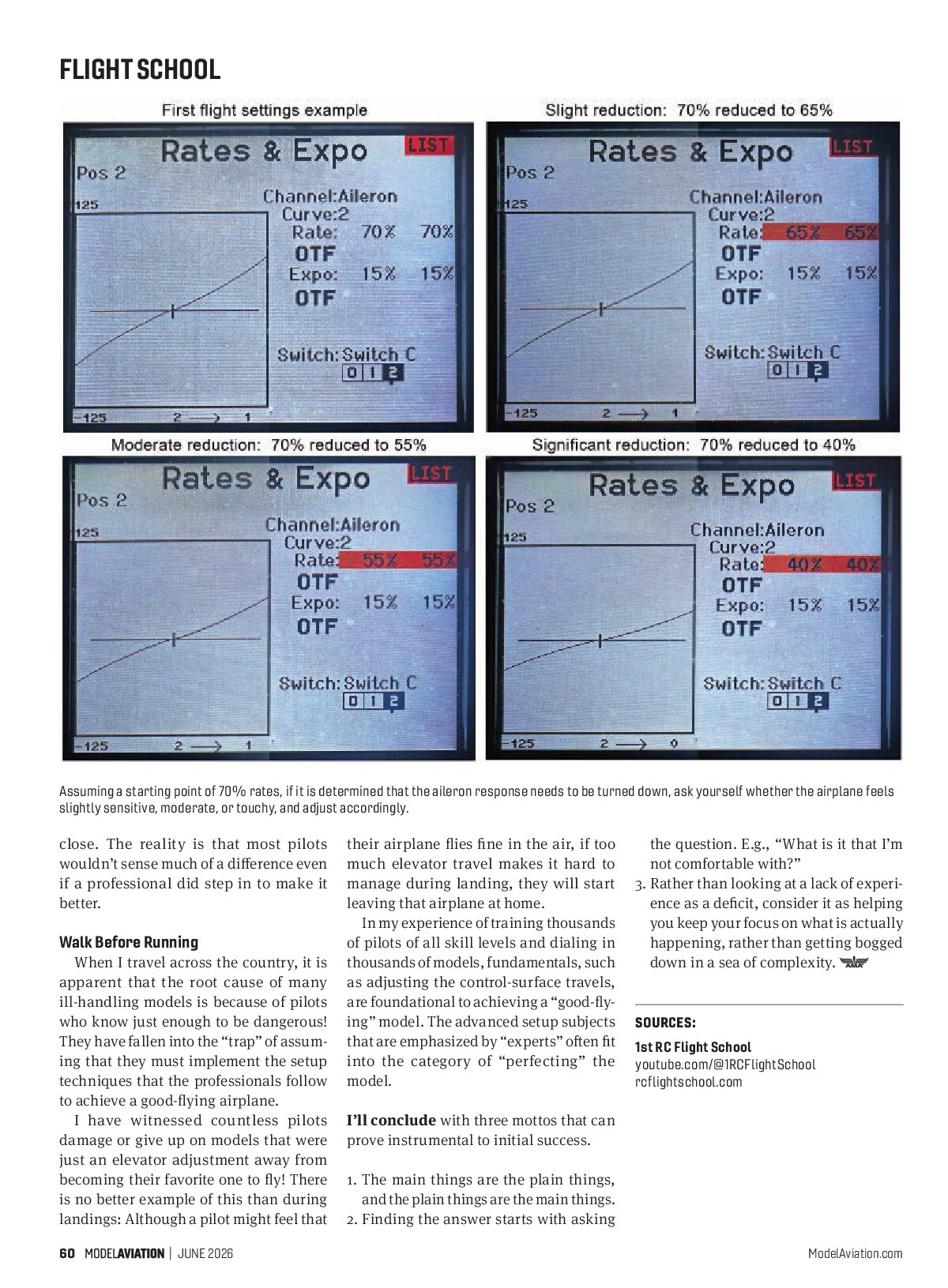
I then ask them, “If I gave you the option to add or decrease the aileron response, which would you choose?” Usually, without hesitation, they respond, “I might like it better if the aileron was cut down a little.” Once we’re on the ground, I’ll ask whether they felt that the aileron was just slightly touchy, moderate, or very touchy. Every time, they’ll accurately gauge whether the adjustment needs to be small, moderate, or significant.
This is when I turn to the entire class and acknowledge that a low-time pilot just demonstrated the ability to make a precise change for the better, but it took going through the motions of asking them questions to get their true impressions to come out. When the students return home after the training course, they will have to take over and continually ask themselves whether they would prefer more or less control-surface travel.
When you think it’s fine, challenge yourself: “Can I make it better?” These additional refinements will ultimately increase your rate of learning and enjoyment.
You will eventually reach a point where you can’t come up with any more adjustments to make, and you might possibly think that it is because you don’t know better. I assure you that when you reach that point, if it isn’t optimum, it will be very close. The reality is that most pilots wouldn’t sense much of a difference even if a professional did step in to make it better.
Walk Before Running
When I travel across the country, it is apparent that the root cause of many ill-handling models is because of pilots who know just enough to be dangerous! They have fallen into the “trap” of assuming that they must implement the setup techniques that the professionals follow to achieve a good-flying airplane.
I have witnessed countless pilots damage or give up on models that were just an elevator adjustment away from becoming their favorite one to fly! There is no better example of this than during landings: Although a pilot might feel that their airplane flies fine in the air, if too much elevator travel makes it hard to manage during landing, they will start leaving that airplane at home.
In my experience of training thousands of pilots of all skill levels and dialing in thousands of models, fundamentals, such as adjusting the control-surface travels, are foundational to achieving a “good-flying” model. The advanced setup subjects that are emphasized by “experts” often fit into the category of “perfecting” the model.
I’ll conclude with three mottos that can prove instrumental to initial success.
- The main things are the plain things, and the plain things are the main things.
- Finding the answer starts with asking the question. E.g., “What is it that I’m not comfortable with?”
- Rather than looking at a lack of experience as a deficit, consider it as helping you keep your focus on what is actually happening, rather than getting bogged down in a sea of complexity.

SOURCES
- 1st RC Flight School
youtube.com/@1RCFlightSchool - rcflightschool.com