Electric Tips for Newcomers
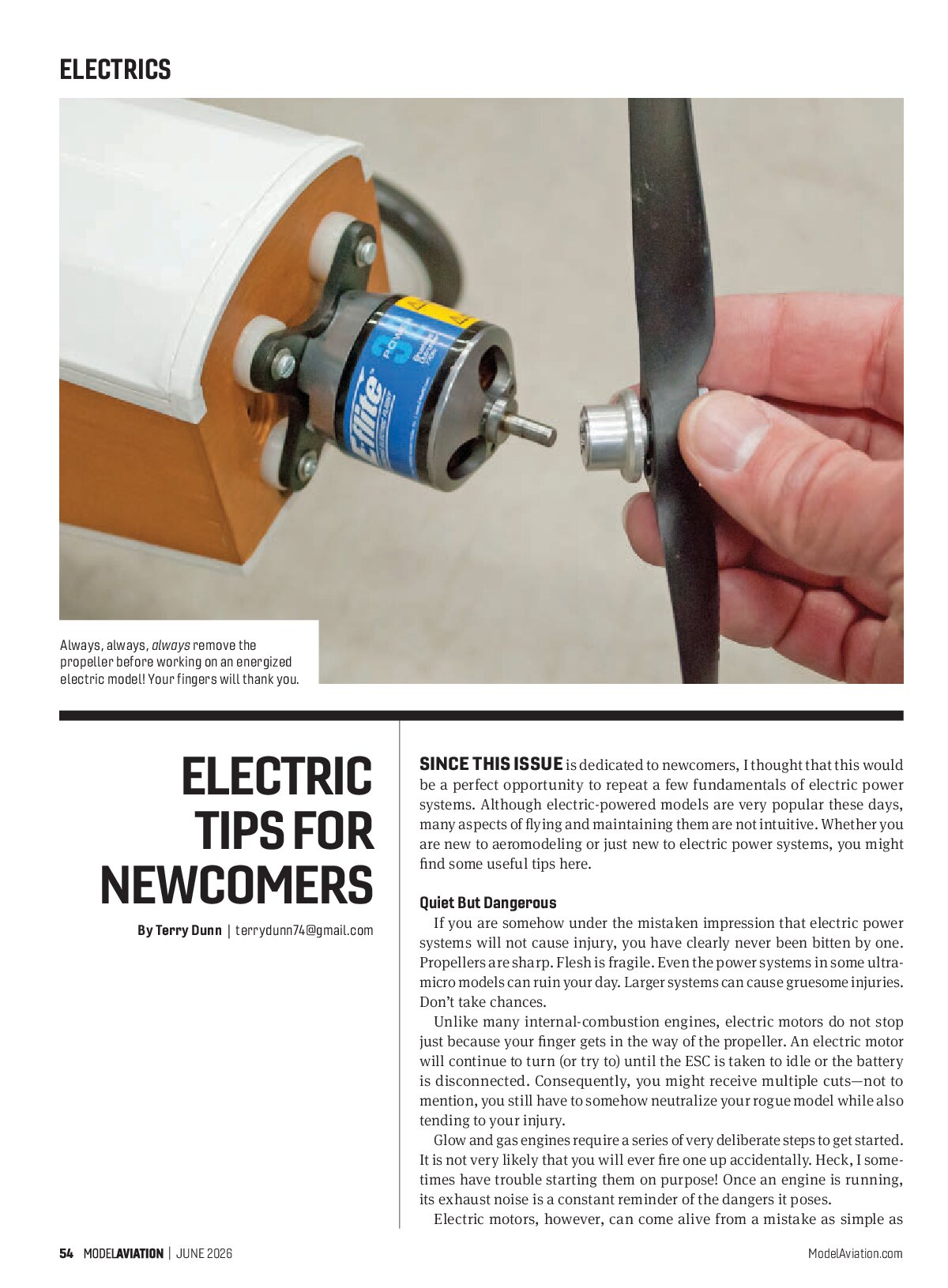
Always, always, always remove the propeller before working on an energized electric model! Your fingers will thank you.
Since this issue is dedicated to newcomers, I thought that this would be a perfect opportunity to repeat a few fundamentals of electric power systems. Although electric-powered models are very popular these days, many aspects of flying and maintaining them are not intuitive. Whether you are new to aeromodeling or just new to electric power systems, you might find some useful tips here.
Quiet But Dangerous
If you are somehow under the mistaken impression that electric power systems will not cause injury, you have clearly never been bitten by one. Propellers are sharp. Flesh is fragile. Even the power systems in some ultramicro models can ruin your day. Larger systems can cause gruesome injuries. Don’t take chances.
Unlike many internal-combustion engines, electric motors do not stop just because your finger gets in the way of the propeller. An electric motor will continue to turn (or try to) until the ESC is taken to idle or the battery is disconnected. Consequently, you might receive multiple cuts—not to mention, you still have to somehow neutralize your rogue model while also tending to your injury.
Glow and gas engines require a series of very deliberate steps to get started. It is not very likely that you will ever fire one up accidentally. Heck, I sometimes have trouble starting them on purpose! Once an engine is running, its exhaust noise is a constant reminder of the dangers it poses.
Electric motors, however, can come alive from a mistake as simple as bumping the throttle stick or reversing the wrong channel. An energized power system (i.e., the battery is connected) will often seem quite harmless because the propeller isn’t spinning and you can’t hear any noise. The reality, however, is that you must recognize and respect the dangers it poses.
My philosophy for handling electric-powered models at the flying field is simple. Whenever the battery is connected, I treat an electric model the same as I would treat a glow or gas model with the engine running. Keep all body parts well clear of the propeller arc and always be wary of the model surging forward at inopportune times.
Many modelers configure a kill switch on their transmitter to help prevent unintentional spin-ups of the motor. While a kill switch can help diminish the occurrence of power system accidents on the ground, it is far from foolproof; I have seen plenty of people get injured by models equipped with a kill switch. Even when your kill switch is engaged, handle your model as though there is an ornery snapping turtle bolted to the firewall.
Workshop accidents with electric models are very common; however, there is an easy way to avoid the danger posed by accidental runups in your shop: remove the propeller whenever you are working on a model with the battery connected. This applies even if you are not working on the actual power system. It only takes a few seconds to be safe. Make this simple task a habit before you have the scars to remind you. Removing the propeller is the single most effective way to avoid workshop injuries with electric-powered models. Full stop.
Battery Care
I think all LiPo batteries that we use in our models have a factory-applied sticker that warns us to not leave the battery unattended while charging. It’s one of those warnings you see so often that it’s easy to dismiss it. Unfortunately, charging incidents do happen. We should heed the message every time.
In the December 2024 “Electrics” column, I talked about a close call that one of my friends experienced. I will repeat it here in his words.
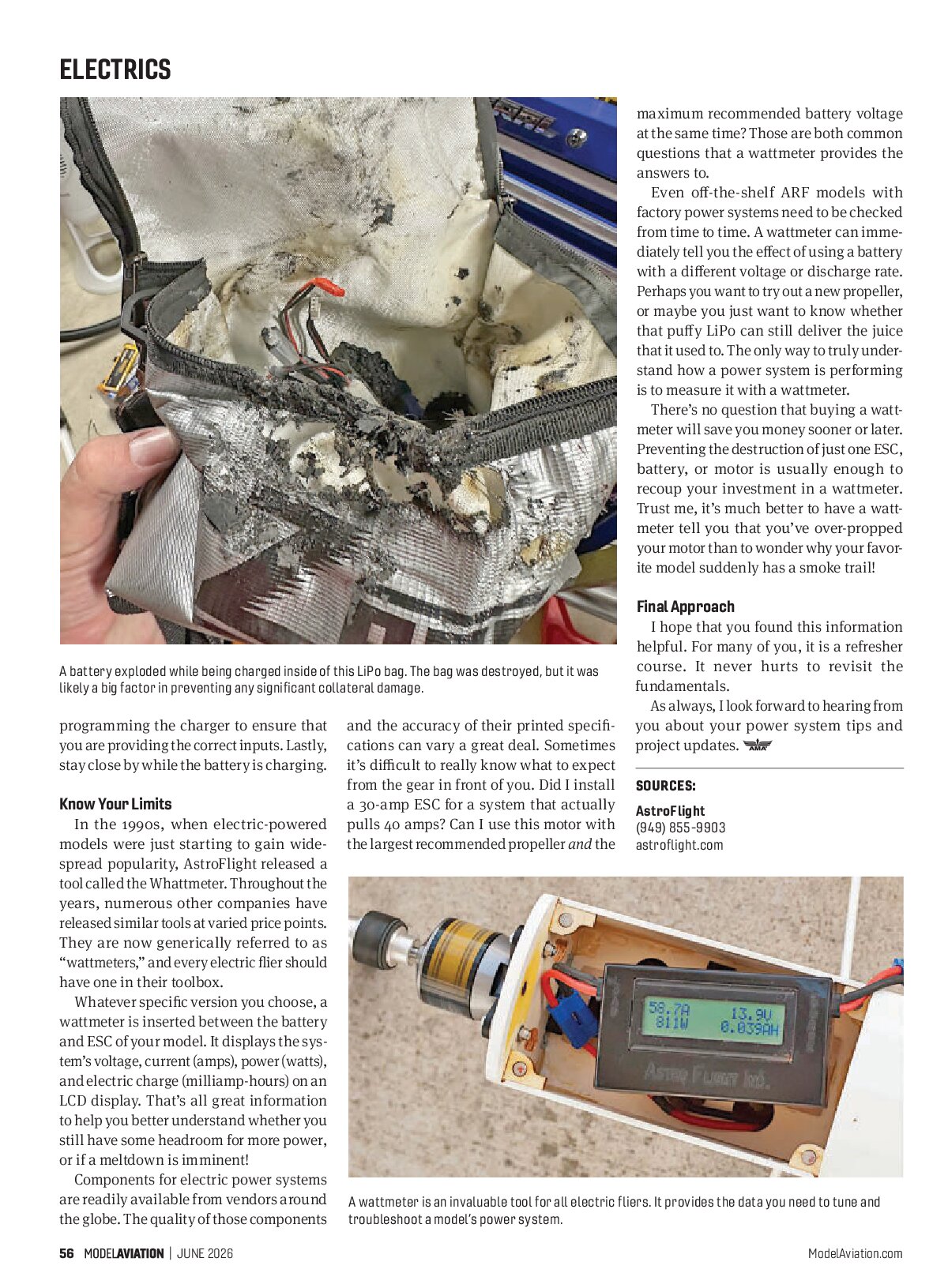
“I had a LiPo explode while charging. I think it was a bad lead from the charger to the battery that led to a short. I had it charging in a LiPo bag, which was damaged by the burning battery. I shoved the LiPo bag into an ammo can and ran it outside. Several other batteries in the LiPo bag were damaged to varying degrees, but no other batteries exploded. My entire basement was filled with smoke, and it permeated the house. Several of my model planes have small burn pits in them. One Combat plane was destroyed, despite it being across the room.”
The good news in this story is that my buddy was doing a lot of things correctly. First, he had the battery in a fireproof LiPo bag. The bag was likely responsible for mitigating the effects of the exploding battery. Equally important is that my friend was in the room monitoring the charger. This allowed him to detect the problem quickly and react; otherwise, the damage could have been much more severe. Thankfully, there was no damage to his home once the smoke cleared.
For me, this episode serves as a reminder to always be vigilant when charging batteries of any type. Periodically inspect your batteries, the charger, and the charging leads for damaged insulation or frayed wires. Pay close attention when you are programming the charger to ensure that you are providing the correct inputs. Lastly, stay close by while the battery is charging.
Know Your Limits
In the 1990s, when electric-powered models were just starting to gain widespread popularity, AstroFlight released a tool called the Whattmeter. Throughout the years, numerous other companies have released similar tools at varied price points. They are now generically referred to as “wattmeters,” and every electric flier should have one in their toolbox.
Whatever specific version you choose, a wattmeter is inserted between the battery and ESC of your model. It displays the system’s voltage, current (amps), power (watts), and electric charge (milliamp-hours) on an LCD display. That’s all great information to help you better understand whether you still have some headroom for more power, or if a meltdown is imminent!
Components for electric power systems are readily available from vendors around the globe. The quality of those components and the accuracy of their printed specifications can vary a great deal. Sometimes it’s difficult to really know what to expect from the gear in front of you. Did I install a 30-amp ESC for a system that actually pulls 40 amps? Can I use this motor with the largest recommended propeller and the maximum recommended battery voltage at the same time? Those are both common questions that a wattmeter provides the answers to.
Even off-the-shelf ARF models with factory power systems need to be checked from time to time. A wattmeter can immediately tell you the effect of using a battery with a different voltage or discharge rate. Perhaps you want to try out a new propeller, or maybe you just want to know whether that puffy LiPo can still deliver the juice that it used to. The only way to truly understand how a power system is performing is to measure it with a wattmeter.
There’s no question that buying a wattmeter will save you money sooner or later. Preventing the destruction of just one ESC, battery, or motor is usually enough to recoup your investment in a wattmeter. Trust me, it’s much better to have a wattmeter tell you that you’ve over-propped your motor than to wonder why your favorite model suddenly has a smoke trail!
Final Approach
I hope that you found this information helpful. For many of you, it is a refresher course. It never hurts to revisit the fundamentals.
As always, I look forward to hearing from you about your power system tips and project updates.


SOURCES
- AstroFlight
(949) 855-9903 - astroflight.com