Differences between FAI and AMA Pylon Racing, Part 2
In my March 2026 “RC Pylon Racing” column, I discussed the differences between FAI and AMA RC Pylon Racing and referenced Jacob Raquet’s coverage of the 2025 FAI F3D and F3E World Championships for Pylon Racing Model Aircraft that appeared in the December 2025 issue of Model Aviation. In this month’s column, I’ll continue by discussing the course layouts and racing formats.
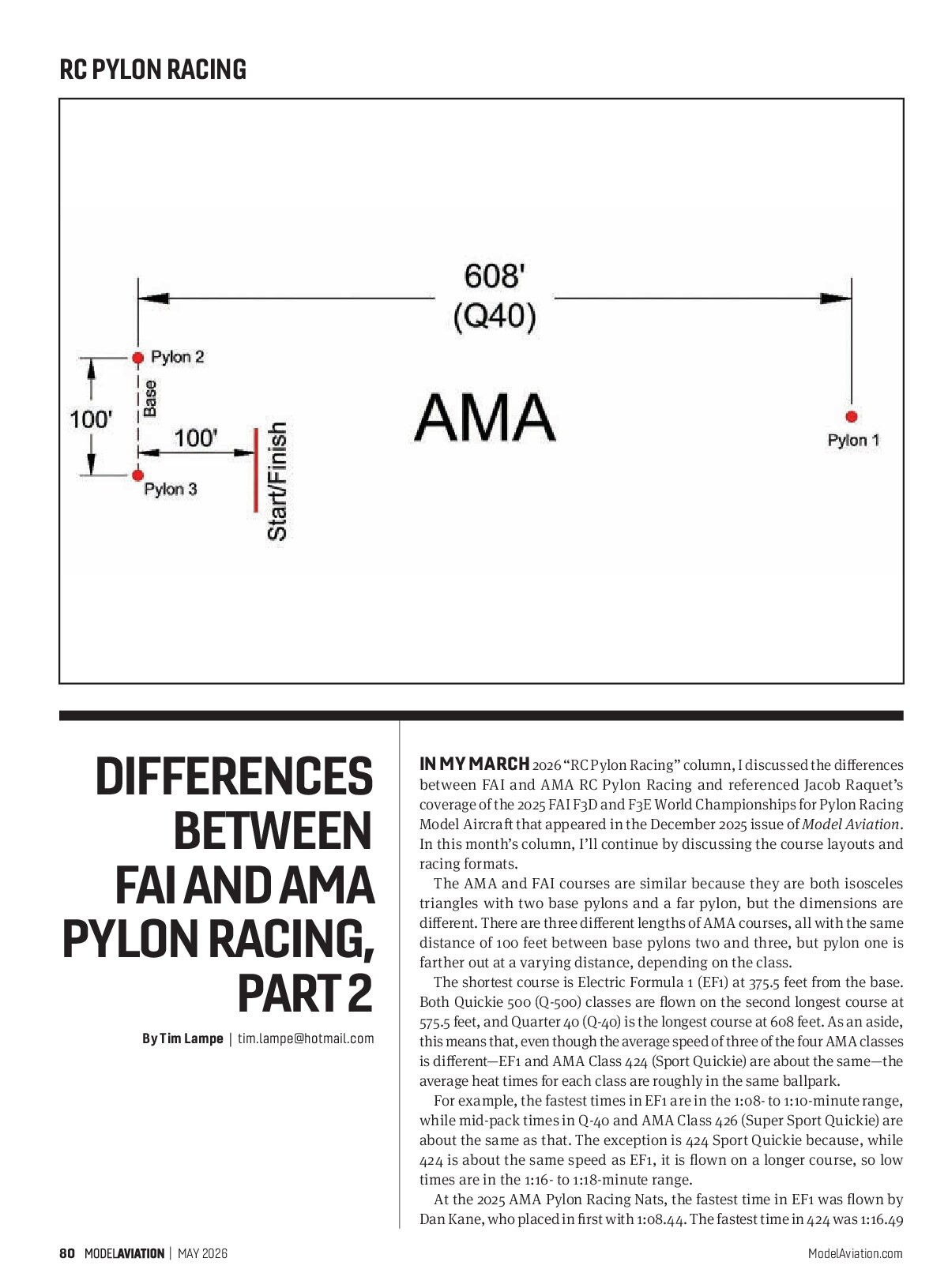
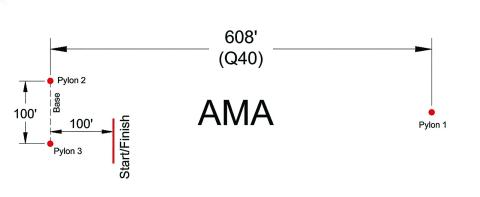
The AMA and FAI courses are similar because they are both isosceles triangles with two base pylons and a far pylon, but the dimensions are different. There are three different lengths of AMA courses, all with the same distance of 100 feet between base pylons two and three, but pylon one is farther out at a varying distance, depending on the class.
The shortest course is Electric Formula 1 (EF1) at 375.5 feet from the base. Both Quickie 500 (Q-500) classes are flown on the second longest course at 575.5 feet, and Quarter 40 (Q-40) is the longest course at 608 feet. As an aside, this means that, even though the average speed of three of the four AMA classes is different—EF1 and AMA Class 424 (Sport Quickie) are about the same—the average heat times for each class are roughly in the same ballpark.
For example, the fastest times in EF1 are in the 1:08- to 1:10-minute range, while mid-pack times in Q-40 and AMA Class 426 (Super Sport Quickie) are about the same as that. The exception is 424 Sport Quickie because, while 424 is about the same speed as EF1, it is flown on a longer course, so low times are in the 1:16- to 1:18-minute range.
At the 2025 AMA Pylon Racing Nats, the fastest time in EF1 was flown by Dan Kane, who placed in first with 1:08.44. The fastest time in 424 was 1:16.49 and flown by Roy Andrassy, who also received first place in his class. The fastest time in 426 was 1:00.97 and flown by Matt Fehling, who came in 21st place. The fastest time in AMA Class 422 (Q-40) was 1:01.24 and flown by Jim Allen, who took seventh place.
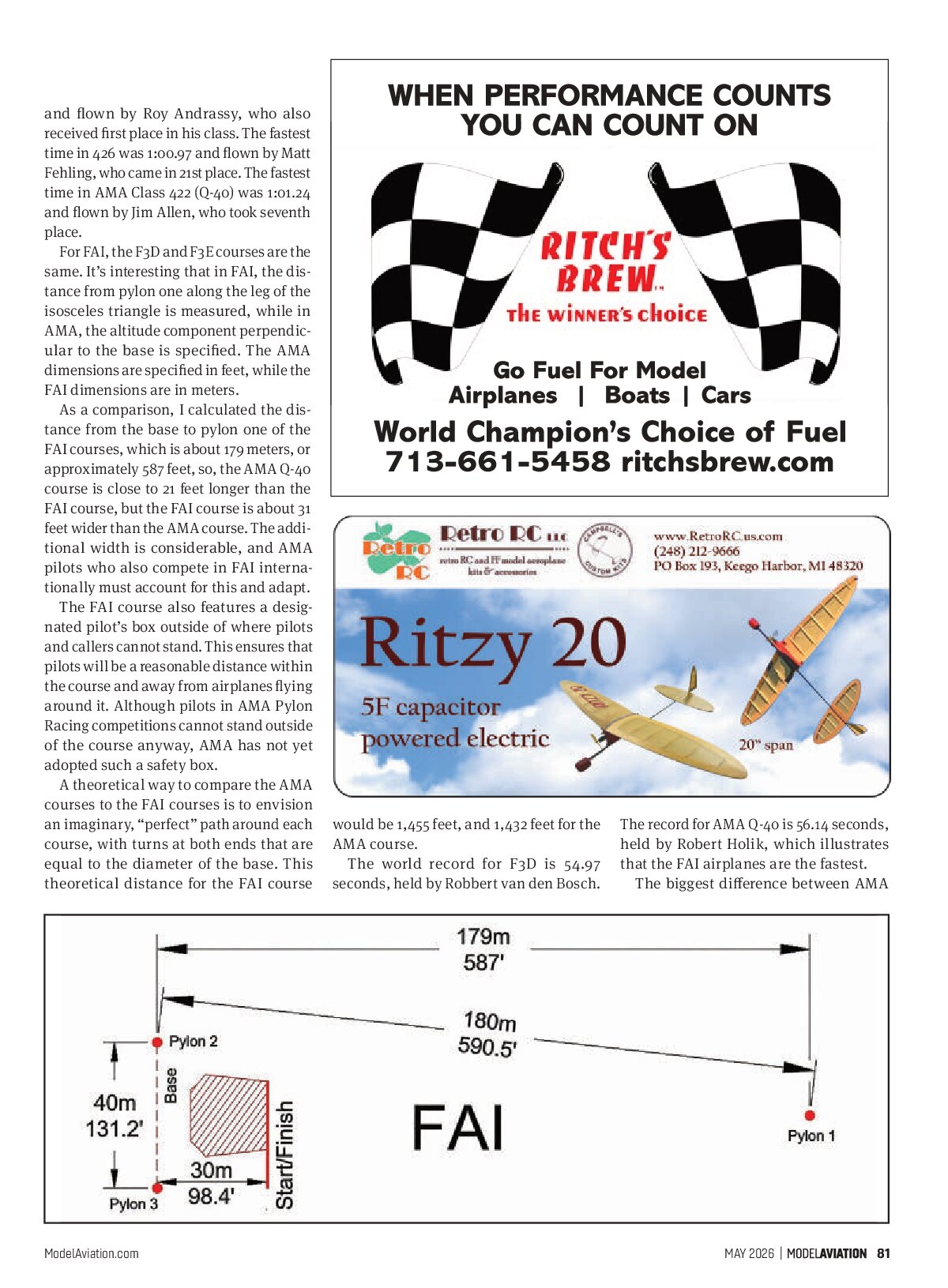
For FAI, the F3D and F3E courses are the same. It’s interesting that in FAI, the distance from pylon one along the leg of the isosceles triangle is measured, while in AMA, the altitude component perpendicular to the base is specified. The AMA dimensions are specified in feet, while the FAI dimensions are in meters.
As a comparison, I calculated the distance from the base to pylon one of the FAI courses, which is about 179 meters, or approximately 587 feet, so, the AMA Q-40 course is close to 21 feet longer than the FAI course, but the FAI course is about 31 feet wider than the AMA course. The additional width is considerable, and AMA pilots who also compete in FAI internationally must account for this and adapt.
The FAI course also features a designated pilot’s box outside of where pilots and callers cannot stand. This ensures that pilots will be a reasonable distance within the course and away from airplanes flying around it. Although pilots in AMA Pylon Racing competitions cannot stand outside of the course anyway, AMA has not yet adopted such a safety box.
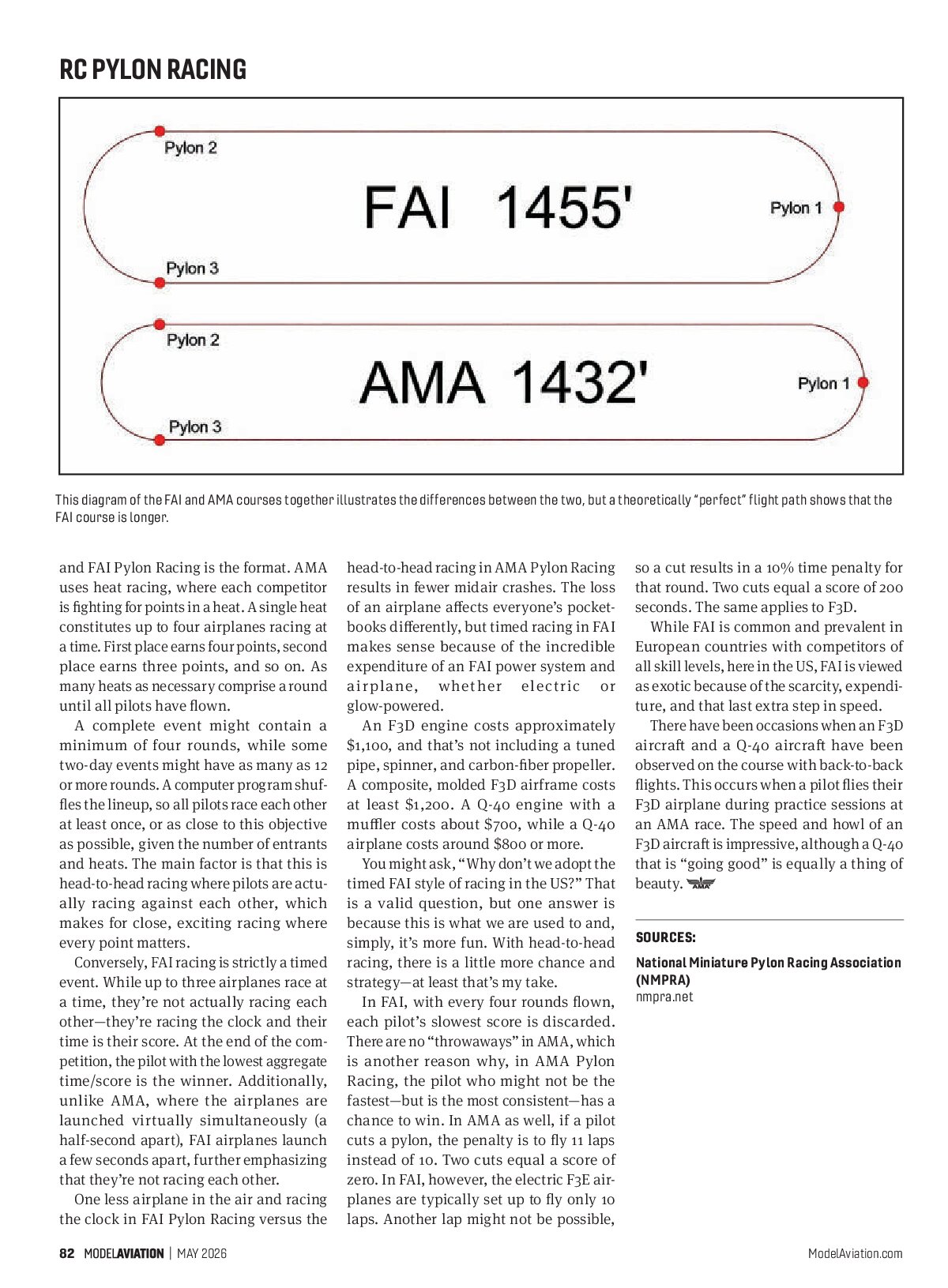
A theoretical way to compare the AMA courses to the FAI courses is to envision an imaginary, “perfect” path around each course, with turns at both ends that are equal to the diameter of the base. This theoretical distance for the FAI course would be 1,455 feet, and 1,432 feet for the AMA course.
The world record for F3D is 54.97 seconds, held by Robbert van den Bosch. The record for AMA Q-40 is 56.14 seconds, held by Robert Holik, which illustrates that the FAI airplanes are the fastest.
The biggest difference between AMA and FAI Pylon Racing is the format. AMA uses heat racing, where each competitor is fighting for points in a heat. A single heat constitutes up to four airplanes racing at a time. First place earns four points, second place earns three points, and so on. As many heats as necessary comprise a round until all pilots have flown.
A complete event might contain a minimum of four rounds, while some two-day events might have as many as 12 or more rounds. A computer program shuffles the lineup, so all pilots race each other at least once, or as close to this objective as possible, given the number of entrants and heats. The main factor is that this is head-to-head racing where pilots are actually racing against each other, which makes for close, exciting racing where every point matters.
Conversely, FAI racing is strictly a timed event. While up to three airplanes race at a time, they’re not actually racing each other—they’re racing the clock and their time is their score. At the end of the competition, the pilot with the lowest aggregate time/score is the winner. Additionally, unlike AMA, where the airplanes are launched virtually simultaneously (a half-second apart), FAI airplanes launch a few seconds apart, further emphasizing that they’re not racing each other.
One less airplane in the air and racing the clock in FAI Pylon Racing versus the head-to-head racing in AMA Pylon Racing results in fewer midair crashes. The loss of an airplane affects everyone’s pocketbooks differently, but timed racing in FAI makes sense because of the incredible expenditure of an FAI power system and airplane, whether electric or glow-powered.
An F3D engine costs approximately $1,100, and that’s not including a tuned pipe, spinner, and carbon-fiber propeller. A composite, molded F3D airframe costs at least $1,200. A Q-40 engine with a muffler costs about $700, while a Q-40 airplane costs around $800 or more.
You might ask, “Why don’t we adopt the timed FAI style of racing in the US?” That is a valid question, but one answer is because this is what we are used to and, simply, it’s more fun. With head-to-head racing, there is a little more chance and strategy—at least that’s my take.
In FAI, with every four rounds flown, each pilot’s slowest score is discarded. There are no “throwaways” in AMA, which is another reason why, in AMA Pylon Racing, the pilot who might not be the fastest—but is the most consistent—has a chance to win. In AMA as well, if a pilot cuts a pylon, the penalty is to fly 11 laps instead of 10. Two cuts equal a score of zero. In FAI, however, the electric F3E airplanes are typically set up to fly only 10 laps. Another lap might not be possible, so a cut results in a 10% time penalty for that round. Two cuts equal a score of 200 seconds. The same applies to F3D.
While FAI is common and prevalent in European countries with competitors of all skill levels, here in the US, FAI is viewed as exotic because of the scarcity, expenditure, and that last extra step in speed.
There have been occasions when an F3D aircraft and a Q-40 aircraft have been observed on the course with back-to-back flights. This occurs when a pilot flies their F3D airplane during practice sessions at an AMA race. The speed and howl of an F3D aircraft is impressive, although a Q-40 that is “going good” is equally a thing of beauty.


SOURCES
- National Miniature Pylon Racing Association (NMPRA)
- nmpra.net