Jet Precision Aerobatics
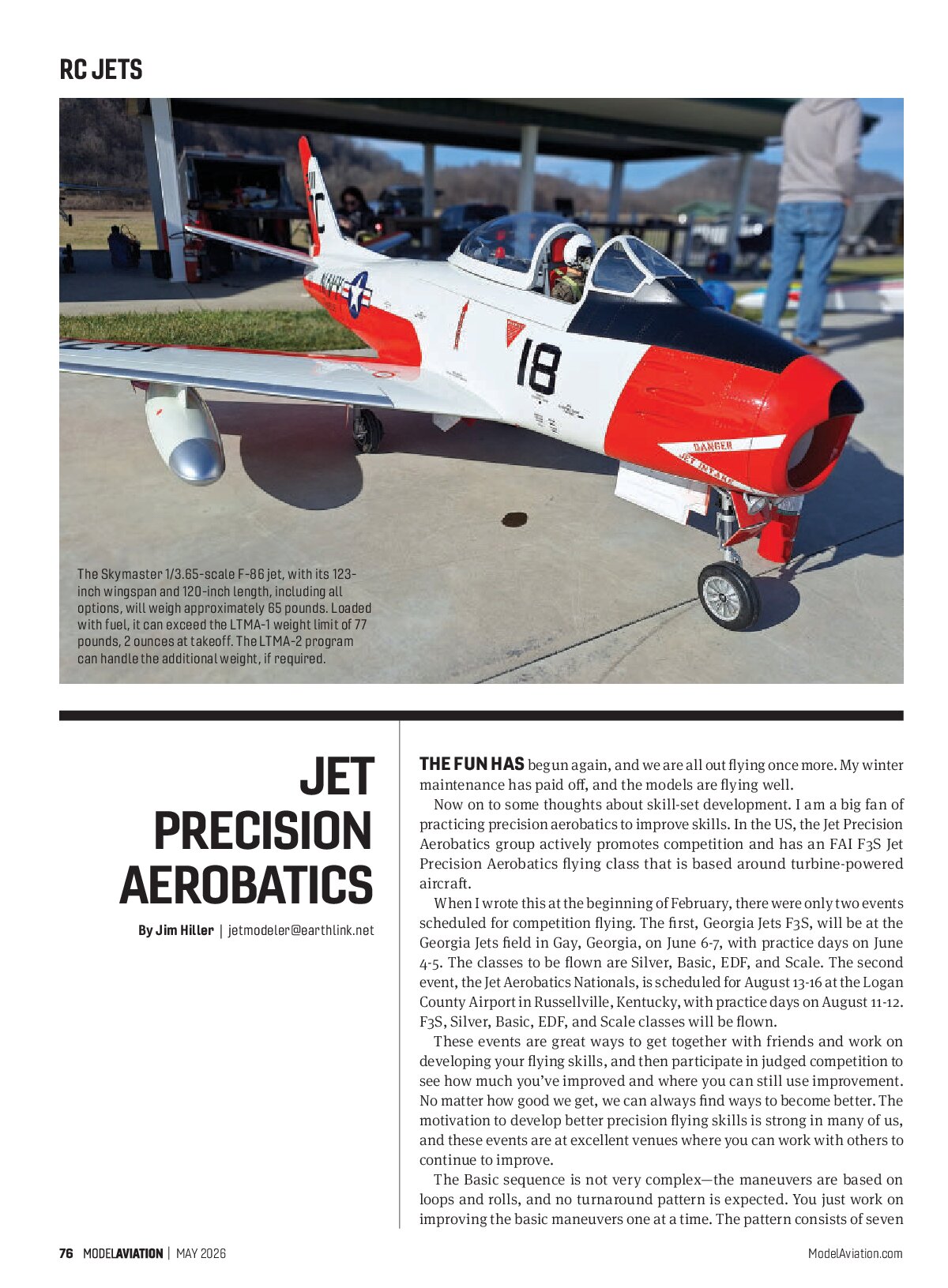
The Skymaster 1/3.65-scale F-86 jet, with its 123-inch wingspan and 120-inch length, including all options, will weigh approximately 65 pounds. Loaded with fuel, it can exceed the LTMA-1 weight limit of 77 pounds, 2 ounces at takeoff. The LTMA-2 program can handle the additional weight, if required.
RC JETS
The fun has begun again, and we are all out flying once more. My winter maintenance has paid off, and the models are flying well.
Now on to some thoughts about skill-set development. I am a big fan of practicing precision aerobatics to improve skills. In the US, the Jet Precision Aerobatics group actively promotes competition and has an FAI F3S Jet Precision Aerobatics flying class that is based around turbine-powered aircraft.
When I wrote this at the beginning of February, there were only two events scheduled for competition flying. The first, Georgia Jets F3S, will be at the Georgia Jets field in Gay, Georgia, on June 6-7, with practice days on June 4-5. The classes to be flown are Silver, Basic, EDF, and Scale. The second event, the Jet Aerobatics Nationals, is scheduled for August 13-16 at the Logan County Airport in Russellville, Kentucky, with practice days on August 11-12. F3S, Silver, Basic, EDF, and Scale classes will be flown.
These events are great ways to get together with friends and work on developing your flying skills, and then participate in judged competition to see how much you’ve improved and where you can still use improvement. No matter how good we get, we can always find ways to become better. The motivation to develop better precision flying skills is strong in many of us, and these events are at excellent venues where you can work with others to continue to improve.
The Basic sequence is not very complex—the maneuvers are based on loops and rolls, and no turnaround pattern is expected. You just work on improving the basic maneuvers one at a time. The pattern consists of seven maneuvers that range from basic loops and slow rolls up to a square loop and even a classic Cobra maneuver.
My favorite practice maneuver in this sequence is the first of two congruent loops. The goal is to perform two round loops with the second loop tracing the path of the first loop. Precision flying is the ability to fly a true flight path that defines the round loop. It sounds so simple, doesn’t it?
The thought process for flying this maneuver begins as you line up for the first loop. Are you level at an altitude that feels comfortable to you? Is your airspeed correct for entering the loop? Are you comfortably out at a distance from yourself? Remember these because at the end of the first loop, you will want to be at the same position and same speed.
Concentrate on keeping the first loop round. Go to full throttle as you enter the loop to help maintain speed, pull the elevator, and begin. As the airplane completes the first quarter of the loop, start relaxing the elevator to maintain the same radius of the flight path—remember that it needs to be a round circle. Across the top, you will have minimal elevator as the airplane falls through the third quarter of the loop, with the proper amount of power coming off to not overspeed the backside of it.
The airplane will start coming around the backside of the loop and it will now be the reverse of the first half. The elevator pull will start increasing as the model comes straight down vertically to maintain the round loop.
The finish to the first loop is to hit the entry point dead on in both altitude and distance out, along with the proper throttle and airspeed to enter the second loop. You’re going to do it all over again for the second loop, only now you will make it at the same diameter as the first one.
All of this sounds complicated, but that’s what makes precision flying such a thrill. Those who do it well are among the top tier of pilots at any airfield. I personally enjoy flying the two-loop maneuver or even old-school three loops. The satisfaction of flying them well is wonderful.
I would encourage anyone who has an interest in jet precision aerobatics to attend one or both of the F3S competitions this year and learn what it is all about. Make new friends and improve your flying skills along the way.

Extra-Large Model Jets
A growing trend in jets is large and extra-large aircraft. They are becoming very popular. To legally fly a model that has more than a 55-pound takeoff weight in the US, we operate under the AMA Large Model Aircraft (LMA) Program. It has been highly successful, and many modelers participate in it.
Full details and documents about the Large Model Aircraft Program can be found in the “Documents” section of the AMA website; the link is in “Sources.” Go to the “Media & Resources” tab, then to “AMA Documents,” and, finally, to the “Large Model Aircraft Program (over 55 pounds)” tab and click on the + sign in the right corner. You can then select the program documents of interest to you. For LMA and large turbine model aircraft (LTMA), review Document 520-A: Radio Control Large Model Airplane Program.
The LTMA-1 guidelines are for aircraft with a 55-pound through 77-pound, 2-ounce takeoff weight. I have operated my Xtreme ARF Vixen sport jet under this simple process for many years. My permit to fly is required to be updated every three years. The Vixen can be less than 55 pounds at takeoff, but with the addition of a smoke system, it weighs approximately 62 pounds at takeoff.
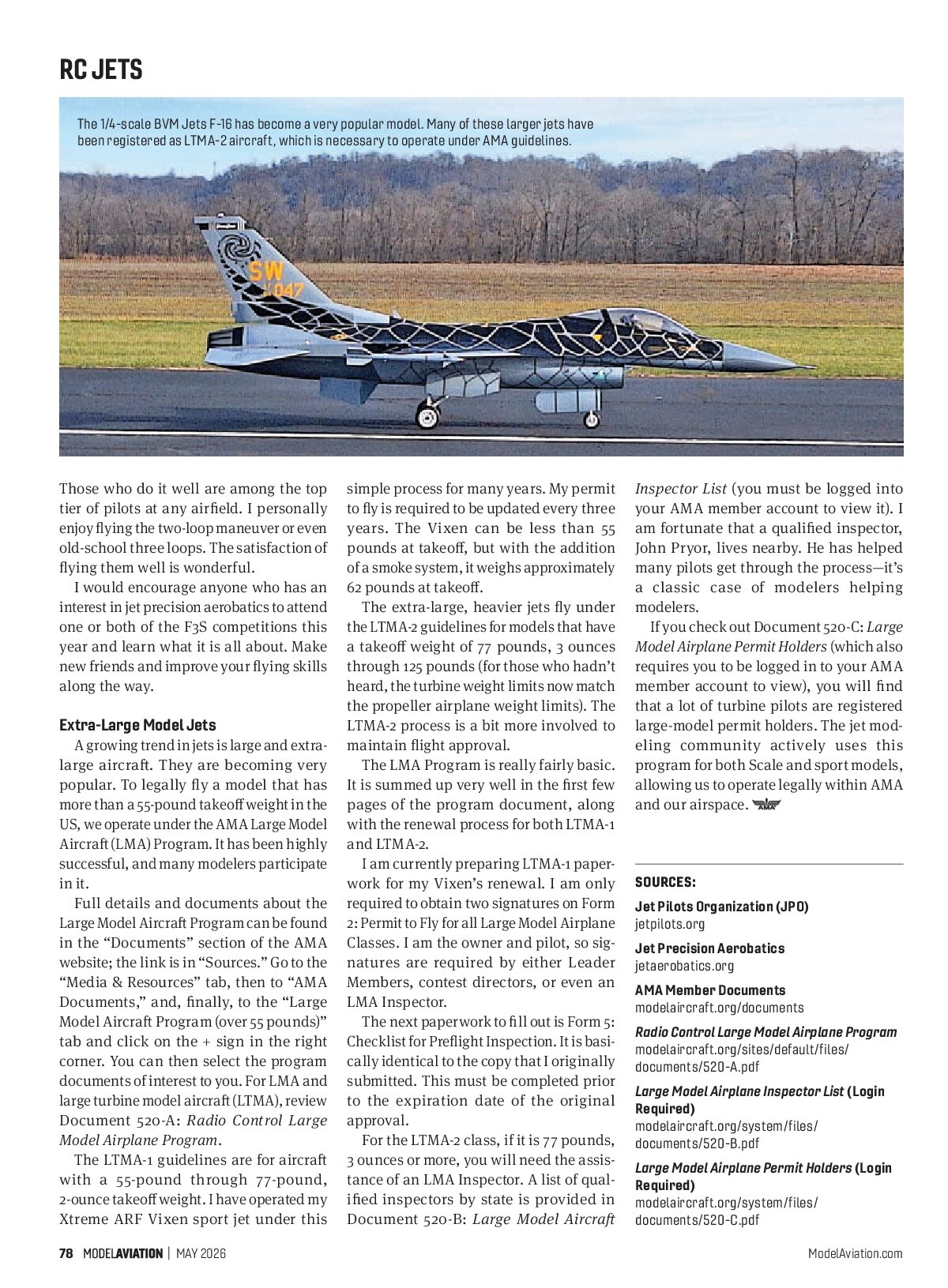
The extra-large, heavier jets fly under the LTMA-2 guidelines for models that have a takeoff weight of 77 pounds, 3 ounces through 125 pounds (for those who hadn’t heard, the turbine weight limits now match the propeller airplane weight limits). The LTMA-2 process is a bit more involved to maintain flight approval.
The LMA Program is really fairly basic. It is summed up very well in the first few pages of the program document, along with the renewal process for both LTMA-1 and LTMA-2.
I am currently preparing LTMA-1 paperwork for my Vixen’s renewal. I am only required to obtain two signatures on Form 2: Permit to Fly for all Large Model Airplane Classes. I am the owner and pilot, so signatures are required by either Leader Members, contest directors, or even an LMA Inspector.
The next paperwork to fill out is Form 5: Checklist for Preflight Inspection. It is basically identical to the copy that I originally submitted. This must be completed prior to the expiration date of the original approval.
For the LTMA-2 class, if it is 77 pounds, 3 ounces or more, you will need the assistance of an LMA Inspector. A list of qualified inspectors by state is provided in Document 520-B: Large Model Aircraft Inspector List (you must be logged into your AMA member account to view it). I am fortunate that a qualified inspector, John Pryor, lives nearby. He has helped many pilots get through the process—it’s a classic case of modelers helping modelers.
If you check out Document 520-C: Large Model Airplane Permit Holders (which also requires you to be logged in to your AMA member account to view), you will find that a lot of turbine pilots are registered large-model permit holders. The jet modeling community actively uses this program for both Scale and sport models, allowing us to operate legally within AMA and our airspace.

SOURCES
- Jet Pilots Organization (JPO)
- jetpilots.org
- Jet Precision Aerobatics
- jetaerobatics.org
- AMA Member Documents
- modelaircraft.org/documents
- Radio Control Large Model Airplane Program
- modelaircraft.org/sites/default/files/documents/520-A.pdf
- Large Model Airplane Inspector List (Login Required)
- modelaircraft.org/system/files/documents/520-B.pdf
- Large Model Airplane Permit Holders (Login Required)
- modelaircraft.org/system/files/documents/520-C.pdf