
The Contra Drive for Pattern
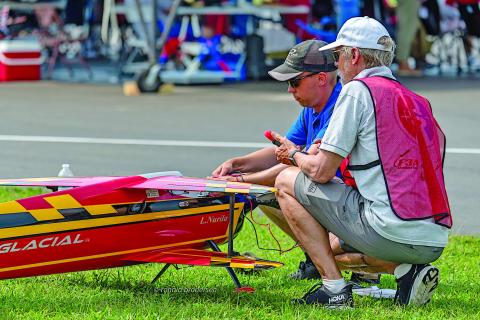
Dan Underkofler performs a technical inspection on Lassie Nurila’s airplane after his flight. Photo by Ronald Brodersen.
Throughout the last few years, RC Aerobatics (Pattern) has slowly migrated to the electric contra drive being the normal power setup for a Pattern airplane. The evolution of propulsion for Pattern has gone from simple two-stroke glow engines to the more-complex YS four-stroke engines that dominated the market to 10-cell electric propulsion with any option you can think of—inrunner, outrunner, belt drive, etc.
As I write this, not only has electric propulsion dominated the sport, the contra drive has now made its way to dominating F3A RC Aerobatics in its entirety; I have not seen these drive systems used in any other part of our hobby. They were developed specifically for our models by Pattern pilots and have been refined throughout the years to what we are using today. They are not new—just more popular now than ever!
If you attended the FAI F3A World Championship for Aerobatic Model Aircraft last August, you saw that approximately 90% of the aircraft utilized the contra power systems. The contra-drive system is here to stay, and it’s more affordable and even easier to operate.
What Are the Main Benefits of the Contra Drive?
- The gyro effect of the aircraft is eliminated. In simple terms (that I understand), the yawing of the aircraft when elevator is applied is eliminated.
- The P-factor is eliminated. This is the yaw that is introduced when the thrustline doesn’t align with the flight path of the airplane.
- Mixing for different flight conditions is reduced (downlines, knife-edge, etc.).
- Powerful braking.
- More energy efficiency.
What Common Types of Contra Drives Are Available?
Planetary gear drives were the first to come to market and have been in use for more than a decade. The belt and gear drives have become more popular as of late and are the most common drives available.
Maintenance is low on the modern drives; you can bolt the drive on and fly, with little work after the fact. This doesn’t mean that you should skip checking your equipment—everything should be reviewed each season.


Common Propeller Sizes
- 24 x 20 front and back
- 23 x 20 front and back
- 23 x 20 front; 23 x 22 back
In my limited experience with the contra drive, it does make the aircraft trim easier and fly “truer,” but it’s not necessarily easier to fly nor does it give you a pass on putting in the work that is required. In Pattern, you still must fly the airplane with skill. The contra drive might reduce some of the setup and mixing, but it’s still the pilot with skills who is doing the work.
This is a skill you will need to learn and develop to contain the drive system, even on simple, straight lines, but it’s not out of reach for any pilot. If you are new to Pattern, I would suggest starting with a single drive then converting as you move up. If you have been holding back on making the jump, I say that now is the time!
Until next time!


Photo captions
A belt- and gear-driven DualSky contra drive, complete with a propeller and spinner.
Another version of the belt and gear drive that is popular today.
SOURCES
- National Society of Radio Controlled Aerobatics (NSRCA)
- nsrca.us


