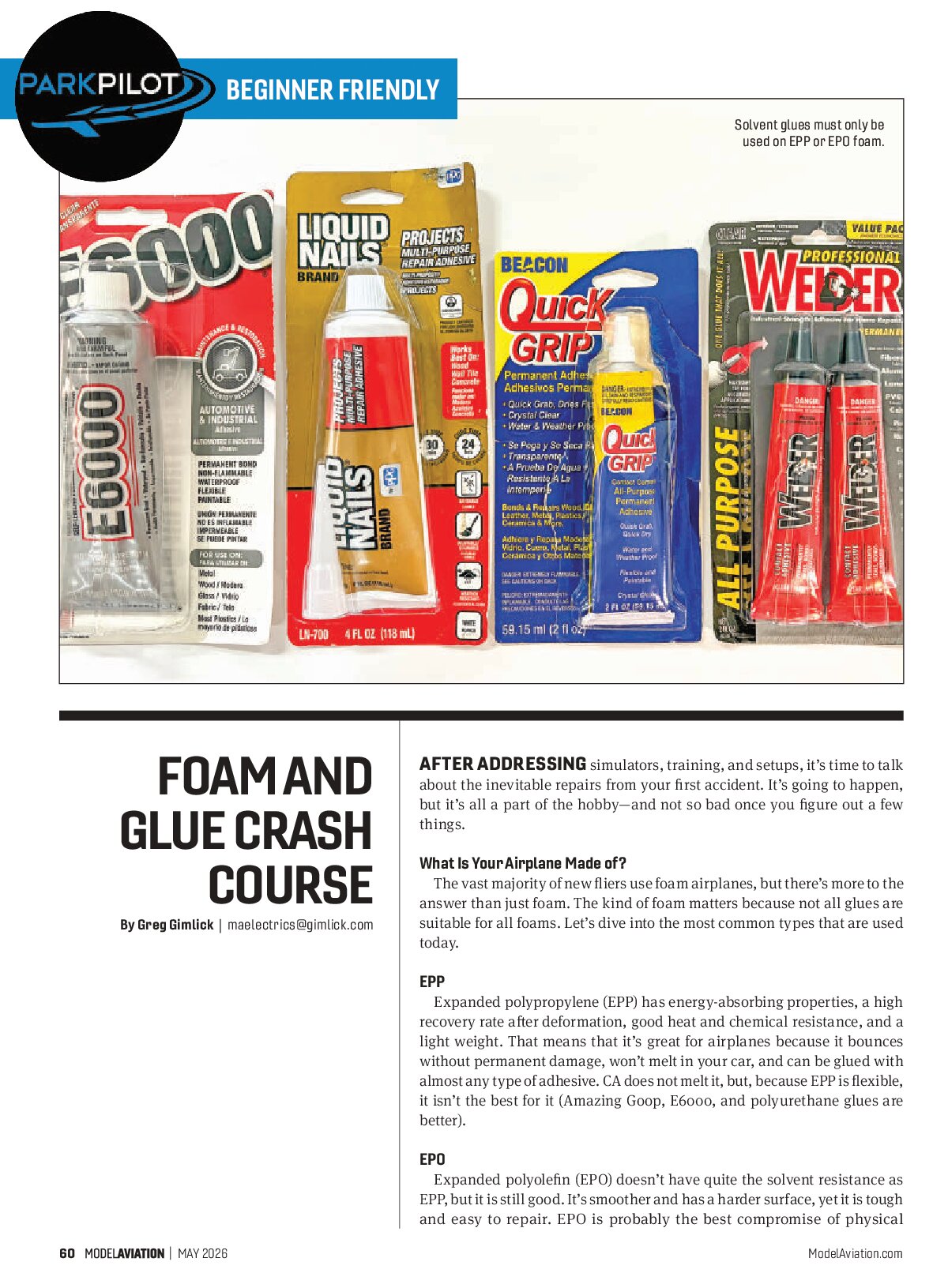
Solvent glues must only be used on EPP or EPO foam.
Foam and Glue Crash Course
By Greg Gimlick | maelectrics@gimlick.com
After addressing simulators, training, and setups, it’s time to talk about the inevitable repairs from your first accident. It’s going to happen, but it’s all a part of the hobby—and not so bad once you figure out a few things.
What Is Your Airplane Made of?
The vast majority of new fliers use foam airplanes, but there’s more to the answer than just foam. The kind of foam matters because not all glues are suitable for all foams. Let’s dive into the most common types that are used today.
EPP
Expanded polypropylene (EPP) has energy-absorbing properties, a high recovery rate after deformation, good heat and chemical resistance, and a light weight. That means that it’s great for airplanes because it bounces without permanent damage, won’t melt in your car, and can be glued with almost any type of adhesive. CA does not melt it, but, because EPP is flexible, it isn’t the best for it (Amazing Goop, E6000, and polyurethane glues are better).


EPO
Expanded polyolefin (EPO) doesn’t have quite the solvent resistance as EPP, but it is still good. It’s smoother and has a harder surface, yet it is tough and easy to repair. EPO is probably the best compromise of physical properties for most RC model applications. Many of the same properties of EPP apply, but the surface of the airplane feels smoother and harder to the touch. CA will bond it chemically, which makes it really easy to build and repair quickly.
EPS
Expanded polystyrene (EPS) is smooth and has a crisp surface but almost no solvent resistance. It accepts all sorts of paint and decals, but surface dents don’t heal themselves and it’s very prone to dings and dents that don’t go away.
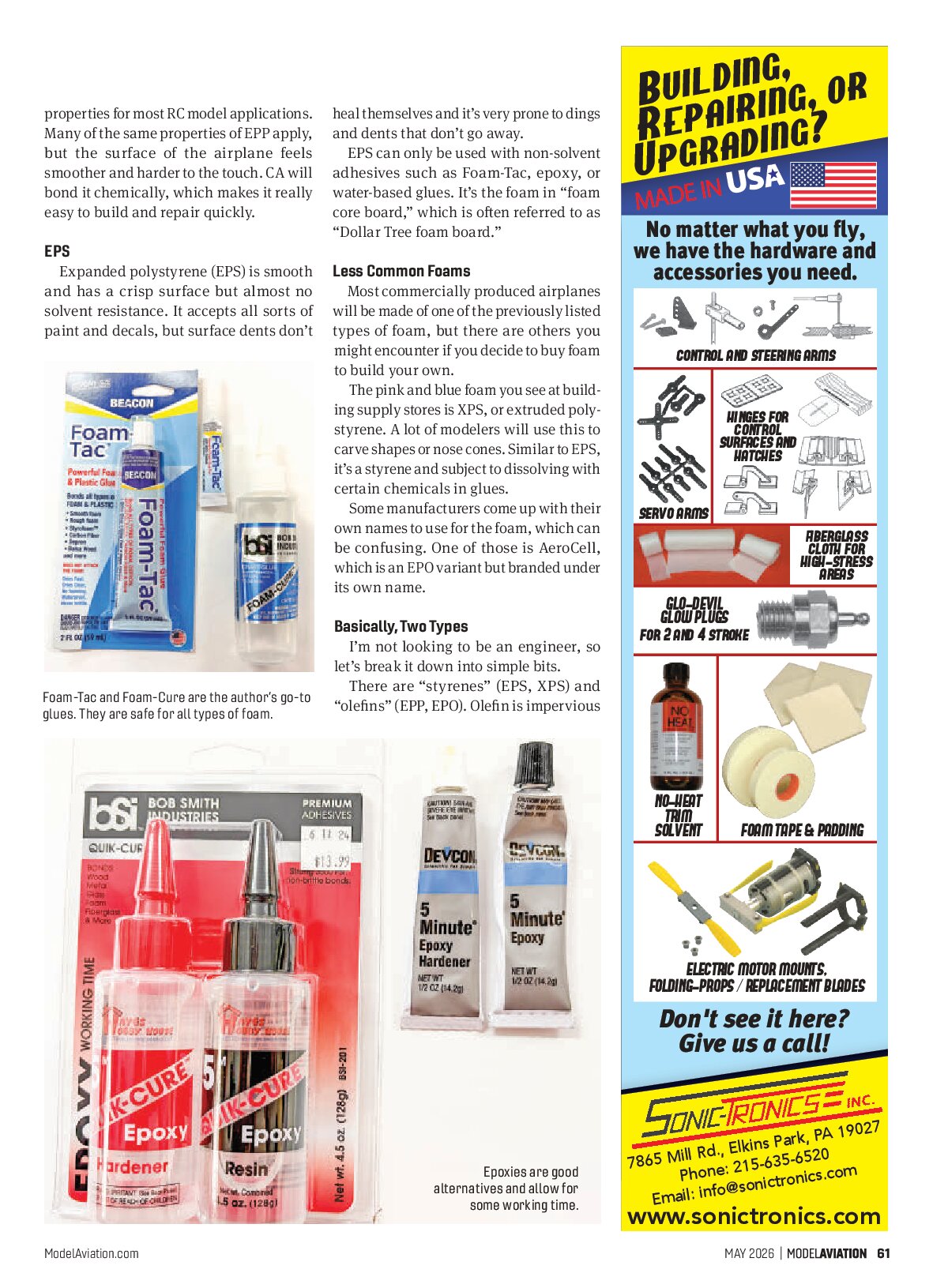
EPS can only be used with non-solvent adhesives such as Foam-Tac, epoxy, or water-based glues. It’s the foam in “foam core board,” which is often referred to as “Dollar Tree foam board.”
Less Common Foams
Most commercially produced airplanes will be made of one of the previously listed types of foam, but there are others you might encounter if you decide to buy foam to build your own.
The pink and blue foam you see at building supply stores is XPS, or extruded polystyrene. A lot of modelers will use this to carve shapes or nose cones. Similar to EPS, it’s a styrene and subject to dissolving with certain chemicals in glues.
Some manufacturers come up with their own names to use for the foam, which can be confusing. One of those is AeroCell, which is an EPO variant but branded under its own name.
Basically, Two Types
I’m not looking to be an engineer, so let’s break it down into simple bits.
There are “styrenes” (EPS, XPS) and “olefins” (EPP, EPO). Olefin is impervious to most chemicals, and almost any glue will adhere to it without damage. Styrene is more sensitive to chemicals, and a careful choice of glue is important to prevent it from melting.
So … Which Glue?
An easy test to see what’s safe for your airplane is to find a spot inside of the fuselage that is out of sight and not structurally important and perform a chemical test. Put a tiny bit of acetone on a Q-tip and touch a spot of foam. Do this very lightly—don’t drench your airplane! Observe the spot and see whether it gets soft and melty. If it does, you have styrene foam and should avoid any solvent-based glues.
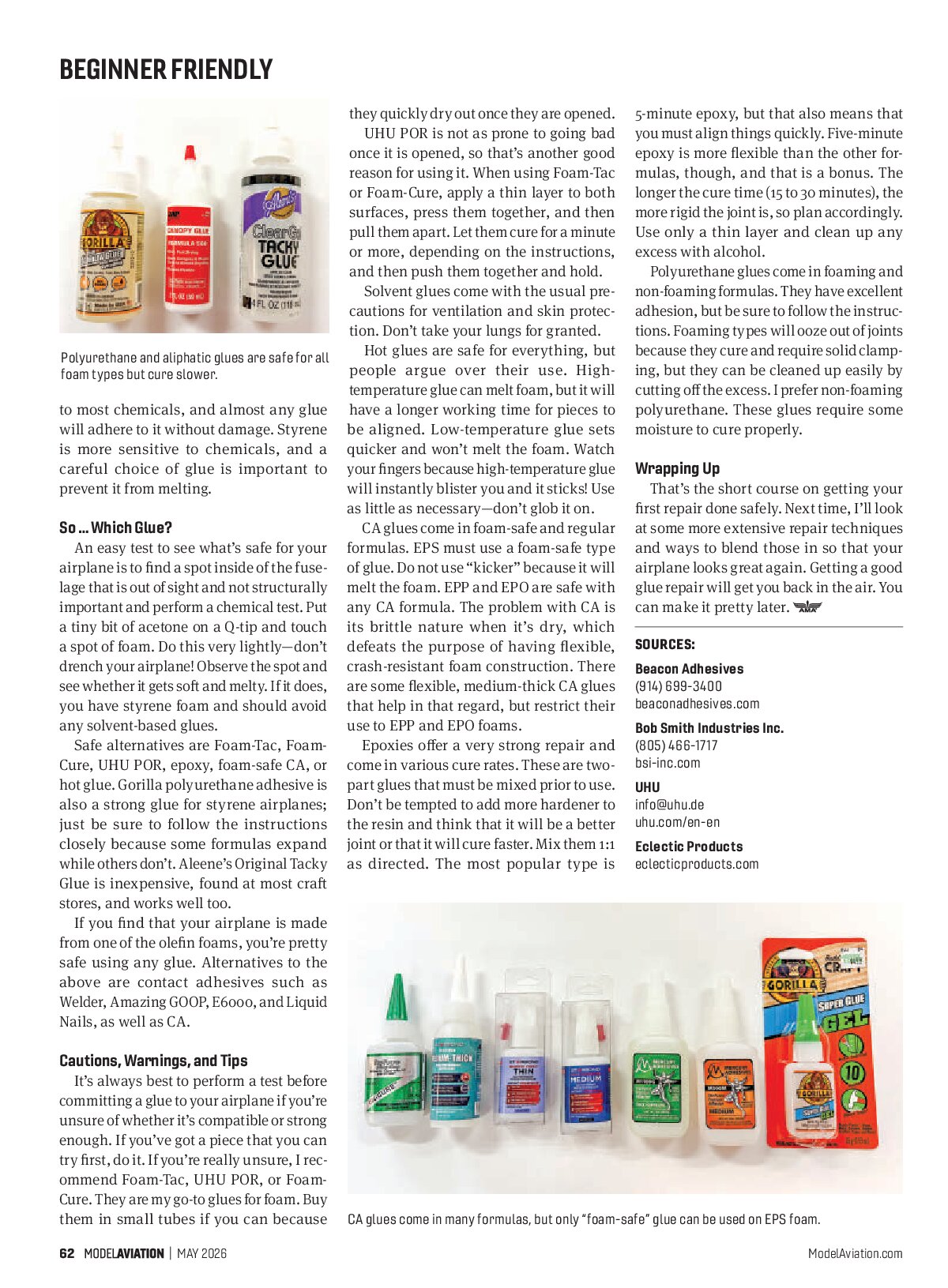
Safe alternatives are Foam-Tac, Foam-Cure, UHU POR, epoxy, foam-safe CA, or hot glue. Gorilla polyurethane adhesive is also a strong glue for styrene airplanes; just be sure to follow the instructions closely because some formulas expand while others don’t. Aleene’s Original Tacky Glue is inexpensive, found at most craft stores, and works well too.
If you find that your airplane is made from one of the olefin foams, you’re pretty safe using any glue. Alternatives to the above are contact adhesives such as Welder, Amazing GOOP, E6000, and Liquid Nails, as well as CA.
NRHSA


Cautions, Warnings, and Tips
It’s always best to perform a test before committing a glue to your airplane if you’re unsure of whether it’s compatible or strong enough. If you’ve got a piece that you can try first, do it. If you’re really unsure, I recommend Foam-Tac, UHU POR, or Foam-Cure. They are my go-to glues for foam. Buy them in small tubes if you can because they quickly dry out once they are opened.
UHU POR is not as prone to going bad once it is opened, so that’s another good reason for using it. When using Foam-Tac or Foam-Cure, apply a thin layer to both surfaces, press them together, and then pull them apart. Let them cure for a minute or more, depending on the instructions, and then push them together and hold.
Solvent glues come with the usual precautions for ventilation and skin protection. Don’t take your lungs for granted.
Hot glues are safe for everything, but people argue over their use. High-temperature glue can melt foam, but it will have a longer working time for pieces to be aligned. Low-temperature glue sets quicker and won’t melt the foam. Watch your fingers because high-temperature glue will instantly blister you and it sticks! Use as little as necessary—don’t glob it on.
CA glues come in foam-safe and regular formulas. EPS must use a foam-safe type of glue. Do not use “kicker” because it will melt the foam. EPP and EPO are safe with any CA formula. The problem with CA is its brittle nature when it’s dry, which defeats the purpose of having flexible, crash-resistant foam construction. There are some flexible, medium-thick CA glues that help in that regard, but restrict their use to EPP and EPO foams.
Epoxies offer a very strong repair and come in various cure rates. These are two-part glues that must be mixed prior to use. Don’t be tempted to add more hardener to the resin and think that it will be a better joint or that it will cure faster. Mix them 1:1 as directed. The most popular type is 5-minute epoxy, but that also means that you must align things quickly. Five-minute epoxy is more flexible than the other formulas, though, and that is a bonus. The longer the cure time (15 to 30 minutes), the more rigid the joint is, so plan accordingly. Use only a thin layer and clean up any excess with alcohol.
Polyurethane glues come in foaming and non-foaming formulas. They have excellent adhesion, but be sure to follow the instructions. Foaming types will ooze out of joints because they cure and require solid clamping, but they can be cleaned up easily by cutting off the excess. I prefer non-foaming polyurethane. These glues require some moisture to cure properly.
Wrapping Up
That’s the short course on getting your first repair done safely. Next time, I’ll look at some more extensive repair techniques and ways to blend those in so that your airplane looks great again. Getting a good glue repair will get you back in the air. You can make it pretty later.


SOURCES
- Beacon Adhesives
(914) 699-3400 - beaconadhesives.com
- Bob Smith Industries Inc.
(805) 466-1717 - bsi-inc.com
- UHU
info@uhu.de - uhu.com/en-en
- Eclectic Products
eclecticproducts.com