What to Expect at an RC Scale Aerobatics Contest
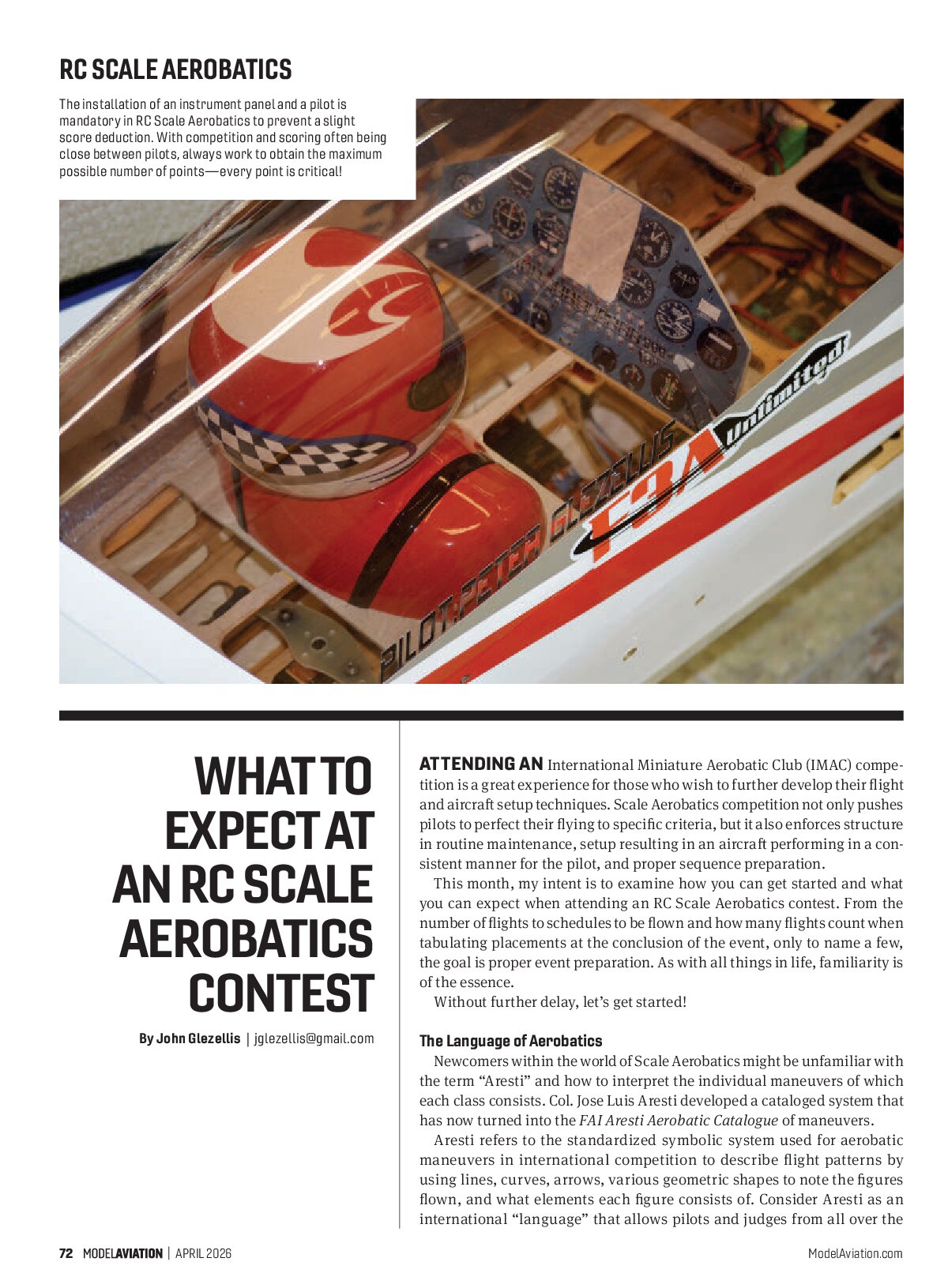
The installation of an instrument panel and a pilot is mandatory in RC Scale Aerobatics to prevent a slight score deduction. With competition and scoring often being close between pilots, always work to obtain the maximum possible number of points—every point is critical!
Attending an International Miniature Aerobatic Club (IMAC) competition is a great experience for those who wish to further develop their flight and aircraft setup techniques. Scale Aerobatics competition not only pushes pilots to perfect their flying to specific criteria, but it also enforces structure in routine maintenance, setup resulting in an aircraft performing in a consistent manner for the pilot, and proper sequence preparation.
This month, my intent is to examine how you can get started and what you can expect when attending an RC Scale Aerobatics contest. From the number of flights to schedules to be flown and how many flights count when tabulating placements at the conclusion of the event, only to name a few, the goal is proper event preparation. As with all things in life, familiarity is of the essence.
Without further delay, let’s get started!
The Language of Aerobatics
Newcomers within the world of Scale Aerobatics might be unfamiliar with the term “Aresti” and how to interpret the individual maneuvers of which each class consists. Col. Jose Luis Aresti developed a cataloged system that has now turned into the FAI Aresti Aerobatic Catalogue of maneuvers.
Aresti refers to the standardized symbolic system used for aerobatic maneuvers in international competition to describe flight patterns by using lines, curves, arrows, various geometric shapes to note the figures flown, and what elements each figure consists of. Consider Aresti as an international “language” that allows pilots and judges from all over the world the ability to communicate maneuvers with ease.
To learn more about Aresti and how it applies to RC Scale Aerobatics, visit the official IMAC website, listed in “Sources.” Once on the website, select “Education,” followed by “Flying Techniques.” Within this section of the website, you can find the Aresti Dictionary, a guide to reading Aresti, and other information that is extremely valuable in terms of knowledge.
Program Familiarity
A typical Scale Aerobatics contest consists of five different classes that increase in difficulty. An optional 4-minute Freestyle class might also be offered, but a pilot must compete in one of the classes below to be allowed to compete in it.

Pilots may initially enter any class they wish, but once they have flown at a contest in a particular class, they cannot compete in a lower class without written permission from their regional director.
When I first began my quest in Scale Aerobatics competition, I was already an avid competitor in the RC Aerobatics (Pattern) Masters class. However, I began in the IMAC Sportsman category for one season before advancing, in time, to the Unlimited class to ensure that certain fundamentals were gained before moving to the class that followed. The models that are flown in IMAC and Pattern are quite different, and while they are still being judged in terms of precision, subtle differences exist within the rules that must be examined.
It is often desirable for a pilot to arrive at a competition flying site a day or so in advance. Many overestimate the importance of not only getting a few flights in at the competition site, but, more importantly, ensuring that the aircraft is ready to perform at a different elevation and/or climate compared with the pilot’s home flying field.
After the airplane is ready for flight, it is essential to power it and the transmitter and make certain that all servos respond, all control directions are correct, and that the equipment passes a range check. Always examine the elevation of the flying site and the orientation of the sun so that no surprises exist on the day of competition and you can prepare accordingly.
At the contest, the standard is to fly a minimum of six Known sequences and one Unknown sequence per class, with the exception of the Basic class. An Unknown sequence for the Sportsman through Unlimited classes during a two-day contest will be flown unless inclement weather prevents it or when the IMAC Board or respective regional director have approved not flying the Unknown.
Basic does not fly an Unknown, so those pilots may fly an additional Known sequence. A Basic Known sequence that is flown in lieu of the Unknown can be scored in the score program as an Unknown with the Unknown drop schedule.
The Unknown is typically distributed the morning of a one-day contest or the evening before the second day of competition. Having a caller draft “practice” Unknown routines can be helpful beforehand so that the pilot can become comfortable with flying and positioning the new figures in a routine that is flown once.
Let’s look at the number of flights that are flown and possible in-flight failures. If a Known sequence that is in progress cannot be completed for any reason (i.e., mechanical failure), the pilot will receive zeros for each maneuver that is unscored for that particular sequence. If the second sequence, which typically starts after the completion of the first sequence in flight, has not been flown and the model cannot be made ready to fly, it can be flown with a backup model. Should this be the case, the pilot will be positioned last in the round and be subject to whatever time constraints might exist at the event.
When more than one Unknown sequence (or Known sequence for Basic) is flown, one or more sequences might be dropped at the discretion of the contest director. Contestants will have one attempt to complete the sequence, so you must have confidence in the aircraft and all equipment that is used because any equipment failure, such as an engine, transmitter, or battery, can result in a zero for the flight.
It is important to note that an attempt begins when the pilot or caller makes a vocal declaration, such as “In the box,” “Entering the box,” or a similar statement that indicates when the pilot is starting the sequence. A vocal signal is mandatory to initiate the attempt, and if this is not made, the pilot will receive a zero for the sequence per the rule book.
All sequences, whether Known or Unknown, will follow the procedure for normalized scoring and drops, as defined in the current AMA Competition Regulations Rule Book for RC Scale Aerobatics.
Closing Thoughts
In closing, you have now learned a bit more about what can be expected at both one- and two-day events. While these columns are meant to examine certain fundamentals, attending a competition and/or a judging seminar will be extremely beneficial.
I strongly urge you to seek help from a more experienced competition pilot if you ever question certain items, the right advice from someone who will give you the proper feedback, or feel free to write to me!
Until next time, fly hard!

SOURCES
- FAI
- fai.org
- IMAC
- flyimac.org
- AMA Competition Regulations Rule Book 2026-2027: Radio Control Scale Aerobatics
- modelaircraft.org/sites/default/files/events/rule-books/2026/RC_Scale_Aerobatics_2026-2027.pdf