Remembering the Greats
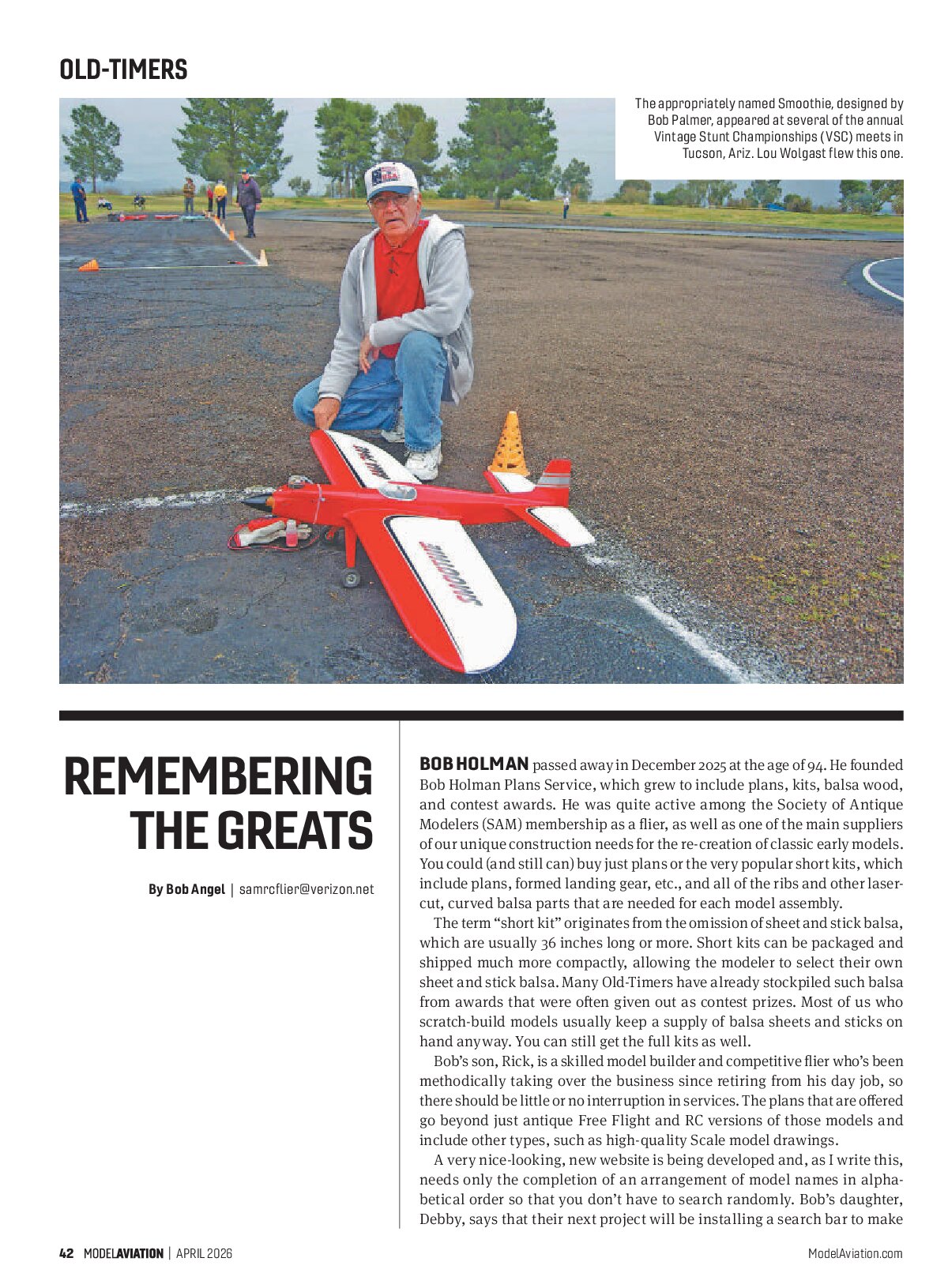
The appropriately named Smoothie, designed by Bob Palmer, appeared at several of the annual Vintage Stunt Championships (VSC) meets in Tucson, Ariz. Lou Wolgast flew this one.
Bob Holman passed away in December 2025 at the age of 94. He founded Bob Holman Plans Service, which grew to include plans, kits, balsa wood, and contest awards. He was quite active among the Society of Antique Modelers (SAM) membership as a flier, as well as one of the main suppliers of our unique construction needs for the re-creation of classic early models. You could (and still can) buy just plans or the very popular short kits, which include plans, formed landing gear, etc., and all of the ribs and other laser-cut, curved balsa parts that are needed for each model assembly.
The term “short kit” originates from the omission of sheet and stick balsa, which are usually 36 inches long or more. Short kits can be packaged and shipped much more compactly, allowing the modeler to select their own sheet and stick balsa. Many Old-Timers have already stockpiled such balsa from awards that were often given out as contest prizes. Most of us who scratch-build models usually keep a supply of balsa sheets and sticks on hand anyway. You can still get the full kits as well.
Bob’s son, Rick, is a skilled model builder and competitive flier who’s been methodically taking over the business since retiring from his day job, so there should be little or no interruption in services. The plans that are offered go beyond just antique Free Flight and RC versions of those models and include other types, such as high-quality Scale model drawings.
A very nice-looking, new website is being developed and, as I write this, needs only the completion of an arrangement of model names in alphabetical order so that you don’t have to search randomly. Bob’s daughter, Debby, says that their next project will be installing a search bar to make it easier. Check the “Sources” section for the website link.
I plucked the following comment randomly from the internet:
“Bob was one of the intrepid people who kept Free Flight alive all over the world. His fantastic short-kit service was (is) fast and high quality. He will be missed by all in the Free Flight community. God bless you, Bob … ”
Bob Palmer and J.C. Yates
Bob Palmer (January 22, 1918 to February 1, 2005) and J.C. Yates (October 10, 1915 to September 9, 2002) are each members of the AMA Hall of Fame (HOF) and the Precision Aerobatics Model Pilots Association (PAMPA) HOF. I’m introducing their biographies together because they were close friends and often operated as a team.
Bob was an innovative Control Line (CL) competitor and designer who won the Nats CL Precision Aerobatics events in both 1955 and 1959. He was a member of the international FAI USA team in 1960 for the F2 World Championships for Control Line Model Aircraft, which was held in Hungary that year, where he placed third overall, ensuring Team USA of a first-place victory.
He served as an AMA contest director, devoting many hours to assisting others while further advancing the sport. He developed the use of wing flaps for CL models that move opposite the direction of the elevators to produce tighter, smoother turns. Those flaps have become a near-necessity for any serious CL Aerobatics competitor.
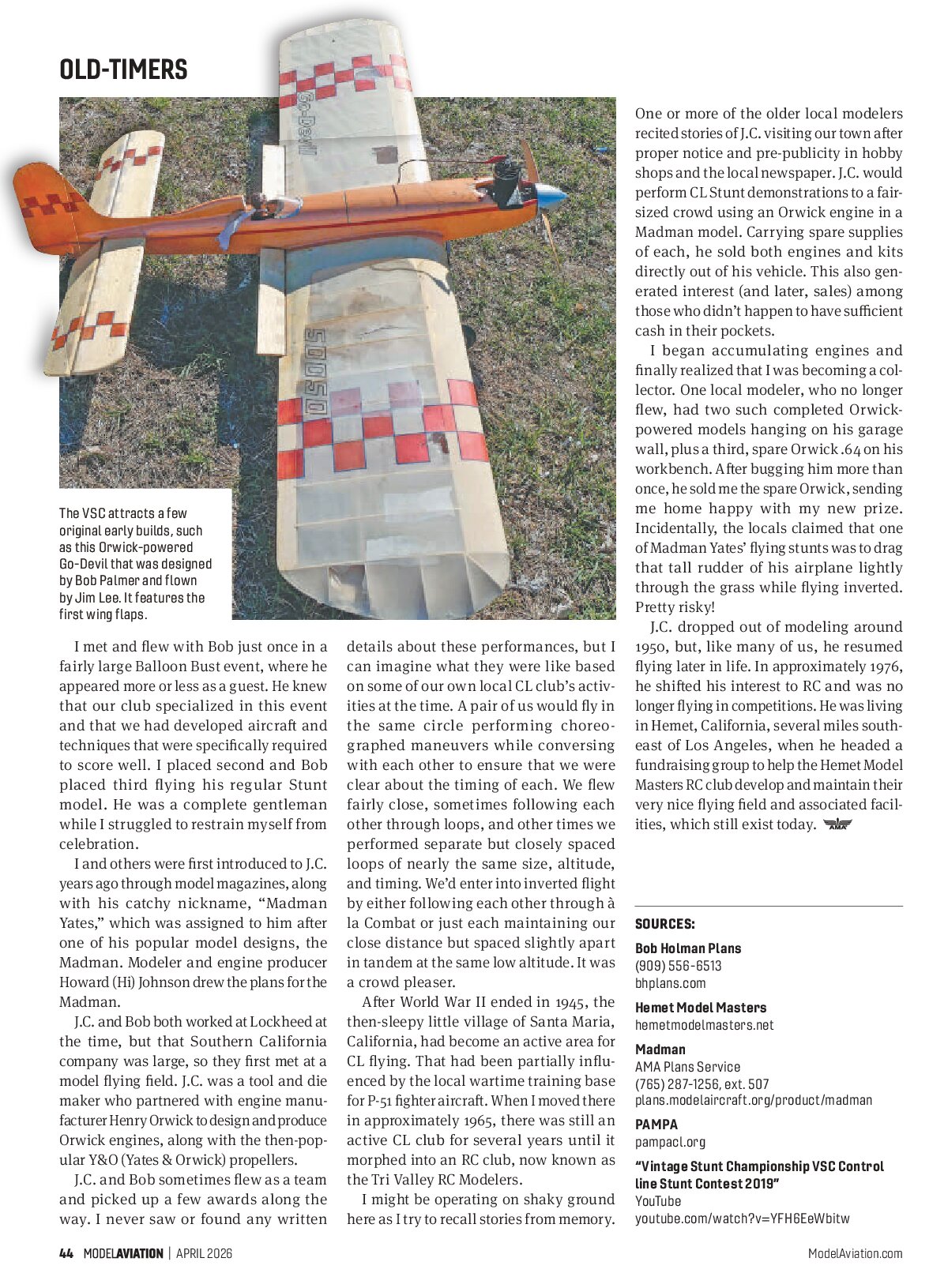
Bob published how-to articles in model magazines, as well as plans, which have been kitted and used by generations of CL sport and competition modelers. He became known by the nickname “Smoothie” after one of his model designs of the same name. Bob also worked for Lockheed Aircraft in Southern California and headed its wind tunnel model shop.
I met and flew with Bob just once in a fairly large Balloon Bust event, where he appeared more or less as a guest. He knew that our club specialized in this event and that we had developed aircraft and techniques that were specifically required to score well. I placed second and Bob placed third flying his regular Stunt model. He was a complete gentleman while I struggled to restrain myself from celebration.
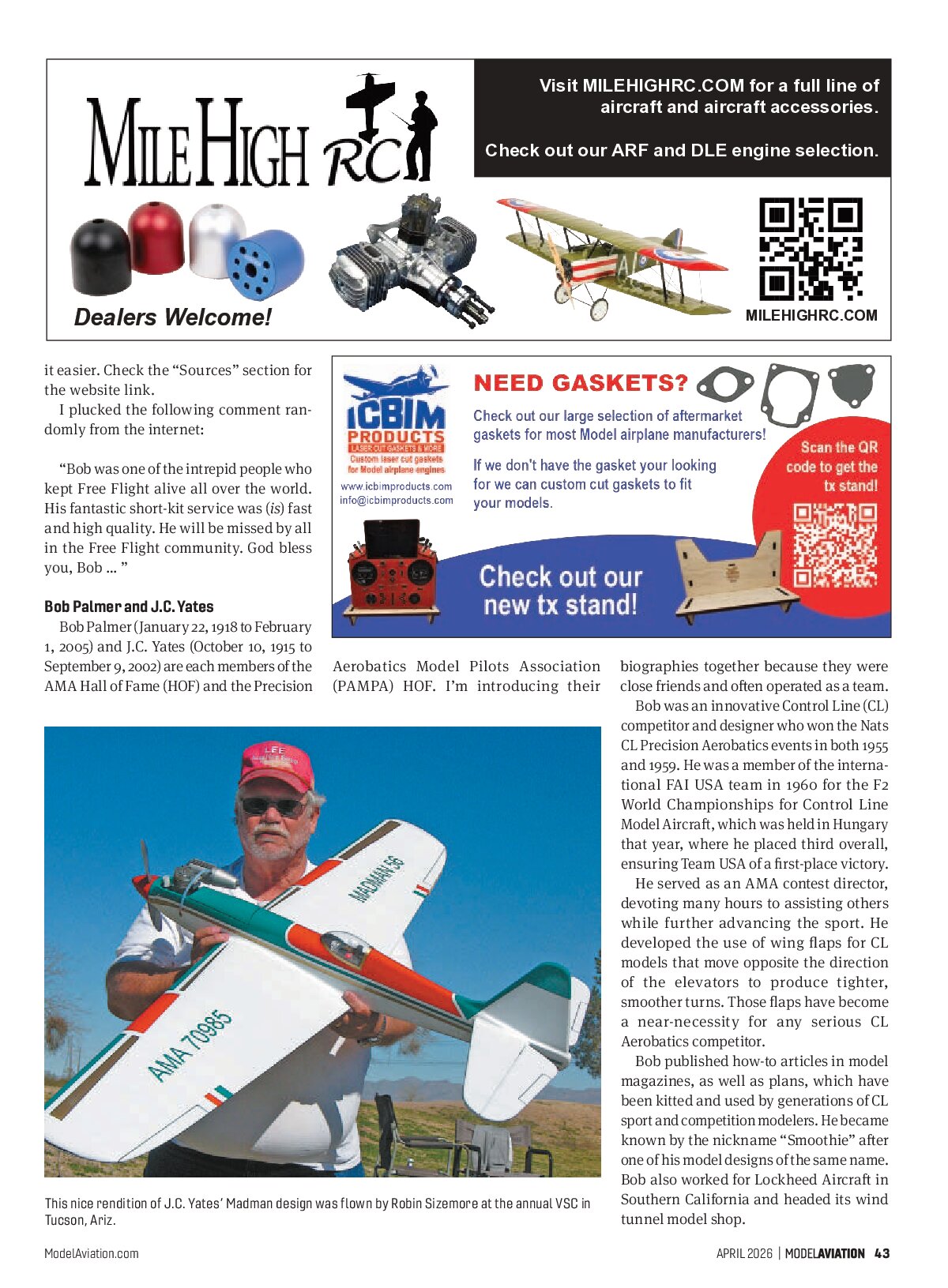
I and others were first introduced to J.C. years ago through model magazines, along with his catchy nickname, “Madman Yates,” which was assigned to him after one of his popular model designs, the Madman. Modeler and engine producer Howard (Hi) Johnson drew the plans for the Madman.
J.C. and Bob both worked at Lockheed at the time, but that Southern California company was large, so they first met at a model flying field. J.C. was a tool and die maker who partnered with engine manufacturer Henry Orwick to design and produce Orwick engines, along with the then-popular Y&O (Yates & Orwick) propellers.
J.C. and Bob sometimes flew as a team and picked up a few awards along the way. I never saw or found any written details about these performances, but I can imagine what they were like based on some of our own local CL club’s activities at the time. A pair of us would fly in the same circle performing choreographed maneuvers while conversing with each other to ensure that we were clear about the timing of each. We flew fairly close, sometimes following each other through loops, and other times we performed separate but closely spaced loops of nearly the same size, altitude, and timing. We’d enter into inverted flight by either following each other through à la Combat or just each maintaining our close distance but spaced slightly apart in tandem at the same low altitude. It was a crowd pleaser.
After World War II ended in 1945, the then-sleepy little village of Santa Maria, California, had become an active area for CL flying. That had been partially influenced by the local wartime training base for P-51 fighter aircraft. When I moved there in approximately 1965, there was still an active CL club for several years until it morphed into an RC club, now known as the Tri Valley RC Modelers.
I might be operating on shaky ground here as I try to recall stories from memory. One or more of the older local modelers recited stories of J.C. visiting our town after proper notice and pre-publicity in hobby shops and the local newspaper. J.C. would perform CL Stunt demonstrations to a fair-sized crowd using an Orwick engine in a Madman model. Carrying spare supplies of each, he sold both engines and kits directly out of his vehicle. This also generated interest (and later, sales) among those who didn’t happen to have sufficient cash in their pockets.
I began accumulating engines and finally realized that I was becoming a collector. One local modeler, who no longer flew, had two such completed Orwick-powered models hanging on his garage wall, plus a third, spare Orwick .64 on his workbench. After bugging him more than once, he sold me the spare Orwick, sending me home happy with my new prize. Incidentally, the locals claimed that one of Madman Yates’ flying stunts was to drag that tall rudder of his airplane lightly through the grass while flying inverted. Pretty risky!
J.C. dropped out of modeling around 1950, but, like many of us, he resumed flying later in life. In approximately 1976, he shifted his interest to RC and was no longer flying in competitions. He was living in Hemet, California, several miles southeast of Los Angeles, when he headed a fundraising group to help the Hemet Model Masters RC club develop and maintain their very nice flying field and associated facilities, which still exist today.


SOURCES
- Bob Holman Plans
(909) 556-6513 - bhplans.com
- Hemet Model Masters
- hemetmodelmasters.net
- Madman
AMA Plans Service - (765) 287-1256, ext. 507
plans.modelaircraft.org/product/madman - PAMPA
- pampacl.org
- “Vintage Stunt Championship VSC Control line Stunt Contest 2019”
YouTube - youtube.com/watch?v=YFH6EeWbitw