Interested in sharing your handiwork? Visit ModelAviation.com for submission guidelines.
Martin Justis’ (Columbus, Indiana; email: martin.justis@cummins.com) 1/3-scale kit build of the Sopwith Camel is from JW Modellbau of Germany and is available in the US through Vogelsang Aeroscale.
The 112-inch wingspan Camel is powered by a Stihl 80cc four-stroke engine that Martin converted from a backpack blower. The airplane is covered in Profi Cover and painted with latex paint.
“The plane took exactly six months from opening the box to the maiden flight,” Martin said. “The kit is designed to build very fast, yet it is still light and very scale. It flies well and would be a good entry into 1/3-scale World War I flying.” He stated that he really enjoys Dawn Patrols and tries to go to several every year. “This has been the most fun I’ve had building an RC plane in the 40 or so years I’ve been modeling.”
Robert Fish’s (Paulden, Arizona; email: robert.fish.aerobatics@gmail.com) Striker was originally featured as a construction article in the February 1968 edition of the British publication Radio Control Models and Electronics. It was built from a KYM Manufacturing laser-cut kit.
The airplane is of all-wood construction and is powered by an Innov8ive Designs BadAss 3530-700 electric motor and ESC. It took approximately 100 hours to build and is covered with red UltraCote.
“The model exceeded all of my expectations in flight,” said Robert. “[It is] very stable and performs all Classic Pattern maneuvers with ease and grace.”
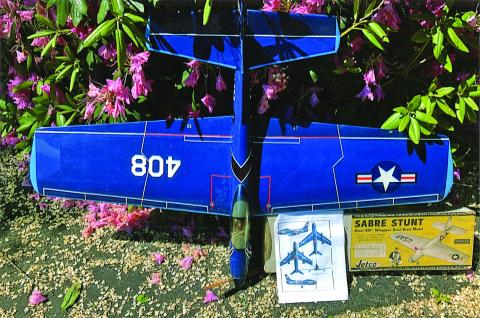
Leonard Thibault (Worcester, Massachusetts; email: lttebag@yahoo.com) is a member of the Quinapoxite Model Flying Club and has flown both Control Line (CL) and RC models. This Jetco Sabre CL Stunt model was purchased in the 1960s for approximately $12 and was built and flown by Leonard, who is now 85 years young. Its equivalent design placed second in the Open CL Stunt class at the AMA Nats.
The original model was rebuilt to its current design, which is depicted in the Profile Publications Number 42: The North American FJ Fury booklet, as a U.S. Navy North American FJ-3 Fury (Bureau Number 135978 of the VF-154 Fighter Squadron) sometime in the 1980s.
The model is covered with MonoKote and powered by a Fox 35 Stunt engine using a 10 x 6 propeller. The build time was 100-plus hours. Leonard said that the Sabre’s flight speed is somewhat fast and maneuverable.
Paul Bryk (Wilmington, Delaware; email: brykmantis@aol.com) submitted pictures of his BMJR Super Sniffer. “I really enjoyed building this little guy,” he said. “It is the third one I’ve had in my 65 years. The first was from Midwest.”
“Be sure to get a good look at the eyes and the teeth,” Paul continued. ” I think they really give it character; like a creature from the yellow submarine, or maybe a flying piranha (the upper wing and eyebrow art were done by Tony A.).” He added that the Super Sniffer’s flight characteristics are silky smooth and relaxing, with it flying for at least 20 minutes on a three-cell 1,300 mAh LiPo battery. “It’s not fast, nor can it do loops or rolls. It is just the most relaxing flying imaginable.”
Brian Malin, from BMJR Models, obtained a copy of Paul’s pictures and said that it was the neatest Super Sniffer the company had seen in a long time!


The color scheme on Bill Sheridan’s (Southington, Connecticut; email: bnsheridan1983@gmail.com) Balsa USA 1/6-scale DR.1 was taken from the Black Baron at the Old Rhinebeck Aerodrome in Rhinebeck, New York. Bill said, “It is primarily red as Manfred von Richthofen would have done but with black and white stripes that are taken from Jasta 6.”
The cowling face is from Werner Voss. Bill used Oratex covering as Balsa USA suggested, finding it easy to work with. All of the accessories were suggested by Balsa USA as well: 1/6 Spandau machine guns, Du-Bro vintage wheels, plus a decal set. The dummy engine is from Scale RC Engines with a Xoar propeller. Control is by a Spektrum system with A4040 servos and power is by a Cobra 3520 motor.
Bill stated that the quality of the kit materials and instructions provided by Balsa USA were excellent. He belongs to the Central Connecticut Radio Control Club in Farmington, Connecticut, where he flies with a group of retired friends on a regular basis.
Frank Larocca (Marlboro, New Jersey; email: f.larocca@verizon.net) built his 1/4-scale Aeronca Champ from a design by the late Wendell Hostetler. “I purchased the kit from National Balsa. It is actually 26% of a full-scale Aeronca Champ,” he said.
The exterior is covered with Oratex and the blue is Hangar 9 covering. The color, stripes, and graphics were copied from a full-scale Aeronca Champ that was designed and owned by George Devlin.
The model is powered by an E-flite 90 motor, Castle Creations Talon 90 ESC, a 17 x 10 electric propeller, and a 6S 5,000 mAh battery. A Spektrum AR631 receiver and five high-torque Spektrum servos were also utilized. The battery compartment is right behind the motor, which helped to balance the center of gravity. The all-up weight is 14 pounds with the battery.
Frank, the treasurer of the Monmouth Model Airplane Club in Manalapan, New Jersey, had planned to maiden it in summer 2025. “It was a fun and challenging build.”
Dr. Carmen S. Luciano (Calabash, NC; email: carmenluciano@sbcglobal.net) was looking for a model from years past and saw this 1970 Smoothie kit from Balsa USA. It sports a 52-inch low wing with a full weight of 5-plus pounds. “It’s been a while since I built a model from a kit,” he said, “but my memory dexterity and building skills made this build a pleasure.”
The Balsa USA plans were upgraded to modern specifications with standard instructions, and it was built as described in the plans with modification to the motor mount for a Saito 56 four-stroke engine. Carmen used MonoKote covering in his own color scheme with decals that he designed and made himself. Control is by a Spektrum DX8 transmitter using four channels and a 2.4 GHz Spektrum receiver.
“It flies as you would expect—like a well-balanced sport plane circa-1970.”
Bob Marsteller (Alliance, Nebraska; email: b_steller@hotmail.com) states that Balsa USA’s Northstar airframes are perfect for modifying.
For his Northstar, Bob enlarged the horizontal stabilizer and elevator a little, trimmed the tip floats, and added the winglets. The strakes at the front of the wing are bigger as well. The wing floats are foam-filled, and the airplane is covered with MonoKote.
Powered by an O.S. 55AX engine turning a Master Airscrew 11 x 7 three-blade propeller, the Northstar weighs 7 pounds, 8 ounces.