Electric Power System Basics
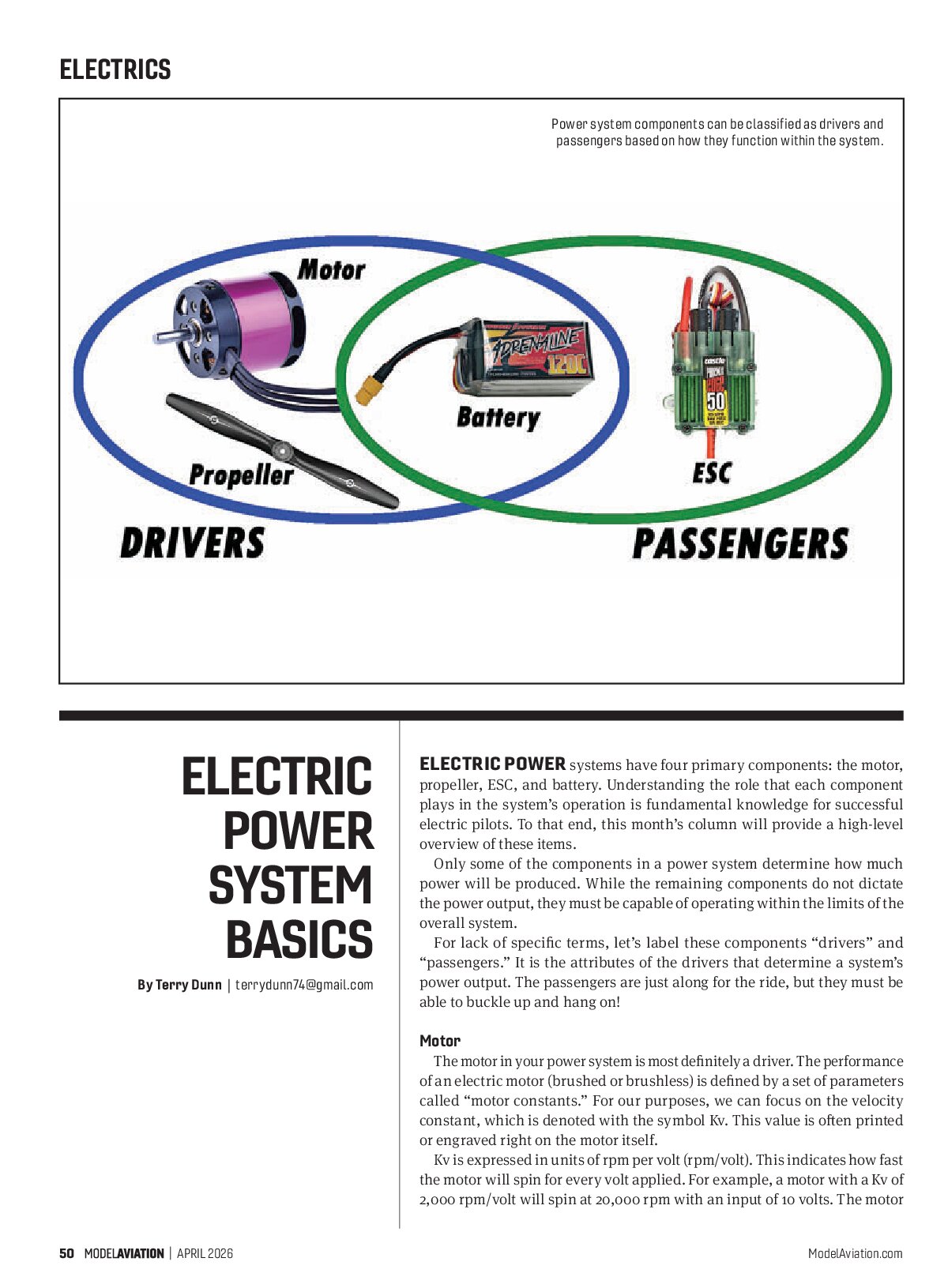
Power system components can be classified as drivers and passengers based on how they function within the system.
Electric Power systems have four primary components: the motor, propeller, ESC, and battery. Understanding the role that each component plays in the system’s operation is fundamental knowledge for successful electric pilots. To that end, this month’s column will provide a high-level overview of these items.
Only some of the components in a power system determine how much power will be produced. While the remaining components do not dictate the power output, they must be capable of operating within the limits of the overall system.
For lack of specific terms, let’s label these components “drivers” and “passengers.” It is the attributes of the drivers that determine a system’s power output. The passengers are just along for the ride, but they must be able to buckle up and hang on!
Motor
The motor in your power system is most definitely a driver. The performance of an electric motor (brushed or brushless) is defined by a set of parameters called “motor constants.” For our purposes, we can focus on the velocity constant, which is denoted with the symbol Kv. This value is often printed or engraved right on the motor itself.
Kv is expressed in units of rpm per volt (rpm/volt). This indicates how fast the motor will spin for every volt applied. For example, a motor with a Kv of 2,000 rpm/volt will spin at 20,000 rpm with an input of 10 volts. The motor will operate at this rpm only if it is not under any load.
A motor with no load is not very useful—we want it to actually do something! Imposing a load on the motor, such as a propeller, will make it spin at a lower rpm. The motor still wants to turn at the no-load rpm, but the burden of the load prevents it from doing so. The greater the load, the slower the motor will spin, and the more electrical current (amps) it will pull. This also means that the motor is producing more power (volts x amps).
Because electric motors are not 100% efficient, they produce some degree of heat. The amount of heat that is generated is a factor of the amount of power the motor is producing. More power equals more heat. At reasonable power levels (and with adequate air cooling), a given motor can safely dissipate this heat. If you overload a motor and force it to produce more power than what it is rated for, it will generate more heat than it can dissipate, and the motor will continue to get hotter until something fails.
A motor might not fail the first time it overheats, but it will likely not tolerate such abuse for long. I think you will understand how to avoid overloading (and thus, overheating) your motor as I discuss the other power system components.
Propeller
The propeller is also a driver of your power system. The size of the propeller is a major factor that determines the load on the motor and the power that it produces. Increasing either the diameter, pitch, or number of blades on the propeller will increase the load on the motor.
Not all propellers are created equal. Even propellers that are seemingly the same size can impart different loads on the motor. Two 9 x 6 propellers from different manufacturers can differ in the profile of the propeller blades as well as the airfoils, which would cause them to perform differently and create unique loads on the motor.
ESC
The ESC is a passenger in the power system. Changing the ESC will not affect the current draw of the system or the power it generates. Your primary goal when selecting an ESC is to ensure that it is rated to handle the full-throttle current of your power system.
If your system pulls 38 amps at full throttle, you will want an ESC that is rated for at least 38 amps. The closest viable candidate would likely be a 40-amp ESC. The system will work just fine if you use an ESC that is rated for even more current. You can put in a 100-amp ESC with no problems. The only disadvantage of using the 100-amp ESC in this example is that it will likely be physically larger, heavier, and costlier than the 40-amp unit.
If you install a smaller ESC (such as a 25-amp unit), it will not choke the current one bit. The power system will still pull 38 amps at full throttle. You’re simply operating the ESC beyond the current it is rated for—the smell will be terrible when it inevitably goes poof! Without exception, the ESC must be rated to handle the full-throttle current of your power system. It goes without saying that the ESC should be rated for the voltage of your battery as well.
Some modelers believe that they can get away with the 25-amp ESC if they never exceed 2/3 throttle or if they lower the throttle endpoint on their transmitter. As discussed in a previous column, those are ineffective strategies. The only correct approach for using the 25-amp ESC is to reduce the size of the propeller and/or reduce the voltage of the battery such that the full-throttle current of the system is no more than 25 amps.
Battery
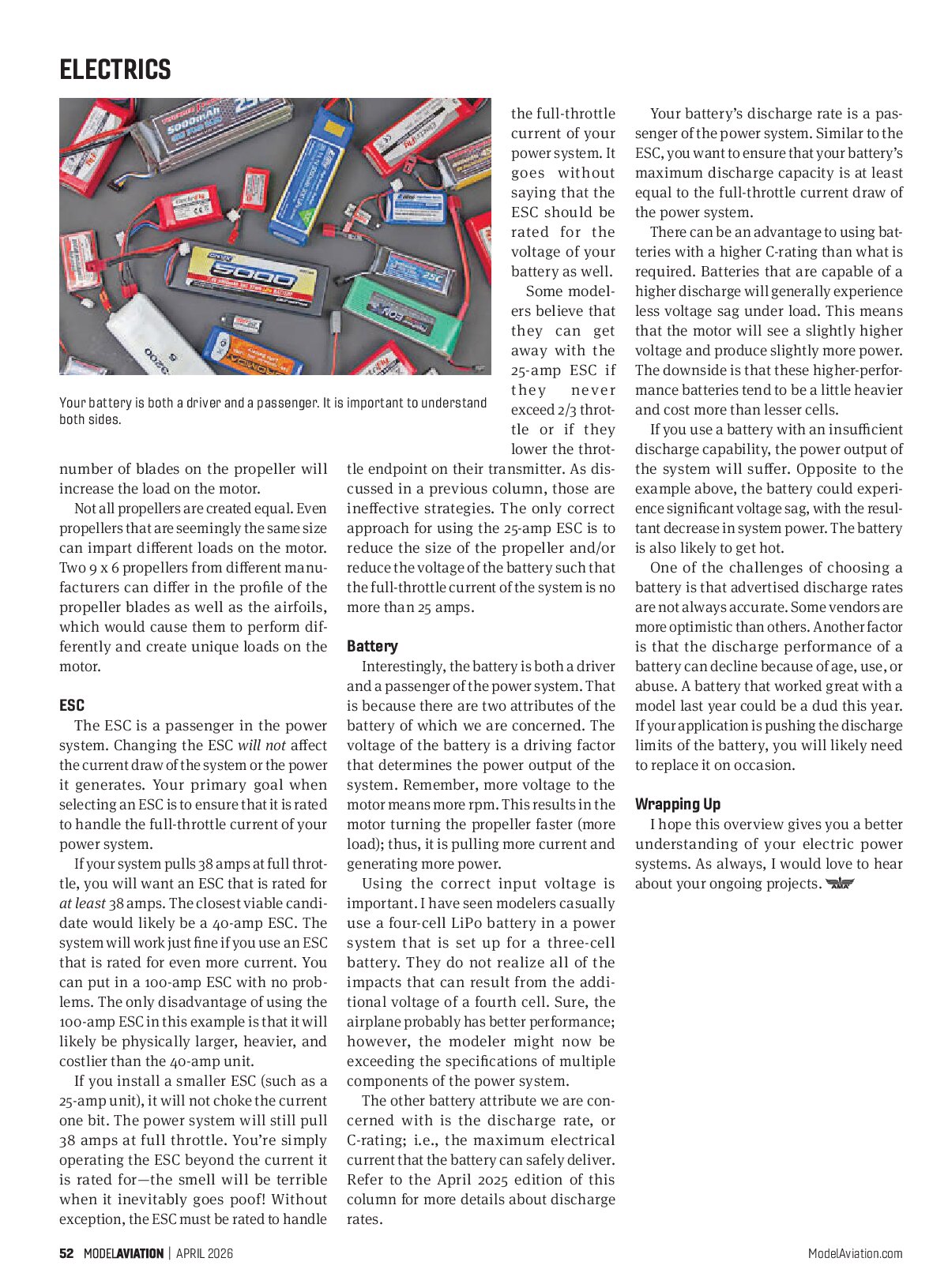
Interestingly, the battery is both a driver and a passenger of the power system. That is because there are two attributes of the battery of which we are concerned. The voltage of the battery is a driving factor that determines the power output of the system. Remember, more voltage to the motor means more rpm. This results in the motor turning the propeller faster (more load); thus, it is pulling more current and generating more power.
Using the correct input voltage is important. I have seen modelers casually use a four-cell LiPo battery in a power system that is set up for a three-cell battery. They do not realize all of the impacts that can result from the additional voltage of a fourth cell. Sure, the airplane probably has better performance; however, the modeler might now be exceeding the specifications of multiple components of the power system.
The other battery attribute we are concerned with is the discharge rate, or C-rating; i.e., the maximum electrical current that the battery can safely deliver. Refer to the April 2025 edition of this column for more details about discharge rates.
Your battery’s discharge rate is a passenger of the power system. Similar to the ESC, you want to ensure that your battery’s maximum discharge capacity is at least equal to the full-throttle current draw of the power system.
There can be an advantage to using batteries with a higher C-rating than what is required. Batteries that are capable of a higher discharge will generally experience less voltage sag under load. This means that the motor will see a slightly higher voltage and produce slightly more power. The downside is that these higher-performance batteries tend to be a little heavier and cost more than lesser cells.
If you use a battery with an insufficient discharge capability, the power output of the system will suffer. Opposite to the example above, the battery could experience significant voltage sag, with the resultant decrease in system power. The battery is also likely to get hot.
One of the challenges of choosing a battery is that advertised discharge rates are not always accurate. Some vendors are more optimistic than others. Another factor is that the discharge performance of a battery can decline because of age, use, or abuse. A battery that worked great with a model last year could be a dud this year. If your application is pushing the discharge limits of the battery, you will likely need to replace it on occasion.
Wrapping Up
I hope this overview gives you a better understanding of your electric power systems. As always, I would love to hear about your ongoing projects.