Betting on a Propeller Strike?
I Fold!
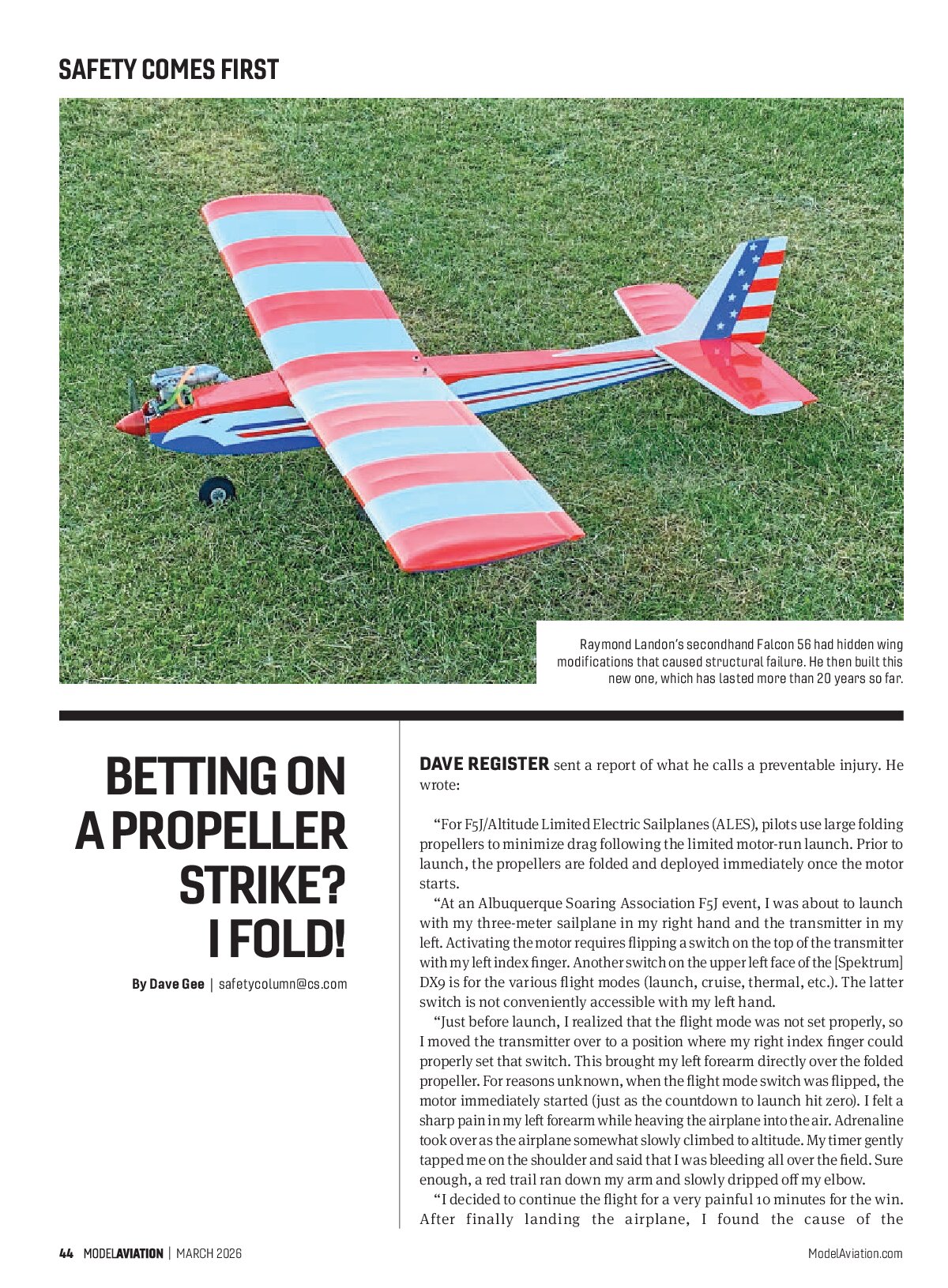
Raymond Landon’s secondhand Falcon 56 had hidden wing modifications that caused structural failure. He then built this new one, which has lasted more than 20 years so far.
Safety Comes First
Dave Register sent a report of what he calls a preventable injury. He wrote:
“For F5J/Altitude Limited Electric Sailplanes (ALES), pilots use large folding propellers to minimize drag following the limited motor-run launch. Prior to launch, the propellers are folded and deployed immediately once the motor starts.
“At an Albuquerque Soaring Association F5J event, I was about to launch with my three-meter sailplane in my right hand and the transmitter in my left. Activating the motor requires flipping a switch on the top of the transmitter with my left index finger. Another switch on the upper left face of the [Spektrum] DX9 is for the various flight modes (launch, cruise, thermal, etc.). The latter switch is not conveniently accessible with my left hand.
“Just before launch, I realized that the flight mode was not set properly, so I moved the transmitter over to a position where my right index finger could properly set that switch. This brought my left forearm directly over the folded propeller. For reasons unknown, when the flight mode switch was flipped, the motor immediately started (just as the countdown to launch hit zero). I felt a sharp pain in my left forearm while heaving the airplane into the air. Adrenaline took over as the airplane somewhat slowly climbed to altitude. My timer gently tapped me on the shoulder and said that I was bleeding all over the field. Sure enough, a red trail ran down my arm and slowly dripped off my elbow.
“I decided to continue the flight for a very painful 10 minutes for the win. After finally landing the airplane, I found the cause of the slower-than-expected climb: both propellers were missing about an inch from each tip. Where those propeller tips went and how they managed to miss further injury, I’ll never know. The rather deep cut did not require stitches, but it took many weeks to heal and left a reminder to never reach over a folded propeller, no matter the presumed condition of the airplane and radio!”
I sure give him credit for having a competitive spirit! Rest assured that if it was me who was cut and bleeding, that airplane would be coming down fast, trophy or no trophy.
Dave was able to safely choose to continue his flight because by the time he knew about possible propeller damage, the motor run was already finished. The rest of an F5J event is gliding. With a conventionally-powered model, a damaged airscrew should be shut down as soon as possible, with the model making a dead-stick landing. Damaged propellers can throw shards or entire blades, and this is something that should be avoided! Dave knew that he had a safe option and decided to display stoicism. I’m impressed.
Today’s powerful electric motors and fast-spinning propellers make it vital for pilots to be extra methodical with their launch procedures. Any occurrence that alters a preflight routine should be seen as a danger and treated with extra care. Competition adds pressure to flight operations, but we still need to make wise and safe choices.
Shake It, Baby!
My recent discussion about fire extinguishers that don’t work when they are needed brought many reader responses. Gene Drake and others told me that they have seen professional fire extinguisher service workers shake the bottles during yearly inspections and commercial units get tapped on the base with a rubber mallet (if you can believe that). This is to loosen up the contents and ensure proper flow when they are activated. I consulted several instruction manuals before publishing this column, and none of them mentioned rubber mallets! Still, it does seem like common sense to shake the contents once in a while. I’ve adopted this idea with my home units—but no hammering on a pressurized tank for me, please.
The Dangers of Friendliness
Another recent topic was the varying friendliness levels of RC clubs toward a newcomer or a visitor. Readers emailed me about online modeling hobby groups and how they sometimes won’t allow visitors to post or even see the content. It didn’t take much research to find the reason for this.
Anyone who has participated in aeromodeling social media knows that low-down scammers are lurking everywhere and are eager to take advantage of an open and friendly environment. They will abuse this trust by posting fake sales notices for modeling equipment at bargain prices. Of course, you’ll never see any merchandise after you pay them. Clubs and chatroom administrators learn fast—they take action to keep members safe, so you’ll often face a vetting process before being allowed into an online community. It’s a shame, but that seems to be what is needed to keep us safe from fraudsters.

Coming Down on a Wing and a Prayer
Raymond Landon sent in a sad story about an in-flight structural failure. He wrote:
“My first RC airplane was a used Carl Goldberg Falcon 56. It was a great airplane. One day, I made a high-bank turn and the main wing folded in two. Crash investigation revealed that the previous owner had sawed the wing in two, perhaps to lessen the dihedral. There was no pass-through wing spar or reinforcement. I liked the aircraft so much that I went down to the local hobby store and purchased a Goldberg Falcon 56 II kit. I built it in 1994 (see the picture) and still fly it.”
Any model that you did not personally build should get a careful and detailed inspection before flight, as Raymond found out in a sudden way. Modelers can’t resist making “improvements” to a kit. Sometimes these homespun engineering changes aren’t so great. Comparing an airframe to the original plans would be best, if possible. If an identical model is available, that’s useful as well. Spare no effort in your preflight scrutiny if you don’t want to recreate the traumatic flight of Raymond’s secondhand Falcon 56.
Wet Mystery Airplane
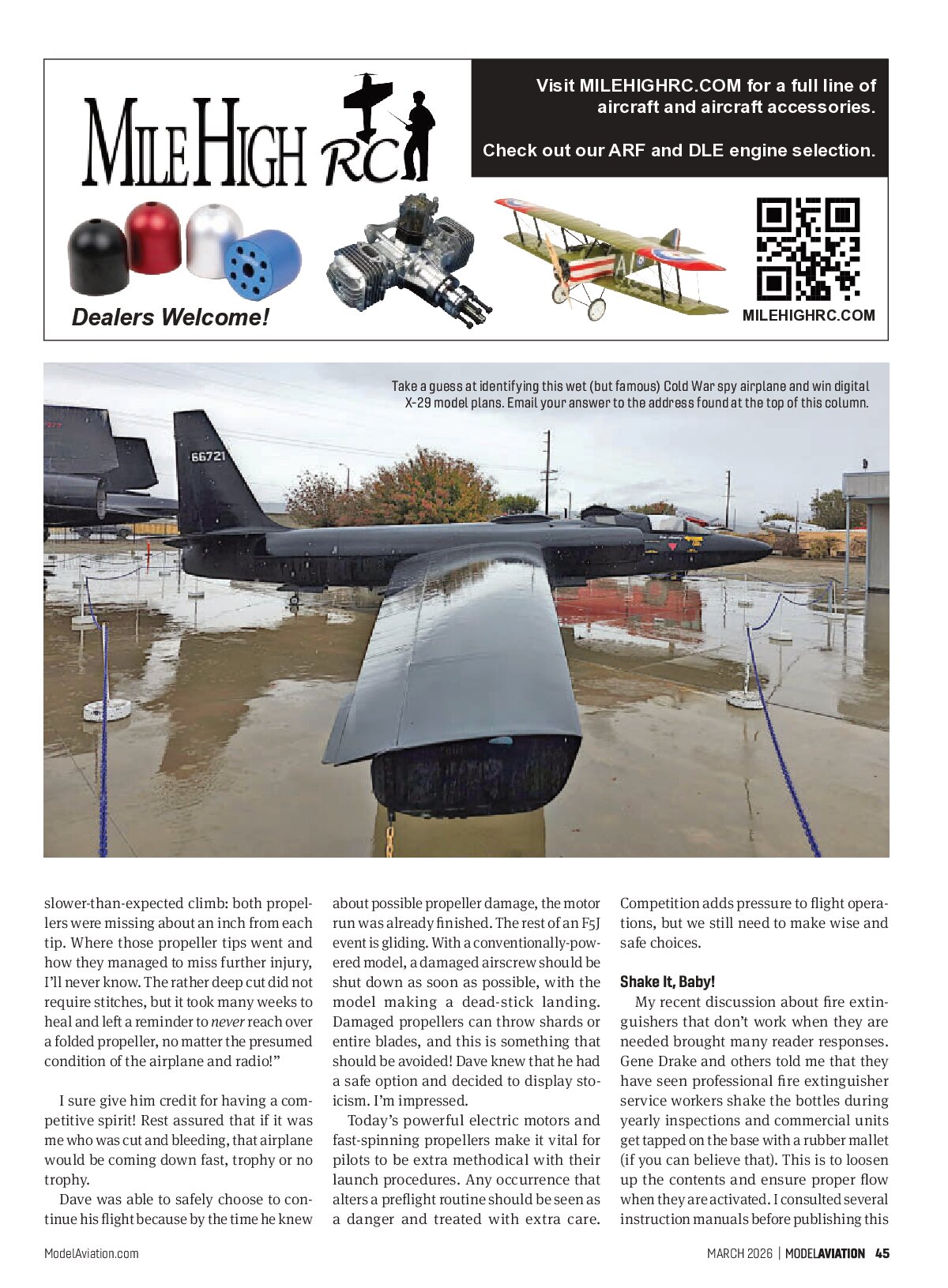
I snapped the photo of this month’s mystery airplane on a rare rainy day in the desert of Palmdale, California. It started life as a top-secret spy airplane, flying too high to be intercepted. Some are still in use as research aircraft. This one is displayed at Blackbird Air Park in Palmdale, and I highly recommend a visit to see the huge, sleek airplane in person. Please send your guess to the email address found at the beginning of this article.
Unflyable Prize Plans
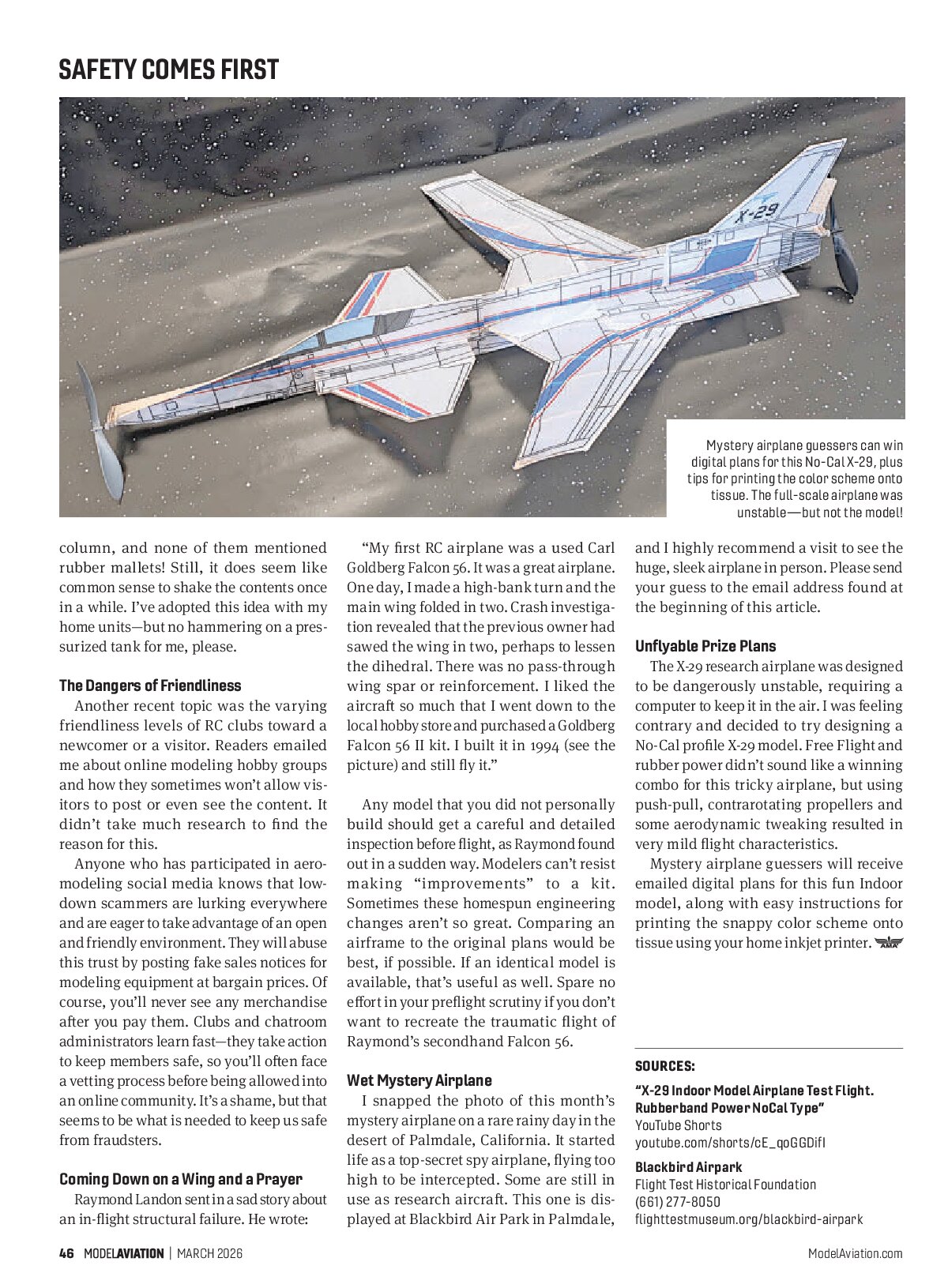
The X-29 research airplane was designed to be dangerously unstable, requiring a computer to keep it in the air. I was feeling contrary and decided to try designing a No-Cal profile X-29 model. Free Flight and rubber power didn’t sound like a winning combo for this tricky airplane, but using push-pull, contrarotating propellers and some aerodynamic tweaking resulted in very mild flight characteristics.
Mystery airplane guessers will receive emailed digital plans for this fun Indoor model, along with easy instructions for printing the snappy color scheme onto tissue using your home inkjet printer.

SOURCES
- “X-29 Indoor Model Airplane Test Flight. Rubberband Power NoCal Type”
YouTube Shorts - youtube.com/shorts/cE_qoGGDifI
- Blackbird Airpark
Flight Test Historical Foundation
(661) 277-8050 - flighttestmuseum.org/blackbird-airpark