
Flying experiences at events
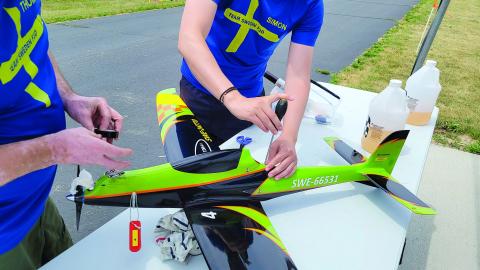
Simon Nyholm, from Sweden, prepares his F3D aircraft before a round of Pylon Racing at the 2022 FAI F3D/F3E World Championships for Pylon Racing Model Aircraft, which was held at the International Aeromodeling Center in Muncie, Ind. The cowling over the top conceals the tuned pipe.
Reading Jacob Raquet’s informative article in the December 2025 Model Aviation about the FAI F3D/F3E World Championships for Pylon Racing Model Aircraft gave me an idea for this month’s column: What’s the difference between AMA and FAI RC Pylon Racing? Because of the extent of this topic, it’s going to be in two parts.
My apologies to AMA Pylon Racing pilots who have experience in FAI and already know the differences, but there are those who enjoy reading along, even if they don’t aspire to get involved in Pylon Racing. There are also currently active AMA Pylon Racing pilots who have heard of FAI but might not know the differences between the two.
Here in the US, the governing body of RC Pylon Racing is AMA, with advisement from the Special Interest Group, the National Miniature Pylon Racing Association (NMPRA). Although NMPRA serves and reflects the needs of its membership and Pylon Racing in general, AMA oversees racing activities, including publishing rules, sanctioning events, providing insurance, etc. It’s an oversimplification to say that FAI Pylon Racing is the same as AMA—only on an international level—but for the purposes of this column, I’ll leave it at that. International competitions require an internationally recognized set of rules. It’s similar to Olympic sports, where Olympic rules might vary from national rules.
Back to the airplanes. AMA has four active classes that are typically held at an event. Although some events might hold only one or two classes, others will hold all four classes throughout a two-day weekend.
From the slowest to the fastest, the four AMA classes are: Electric Formula 1 (EF1), Sport Quickie 500 (Q-500), Super Sport Q-500, and Quarter 40 (Q-40). Each class has a set of specifications for the aircraft regarding just about everything you can think of, including the minimum weight, wing area, fuselage width, fuselage height, wing thickness, wheel size, engine/motor size, propeller size, etc.
EF1 and Q-40 also stipulate that, within certain guidelines, the aircraft must be modeled after a full-scale aircraft that actually participated in a full-scale Pylon Racing competition. In other words, roughly speaking, EF1 and Q-40 aircraft are Scale models.
Both of the Q-500 classes typically use a “Hershey bar” wing with a constant chord and a fuselage with a square cross section. These models are not Scale and are intentionally relatively simple to keep costs reasonable and the focus more on racing than design.
Let’s take a look at FAI aircraft. In FAI RC Pylon Racing, there are two classes: Simply put, glow and electric. The glow-power class is called F3D and the electric-power class is F3E. The same as glow engines in AMA, F3D glow engines are a .40 cu. in. displacement. However, unlike AMA glow engines that run on fuel with 15% nitromethane, F3D engines run on glow fuel without nitro. Despite FAI fuel being less “potent,” FAI engines are even faster than the fastest engines in AMA Q-40 because of their high degree of tune. Setting up and tuning an FAI engine to be competitive on an international stage requires skills and experience on a whole other level!
The same as AMA Pylon Racing airplanes, F3D aircraft have specific design criteria, but there is no requirement for the model to be Scale, so F3D models evolve to whatever design will be the fastest. Where form follows function, F3D aircraft are purposeful and beautiful—even evil-looking, if you ask me!
On the electric-power side, F3E aircraft specifications are much less constrained than AMA EF1. In addition to EF1 aircraft’s rough scale requirement, only certain motors are approved, there is only one approved propeller, and ESCs are limited to certain cost and current-rating specifications.
Although EF1 is not a beginner class, it is somewhat intended as a good avenue for getting into Pylon Racing. It’s more about the pilot—not the technology. Conversely, aside from just a few specifications, F3E is the wild, wild West, where just about anything goes and modelers are free to apply their imagination and expertise to the fullest.
The only airframe specifications are a minimum weight of 1,000 grams, a maximum flying-surface loading of 65 grams per square decimeter, a maximum no-load battery voltage of 21 volts (a 5S LiPo battery), and an energy limitation of 1,000 watts per minute. Because of this, we see all kinds of variations, including folding propellers, variable-pitch propellers, single-blade propellers, inrunner motors, outrunner motors, and a variety of airframes.
In F3E, speeds reach approximately 210 mph. The world record is held by Mark de Groot of the Netherlands, with a time of 54.50 seconds at the 2025 F3D/F3E World Championships in Rothenburg, Germany. The world record for F3D is held by Robbert van den Bosch, also from the Netherlands, with 54.97 seconds at the same event. I must say, I always knew that the electric FAI aircraft were just about as fast as F3D, but until I started researching for this column, I didn’t know that the F3E record was faster—at least at this moment in time.
Let me get back to one aspect of F3E: the watt limiter. Although there are no constraints on the propeller, ESC, motor, or battery capacity, there has to be some sort of limit for safety’s sake and for the spirit of competition. This is where the watt limiter comes in.
A watt limiter is an onboard electrical device connected between the battery and ESC that cuts power after 1,000 watt-minutes has been reached. This system also encourages efficiency. It’s not just about whatever is fastest; it’s how you choose to use the power that is available.
For example, if your drive (or motor/propeller/battery combination) draws 1,000 watts, it will run for 1 minute. You’re basically giving yourself 60 seconds to complete a 10-lap race. A 60-second race is pretty good, but the record is close to 54 seconds, so if you’re getting 10 laps before the limiter cuts the motor, you’ve left energy on the table. You might strive for a setup that uses more watts so that you can go faster and use all of the energy allowed. Approximately 1,070 watts should give you a 56-second run, so you might use a bigger propeller, warm the battery, use a different motor, etc.
I don’t believe that competitors measure and calculate the watts, per se, to predict run time, but this exercise illustrates how the watt limiter works. The more power you use, the faster you can go, but the shorter the run time. Nothing is free!

I’ll continue this discussion in the next column with the differences between the FAI and AMA courses and the racing formats.


SOURCES
- NMPRA
- nmpra.net
- AMA Competition Regulations
Radio Control Pylon Racing - modelaircraft.org/sites/default/files/events/rule-books/RC_Pylon_Racing_2024-2025.pdf
- FAI Sporting Code
Section 4—Aeromodelling, Volume F3, Radio Control Pylon Racing Model Aircraft - fai.org/sites/default/files/sc4_vol_f3_pylon_23.pdf


