
The Spin!
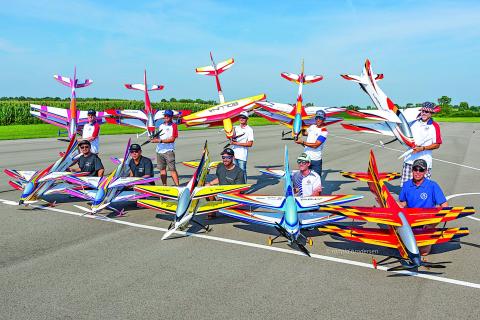
The top 10 finalists for the 2025 FAI F3A World Championship for Aerobatic Model Aircraft in Muncie, Ind. Photo by Ronald Brodersen.
I want to review a fun and highly contested topic in the RC Aerobatics (Pattern) circle: the spin. A spin is a stalled state with the aircraft spiraling or corkscrewing straight down—in our case, in a controlled state. The key here is that it is a stalled maneuver. With our RC airplanes, the spin is recovered by just letting go of the sticks, and then the airplane stops and you have recovered. As with everything in Pattern, there are some criteria for our spins that make it a little more difficult to execute, as well as difficult to judge at times. This also includes downgrades that are sometimes difficult.
The spin is judged in multiple parts: the entry, the execution, and the exit. Sometimes the entry downgrades are misunderstood and there isn’t a chance to continue downgrading the maneuver to receive a score other than zero.
First, let’s review the 2025 FAI Sporting Code for RC Aerobatics on spins and what it states:
5B.8.12. SPINS
All spins are entered and exited with horizontal lines. In order to spin, the model aircraft must be stalled. The entry is flown in a horizontal flight path with the nose-up attitude increasing as the speed decreases. Drift of the model aircraft from the flight path at this point should not be downgraded, since it is in a near-stalled condition. However, severe yawing during the near-stalled condition, should be downgraded by 1 point per 15 degrees. A climbing flight path just prior to the spin must be downgraded, using the 1 point per 15 degree rule. The nose then drops as the model aircraft stalls. Simultaneously as the nose drops, the wing also drops in the direction of the spin. Drift during the rotation of the spin should not be downgraded since the model aircraft is in a stalled condition, provided the model aircraft does not drift outside the maneuvering zone.
If the model aircraft does not stall or if the model aircraft is snap-rolled or spiral-dived into the spin, the maneuver is zeroed. If the model aircraft slides into the spin (is loath to spin), the maneuver must be downgraded by using the 1 point per 15 degree rule. Forcing the model aircraft to spin in the opposite direction as the initial rotation must be severely downgraded. Forcing the model aircraft to spin from a high angle of attack with down (or up) elevator, should be downgraded by 4 or 5 points. Judges must carefully observe the stalled attitude, which is not necessarily a complete stop, especially in no-wind conditions. This is no reason for downgrading.
After the defined number of turns, the stop of rotation is judged in the same manner as for a roll, downgraded 1 point per 15 degree deviation of heading. The spin rotation should stop parallel to the flight line. “Unloading”, or stopping the spin rotation early and then applying only aileron to roll the model aircraft to the desired attitude, should be downgraded using the 1 point per 15 degree rule.
A vertical downward line of visible length must be held after the rotation stops. The pull- or push-out is judged like a part-loop and if followed by a part-roll, should be separated by a well-defined line of straight flight. Different models spin in different attitudes, and the attitude is not to be taken into consideration, as long as the model aircraft is stalled. Any reversals in direction must be immediate, and if the model aircraft returns to an unstalled condition during the spin, the maneuver is severely downgraded. The rate of rotation during a reversed spin may be slightly different, without a downgrade, but if the difference is significant, 1 point is subtracted.

The Spin in Basic Steps
Enter with a straight horizontal line across. The nose comes up to initiate the stall by adding up-elevator.
- As the airplane stalls, it should drop a wing in conjunction with the nose-up attitude. You can nudge the airplane with rudder in the direction of the spin that you want, but be advised—this could get you a downgrade if you rush the spin entry or move the airplane off track. Timing is key here.
- As you stall, use full up-elevator (positive spin), full rudder, and aileron. Make the airplane spin or corkscrew in the stalled state straight down.
- To stop, let go of the sticks, draw a line, and then pull a smooth radius to your exit.
Downgrades Specific to a Spin
- If there is a gain in altitude prior to the spin, apply one point per 15°.
- Severe yawing during the near-stalled condition should be downgraded by one point per 15°.
- If the model aircraft does not stall or snap-rolls or spiral-dives into the spin, the maneuver is zeroed.
- If the model aircraft slides into the spin (is loath to spin), the maneuver must be downgraded by using the one-point-per-15° rule.
- The stop of rotation is judged in the same manner as for a roll: downgraded one point per 15° in deviation of heading.
- The rate of rotation during a reversed spin might be slightly different without a downgrade, but if the difference is significant, one point is subtracted.
- If there is no visible vertical line following rotation(s), one point is subtracted.
Not Downgrades
- Drift when stalled or near-stalled (not outside the aerobatic zone).
- Conditions (ie., no wind) might mean that the aircraft does not completely stop.
- The specific attitude of the aircraft during a spin should not be judged as long as it remains stalled.
- The rate of rotation in a reversed spin is a slightly different speed.
Spins are the hardest to judge. Once they are entered, they happen fast. Review the above for when you have to judge, and practice your spins as a pilot. Don’t be afraid to ask questions or even not score a maneuver because you didn’t see it fully. As a pilot, understanding the downgrades is just as beneficial as it is for the judge.
If you are reading this and you have never done a spin before, get some altitude three or four mistakes high and give it a shot.
Until next time!


SOURCES
- National Society of Radio Controlled Aerobatics (NSRCA)
- nsrca.us
- FAI Sporting Code
Section 4—Aeromodelling, Volume F3, Radio Control Aerobatics, 2025 Edition - fai.org/sites/default/files/sc4_vol_f3_aerobatics_25.pdf


