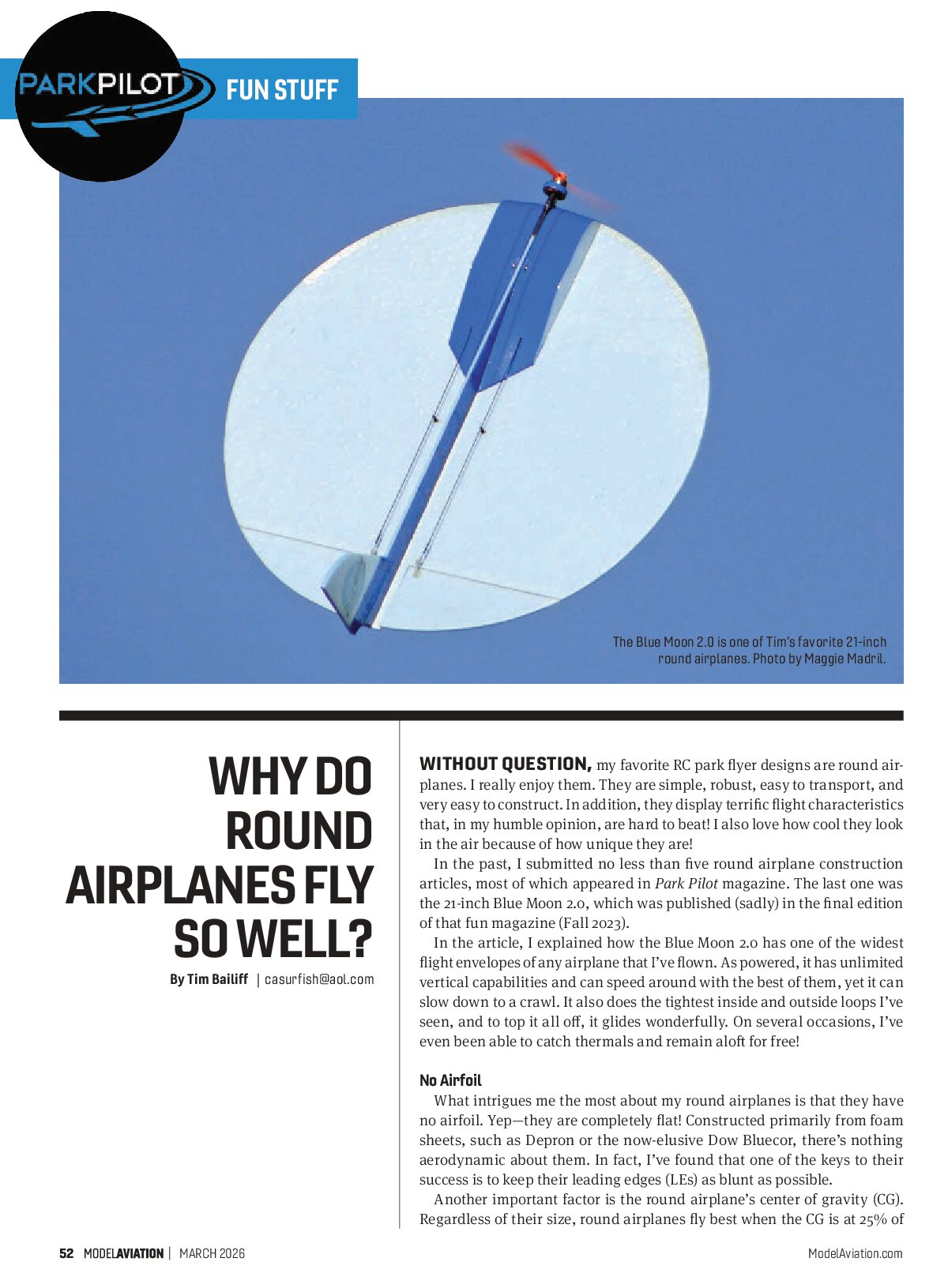
The Blue Moon 2.0 is one of Tim’s favorite 21-inch round airplanes. Photo by Maggie Madril.
Why Do Round Airplanes Fly So Well?
By Tim Bailiff | casurfish@aol.com
Without question, my favorite RC park flyer designs are round airplanes. I really enjoy them. They are simple, robust, easy to transport, and very easy to construct. In addition, they display terrific flight characteristics that, in my humble opinion, are hard to beat! I also love how cool they look in the air because of how unique they are!


In the past, I submitted no less than five round airplane construction articles, most of which appeared in Park Pilot magazine. The last one was the 21-inch Blue Moon 2.0, which was published (sadly) in the final edition of that fun magazine (Fall 2023).
In the article, I explained how the Blue Moon 2.0 has one of the widest flight envelopes of any airplane that I’ve flown. As powered, it has unlimited vertical capabilities and can speed around with the best of them, yet it can slow down to a crawl. It also does the tightest inside and outside loops I’ve seen, and to top it all off, it glides wonderfully. On several occasions, I’ve even been able to catch thermals and remain aloft for free!
No Airfoil
What intrigues me the most about my round airplanes is that they have no airfoil. Yep—they are completely flat! Constructed primarily from foam sheets, such as Depron or the now-elusive Dow Bluecor, there’s nothing aerodynamic about them. In fact, I’ve found that one of the keys to their success is to keep their leading edges (LEs) as blunt as possible.
Another important factor is the round airplane’s center of gravity (CG). Regardless of their size, round airplanes fly best when the CG is at 25% of the diameter, as measured back from the motor mount. By balancing them at that forward position, a little bit of positive (up) elevator reflex needs to be added. This aerodynamically induces a pitch-up. This pitch-up, along with the blunt LE, is where the secret lies!
What’s the Secret?
So, what’s that secret? Well, a friend and I worked out a plan to discover just that. We experimented by tufting one of our round-wing park flyers. For those who are unfamiliar, tufting is where short (4-inch) lengths of yarn are taped to the top and bottom of a wing. Generally, there are quite a few tufts because they are placed only inches apart. As the airplane is flown, the yarn allows us to visualize how the air flows over different areas of the wing. What we found was really interesting.
First, we noticed that the yarn danced erratically along the top of the wing, while it pretty much laid flat and remained streamlined along the bottom of the wing. However, the wingtips were a different story. At the tips of the round wing, the yarn was actually pulled from beneath and lifted onto the top! The yarn’s behavior indicated to us that a much lower pressure existed on the top of the wing, as opposed to the bottom. Interestingly, this occurred even at higher speeds.


Our Conclusion
Our conclusion was that the blunt LE, when presented at a slightly positive angle of attack (AOA), actually kicks the air up and back, thereby creating a low-pressure bubble on the top of the wing. In other words, it creates lift! Furthermore, the positive AOA presented on the entire flat underside of the round wing, allowing the air to effectively push up against it as well. More lift! Our discovery indicated that it’s a win-win for round airplanes!
Back at the Hangar
Currently, my round airplane squadron ranges from a large 30-inch flying saucer (the Alien UFO) stair-stepping all the way down to a diminutive 5-inch flying disc (the Fly’n-A-Round). All are interesting and great fun to fly! In fact, they almost fly like magic. Hey—that must be it! It’s magic that makes them fly so well!
The next time you are looking for a simple, great-flying park flyer, consider giving round airplanes a try. Honestly, if you follow the main principles as presented, you’ll have no problem designing and building one of your own. You can then join the rest of us round airplane enthusiasts who enjoy the clear blue sky above.
Until next time, my friends, stay safe, stay well, and I’ll see you “around.” Fun stuff …


Photo captions
This 10-inch ducted-fan, round airplane is called the Disc-Go. Madril photo.
Far out! This 30-inch foam flying saucer is called the Alien UFO. Madril photo.
SOURCES
- Source Name Source Name Source Name
info - website.com