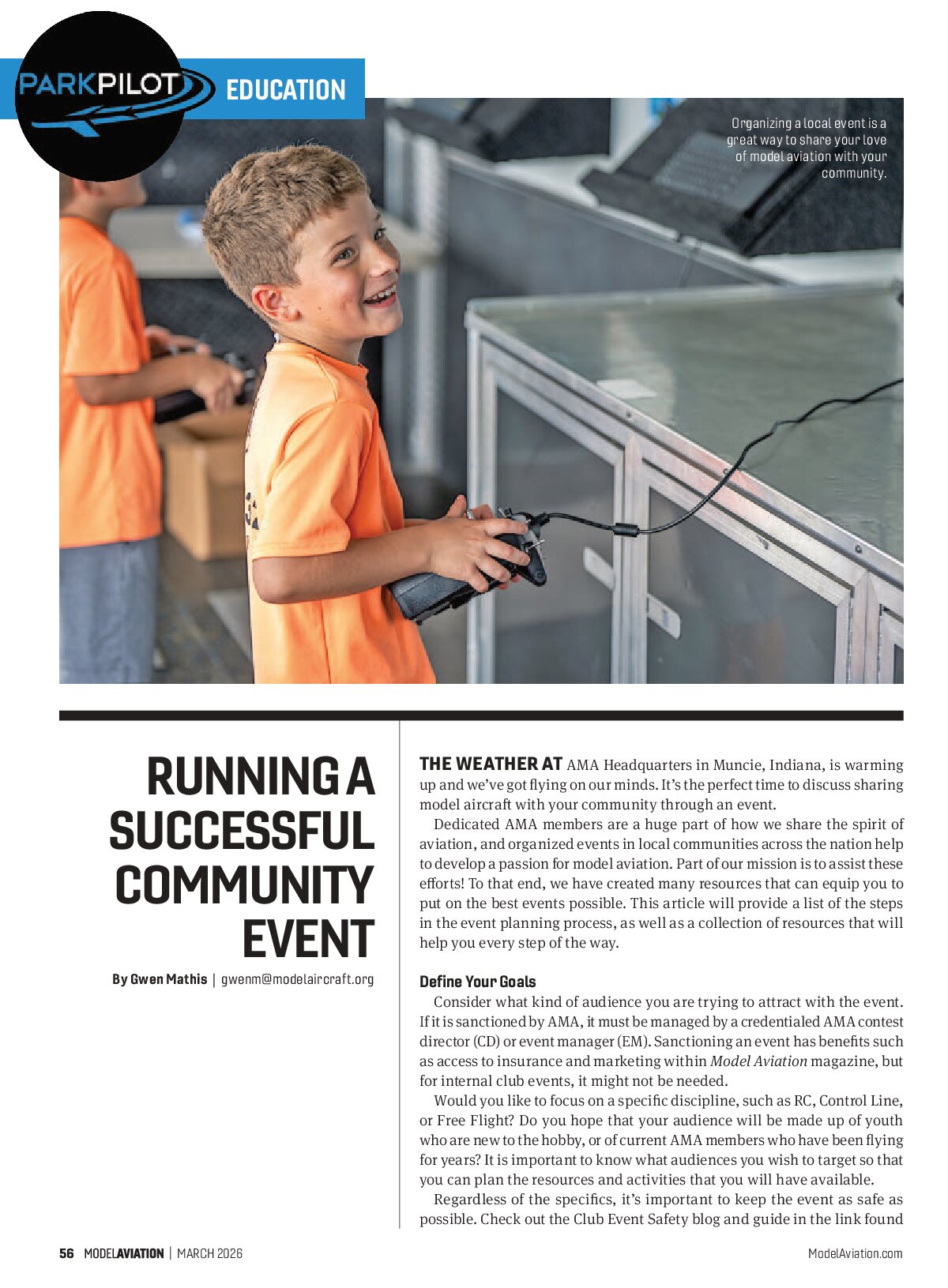
Organizing a local event is a great way to share your love of model aviation with your community.
Running a Successful Community Event
By Gwen Mathis | gwenm@modelaircraft.org
The weather at AMA Headquarters in Muncie, Indiana, is warming up and we’ve got flying on our minds. It’s the perfect time to discuss sharing model aircraft with your community through an event.
Dedicated AMA members are a huge part of how we share the spirit of aviation, and organized events in local communities across the nation help to develop a passion for model aviation. Part of our mission is to assist these efforts! To that end, we have created many resources that can equip you to put on the best events possible. This article will provide a list of the steps in the event planning process, as well as a collection of resources that will help you every step of the way.
Define Your Goals
Consider what kind of audience you are trying to attract with the event. If it is sanctioned by AMA, it must be managed by a credentialed AMA contest director (CD) or event manager (EM). Sanctioning an event has benefits such as access to insurance and marketing within Model Aviation magazine, but for internal club events, it might not be needed.
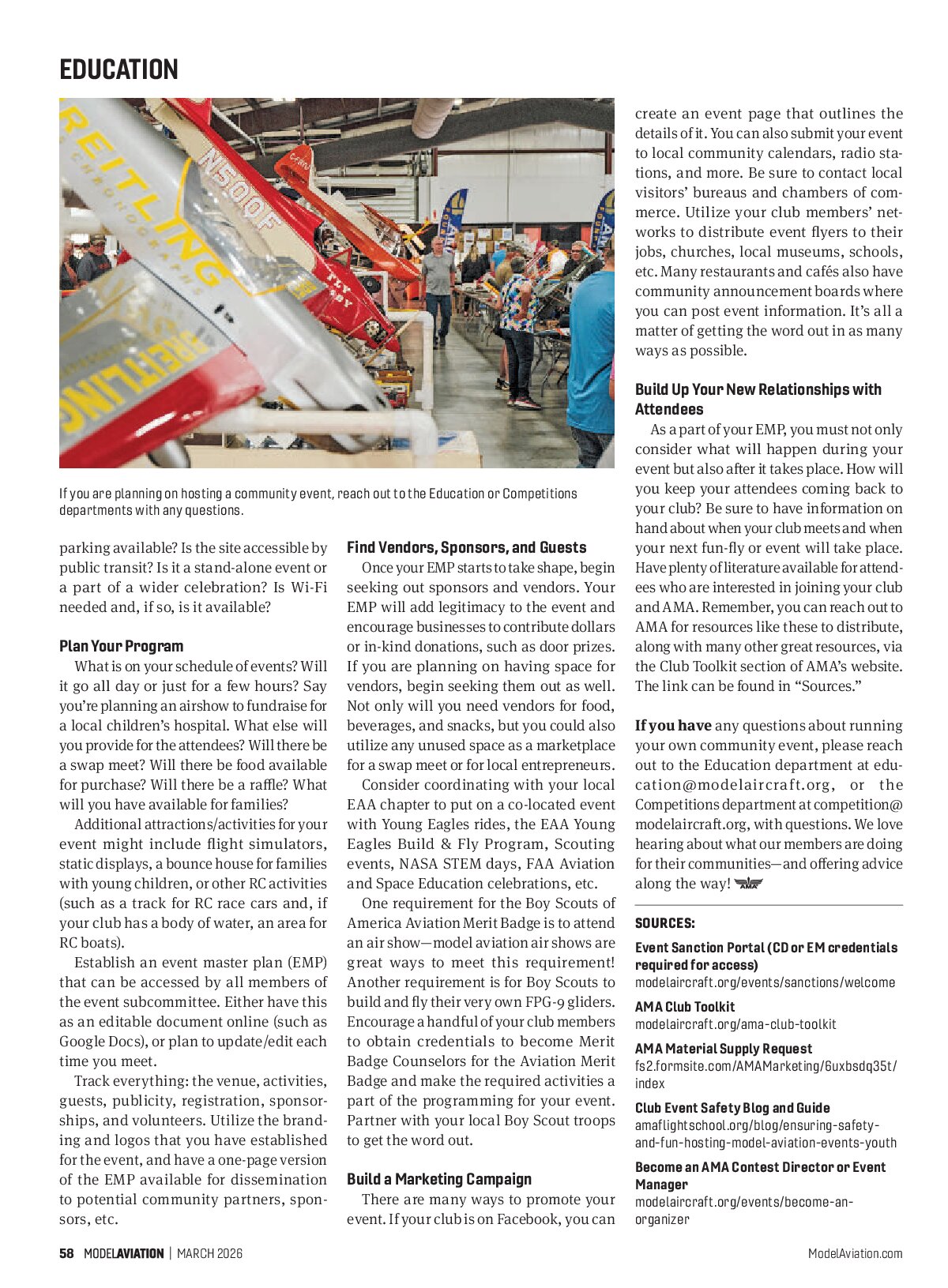
Would you like to focus on a specific discipline, such as RC, Control Line, or Free Flight? Do you hope that your audience will be made up of youth who are new to the hobby, or of current AMA members who have been flying for years? It is important to know what audiences you wish to target so that you can plan the resources and activities that you will have available.
Regardless of the specifics, it’s important to keep the event as safe as possible. Check out the Club Event Safety blog and guide in the link found in “Sources” for suggestions on how to help ensure that your event is safe and fun for all.


Where Does the Buck Stop?
Identify an EM or CD and establish an event subcommittee with clearly defined roles, such as for the budget, location/venue, promotion/publicity, sponsors, and volunteer management. Assigning roles to team members establishes accountability and ensures that all tasks are completed without overloading one individual with too many tasks. Be sure to plan regular meetings to track progress.
Define a Timeline
Again, the time to start planning an event is a minimum of four to six months in advance. During the initial planning stages (within the first one to three months), you should establish your goals and objectives, budget, venue, and programming. The latter half of the planning process will consist of confirming sponsors, vendors, and volunteers, as well as marketing the event and selling tickets, if applicable.
Establish a Budget
After establishing your goals and objectives, it will be easier to envision a budget for your event. You will need to consider things such as advertising and materials for make-and-take projects, as well as costs for the venue, vendors, food and beverage, and various rentals (pop-up tents, golf carts, porta-potties, etc.). Once you have established everything that has a cost attached, begin your research to determine the overall budget for your event, which can be supplemented by charging for various elements, such as parking, food, raffle tickets, etc. You can also offset costs by seeking out local sponsorships.
Find a Venue
Book your event early if you are not planning on utilizing your own flying site. Regardless of whether you’re renting a venue or if you have one in place, consider the following: Do you have enough restrooms for everyone? Is the site accessible to people with disabilities? Is ample parking available? Is the site accessible by public transit? Is it a stand-alone event or a part of a wider celebration? Is Wi-Fi needed and, if so, is it available?
Plan Your Program
What is on your schedule of events? Will it go all day or just for a few hours? Say you’re planning an airshow to fundraise for a local children’s hospital. What else will you provide for the attendees? Will there be a swap meet? Will there be food available for purchase? Will there be a raffle? What will you have available for families?
Additional attractions/activities for your event might include flight simulators, static displays, a bounce house for families with young children, or other RC activities (such as a track for RC race cars and, if your club has a body of water, an area for RC boats).
Establish an event master plan (EMP) that can be accessed by all members of the event subcommittee. Either have this as an editable document online (such as Google Docs), or plan to update/edit each time you meet.
Track everything: the venue, activities, guests, publicity, registration, sponsorships, and volunteers. Utilize the branding and logos that you have established for the event, and have a one-page version of the EMP available for dissemination to potential community partners, sponsors, etc.

Find Vendors, Sponsors, and Guests
Once your EMP starts to take shape, begin seeking out sponsors and vendors. Your EMP will add legitimacy to the event and encourage businesses to contribute dollars or in-kind donations, such as door prizes. If you are planning on having space for vendors, begin seeking them out as well. Not only will you need vendors for food, beverages, and snacks, but you could also utilize any unused space as a marketplace for a swap meet or for local entrepreneurs.
Consider coordinating with your local EAA chapter to put on a co-located event with Young Eagles rides, the EAA Young Eagles Build & Fly Program, Scouting events, NASA STEM days, FAA Aviation and Space Education celebrations, etc.
One requirement for the Boy Scouts of America Aviation Merit Badge is to attend an air show—model aviation air shows are great ways to meet this requirement! Another requirement is for Boy Scouts to build and fly their very own FPG-9 gliders. Encourage a handful of your club members to obtain credentials to become Merit Badge Counselors for the Aviation Merit Badge and make the required activities a part of the programming for your event. Partner with your local Boy Scout troops to get the word out.
Build a Marketing Campaign
There are many ways to promote your event. If your club is on Facebook, you can create an event page that outlines the details of it. You can also submit your event to local community calendars, radio stations, and more. Be sure to contact local visitors’ bureaus and chambers of commerce. Utilize your club members’ networks to distribute event flyers to their jobs, churches, local museums, schools, etc. Many restaurants and cafés also have community announcement boards where you can post event information. It’s all a matter of getting the word out in as many ways as possible.
Build Up Your New Relationships with Attendees
As a part of your EMP, you must not only consider what will happen during your event but also after it takes place. How will you keep your attendees coming back to your club? Be sure to have information on hand about when your club meets and when your next fun-fly or event will take place. Have plenty of literature available for attendees who are interested in joining your club and AMA. Remember, you can reach out to AMA for resources like these to distribute, along with many other great resources, via the Club Toolkit section of AMA’s website. The link can be found in “Sources.”
If you have any questions about running your own community event, please reach out to the Education department at education@modelaircraft.org, or the Competitions department at competition@modelaircraft.org, with questions. We love hearing about what our members are doing for their communities—and offering advice along the way!

SOURCES
- Event Sanction Portal (CD or EM credentials required for access)
- modelaircraft.org/events/sanctions/welcome
- AMA Club Toolkit
- modelaircraft.org/ama-club-toolkit
- AMA Material Supply Request
- fs2.formsite.com/AMAMarketing/6uxbsdq35t/index
- Club Event Safety Blog and Guide
- amaflightschool.org/blog/ensuring-safety-and-fun-hosting-model-aviation-events-youth
- Become an AMA Contest Director or Event Manager
modelaircraft.org/events/become-an-organizer