Model aircraft lead to NASA
except as noted
No Better
Classroom
Like many of you, I was introduced to aeromodeling at an early age. My grandfather and uncles were active in Control Line (CL) and Free Flight (FF) modeling. When I showed an interest in these activities, my father joined in as well. I have many fond memories of flying my Cox PT-19 and other 1/2A-size CL models with my family. We later stepped up to larger Stunt airplanes like the Flite Streak from Top Flite, the Sterling Ringmaster, and a Carl Goldberg Buster. On one particularly memorable outing, our Sterling Flying Fool biplane shed its top wing while I was at the controls! Needless to say, the rest of the flight didn’t last much longer.
Other memories involve creating FF gliders using balsa or scrap Styrofoam. I do not recall building any of those gliders from plans. We just figured things out as we went. Some of them flew great—others, not so much.
I didn’t recognize it at the time, but those days of my youth that were spent “playing” with model airplanes were actually my first engineering courses, often mixed with hefty doses of geometry, art, and shop class. On the days when things didn’t go so well, there were probably some psychology lessons too!
For an aviation-minded kid like me, there were no better classrooms than my workbench (our kitchen table) and the flying field. I could make a change to a model and observe the result in how it flew. That’s classic hands-on science. I was too busy having fun to realize that I was also preparing for my future career as an aerospace engineer.
Chicken or Egg?
I often wonder if it was my DNA-level fascination with aviation that drew me to aeromodeling. Conversely, it is possible that my involvement in aeromodeling ignited the aviation embers within me. I tend to lean toward the first theory. After all, my brain seemed to be locked into aviation even when I wasn’t working on my flying models. I loved reading about airplanes, building plastic airplane models, drawing airplanes, watching movies with airplanes, visiting airplane museums, going to air shows—you name it. If liking airplanes was a disease, I was incurable.
Whatever the origin of my aviation bug truly was, it was obvious that aeromodeling was the most practical outlet to indulge my fascination about flight. My parents were always supportive of my involvement with model airplanes. I am sure that they recognized the educational benefits of my flying projects. I am equally sure that they wanted to occupy my curious mind (and hands), lest I investigate the inner workings of the family VCR! I am thankful all the same.
With just a little bit of balsa and an X-Acto knife, I could dream up, build, and test anything I wanted within the budget and skill set of a preteen. My economic situation might not have grown much in those early years, but my modeling chops and understanding of physics expanded exponentially. It is safe to say that aeromodeling nurtured my passion for aviation in ways that no other activity could.
I have to admit that my focus wavered somewhat during my teen years. After thumbing through Tower Hobbies catalogs countless times, I also became interested in RC cars. Subsequently, I began racing all types of wheeled RC vehicles with an intensity equal to my airplane projects. RC racing gave me the same sort of buzz that airplanes did. I was soaking in physics lessons (motor gearing, suspension setup, steering geometry, etc.) while also enjoying a creative outlet (I loved airbrushing RC car bodies). The fact that I was never a very good driver hardly seemed to matter. The racetrack was another fun-filled classroom.

The Payoff
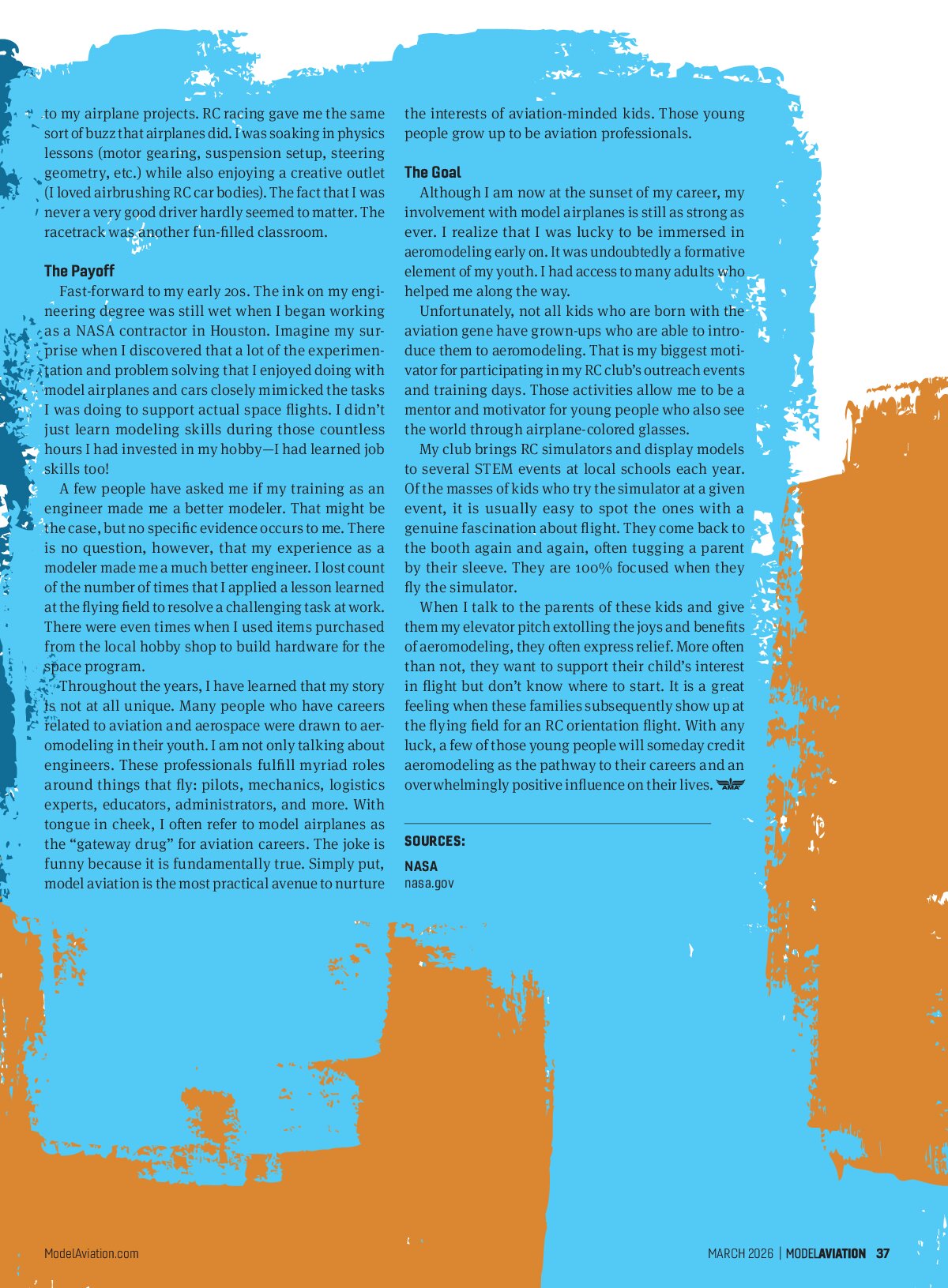
Fast-forward to my early 20s. The ink on my engineering degree was still wet when I began working as a NASA contractor in Houston. Imagine my surprise when I discovered that a lot of the experimentation and problem solving that I enjoyed doing with model airplanes and cars closely mimicked the tasks I was doing to support actual space flights. I didn’t just learn modeling skills during those countless hours I had invested in my hobby—I had learned job skills too!
A few people have asked me if my training as an engineer made me a better modeler. That might be the case, but no specific evidence occurs to me. There is no question, however, that my experience as a modeler made me a much better engineer. I lost count of the number of times that I applied a lesson learned at the flying field to resolve a challenging task at work. There were even times when I used items purchased from the local hobby shop to build hardware for the space program.
Throughout the years, I have learned that my story is not at all unique. Many people who have careers related to aviation and aerospace were drawn to aeromodeling in their youth. I am not only talking about engineers. These professionals fulfill myriad roles around things that fly: pilots, mechanics, logistics experts, educators, administrators, and more. With tongue in cheek, I often refer to model airplanes as the “gateway drug” for aviation careers. The joke is funny because it is fundamentally true. Simply put, model aviation is the most practical avenue to nurture the interests of aviation-minded kids. Those young people grow up to be aviation professionals.
The Goal
Although I am now at the sunset of my career, my involvement with model airplanes is still as strong as ever. I realize that I was lucky to be immersed in aeromodeling early on. It was undoubtedly a formative element of my youth. I had access to many adults who helped me along the way.
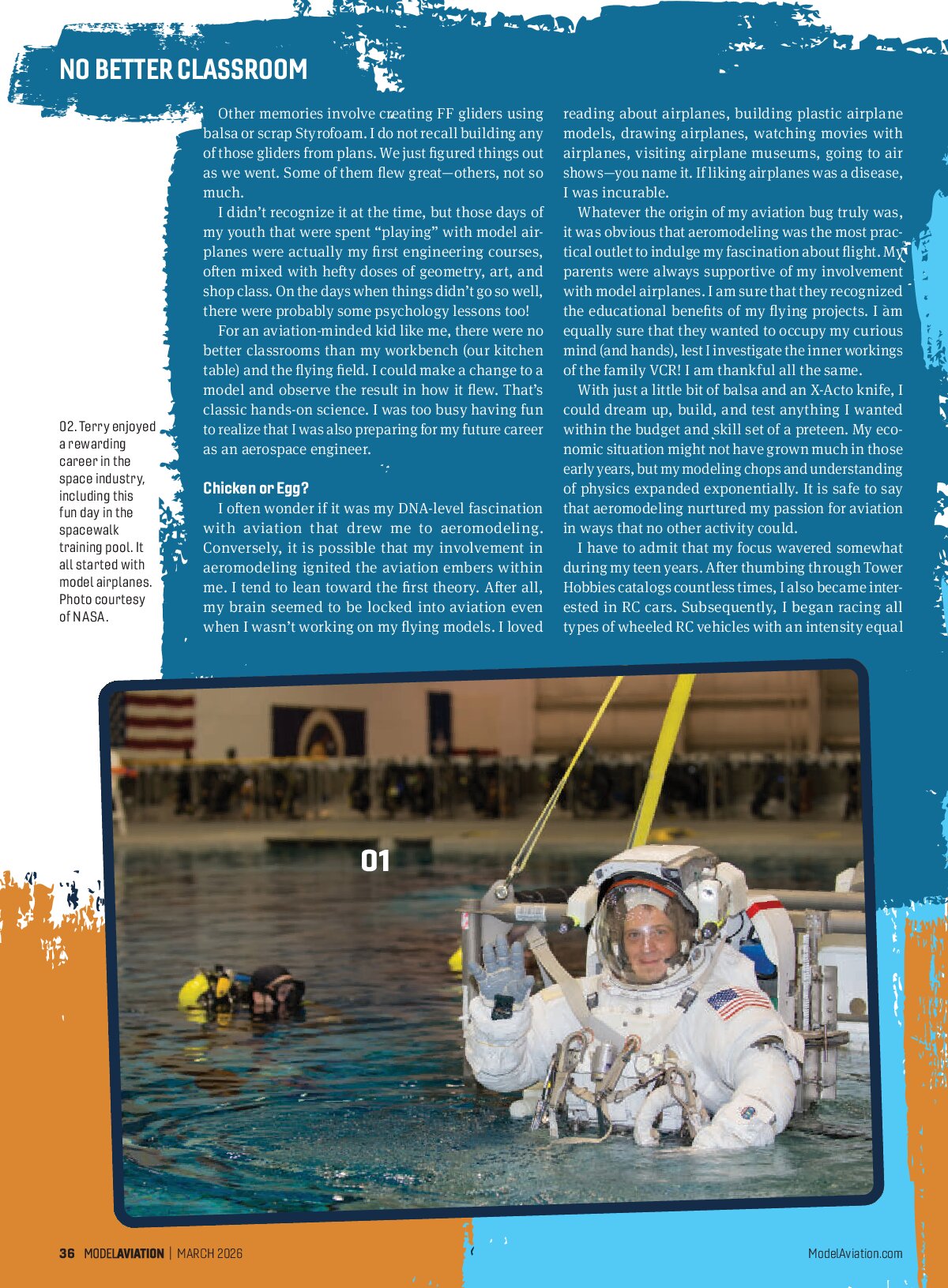
Unfortunately, not all kids who are born with the aviation gene have grown-ups who are able to introduce them to aeromodeling. That is my biggest motivator for participating in my RC club’s outreach events and training days. Those activities allow me to be a mentor and motivator for young people who also see the world through airplane-colored glasses.
My club brings RC simulators and display models to several STEM events at local schools each year. Of the masses of kids who try the simulator at a given event, it is usually easy to spot the ones with a genuine fascination about flight. They come back to the booth again and again, often tugging a parent by their sleeve. They are 100% focused when they fly the simulator.
When I talk to the parents of these kids and give them my elevator pitch extolling the joys and benefits of aeromodeling, they often express relief. More often than not, they want to support their child’s interest in flight but don’t know where to start. It is a great feeling when these families subsequently show up at the flying field for an RC orientation flight. With any luck, a few of those young people will someday credit aeromodeling as the pathway to their careers and an overwhelmingly positive influence on their lives.
Photo captions
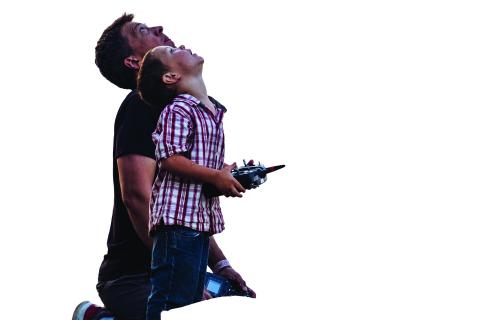
01. Terry coaches an aspiring young pilot at EAA AirVenture Oshkosh in Oshkosh, Wis.
02. Terry enjoyed a rewarding career in the space industry, including this fun day in the spacewalk training pool. It all started with model airplanes. Photo courtesy of NASA.
SOURCES
- NASA
nasa.gov