Building the Ruptured Duck
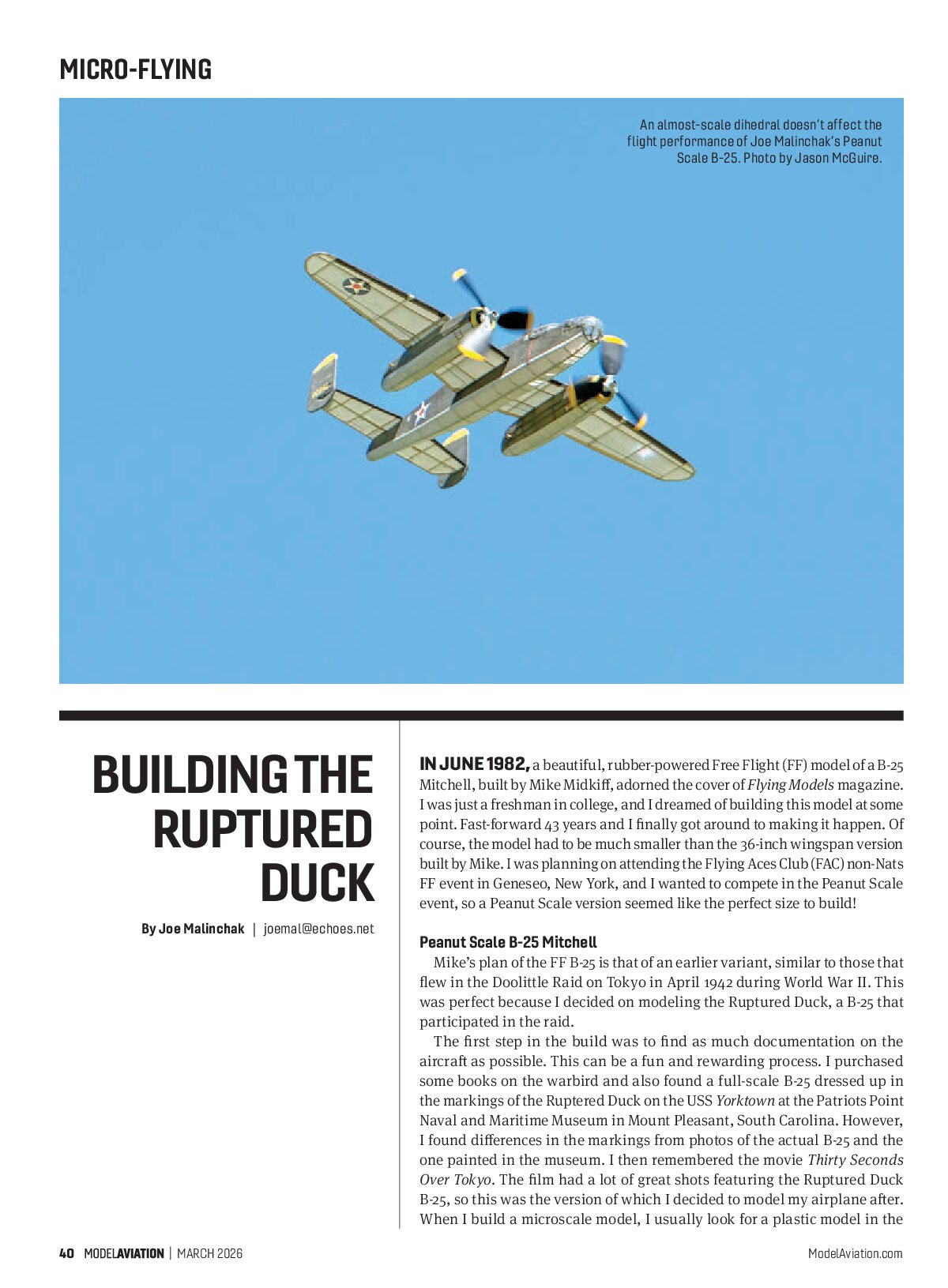
An almost-scale dihedral doesn’t affect the flight performance of Joe Malinchak’s Peanut Scale B-25. Photo by Jason McGuire.
In June 1982, a beautiful, rubber-powered Free Flight (FF) model of a B-25 Mitchell, built by Mike Midkiff, adorned the cover of Flying Models magazine. I was just a freshman in college, and I dreamed of building this model at some point. Fast-forward 43 years and I finally got around to making it happen. Of course, the model had to be much smaller than the 36-inch wingspan version built by Mike. I was planning on attending the Flying Aces Club (FAC) non-Nats FF event in Geneseo, New York, and I wanted to compete in the Peanut Scale event, so a Peanut Scale version seemed like the perfect size to build!
Peanut Scale B-25 Mitchell
Mike’s plan of the FF B-25 is that of an earlier variant, similar to those that flew in the Doolittle Raid on Tokyo in April 1942 during World War II. This was perfect because I decided on modeling the Ruptured Duck, a B-25 that participated in the raid.
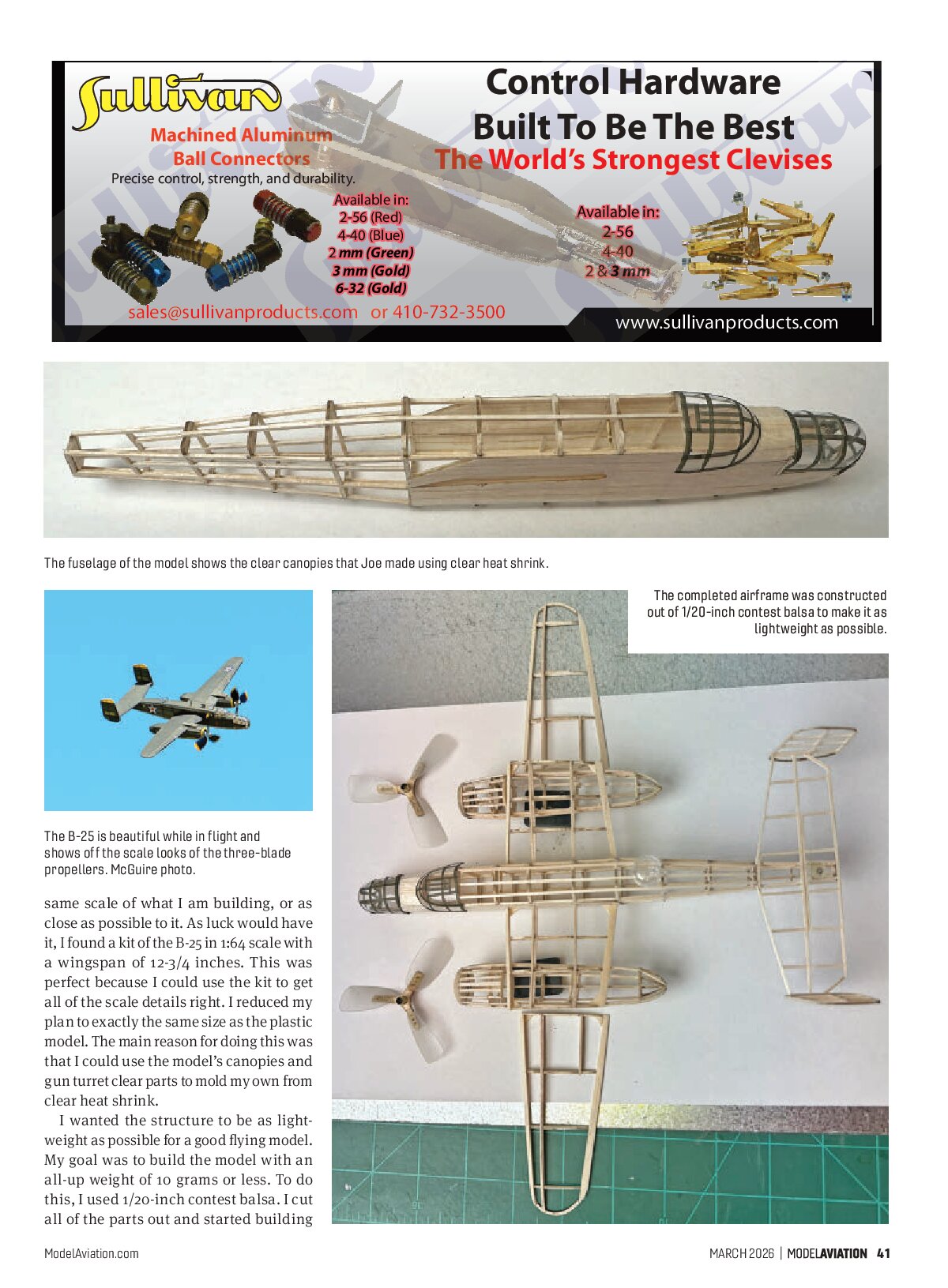
The first step in the build was to find as much documentation on the aircraft as possible. This can be a fun and rewarding process. I purchased some books on the warbird and also found a full-scale B-25 dressed up in the markings of the Ruptered Duck on the USS Yorktown at the Patriots Point Naval and Maritime Museum in Mount Pleasant, South Carolina. However, I found differences in the markings from photos of the actual B-25 and the one painted in the museum. I then remembered the movie Thirty Seconds Over Tokyo. The film had a lot of great shots featuring the Ruptured Duck B-25, so this was the version of which I decided to model my airplane after. When I build a microscale model, I usually look for a plastic model in the same scale of what I am building, or as close as possible to it. As luck would have it, I found a kit of the B-25 in 1:64 scale with a wingspan of 12-3/4 inches. This was perfect because I could use the kit to get all of the scale details right. I reduced my plan to exactly the same size as the plastic model. The main reason for doing this was that I could use the model’s canopies and gun turret clear parts to mold my own from clear heat shrink.
I wanted the structure to be as lightweight as possible for a good flying model. My goal was to build the model with an all-up weight of 10 grams or less. To do this, I used 1/20-inch contest balsa. I cut all of the parts out and started building as per the plans. The only modification that I made was to extend the engine nacelles out approximately 1/2 inch to allow for a longer rubber motor and to help keep it from bunching up toward the rear of the nacelle.
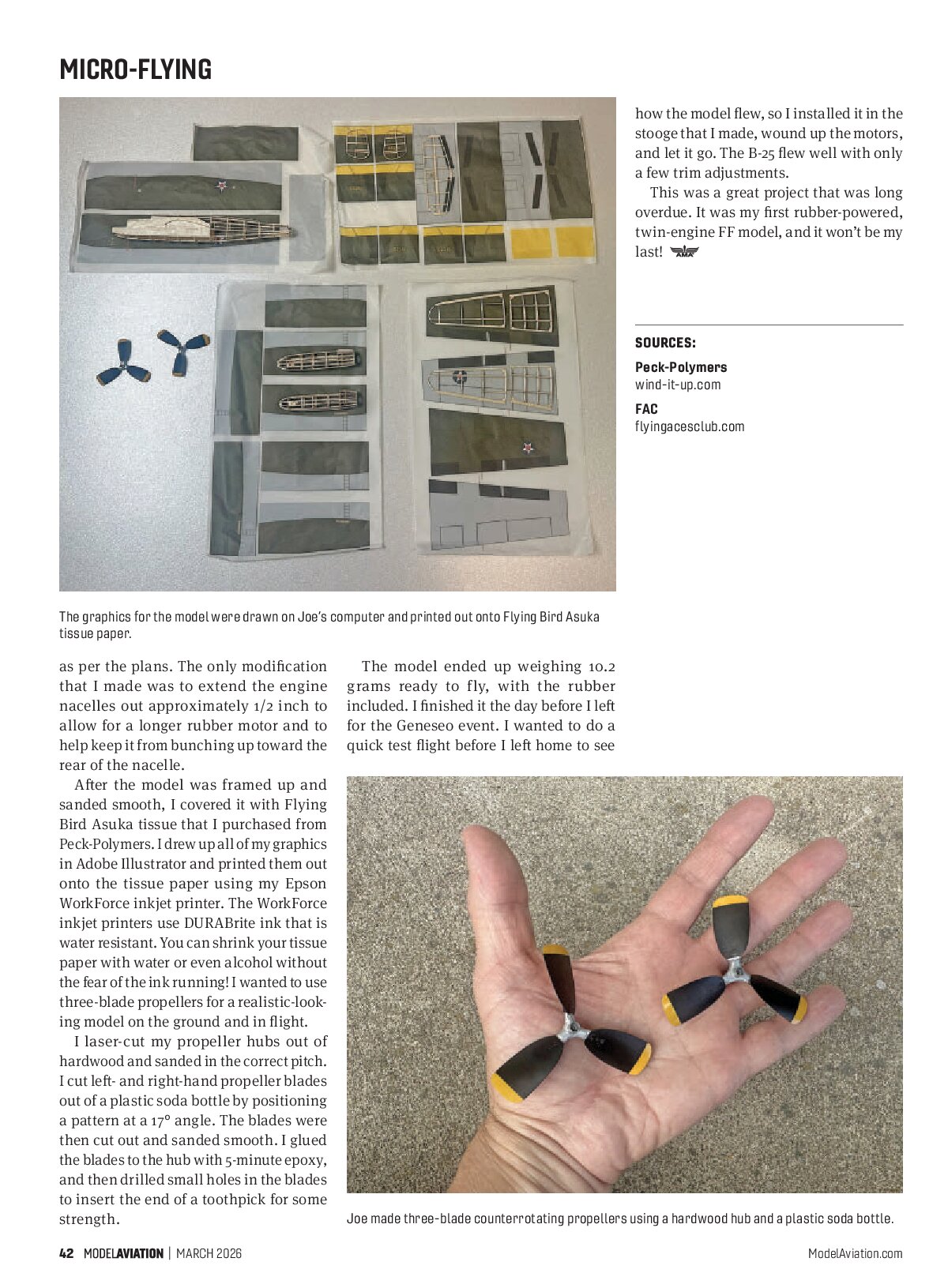
After the model was framed up and sanded smooth, I covered it with Flying Bird Asuka tissue that I purchased from Peck-Polymers. I drew up all of my graphics in Adobe Illustrator and printed them out onto the tissue paper using my Epson WorkForce inkjet printer. The WorkForce inkjet printers use DURABrite ink that is water resistant. You can shrink your tissue paper with water or even alcohol without the fear of the ink running! I wanted to use three-blade propellers for a realistic-looking model on the ground and in flight.
I laser-cut my propeller hubs out of hardwood and sanded in the correct pitch. I cut left- and right-hand propeller blades out of a plastic soda bottle by positioning a pattern at a 17° angle. The blades were then cut out and sanded smooth. I glued the blades to the hub with 5-minute epoxy, and then drilled small holes in the blades to insert the end of a toothpick for some strength.
The model ended up weighing 10.2 grams ready to fly, with the rubber included. I finished it the day before I left for the Geneseo event. I wanted to do a quick test flight before I left home to see how the model flew, so I installed it in the stooge that I made, wound up the motors, and let it go. The B-25 flew well with only a few trim adjustments.
This was a great project that was long overdue. It was my first rubber-powered, twin-engine FF model, and it won’t be my last!


SOURCES
- Peck-Polymers
- wind-it-up.com
- FAC
flyingacesclub.com