Interested in sharing your handiwork? Visit ModelAviation.com for submission guidelines.
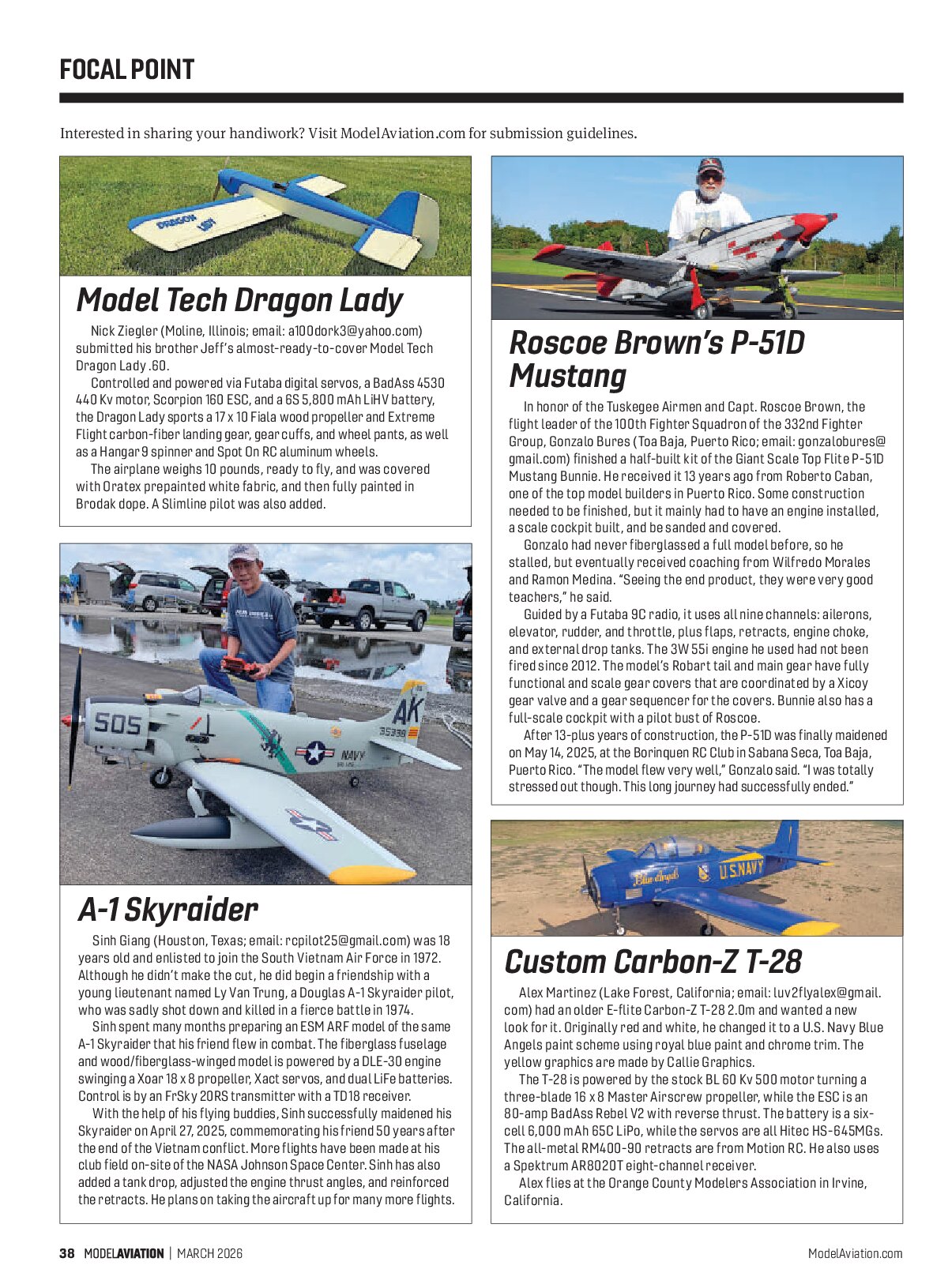
Nick Ziegler (Moline, Illinois; email: a100dork3@yahoo.com) submitted his brother Jeff’s almost-ready-to-cover Model Tech Dragon Lady .60.
Controlled and powered via Futaba digital servos, a BadAss 4530 440 Kv motor, Scorpion 160 ESC, and a 6S 5,800 mAh LiHV battery, the Dragon Lady sports a 17 x 10 Fiala wood propeller and Extreme Flight carbon-fiber landing gear, gear cuffs, and wheel pants, as well as a Hangar 9 spinner and Spot On RC aluminum wheels.
The airplane weighs 10 pounds, ready to fly, and was covered with Oratex prepainted white fabric, and then fully painted in Brodak dope. A Slimline pilot was also added.
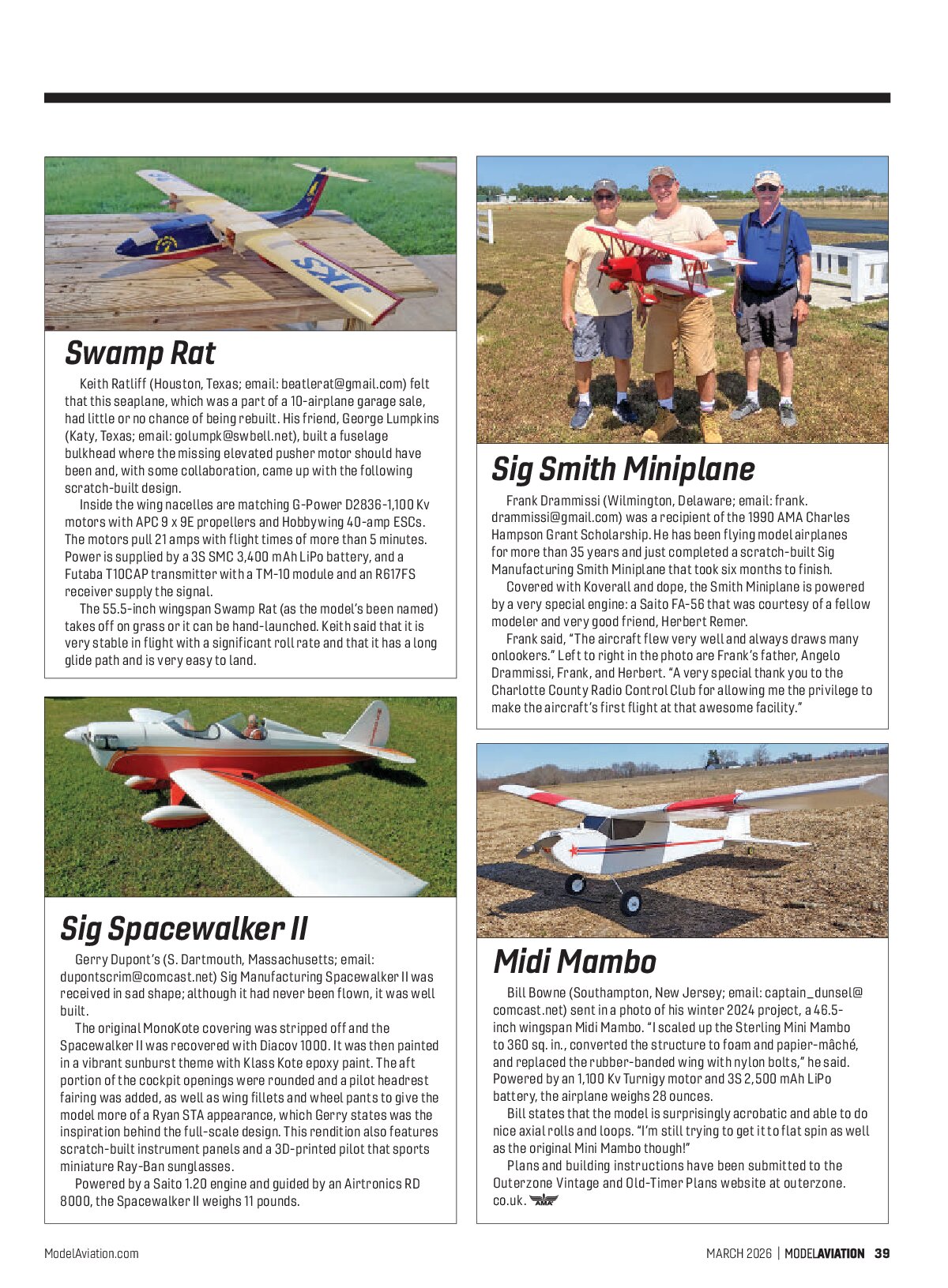
In honor of the Tuskegee Airmen and Capt. Roscoe Brown, the flight leader of the 100th Fighter Squadron of the 332nd Fighter Group, Gonzalo Bures (Toa Baja, Puerto Rico; email: gonzalobures@gmail.com) finished a half-built kit of the Giant Scale Top Flite P-51D Mustang Bunnie. He received it 13 years ago from Roberto Caban, one of the top model builders in Puerto Rico. Some construction needed to be finished, but it mainly had to have an engine installed, a scale cockpit built, and be sanded and covered.
Gonzalo had never fiberglassed a full model before, so he stalled, but eventually received coaching from Wilfredo Morales and Ramon Medina. “Seeing the end product, they were very good teachers,” he said.
Guided by a Futaba 9C radio, it uses all nine channels: ailerons, elevator, rudder, and throttle, plus flaps, retracts, engine choke, and external drop tanks. The 3W 55i engine he used had not been fired since 2012. The model’s Robart tail and main gear have fully functional and scale gear covers that are coordinated by a Xicoy gear valve and a gear sequencer for the covers. Bunnie also has a full-scale cockpit with a pilot bust of Roscoe.
After 13-plus years of construction, the P-51D was finally maidened on May 14, 2025, at the Borinquen RC Club in Sabana Seca, Toa Baja, Puerto Rico. “The model flew very well,” Gonzalo said. “I was totally stressed out though. This long journey had successfully ended.”
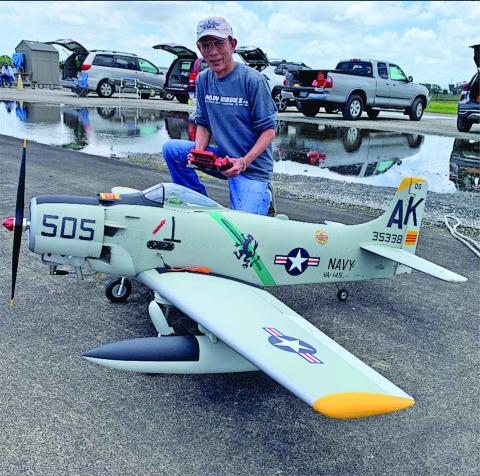
Sinh Giang (Houston, Texas; email: rcpilot25@gmail.com) was 18 years old and enlisted to join the South Vietnam Air Force in 1972. Although he didn’t make the cut, he did begin a friendship with a young lieutenant named Ly Van Trung, a Douglas A-1 Skyraider pilot, who was sadly shot down and killed in a fierce battle in 1974.
Sinh spent many months preparing an ESM ARF model of the same A-1 Skyraider that his friend flew in combat. The fiberglass fuselage and wood/fiberglass-winged model is powered by a DLE-30 engine swinging a Xoar 18 x 8 propeller, Xact servos, and dual LiFe batteries. Control is by an FrSky 20RS transmitter with a TD18 receiver.
With the help of his flying buddies, Sinh successfully maidened his Skyraider on April 27, 2025, commemorating his friend 50 years after the end of the Vietnam conflict. More flights have been made at his club field on-site of the NASA Johnson Space Center. Sinh has also added a tank drop, adjusted the engine thrust angles, and reinforced the retracts. He plans on taking the aircraft up for many more flights.
Alex Martinez (Lake Forest, California; email: luv2flyalex@gmail.com) had an older E-flite Carbon-Z T-28 2.0m and wanted a new look for it. Originally red and white, he changed it to a U.S. Navy Blue Angels paint scheme using royal blue paint and chrome trim. The yellow graphics are made by Callie Graphics.
The T-28 is powered by the stock BL 60 Kv 500 motor turning a three-blade 16 x 8 Master Airscrew propeller, while the ESC is an 80-amp BadAss Rebel V2 with reverse thrust. The battery is a six-cell 6,000 mAh 65C LiPo, while the servos are all Hitec HS-645MGs. The all-metal RM400-90 retracts are from Motion RC. He also uses a Spektrum AR8020T eight-channel receiver.
Alex flies at the Orange County Modelers Association in Irvine, California.


Keith Ratliff (Houston, Texas; email: beatlerat@gmail.com) felt that this seaplane, which was a part of a 10-airplane garage sale, had little or no chance of being rebuilt. His friend, George Lumpkins (Katy, Texas; email: golumpk@swbell.net), built a fuselage bulkhead where the missing elevated pusher motor should have been and, with some collaboration, came up with the following scratch-built design.
Inside the wing nacelles are matching G-Power D2836-1,100 Kv motors with APC 9 x 9E propellers and Hobbywing 40-amp ESCs. The motors pull 21 amps with flight times of more than 5 minutes. Power is supplied by a 3S SMC 3,400 mAh LiPo battery, and a Futaba T10CAP transmitter with a TM-10 module and an R617FS receiver supply the signal.
The 55.5-inch wingspan Swamp Rat (as the model’s been named) takes off on grass or it can be hand-launched. Keith said that it is very stable in flight with a significant roll rate and that it has a long glide path and is very easy to land.
Frank Drammissi (Wilmington, Delaware; email: frank.drammissi@gmail.com) was a recipient of the 1990 AMA Charles Hampson Grant Scholarship. He has been flying model airplanes for more than 35 years and just completed a scratch-built Sig Manufacturing Smith Miniplane that took six months to finish.
Covered with Koverall and dope, the Smith Miniplane is powered by a very special engine: a Saito FA-56 that was courtesy of a fellow modeler and very good friend, Herbert Remer.
Frank said, “The aircraft flew very well and always draws many onlookers.” Left to right in the photo are Frank’s father, Angelo Drammissi, Frank, and Herbert. “A very special thank you to the Charlotte County Radio Control Club for allowing me the privilege to make the aircraft’s first flight at that awesome facility.”
Gerry Dupont’s (S. Dartmouth, Massachusetts; email: dupontscrim@comcast.net) Sig Manufacturing Spacewalker II was received in sad shape; although it had never been flown, it was well built.
The original MonoKote covering was stripped off and the Spacewalker II was recovered with Diacov 1000. It was then painted in a vibrant sunburst theme with Klass Kote epoxy paint. The aft portion of the cockpit openings were rounded and a pilot headrest fairing was added, as well as wing fillets and wheel pants to give the model more of a Ryan STA appearance, which Gerry states was the inspiration behind the full-scale design. This rendition also features scratch-built instrument panels and a 3D-printed pilot that sports miniature Ray-Ban sunglasses.
Powered by a Saito 1.20 engine and guided by an Airtronics RD 8000, the Spacewalker II weighs 11 pounds.
Bill Bowne (Southampton, New Jersey; email: captain_dunsel@comcast.net) sent in a photo of his winter 2024 project, a 46.5-inch wingspan Midi Mambo. “I scaled up the Sterling Mini Mambo to 360 sq. in., converted the structure to foam and papier-mâché, and replaced the rubber-banded wing with nylon bolts,” he said. Powered by an 1,100 Kv Turnigy motor and 3S 2,500 mAh LiPo battery, the airplane weighs 28 ounces.
Bill states that the model is surprisingly acrobatic and able to do nice axial rolls and loops. “I’m still trying to get it to flat spin as well as the original Mini Mambo though!”
Plans and building instructions have been submitted to the Outerzone Vintage and Old-Timer Plans website at outerzone.co.uk.