
Let’s go fast with CL Speed!
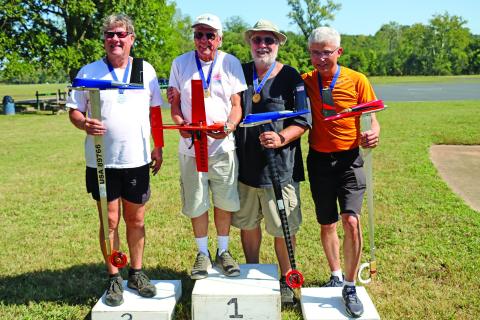
The FAI F2A/F2G team that will represent the USA in the 2026 F2 World Championships for CL Model Aircraft in Perth, Australia, will be (L-R): Patrick Hempel, F2A; Dave Rigotti, F2G; Bill Hughes, F2A; and Alex Valishev, F2A.
We have all watched the scene from Top Gun, where Maverick and Goose are walking out to their F-14 and they say, “I feel the need … the need for speed!” That is what I hope to inspire with everyone who might take time to read this column.
Control Line (CL) Speed is all about going as fast as possible, with a certain size of engine for the 15 different classes of Speed that we fly. Some go a whole lot faster than others, but we all like to go fast! I mean, who hasn’t ever wanted to see how fast your car can go (without getting a ticket, of course)?
In the 15 CL Speed events, we use engines sized from .049 cu. in. up to .65 cu. in., plus there are two classes of pulse jets and, just recently, the FAI added Electric Speed. There are five events that are timed from a standing start, so acceleration is important. It’s kind of like a drag race. The other 10 events are timed for a certain set of laps once the airplane is in the air and has reached top speed.
Introduction to CL Speed
Hello, my name is John Moll. I have been flying CL Speed for quite a few years. I am a contest director and have managed Speed events for my local club (the Lafayette Esquadrille CL Club in Saint Louis, Missouri), as well as the Nats, for the past several years.
How do you find out more about CL Speed? First, start by reading this column. Next, look in Model Aviation magazine and on the AMA website to find a contest in your area and attend and ask questions. Most Speed fliers will give you answers to help you get started and about where to find the supplies that you will need to fly.
You can also contact the North American Speed Society (NASS), the AMA-recognized Special Interest Group for CL Speed. You can become a member and receive its newsletter to find out more about upcoming contests, recent contest results, and technical articles. You will also have access to newsletters from 1983, when NASS was formed, to the current day, with many how-to articles. There are also vendor advertisements for parts and other items to build Speed airplanes.
Some of the easy events to get started in are Fox 35 Stunt Speed and Perky Speed. Both are flown from a standing start and timed for a 1-mile flight. You fly 14 laps for Fox on 60-foot lines, and 16 laps on 52-foot lines for Perky. For Fox 35, you can use any airplane you want, but for Perky, everyone uses the same design of airplane, the 1946 Perky. The plans are available from the AMA Plans Service. You need to keep the plans form of the original Perky, but you must improve the design of the airplane to meet modern safety requirements and to pass the safety pull test. Perky is flown with any .15 cu. in. engine. There are quite a few different engine companies out there, so make your choice.
In both Fox 35 and Perky, there are first through third places, but a lot of fliers try to win Best Average—that is the real prize to win. All of the scores are taken from each event and averaged out to see who came the closest. There are bragging rights to this award. In both of these events, you also do not have to fly while using the pylon, so that makes them good events for newcomers.
NASS is starting a new entry-level event in 2026 called PerkE (Electric Perky). This class uses a Profile Perky-like airplane and commercially available motors, ESCs, batteries, and propellers. Many who fly RC and Free Flight and began flying CL with two-stroke engines now fly using electric motors. We hope this might bring some folks back to the future.
The airplane is available as an easy-build profile kit that you can purchase from Dave Rigotti of NASS. The kit contains laser-cut wood components, a 3D-printed motor mount, wheels, hardware, a bellcrank with a pushrod, and assembly instructions. The motor, ESC, propeller, and spinner are available from two popular suppliers.
The airplane flies on 52-foot, .015-inch stranded wires available from Brodak Manufacturing. This will be an unofficial event run by NASS at the 2026 CL Speed Nats. The rules for the popular easy-to-get-into events are on the NASS website.
You can either fly or start your entry with all Speed events. If you are older or have a disability and fear that you cannot keep up or fly the airplane, you can ask someone at the contest to fly for you.
At a sanctioned Speed contest, everyone uses the standardized fuels that are supplied by the contest organizers. With everyone using the same fuel, however, how do some go faster? This is where engine, airplane, or propeller modifications come into play. I will go deeper into this in future columns.


What do you think? Is CL Speed something that has piqued your interest? Give it a try. There are many folks who will help you get started. Oh, and we don’t give out speeding tickets—just awards for going fast!
Note: I want to offer my congratulations to Bill Hughes, who won first place at the 2025 FAI World Cup for F2A Speed. Alex Valishev came in second place. Way to go to both fliers!


SOURCES
- NASS
- clspeed.org
- AMA Plans Service
(765) 287-1256, ext. 507 - plans.modelaircraft.org
- Lafayette Esquadrille CL Club
- lafayetteesquadrillecl.wordpress.com
- Brodak Manufacturing & Distributing Company, Inc.
(724) 966-2726 - brodak.com


