Building Season Highlights
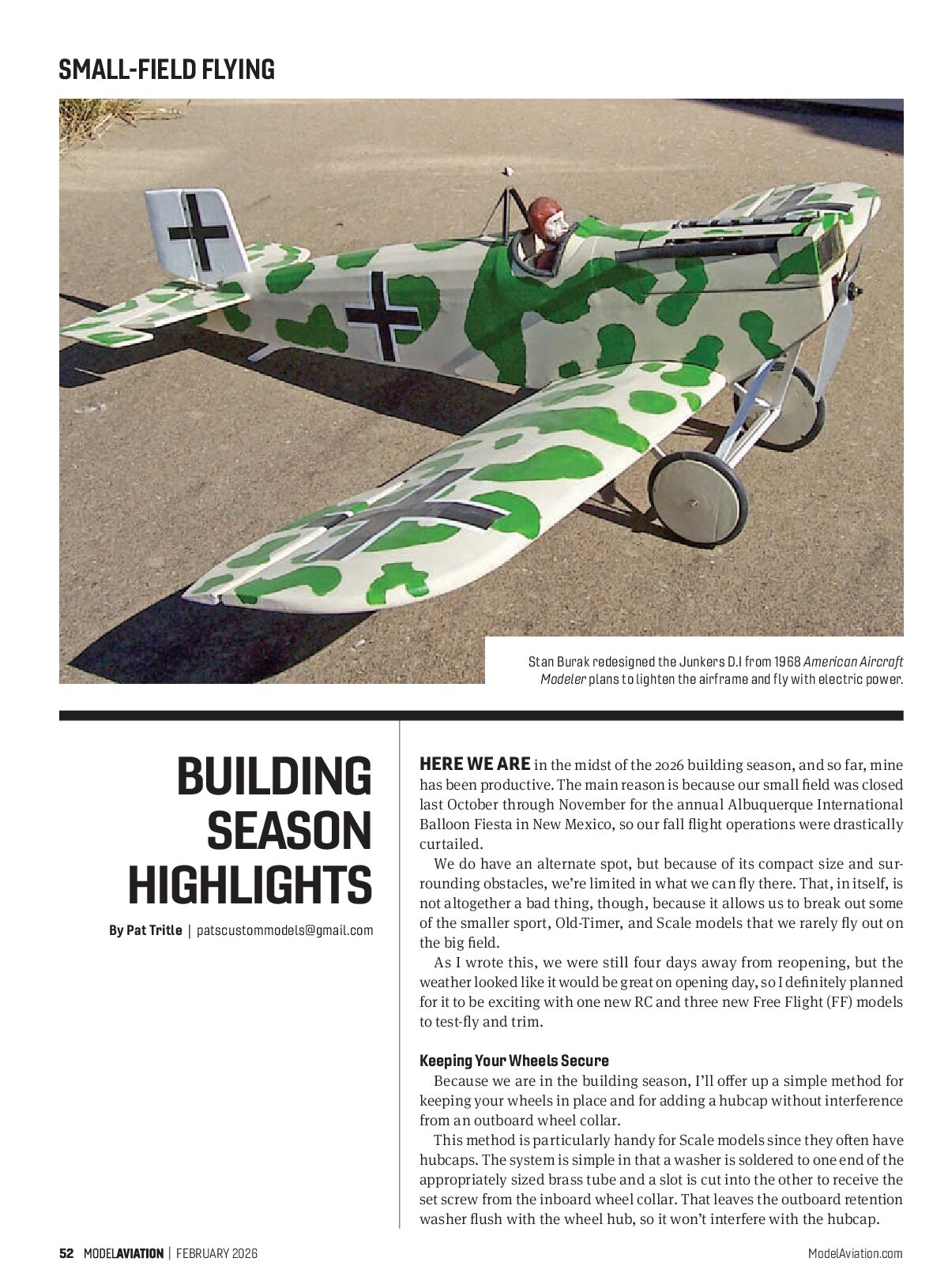
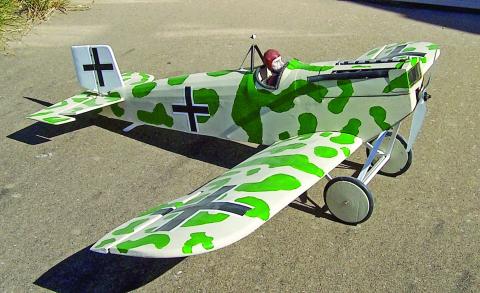
Stan Burak redesigned the Junkers D.I from 1968 American Aircraft Modeler plans to lighten the airframe and fly with electric power.


Small-Field Flying
Here we are in the midst of the 2026 building season, and so far, mine has been productive. The main reason is because our small field was closed last October through November for the annual Albuquerque International Balloon Fiesta in New Mexico, so our fall flight operations were drastically curtailed.
We do have an alternate spot, but because of its compact size and surrounding obstacles, we’re limited in what we can fly there. That, in itself, is not altogether a bad thing, though, because it allows us to break out some of the smaller sport, Old-Timer, and Scale models that we rarely fly out on the big field.
As I wrote this, we were still four days away from reopening, but the weather looked like it would be great on opening day, so I definitely planned for it to be exciting with one new RC and three new Free Flight (FF) models to test-fly and trim.
Keeping Your Wheels Secure
Because we are in the building season, I’ll offer up a simple method for keeping your wheels in place and for adding a hubcap without interference from an outboard wheel collar.
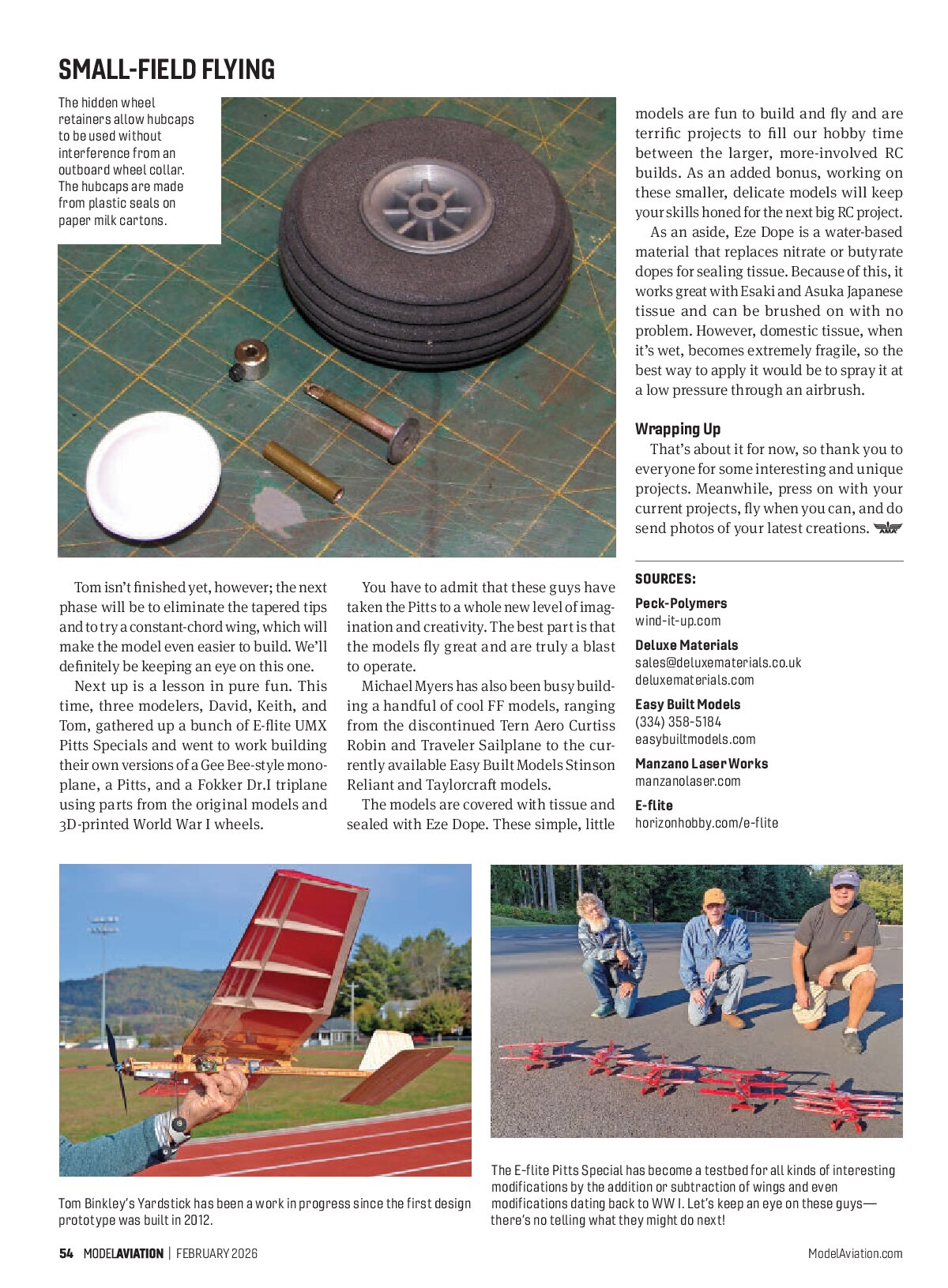
This method is particularly handy for Scale models since they often have hubcaps. The system is simple in that a washer is soldered to one end of the appropriately sized brass tube and a slot is cut into the other to receive the set screw from the inboard wheel collar. That leaves the outboard retention washer flush with the wheel hub, so it won’t interfere with the hubcap.
The tube is sized to fit the axle wire and is cut to length to fit the wheels that are used. The slot is cut with a Dremel cutoff wheel, and more often than not, bushings cut from brass tube are needed to size the axle to the center hole in the wheel.
With the wheel installed on the axle, hubcaps made from the plastic seals of paper milk cartons are glued into place. For this, I use silicone caulk so that the caps can be easily removed should the wheel need to be replaced.

Fresh Off the Building Boards
Now that our wheels are securely in place, let’s have a look at what’s coming off of your building boards. First up is a bit of unusual subject matter from Stan Burak, which he refers to as his low-wing Pietenpol.
The model is actually a Junkers D.1. Stan’s first D.1 was built in 1970 from plans in the November 1968 issue of American Aircraft Modeler magazine. The model was fully sheeted and ended up too heavy to fly well, so this time around, it was redesigned with a structure more in line with the 48-inch wingspan Pietenpol Air Camper that is available from Manzano Laser Works.
The finished model was significantly lighter, largely because of the lack of nose weight that was required to balance the short-nosed model. Rather than going with the scale constant-chord, tapered-thickness wing, Stan used the NACA 4412 airfoil from root-to-tip to simplify the redesign. A BadAss 2814-870 Kv outrunner motor, 50-amp ESC, and a 3,300 mAh 3S LiPo battery supply the power. Test flights are pending, but at a little less than 4 pounds, the Junkers should fly very well.
Stepping into a more whimsical realm, Tom Binkley has been busy redesigning his original Yardstick that was featured in the February 2012 issue of Flying Models magazine.
The design was simplified a bit by eliminating the polyhedral wing and going to a flat center with dihedral tips. The built-up tail was replaced with sheet balsa. The fuselage was made from the older-style narrow yardstick, which is significantly lighter than the newer, more common and wider ones that are currently available.
The upgraded design tips the scales at 190 grams (6.7 ounces). It has a 2204-14T outrunner motor, GWS 7 x 6 propeller, 10-amp ESC, 550 mAh 2S LiPo battery, a pair of 5-gram servos, and uses a Flysky FS-iA6 receiver. The model is easier to build, and it flies just like the original design.
Tom isn’t finished yet, however; the next phase will be to eliminate the tapered tips and to try a constant-chord wing, which will make the model even easier to build. We’ll definitely be keeping an eye on this one.
Next up is a lesson in pure fun. This time, three modelers, David, Keith, and Tom, gathered up a bunch of E-flite UMX Pitts Specials and went to work building their own versions of a Gee Bee-style monoplane, a Pitts, and a Fokker Dr.I triplane using parts from the original models and 3D-printed World War I wheels.
You have to admit that these guys have taken the Pitts to a whole new level of imagination and creativity. The best part is that the models fly great and are truly a blast to operate.
Michael Myers has also been busy building a handful of cool FF models, ranging from the discontinued Tern Aero Curtiss Robin and Traveler Sailplane to the currently available Easy Built Models Stinson Reliant and Taylorcraft models.
The models are covered with tissue and sealed with Eze Dope. These simple, little models are fun to build and fly and are terrific projects to fill our hobby time between the larger, more-involved RC builds. As an added bonus, working on these smaller, delicate models will keep your skills honed for the next big RC project.
As an aside, Eze Dope is a water-based material that replaces nitrate or butyrate dopes for sealing tissue. Because of this, it works great with Esaki and Asuka Japanese tissue and can be brushed on with no problem. However, domestic tissue, when it’s wet, becomes extremely fragile, so the best way to apply it would be to spray it at a low pressure through an airbrush.

Wrapping Up
That’s about it for now, so thank you to everyone for some interesting and unique projects. Meanwhile, press on with your current projects, fly when you can, and do send photos of your latest creations.
SOURCES
- Peck-Polymers
- wind-it-up.com
- Deluxe Materials
sales@deluxematerials.co.uk - deluxematerials.com
- Easy Built Models
(334) 358-5184 - easybuiltmodels.com
- Manzano Laser Works
- manzanolaser.com
- E-flite
- horizonhobby.com/e-flite