Speed Helicopter Flying
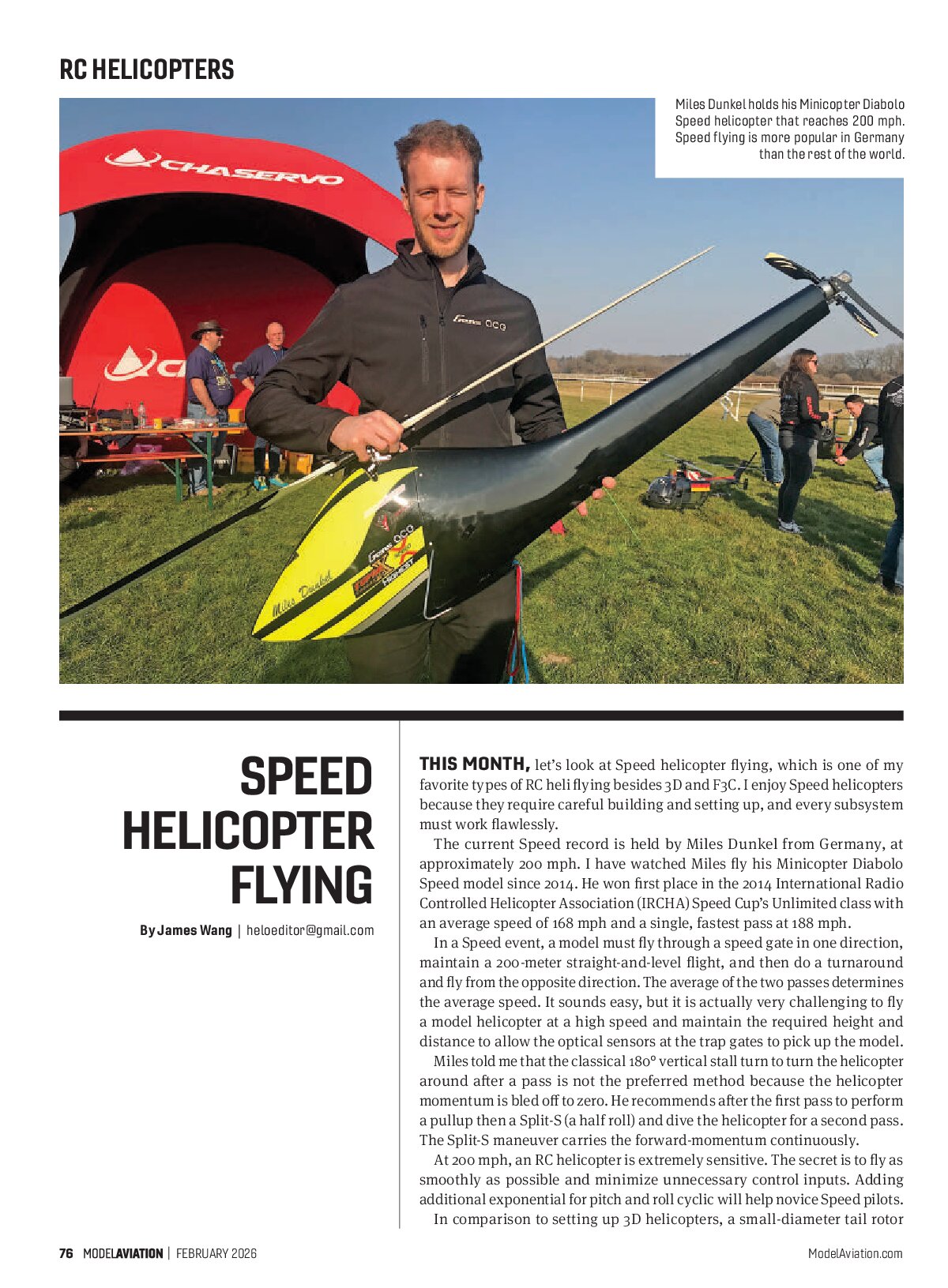
Miles Dunkel holds his Minicopter Diabolo Speed helicopter that reaches 200 mph. Speed flying is more popular in Germany than the rest of the world.


This month, let’s look at Speed helicopter flying, which is one of my favorite types of RC heli flying besides 3D and F3C. I enjoy Speed helicopters because they require careful building and setting up, and every subsystem must work flawlessly.

The current Speed record is held by Miles Dunkel from Germany, at approximately 200 mph. I have watched Miles fly his Minicopter Diabolo Speed model since 2014. He won first place in the 2014 International Radio Controlled Helicopter Association (IRCHA) Speed Cup’s Unlimited class with an average speed of 168 mph and a single, fastest pass at 188 mph.
In a Speed event, a model must fly through a speed gate in one direction, maintain a 200-meter straight-and-level flight, and then do a turnaround and fly from the opposite direction. The average of the two passes determines the average speed. It sounds easy, but it is actually very challenging to fly a model helicopter at a high speed and maintain the required height and distance to allow the optical sensors at the trap gates to pick up the model.
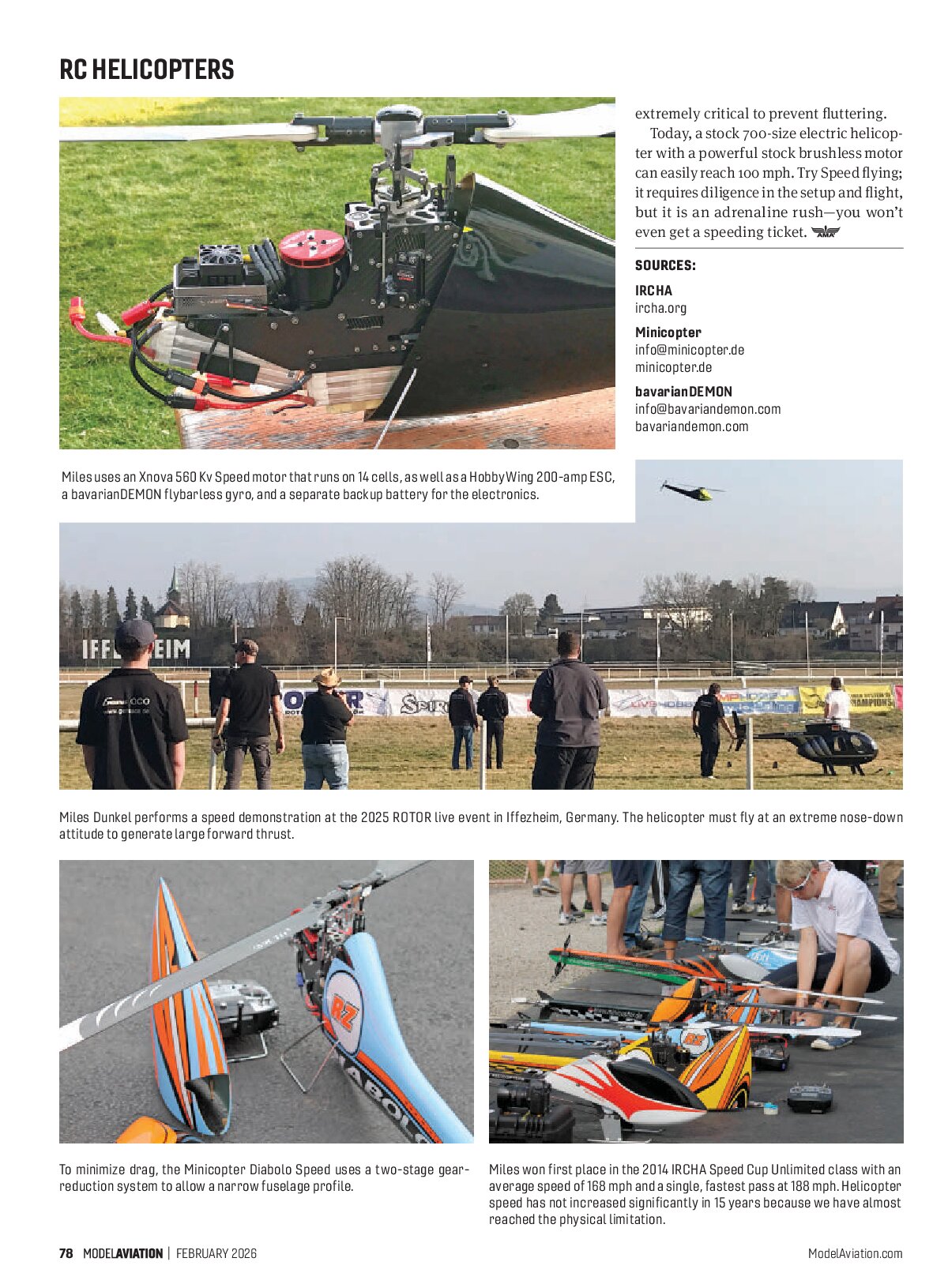
Miles told me that the classical 180° vertical stall turn to turn the helicopter around after a pass is not the preferred method because the helicopter momentum is bled off to zero. He recommends after the first pass to perform a pullup then a Split-S (a half roll) and dive the helicopter for a second pass. The Split-S maneuver carries the forward-momentum continuously.
At 200 mph, an RC helicopter is extremely sensitive. The secret is to fly as smoothly as possible and minimize unnecessary control inputs. Adding additional exponential for pitch and roll cyclic will help novice Speed pilots.
In comparison to setting up 3D helicopters, a small-diameter tail rotor is used for Speed flying, and the gyro yaw gain is set lower because the fuselage weathervane effect will help keep the model straight. Similar to downhill ski racing, every little twitch kills a few miles per hour and takes time to regain the speed again.
All Speed helicopters used by competitors are flybarless because the drag from a traditional flybar robs at least 10% of the speed. Old-fashioned flybar helicopters tend to abruptly pitch the nose upward if there is the slightest aerodynamic perturbation. This is called angle-of-attack instability; it is an inherent characteristic of all main rotors in fast-forward flight. An electronic flybarless gyro is quicker and more sensitive than humans in maintaining a steady and level trajectory.
Gerd Guzicki, from Kassel, Germany, is the founder of Minicopter and the designer of the Diabolo Speed heli. Gerd has made less than 100 Diabolos and each has a unique number and color scheme.
The mechanics are made on CNC machines inside Gerd’s workshop. A two-stage transmission design eliminates the use of a large-diameter reduction gear. The tall, spiral-teeth design helps handle the torque. At roughly 50 volts and a 200-amp current draw, the power equals 10,000 watts, which is a horsepower of 13.4. Using a high-quality LiPo battery is essential. A Speed helicopter can only do three roundtrip passes before running out of juice.
In 1989, before the advent of electric helicopters, my Schülter Magic helicopter used a powerful Italian Rossi 61 engine and was set up for Speed flying, reaching 75 mph. In 1991, my modified Gorham Model Products (GMP) Stork reached 85 mph with an O.S. 61RF engine and a tuned pipe. That was considered extremely fast 35 years ago. Even the best, modern, 91-size two-stroke heli engines only produce less than 4 hp.
The available power from modern electric motors is no longer a limiting factor for Speed flying. The bigger challenge is how to utilize the brute horsepower. Enlarging the rotor diameter or increasing the rotor rpm pushes the blade-tip speed close to the speed of sound and causes drag divergence and flutter. Increasing the collective pitch beyond 15° causes the blades to stall. Hence, it is a delicate balance.
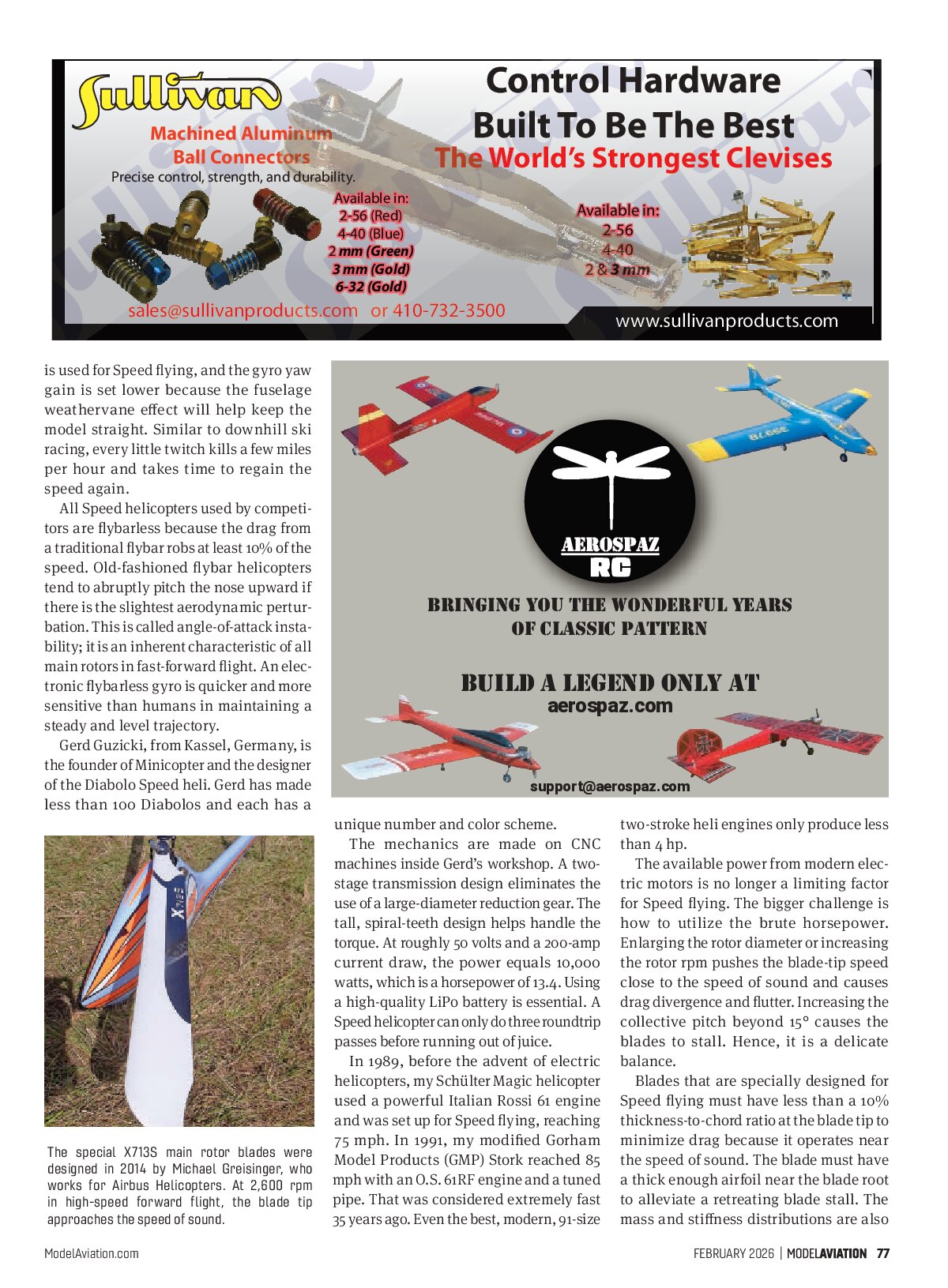
Blades that are specially designed for Speed flying must have less than a 10% thickness-to-chord ratio at the blade tip to minimize drag because it operates near the speed of sound. The blade must have a thick enough airfoil near the blade root to alleviate a retreating blade stall. The mass and stiffness distributions are also extremely critical to prevent fluttering.
Today, a stock 700-size electric helicopter with a powerful stock brushless motor can easily reach 100 mph. Try Speed flying; it requires diligence in the setup and flight, but it is an adrenaline rush—you won’t even get a speeding ticket.
Photo captions

Miles Dunkel performs a speed demonstration at the 2025 ROTOR live event in Iffezheim, Germany. The helicopter must fly at an extreme nose-down attitude to generate large forward thrust.

SOURCES
- IRCHA
- ircha.org
- Minicopter
info@minicopter.de - minicopter.de
bavarianDEMON
info@bavariandemon.com
bavariandemon.com