
Setting Up a New Airplane
By Greg Gimlick | maelectrics@gimlick.com
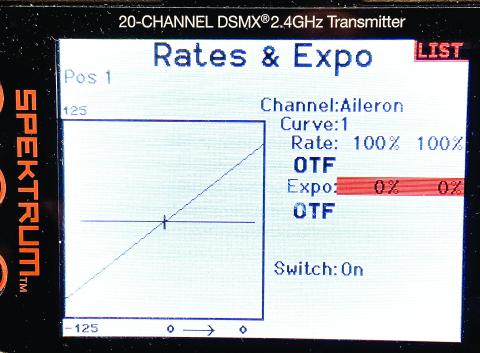
Default rates and exponential settings on a radio are a straight line and 100% travel.
I’ve heard from a lot of you about your flight simulator experiences, and it sounds like most of you have been quite successful. When the snow quits blowing, you’ll find out how much it has helped.
I hope you pulled out the August 2025 issue of Model Aviation and read Dave Scott’s “Flight School” column as I asked in my November column. I’m going to talk about that sort of thing this month. Because you might have gotten a new airplane for Christmas, it’s a good time to think about how you’re going to set it up.

Control Throw Conundrum
We’re fortunate that almost every manufacturer provides thorough information for setting up their airplanes. The manuals list high and low rates and often the suggested exponential, along with the center of gravity location. The BNF aircraft often have setups that you can download directly to your transmitter, so there’s no programming to do.
Unfortunately, I hear it and see it many times when the setups aren’t appropriate for a pilot’s skill or experience. This is often the case when someone gets an airplane that is a tad beyond their experience level. With the proliferation of BNF foamie 3D offerings, several pilots at my field have shown up with aircraft that they just can’t fly. They’re fine airplanes, but they’re set up for 3D fliers.
Just because the manual or preprogrammed setup is extreme doesn’t mean that you have to use those settings. Control throws and exponential can be dialed down to suit your readiness.

My Hacker Edge 540
The Hacker Edge 540 is my “go-to” airplane for practicing maneuvers and getting the rust knocked off of my skills after a crash or long layoff. It’s a 3D airplane, but I have three flight modes set up that allow me to fly it like a trainer, an intermediate stunt model, or a full-fledged 3D machine. I don’t have SAFE technology or any stabilization on this foamie—just a straight, old receiver. If you do have those available on your airplane, you can still set up flight modes as you wish.
My first flight with the Edge 540 was set up per the instructions and it was wild! It had throws that were extreme, and the amount of exponential was higher than anything I had flown. It was a wild ride!
The first thing I did was set up the flight modes. The first flight mode was a very mild setup. It took some experimenting to find the sweet spot, but it was worth the time and effort. These throws are nowhere near those that are recommended, and it’s rock solid. Flight mode two is set up with sportier throws and using the same exponential as flight mode one. Flight mode three is the factory setup. I don’t really enjoy it, but it’s there for when I want to try it.
This airplane is pure ugly. I’ve crashed it, repaired it, crashed it again, and repaired it some more. I love it because it’s tuned perfectly for me and I can practice without being nervous. I think everyone should have such an airplane. Several members of my club have done similar setups with their 3D airplanes, and I’ve seen their skill levels increase exponentially.
Setup: Mechanical or Electronic?
Transmitters today are modern marvels, bordering on magic for the things that they can do. That said, it’s still best to perform your initial setups by mechanical means, such as adjusting clevises, control horns, etc. to get surfaces as close to even as possible. This allows you to finetune in the transmitter to get it perfect. Find the combination that gives you the factory recommended settings then finetune it with the radio.

The Exponential Factor
Exponential (also referred to as expo) is an exceptional feature on our radios. It “softens” the effects around the center and provides full movement at the ends of the stick travel. General guidelines suggest approximately 15% up to 30% exponential, but it’s really a personal choice. The control movement line is linear without any expo, and with a lot of expo, the line is relatively gradual in the center and quickly ramps up toward the edges. The photos show this best.
The problem for most of us who are trying to use the exponential rates that are suggested for extreme 3D fliers is that it seems docile but suddenly becomes extreme. It might seem to deaden your over-controlling as long as you’re in the center of the curve, but it quickly rears its ugly head as you move the stick more. I have one friend who flies most of the time with 90% exponential. I can’t fly his airplanes with those settings.
Dave Scott’s August Column
I’m not going to rehash Dave’s column. Read it, and then read it again until it makes sense to you. The ideal control-throw setup is one that matches your skill level and aircraft. Having too much control throw will discourage the new flier in short order. Having an experienced pilot declare that you need more control throw to keep out of trouble just compounds the problem. New pilots tend to over-control, and this is exacerbated by having too much control throw. It’s not going to get you out of trouble; it’s going to do just the opposite. Like he said, “less is more.”

But the Manual Says …
Most of the time, the manual has recommendations based on extensive testing by factory pilots. This is the best starting point. Have an experienced pilot test-fly your airplane and finetune it. Very seldom have I ever found that I needed more throw than what was recommended, but there have been several instances where I wanted less. Dual or triple rates can provide this.
I set rates up on switches to adjust each control surface separately, but I also set up a flight-mode switch that reduces all of the throws together. This allows me options to get it just the way I want. Once an airplane is tuned for three different options (mild, normal, or extreme), I note the settings and assign a flight mode for each category.
Wrapping Up
Hopefully this has you thinking about setups and how you’ve been doing them. Let me know your thoughts. Get some experienced pilots to help you, but don’t be afraid to ask why they do things the way they do. Our goal should be to help you succeed and enjoy the hobby. Don’t give up on an airplane—tune it!


