TOC Founder Bill Bennett
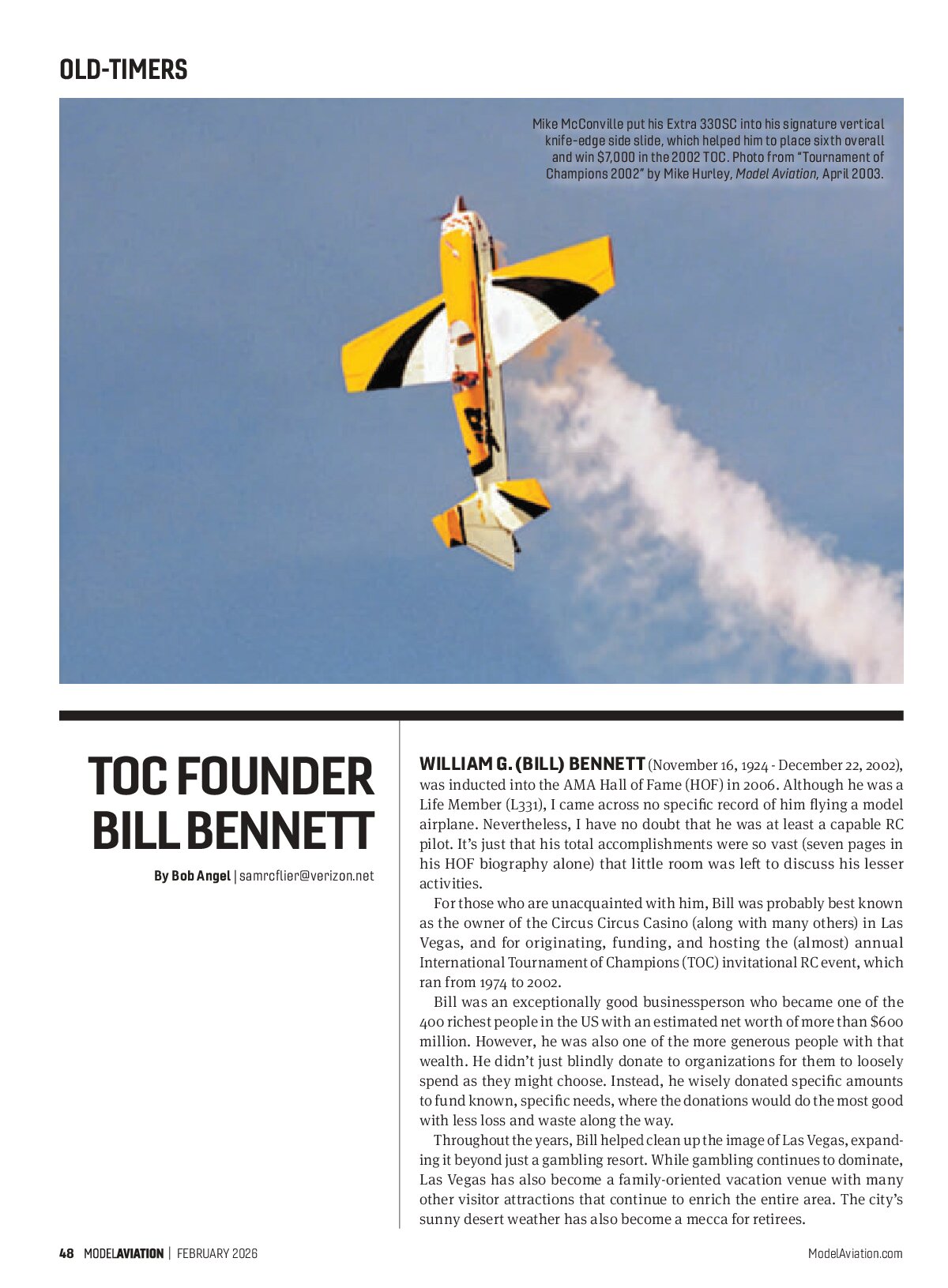
Mike McConville put his Extra 330SC into his signature vertical knife-edge side slide, which helped him to place sixth overall and win $7,000 in the 2002 TOC. Photo from “Tournament of Champions 2002” by Mike Hurley, Model Aviation, April 2003.

William G. (Bill) Bennett (November 16, 1924 - December 22, 2002), was inducted into the AMA Hall of Fame (HOF) in 2006. Although he was a Life Member (L331), I came across no specific record of him flying a model airplane. Nevertheless, I have no doubt that he was at least a capable RC pilot. It’s just that his total accomplishments were so vast (seven pages in his HOF biography alone) that little room was left to discuss his lesser activities.
For those who are unacquainted with him, Bill was probably best known as the owner of the Circus Circus Casino (along with many others) in Las Vegas, and for originating, funding, and hosting the (almost) annual International Tournament of Champions (TOC) invitational RC event, which ran from 1974 to 2002.
Bill was an exceptionally good businessperson who became one of the 400 richest people in the US with an estimated net worth of more than $600 million. However, he was also one of the more generous people with that wealth. He didn’t just blindly donate to organizations for them to loosely spend as they might choose. Instead, he wisely donated specific amounts to fund known, specific needs, where the donations would do the most good with less loss and waste along the way.
Throughout the years, Bill helped clean up the image of Las Vegas, expanding it beyond just a gambling resort. While gambling continues to dominate, Las Vegas has also become a family-oriented vacation venue with many other visitor attractions that continue to enrich the entire area. The city’s sunny desert weather has also become a mecca for retirees.
Bill’s HOF biography lists at least three instances where he funded specific special-purpose campus buildings and centers for the University of Nevada at a rate of a few million dollars each and, in some cases, even the real estate that was needed to build such things as a model for preschool campuses.
He established a foundation for charitable philanthropy to make sure that the millions of donated dollars went to deserving causes that had legitimate needs, and to minimize the possibility of waste, fraud, and abuse during the process. It leaves me wondering—what if Bill Bennett had gone to work for our federal government?
The biggest and best-known modeling event that Bill sponsored and financed was the TOC, which spanned a period of nearly 30 years. Even before and during that time period, however, he completely financed a large number of other modeling projects, including at least a couple of first-class model flying fields in or around Las Vegas.

The TOC Invitational
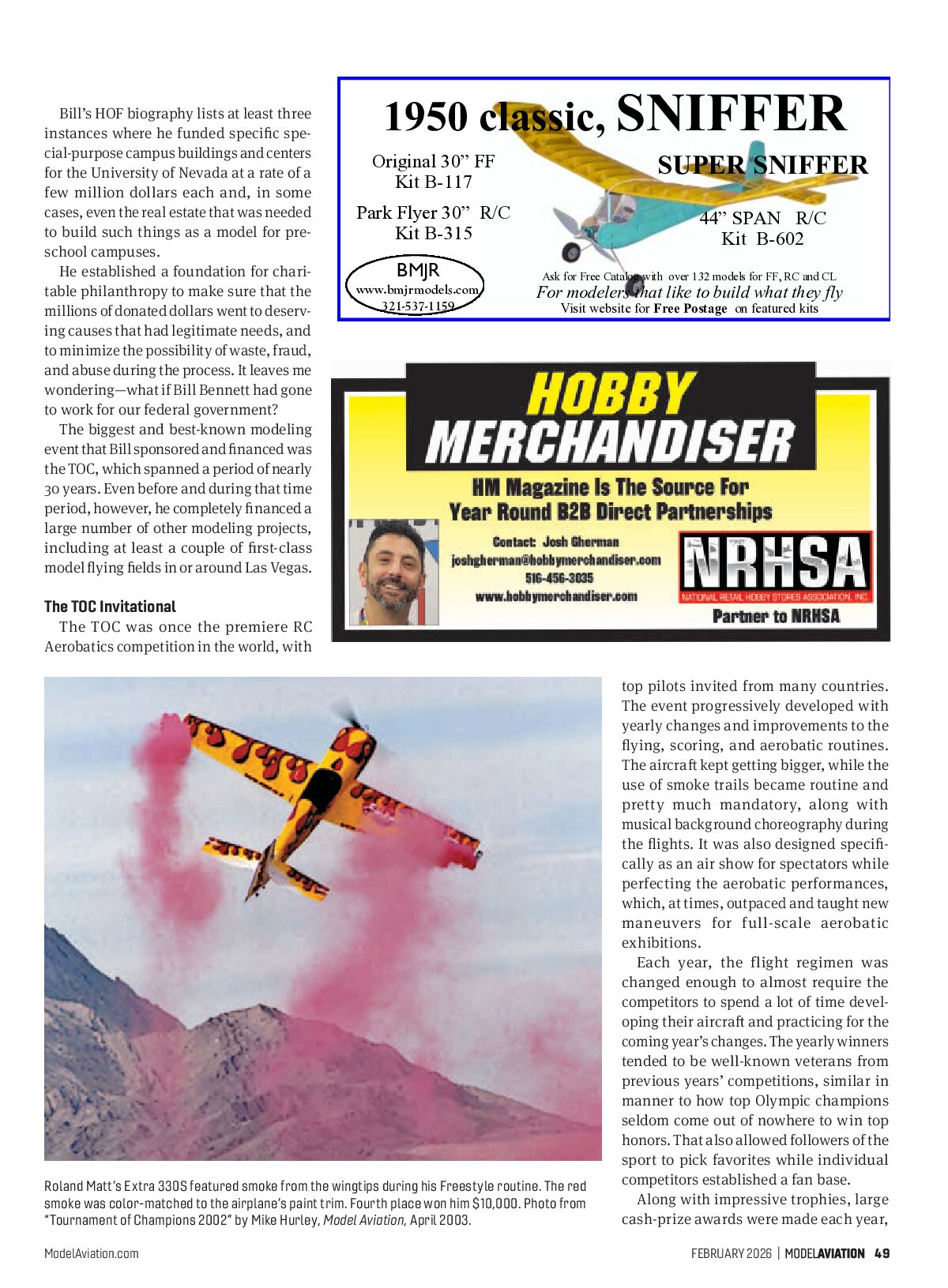
The TOC was once the premiere RC Aerobatics competition in the world, with top pilots invited from many countries. The event progressively developed with yearly changes and improvements to the flying, scoring, and aerobatic routines. The aircraft kept getting bigger, while the use of smoke trails became routine and pretty much mandatory, along with musical background choreography during the flights. It was also designed specifically as an air show for spectators while perfecting the aerobatic performances, which, at times, outpaced and taught new maneuvers for full-scale aerobatic exhibitions.
Each year, the flight regimen was changed enough to almost require the competitors to spend a lot of time developing their aircraft and practicing for the coming year’s changes. The yearly winners tended to be well-known veterans from previous years’ competitions, similar in manner to how top Olympic champions seldom come out of nowhere to win top honors. That also allowed followers of the sport to pick favorites while individual competitors established a fan base.
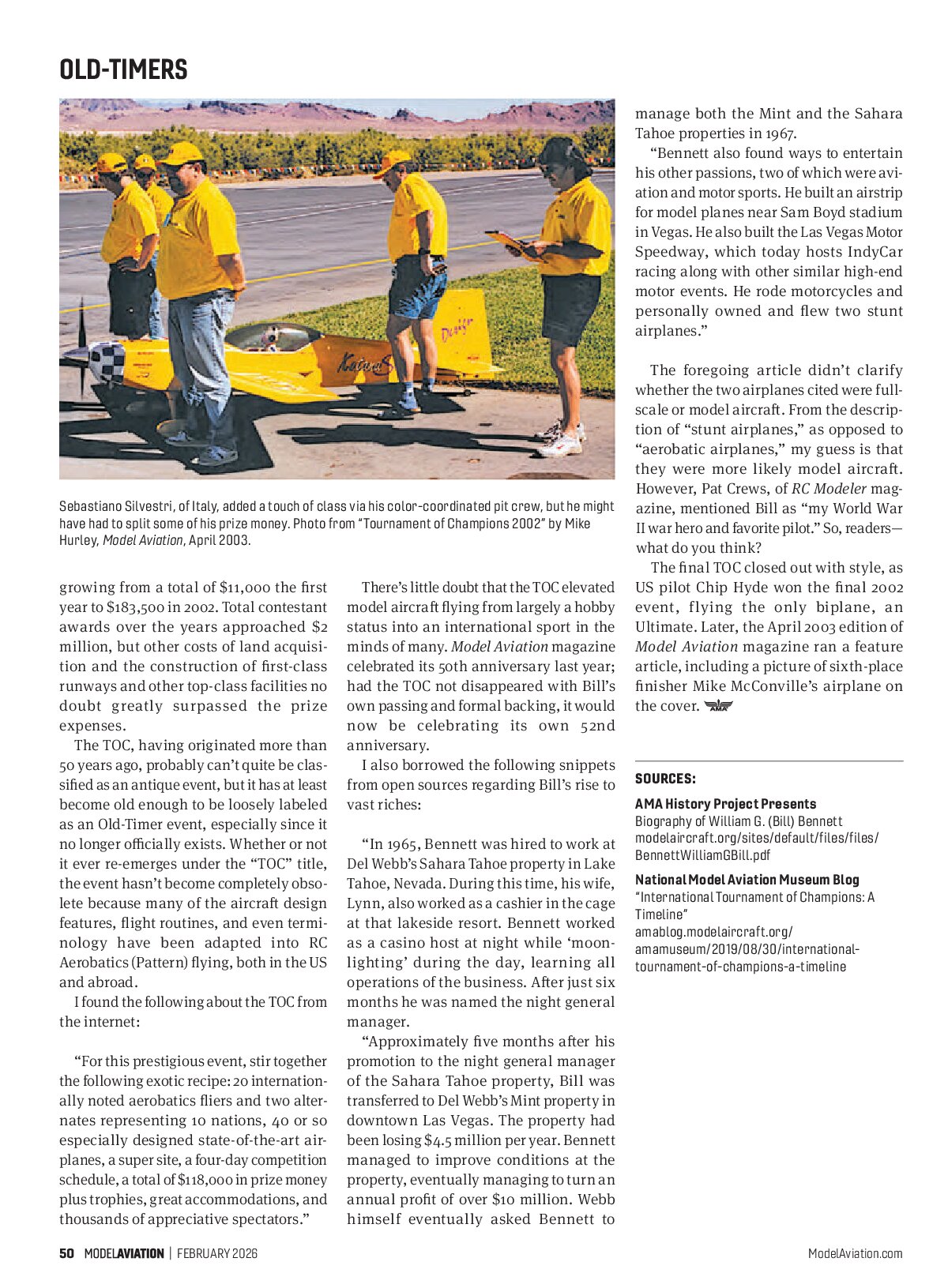
Along with impressive trophies, large cash-prize awards were made each year, growing from a total of $11,000 the first year to $183,500 in 2002. Total contestant awards over the years approached $2 million, but other costs of land acquisition and the construction of first-class runways and other top-class facilities no doubt greatly surpassed the prize expenses.
The TOC, having originated more than 50 years ago, probably can’t quite be classified as an antique event, but it has at least become old enough to be loosely labeled as an Old-Timer event, especially since it no longer officially exists. Whether or not it ever re-emerges under the “TOC” title, the event hasn’t become completely obsolete because many of the aircraft design features, flight routines, and even terminology have been adapted into RC Aerobatics (Pattern) flying, both in the US and abroad.
I found the following about the TOC from the internet:
“For this prestigious event, stir together the following exotic recipe: 20 internationally noted aerobatics fliers and two alternates representing 10 nations, 40 or so especially designed state-of-the-art airplanes, a super site, a four-day competition schedule, a total of $118,000 in prize money plus trophies, great accommodations, and thousands of appreciative spectators.”
There’s little doubt that the TOC elevated model aircraft flying from largely a hobby status into an international sport in the minds of many. Model Aviation magazine celebrated its 50th anniversary last year; had the TOC not disappeared with Bill’s own passing and formal backing, it would now be celebrating its own 52nd anniversary.
I also borrowed the following snippets from open sources regarding Bill’s rise to vast riches:
“In 1965, Bennett was hired to work at Del Webb’s Sahara Tahoe property in Lake Tahoe, Nevada. During this time, his wife, Lynn, also worked as a cashier in the cage at that lakeside resort. Bennett worked as a casino host at night while ‘moonlighting’ during the day, learning all operations of the business. After just six months he was named the night general manager.
“Approximately five months after his promotion to the night general manager of the Sahara Tahoe property, Bill was transferred to Del Webb’s Mint property in downtown Las Vegas. The property had been losing $4.5 million per year. Bennett managed to improve conditions at the property, eventually managing to turn an annual profit of over $10 million. Webb himself eventually asked Bennett to manage both the Mint and the Sahara Tahoe properties in 1967.
“Bennett also found ways to entertain his other passions, two of which were aviation and motor sports. He built an airstrip for model planes near Sam Boyd stadium in Vegas. He also built the Las Vegas Motor Speedway, which today hosts IndyCar racing along with other similar high-end motor events. He rode motorcycles and personally owned and flew two stunt airplanes.”
The foregoing article didn’t clarify whether the two airplanes cited were full-scale or model aircraft. From the description of “stunt airplanes,” as opposed to “aerobatic airplanes,” my guess is that they were more likely model aircraft. However, Pat Crews, of RC Modeler magazine, mentioned Bill as “my World War II war hero and favorite pilot.” So, readers—what do you think?
The final TOC closed out with style, as US pilot Chip Hyde won the final 2002 event, flying the only biplane, an Ultimate. Later, the April 2003 edition of Model Aviation magazine ran a feature article, including a picture of sixth-place finisher Mike McConville’s airplane on the cover.
SOURCES
- AMA History Project Presents
Biography of William G. (Bill) Bennett - modelaircraft.org/sites/default/files/files/BennettWilliamGBill.pdf
- National Model Aviation Museum Blog
“International Tournament of Champions: A Timeline” - amablog.modelaircraft.org/amamuseum/2019/08/30/international-tournament-of-champions-a-timeline