Interested in sharing your handiwork? Visit ModelAviation.com for submission guidelines.
Seagull Models P-47 Razorback

Jeffery Fiscus’ (Portsmouth, Rhode Island; email: fwjeff190@gmail.com) model is a Proctor DVII kit that a friend purchased approximately 15 years ago. “He decided he wouldn’t get it built, so it showed up on my doorstep. I was very happy, as I’ve wanted to build a Proctor kit for quite a few decades!” he said.
The model was schemed as an Albatros-built D.VII flown by Carl Degelo. Jeffery only changed a few minor things in the structure. The full-scale airplane had an open-top cowling, so he fabricated a nearly full dummy engine. The cockpit detailing was scratch-built and finished with a Best Pilots pilot. The guns are Willams Brothers kits with additional detailing added. Power is a Moki 50VT gas four-cycle engine with the exhaust routed through scale exhaust pipes. The radio is a Futaba 14SG with ProModeler and Futaba servos.
Struik Model Technology (SMT) in the Netherlands printed the correct lozenge fabric covering used on the wing. The fuselage and tails are covered with SMT’s scale covering and painted with Warbird Colors and Klass Kote paints. Marking stencils were made by Callie Graphics to Jeffery’s specifications, and the markings were painted with WBC paints. The finishing touch was a laminated Xoar Axial propeller (the propeller in the photo is only for display, but once the best propeller size is figured out for flying, it will be added).
“This was my first larger-scale and detailed World War I model, so it was helpful to have the assistance of several builders on the RCScaleBuilder forum,” said Jefferey. “The plane is ready to fly and will hopefully be out for first flight shortly.”

Deryl Rolle’s (Sugar Land, Texas; email: derylrolle@gmail.com) 81-inch wingspan Seagull Models P-47 Razorback Wicked Wabbit is riveted and all-weathered with an airbrush. His friend, Barry Raborn, brought him the airplane, and Brian Keith did a good job on the build, for which he’s grateful.
The engine is an EME 60 with autostart; Deryl states that it powers right up with his Futaba 32MZ 2.4 GHz Mode 2 helicopter transmitter. He also said that the transmitter plays music when he flies, and he starts dancing and flying at the same time during a warbird gaggle!
“I had a big dream last summer about my Futaba 32MZ evolving into the 32MZ WC transmitter right after the warbird gaggle at Bomber Field [in Texas],” he quipped.
Larry Voorhees (Omaha, Nebraska; email: voorhees.larry@yahoo.com) wanted to build a good Stick airplane and settled on the Old School Model Works 60-inch wingspan Raider.
Weighing approximately 5.5 pounds, it’s guided by a Spektrum system and a BadAss 3530-630 motor with a BadAss 100-amp ESC. Graphics are by Callie Graphics. The top speed is in the 90 mph range using a 6S LiPo battery.
Larry said that the maiden was awesome, with just a few clicks of trim needed, and that Old School Model Works provided an excellent kit and construction details. “I’m 80 years old and still enjoying all aspects of the hobby!”

Steven Meyer’s (Tucson, Arizona; email: navydoc192@icloud.com) Freewing F9F-8 Cougar jet, with an 80mm EDF motor in it, gives realistic scale takeoffs and landings and flies extremely well.
“The top speed so far is 113 mph in straight, level flight. I fly most of the time at half to three-quarter power and I get an average of 5 to 6 minutes on a 6,000 mAh 22.2-volt HRB premium battery,” he said. “I weathered mine consistent with aircraft I saw when I was stationed on board the USS Midway when I was active-duty U.S. Navy.”

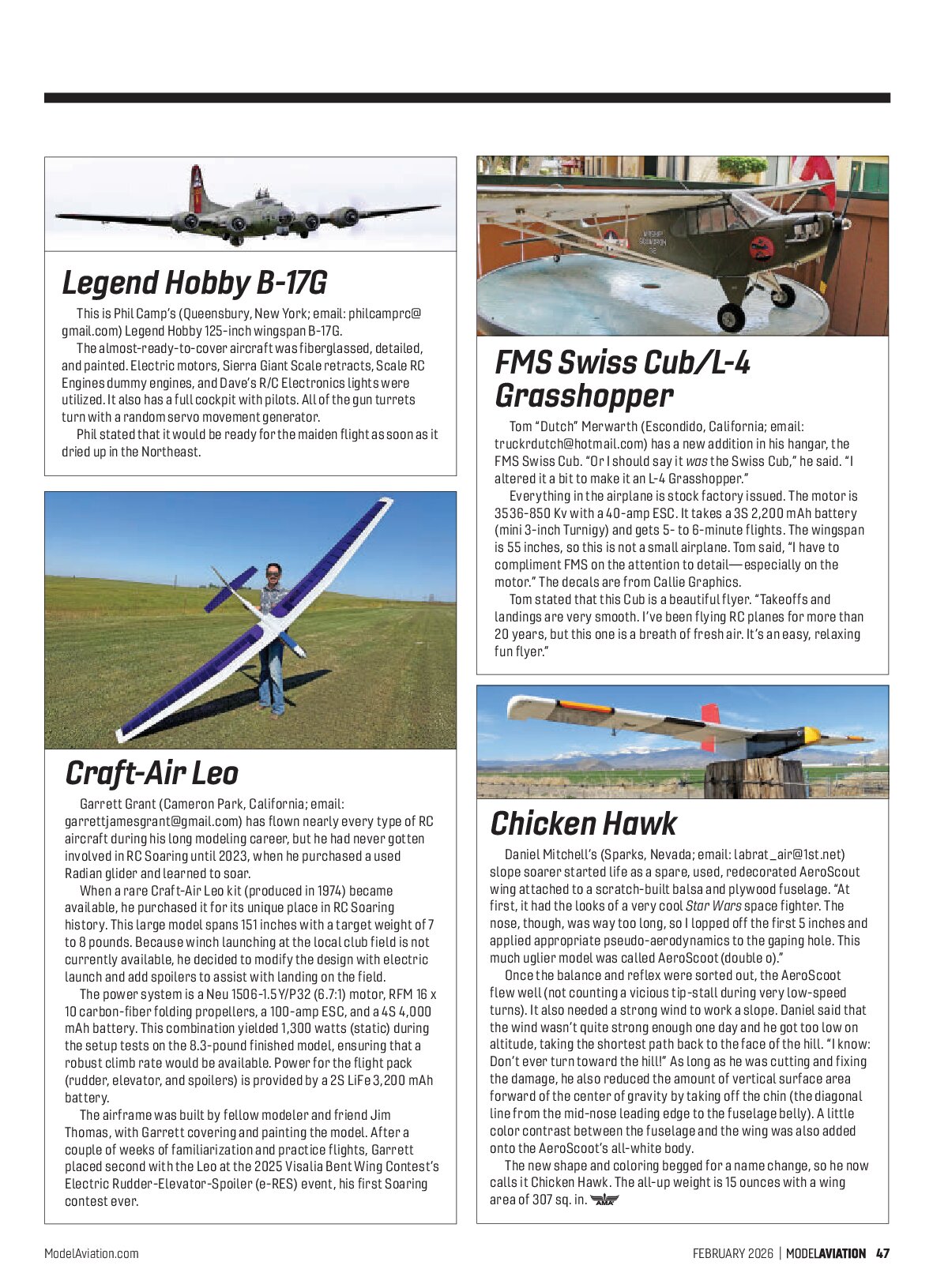
This is Phil Camp’s (Queensbury, New York; email: philcamprc@gmail.com) Legend Hobby 125-inch wingspan B-17G.
The almost-ready-to-cover aircraft was fiberglassed, detailed, and painted. Electric motors, Sierra Giant Scale retracts, Scale RC Engines dummy engines, and Dave’s R/C Electronics lights were utilized. It also has a full cockpit with pilots. All of the gun turrets turn with a random servo movement generator.
Phil stated that it would be ready for the maiden flight as soon as it dried up in the Northeast.
Tom “Dutch” Merwarth (Escondido, California; email: truckrdutch@hotmail.com) has a new addition in his hangar, the FMS Swiss Cub. “Or I should say it was the Swiss Cub,” he said. “I altered it a bit to make it an L-4 Grasshopper.”
Everything in the airplane is stock factory issued. The motor is 3536-850 Kv with a 40-amp ESC. It takes a 3S 2,200 mAh battery (mini 3-inch Turnigy) and gets 5- to 6-minute flights. The wingspan is 55 inches, so this is not a small airplane. Tom said, “I have to compliment FMS on the attention to detail—especially on the motor.” The decals are from Callie Graphics.
Tom stated that this Cub is a beautiful flyer. “Takeoffs and landings are very smooth. I’ve been flying RC planes for more than 20 years, but this one is a breath of fresh air. It’s an easy, relaxing fun flyer.”

Garrett Grant (Cameron Park, California; email: garrettjamesgrant@gmail.com) has flown nearly every type of RC aircraft during his long modeling career, but he had never gotten involved in RC Soaring until 2023, when he purchased a used Radian glider and learned to soar.
When a rare Craft-Air Leo kit (produced in 1974) became available, he purchased it for its unique place in RC Soaring history. This large model spans 151 inches with a target weight of 7 to 8 pounds. Because winch launching at the local club field is not currently available, he decided to modify the design with electric launch and add spoilers to assist with landing on the field.
The power system is a Neu 1506-1.5Y/P32 (6.7:1) motor, RFM 16 x 10 carbon-fiber folding propellers, a 100-amp ESC, and a 4S 4,000 mAh battery. This combination yielded 1,300 watts (static) during the setup tests on the 8.3-pound finished model, ensuring that a robust climb rate would be available. Power for the flight pack (rudder, elevator, and spoilers) is provided by a 2S LiFe 3,200 mAh battery.
The airframe was built by fellow modeler and friend Jim Thomas, with Garrett covering and painting the model. After a couple of weeks of familiarization and practice flights, Garrett placed second with the Leo at the 2025 Visalia Bent Wing Contest’s Electric Rudder-Elevator-Spoiler (e-RES) event, his first Soaring contest ever.
Daniel Mitchell’s (Sparks, Nevada; email: labrat_air@1st.net) slope soarer started life as a spare, used, redecorated AeroScout wing attached to a scratch-built balsa and plywood fuselage. “At first, it had the looks of a very cool Star Wars space fighter. The nose, though, was way too long, so I lopped off the first 5 inches and applied appropriate pseudo-aerodynamics to the gaping hole. This much uglier model was called AeroScoot (double o).”
Once the balance and reflex were sorted out, the AeroScoot flew well (not counting a vicious tip-stall during very low-speed turns). It also needed a strong wind to work a slope. Daniel said that the wind wasn’t quite strong enough one day and he got too low on altitude, taking the shortest path back to the face of the hill. “I know: Don’t ever turn toward the hill!” As long as he was cutting and fixing the damage, he also reduced the amount of vertical surface area forward of the center of gravity by taking off the chin (the diagonal line from the mid-nose leading edge to the fuselage belly). A little color contrast between the fuselage and the wing was also added onto the AeroScoot’s all-white body.
The new shape and coloring begged for a name change, so he now calls it Chicken Hawk. The all-up weight is 15 ounces with a wing area of 307 sq. in.