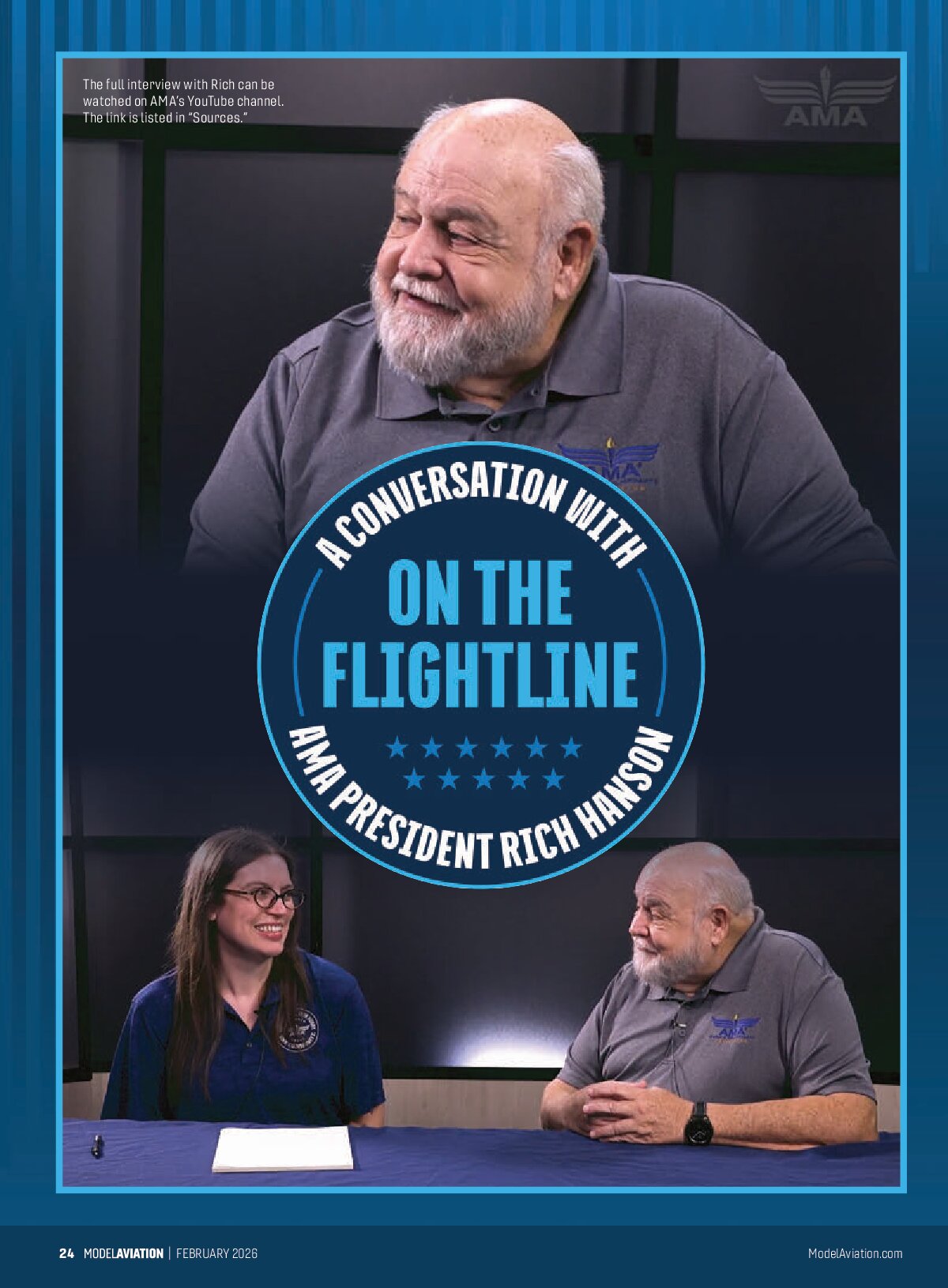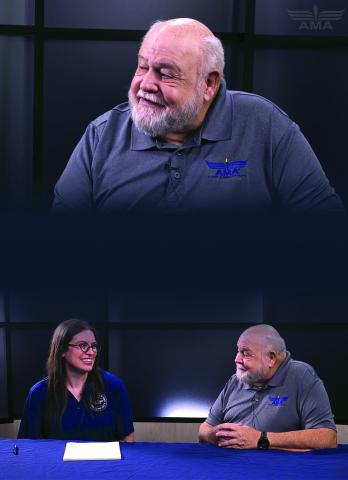
The full interview with Rich can be watched on AMA’s YouTube channel. The link is listed in “Sources.”
The full interview with Rich can be watched on AMA’s YouTube channel. The link is listed in “Sources.”

A CONVERSATION WITH

ON THE FLIGHTLINE

AMA PRESIDENT RICH HANSON
I’ve always been in leadership roles, going all the way back to my high school years in the CAP. I was the cadet commander for my local CAP squadron. That led me into leadership roles within the Army and the National Guard. When I was working for the Department of Public Safety, although I started out as a pilot, I ended my last nine years as the aviation commander, so I’ve always migrated into leadership roles. My leadership style probably was shaped mostly from the military, starting with, as I said, the CAP. Interestingly enough, though, my approach to and my passion for life started with model aviation. I started flying model airplanes back when I was about 6 years old and received a little plastic Cox .049 airplane for Christmas and began flying it.
As I got into my middle school years, I met up with a group of guys who were in the CAP and we started building balsa-type airplanes that flew much better than the old plastic ones. Although my careers have moved in different paths throughout the years, my model aviation interest and passion have always been there. I can honestly say that from age six to today, that's always been a part of my life.
HS: Was there a particular program or initiative you were especially proud of seeing grow while you were president?
RH: The Government Relations work certainly is the center point and the centerpiece of my work within AMA, but I spent 15 years as the District X vice president (VP) before I stepped down to work in Government Relations. One of the biggest challenges in District X, which is mainly the West Coast, was the acquisition, the development, and the retention of flying sites.
The Executive Council (EC), back in the ’90s, developed a program, which we still have today, [helping with] flying site assistance. I was able to use that program in the early years to open six different flying sites within my district. I take some pride in that because getting new flying sites on the West Coast is a real challenge.
Unfortunately, even today, we’re continuing to lose flying sites because of development and changes in government programs, such as the forest service and the park service. I don’t think we’re out of the woods by any means as far as finding new flying sites and keeping our current ones, but we did some good work back in the ’90s and in the early 2000s when I was a VP, and I’m proud of that.
HS: When you first stepped into the role, you talked about keeping AMA relevant and viable for future generations. Do you feel that you have accomplished that vision?
RH: I think we’ve heightened the model aviation community within the greater aviation and aerospace communities. There’s been a natural evolution where members of our community have gone on and achieved great things within aviation, not the least of which, as an example, is Neil Armstrong, who was an AMA member and competitor in his youth and obviously went on to become one of our astronauts and walk on the moon. He’s not the only one though. There have been many others who have followed and gone on to make their mark in the aviation community. While model aviation has always served as a stepping stone into those careers, even today that continues, and I’d like to believe that it will continue into the future.
HS: Every leadership role comes with its fair share of challenges. What was the toughest one for you, and how did you overcome it?
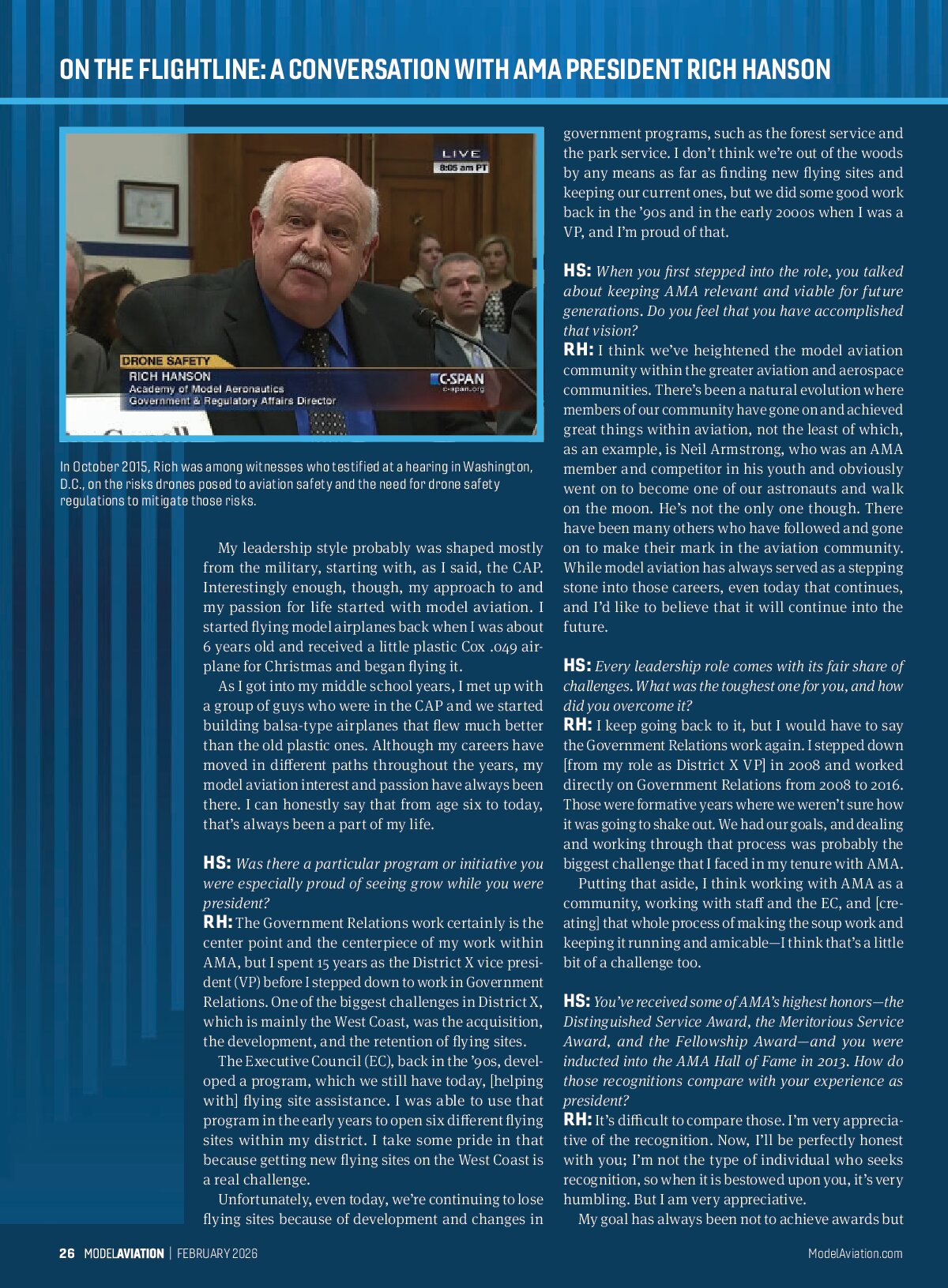
RH: I keep going back to it, but I would have to say the Government Relations work again. I stepped down [from my role as District X VP] in 2008 and worked directly on Government Relations from 2008 to 2016. Those were formative years where we weren’t sure how it was going to shake out. We had our goals, and dealing and working through that process was probably the biggest challenge that I faced in my tenure with AMA.
Putting that aside, I think working with AMA as a community, working with staff and the EC, and [creating] that whole process of making the soup work and keeping it running and amicable—I think that’s a little bit of a challenge too.
HS: You’ve received some of AMA’s highest honors—the Distinguished Service Award, the Meritorious Service Award, and the Fellowship Award—and you were inducted into the AMA Hall of Fame in 2013. How do those recognitions compare with your experience as president?
RH: It’s difficult to compare those. I’m very appreciative of the recognition. Now, I’ll be perfectly honest with you; I’m not the type of individual who seeks recognition, so when it is bestowed upon you, it’s very humbling. But I am very appreciative.
My goal has always been not to achieve awards but to accomplish my goals within AMA, make model aviation better, and make sure model aviation continues. I think if you’ve read my columns, though, I almost always end with some expectation and comment about wanting people to just get out and enjoy the hobby because this is a hobby. It is supposed to be fun. Although the work of AMA is, at times, a challenge—and there is work to it—going out and flying model airplanes is what it’s all about. Being able to fly with other people and interact with other modelers is fun and enjoyable. My aim more than anything else is that people have fun and enjoy this hobby.
HS: Throughout the years, I’m sure you’ve attended a lot of AMA events and met countless members. Do any moments or memories stand out to you? RH: Just about any time I get a chance to get out and interact with other modelers and attend events, it’s a great day. When I first started as the District X VP, which was back in 1993, I started out with CL, and I did a little bit of Free Flight (FF). The bulk of what I did was RC, and I felt that it was important, as the district VP, to try and spread my time and attention equally to the different disciplines within the hobby. I made a concerted effort to get out to see FF, CL, Indoor RC, the International Miniature Aerobatics Club (IMAC) [competitions], Pattern, racing—you name it.
There isn’t one event that stands out, although there have been some pretty significant events throughout the years, such as Top Gun and Joe Nall. Just being at the events themselves is rewarding.
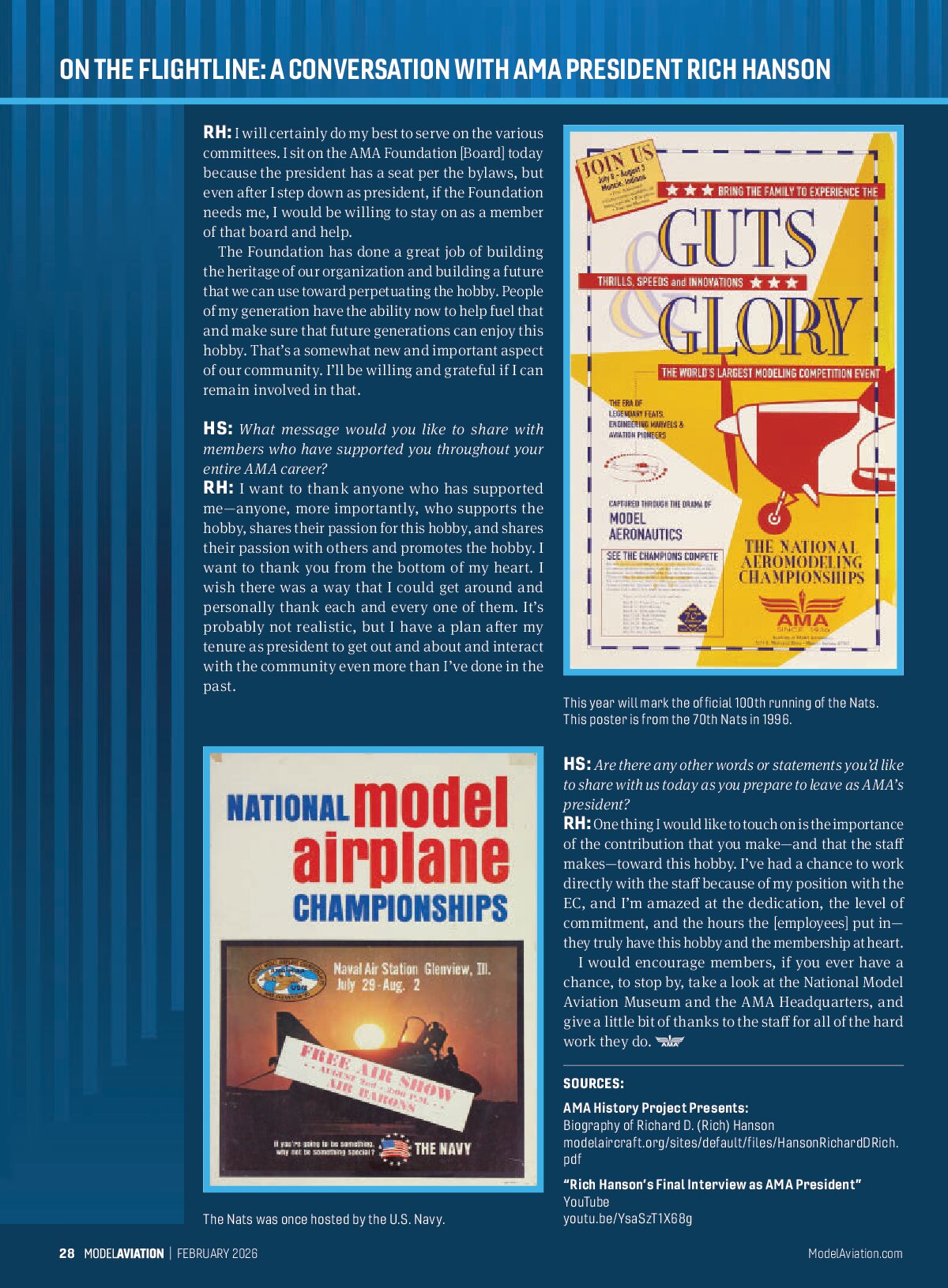
HS: Speaking of events, we do have our 100th year of the official AMA Nats coming up in 2026. Are there any particular years of the Nats that really stand out to you? RH: People who have been in the hobby for a long time look back with fondness on the days when the Nats was run by the U.S. Navy and we traveled around the U.S. It was a little more condensed in those days. You could go to the Nats and see all of model aviation; you could spend a morning watching FF or spend an afternoon watching CL. You could come in the next day and watch RC Pylon Racing or RC Aerobatics (Pattern). Those days of the Nats are what a lot of people look back on with fondness.
The Nats today are spread out over a longer period of time. They’re at the International Aeromodeling Center every year. They’ve changed a little bit, but they’re no less important or prestigious for the organization. Because I live locally, every summer I’m able to come out here and see different aspects of the Nats, but, unfortunately, we’ve lost that—I don’t want to call it the thrill of the Nats, but the heightened involvement that you had in the Nats a few years ago. I’d like to see some way of getting it back, but we haven’t quite cracked that yet.
HS: What advice would you give to your successor as they step into the role? RH: Good luck! No, the advice I would give is that working with the EC is interesting and unique with the way our governance is structured. The president does have a leadership role, but the president really is more of a chairman of the EC and a coordinator.
It’s important to realize that not everyone at the table is going to have the same viewpoints or is going to come from the same walk of life, and that it is going to be important that all sides get aired and are eventually pulled together into the mission and the direction of AMA. My advice would be to have patience, but don’t forget to focus on where the organization is heading and helping the EC move in that direction.
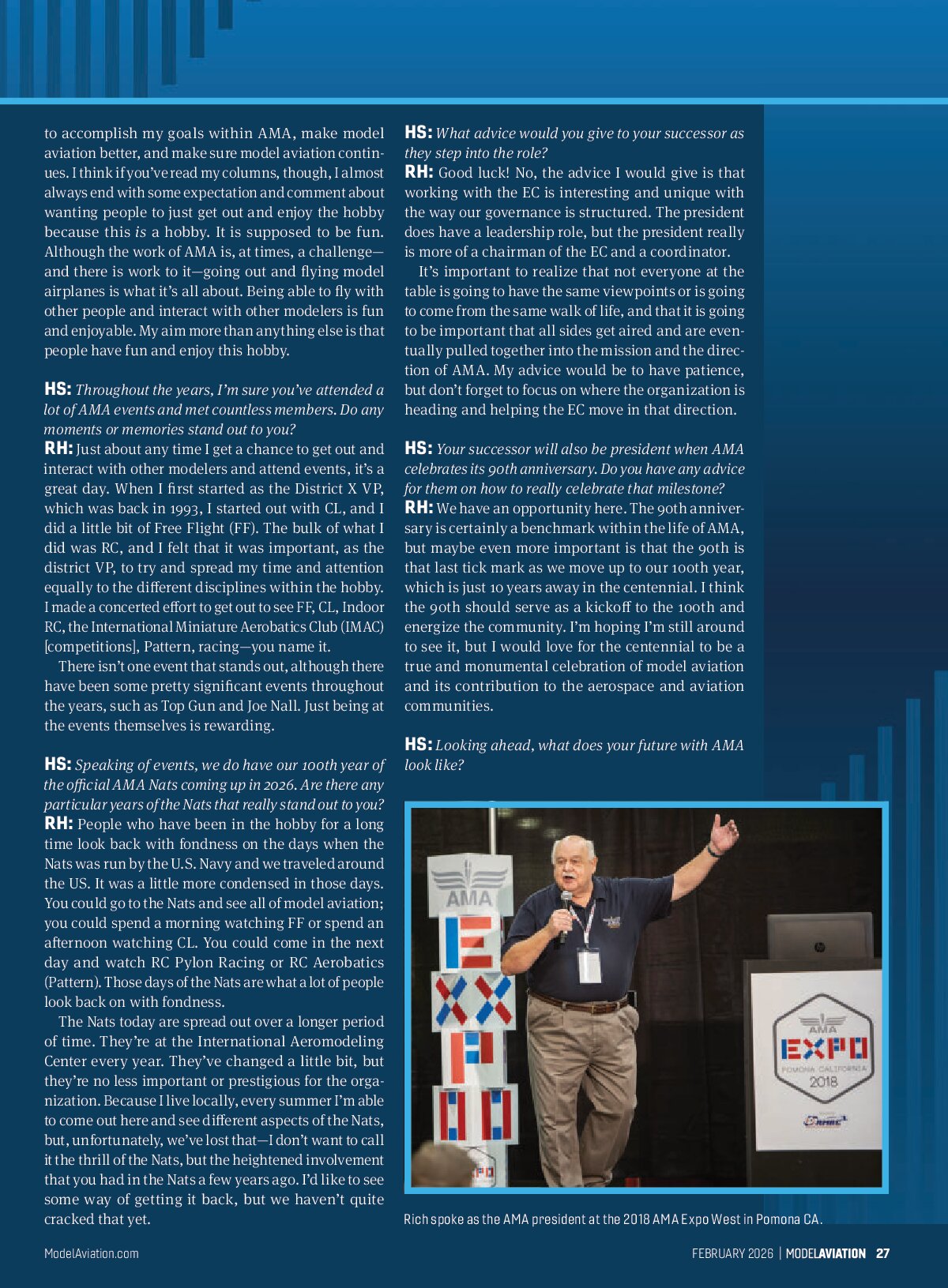
HS: Your successor will also be president when AMA celebrates its 90th anniversary. Do you have any advice for them on how to really celebrate that milestone? RH: We have an opportunity here. The 90th anniversary is certainly a benchmark within the life of AMA, but maybe even more important is that the 90th is that last tick mark as we move up to our 100th year, which is just 10 years away in the centennial. I think the 90th should serve as a kickoff to the 100th and energize the community. I’m hoping I’m still around to see it, but I would love for the centennial to be a true and monumental celebration of model aviation and its contribution to the aerospace and aviation communities.
HS: Looking ahead, what does your future with AMA look like? RH: I will certainly do my best to serve on the various committees. I sit on the AMA Foundation [Board] today because the president has a seat per the bylaws, but even after I step down as president, if the Foundation needs me, I would be willing to stay on as a member of that board and help.
The Foundation has done a great job of building the heritage of our organization and building a future that we can use toward perpetuating the hobby. People of my generation have the ability now to help fuel that and make sure that future generations can enjoy this hobby. That’s a somewhat new and important aspect of our community. I’ll be willing and grateful if I can remain involved in that.
HS: What message would you like to share with members who have supported you throughout your entire AMA career? RH: I want to thank anyone who has supported me—anyone, more importantly, who supports the hobby, shares their passion for this hobby, and shares their passion with others and promotes the hobby. I want to thank you from the bottom of my heart. I wish there was a way that I could get around and personally thank each and every one of them. It’s probably not realistic, but I have a plan after my tenure as president to get out and about and interact with the community even more than I’ve done in the past.
HS: Are there any other words or statements you’d like to share with us today as you prepare to leave as AMA’s president? RH: One thing I would like to touch on is the importance of the contribution that you make—and that the staff makes—toward this hobby. I’ve had a chance to work directly with the staff because of my position with the EC, and I’m amazed at the dedication, the level of commitment, and the hours the [employees] put in—they truly have this hobby and the membership at heart. I would encourage members, if you ever have a chance, to stop by, take a look at the National Model Aviation Museum and the AMA Headquarters, and give a little bit of thanks to the staff for all of the hard work they do.

Sources
- AMA History Project Presents: Biography of Richard D. (Rich) Hanson modelaircraft.org/sites/default/files/HansonRichardDRich.pdf
- "Rich Hanson's Final Interview as AMA President" YouTube youtu.be/YsaSZT1X68g
Transcribed from original scans by AI. Minor OCR errors may remain.