NEAT Fair Highlights
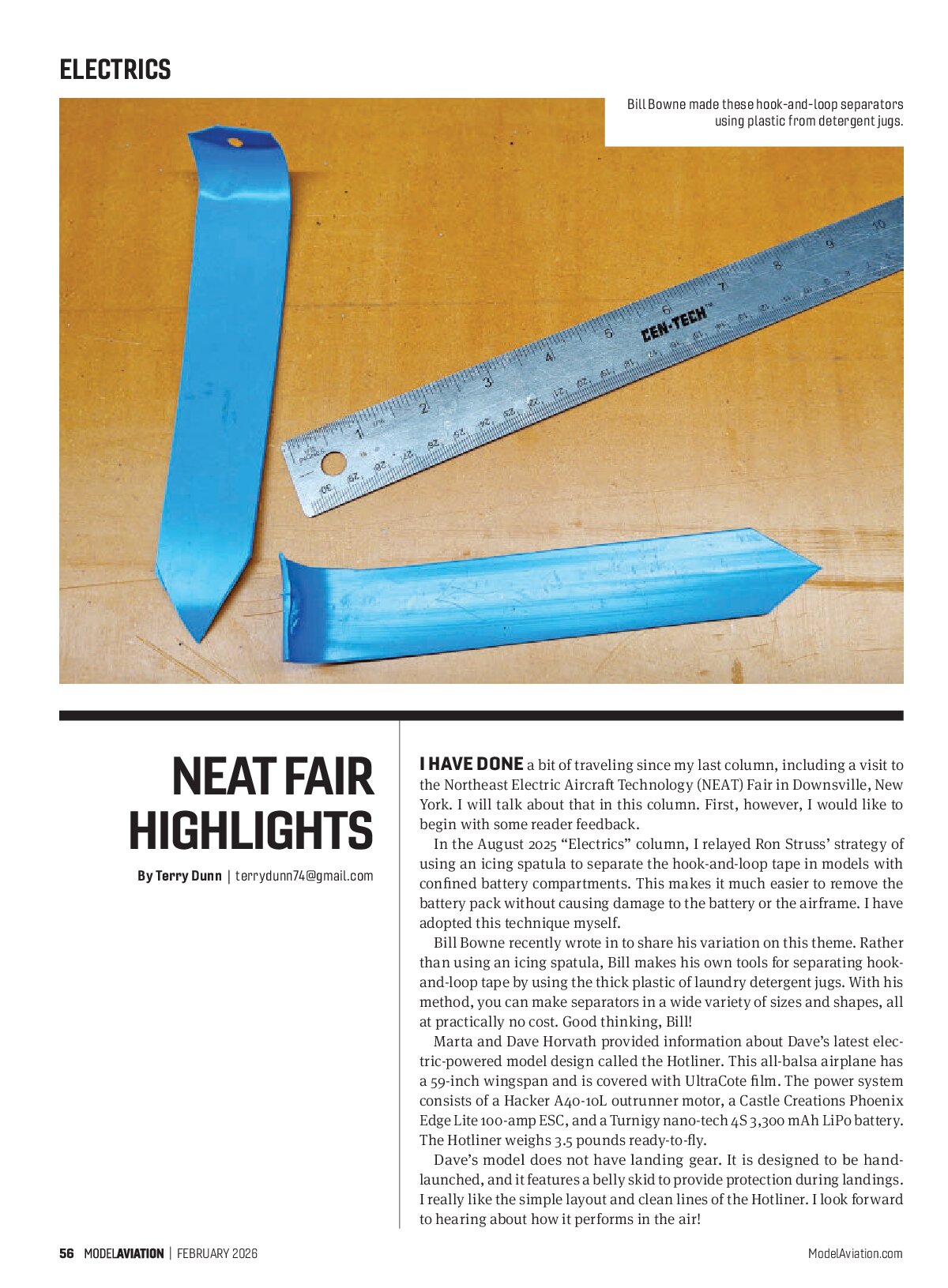
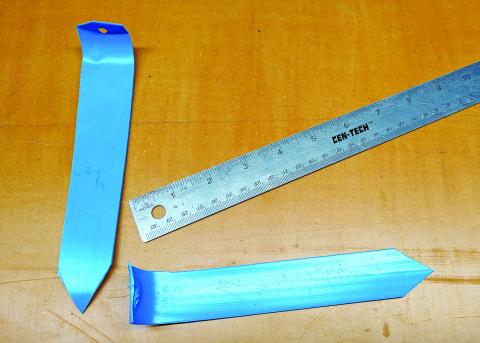
Bill Bowne made these hook-and-loop separators using plastic from detergent jugs.

I have done a bit of traveling since my last column, including a visit to the Northeast Electric Aircraft Technology (NEAT) Fair in Downsville, New York. I will talk about that in this column. First, however, I would like to begin with some reader feedback.
In the August 2025 “Electrics” column, I relayed Ron Struss’ strategy of using an icing spatula to separate the hook-and-loop tape in models with confined battery compartments. This makes it much easier to remove the battery pack without causing damage to the battery or the airframe. I have adopted this technique myself.
Bill Bowne recently wrote in to share his variation on this theme. Rather than using an icing spatula, Bill makes his own tools for separating hook-and-loop tape by using the thick plastic of laundry detergent jugs. With his method, you can make separators in a wide variety of sizes and shapes, all at practically no cost. Good thinking, Bill!
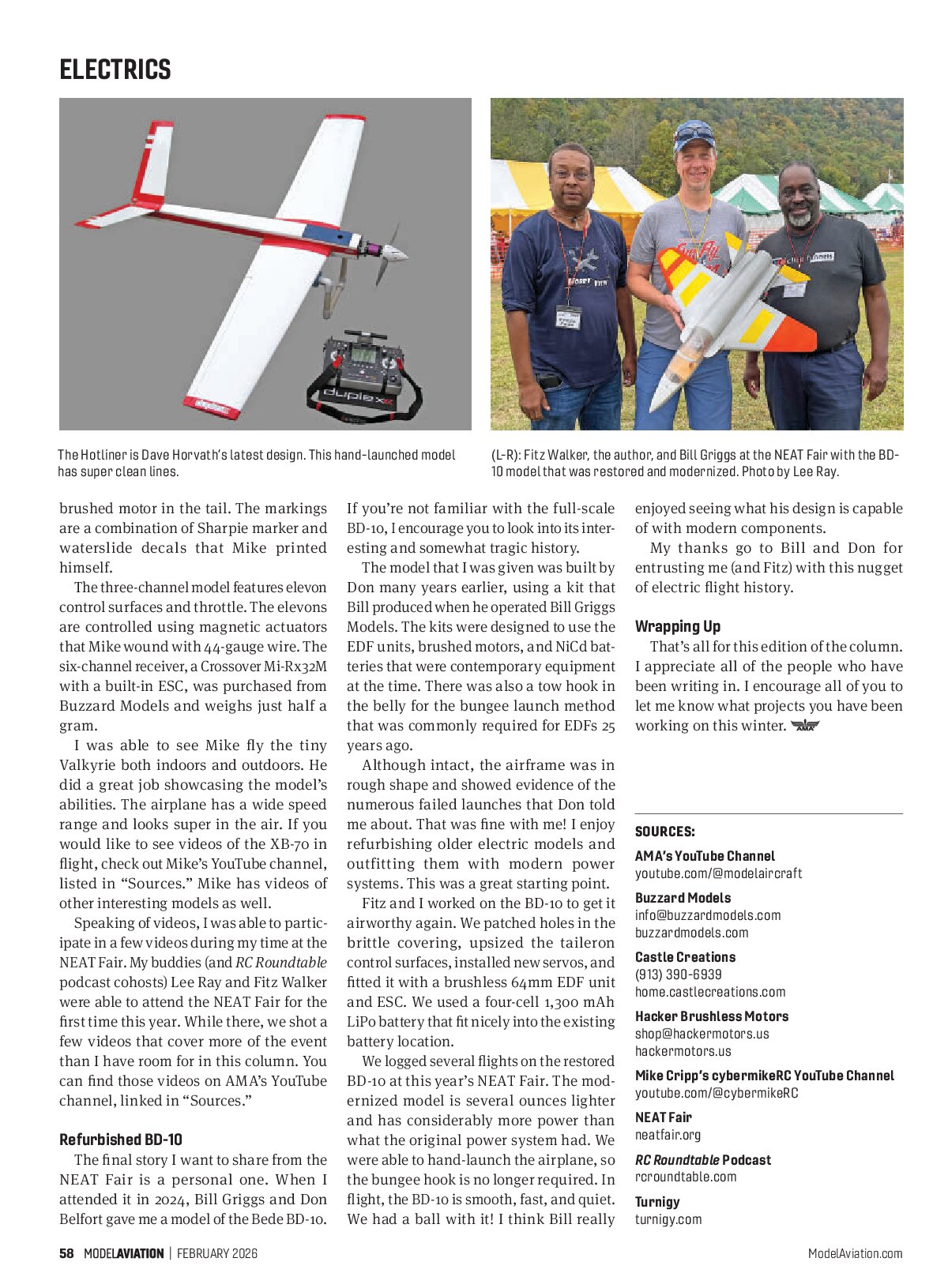
Marta and Dave Horvath provided information about Dave’s latest electric-powered model design called the Hotliner. This all-balsa airplane has a 59-inch wingspan and is covered with UltraCote film. The power system consists of a Hacker A40-10L outrunner motor, a Castle Creations Phoenix Edge Lite 100-amp ESC, and a Turnigy nano-tech 4S 3,300 mAh LiPo battery. The Hotliner weighs 3.5 pounds ready-to-fly.
Dave’s model does not have landing gear. It is designed to be hand-launched, and it features a belly skid to provide protection during landings. I really like the simple layout and clean lines of the Hotliner. I look forward to hearing about how it performs in the air!

Baby Valkyrie
The NEAT Fair is one of my favorite annual modeling events. Aside from the beautiful setting in the Catskill Mountains, there is always a wide variety of amazing electric-powered aircraft to admire. One of my favorite things about the NEAT Fair is that it attracts several of the world’s best builders and innovators of micro-RC models. This year was no exception.
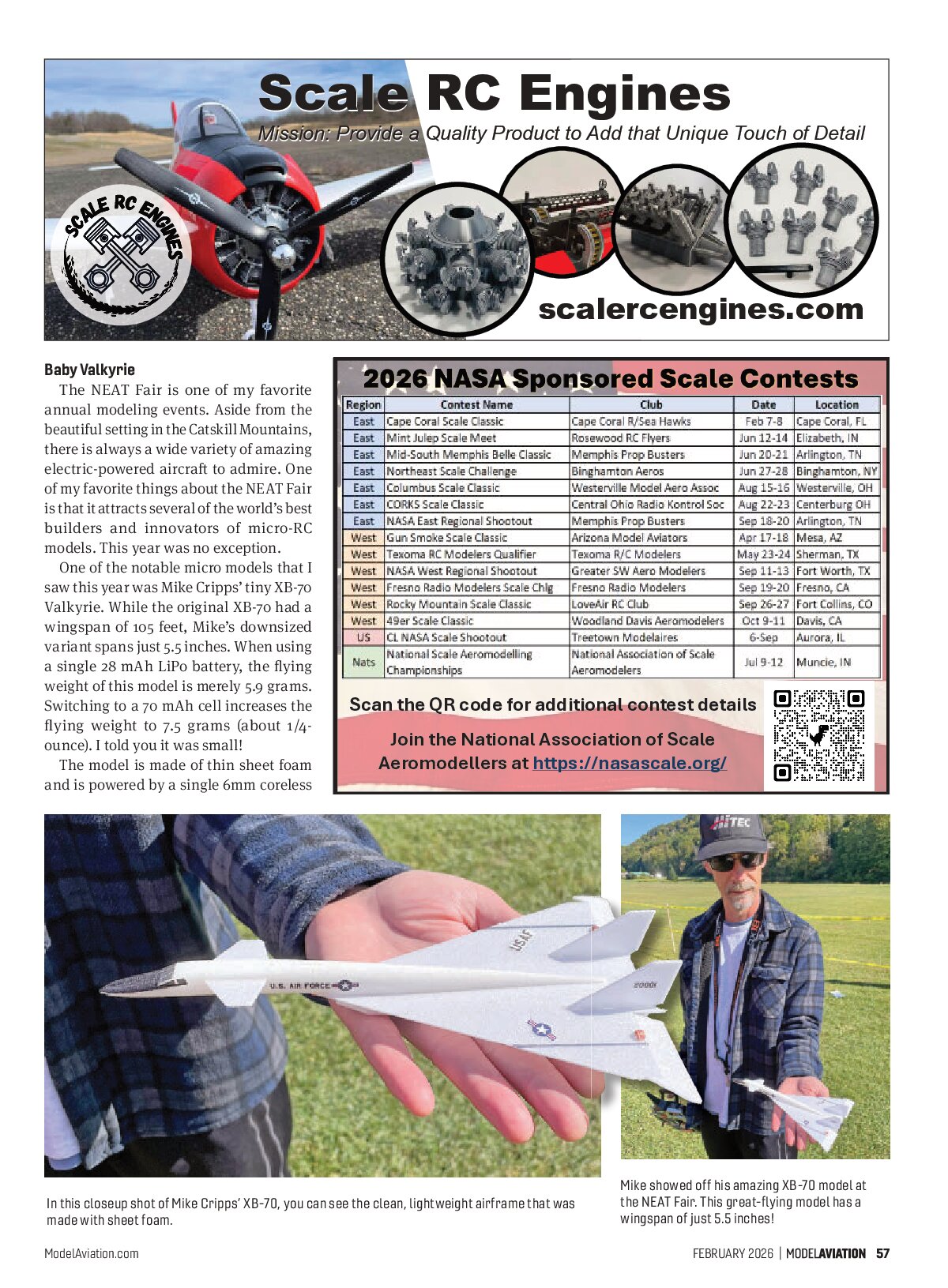
One of the notable micro models that I saw this year was Mike Cripps’ tiny XB-70 Valkyrie. While the original XB-70 had a wingspan of 105 feet, Mike’s downsized variant spans just 5.5 inches. When using a single 28 mAh LiPo battery, the flying weight of this model is merely 5.9 grams. Switching to a 70 mAh cell increases the flying weight to 7.5 grams (about 1/4-ounce). I told you it was small!
The model is made of thin sheet foam and is powered by a single 6mm coreless brushed motor in the tail. The markings are a combination of Sharpie marker and waterslide decals that Mike printed himself.
The three-channel model features elevon control surfaces and throttle. The elevons are controlled using magnetic actuators that Mike wound with 44-gauge wire. The six-channel receiver, a Crossover Mi-Rx32M with a built-in ESC, was purchased from Buzzard Models and weighs just half a gram.
I was able to see Mike fly the tiny Valkyrie both indoors and outdoors. He did a great job showcasing the model’s abilities. The airplane has a wide speed range and looks super in the air. If you would like to see videos of the XB-70 in flight, check out Mike’s YouTube channel, listed in “Sources.” Mike has videos of other interesting models as well.
Speaking of videos, I was able to participate in a few videos during my time at the NEAT Fair. My buddies (and RC Roundtable podcast cohosts) Lee Ray and Fitz Walker were able to attend the NEAT Fair for the first time this year. While there, we shot a few videos that cover more of the event than I have room for in this column. You can find those videos on AMA’s YouTube channel, linked in “Sources.”

Refurbished BD-10
The final story I want to share from the NEAT Fair is a personal one. When I attended it in 2024, Bill Griggs and Don Belfort gave me a model of the Bede BD-10. If you’re not familiar with the full-scale BD-10, I encourage you to look into its interesting and somewhat tragic history.
The model that I was given was built by Don many years earlier, using a kit that Bill produced when he operated Bill Griggs Models. The kits were designed to use the EDF units, brushed motors, and NiCd batteries that were contemporary equipment at the time. There was also a tow hook in the belly for the bungee launch method that was commonly required for EDFs 25 years ago.
Although intact, the airframe was in rough shape and showed evidence of the numerous failed launches that Don told me about. That was fine with me! I enjoy refurbishing older electric models and outfitting them with modern power systems. This was a great starting point.
Fitz and I worked on the BD-10 to get it airworthy again. We patched holes in the brittle covering, upsized the taileron control surfaces, installed new servos, and fitted it with a brushless 64mm EDF unit and ESC. We used a four-cell 1,300 mAh LiPo battery that fit nicely into the existing battery location.
We logged several flights on the restored BD-10 at this year’s NEAT Fair. The modernized model is several ounces lighter and has considerably more power than what the original power system had. We were able to hand-launch the airplane, so the bungee hook is no longer required. In flight, the BD-10 is smooth, fast, and quiet. We had a ball with it! I think Bill really enjoyed seeing what his design is capable of with modern components.
My thanks go to Bill and Don for entrusting me (and Fitz) with this nugget of electric flight history.

Wrapping Up
That’s all for this edition of the column. I appreciate all of the people who have been writing in. I encourage all of you to let me know what projects you have been working on this winter.
SOURCES
- AMA’s YouTube Channel
- youtube.com/@modelaircraft
- Buzzard Models
info@buzzardmodels.com - buzzardmodels.com
- Castle Creations
(913) 390-6939 - home.castlecreations.com
- Hacker Brushless Motors
shop@hackermotors.us - hackermotors.us
- Mike Cripp’s cybermikeRC YouTube Channel
- youtube.com/@cybermikeRC
- NEAT Fair
- neatfair.org
- RC Roundtable Podcast
- rcroundtable.com
- Turnigy
turnigy.com