
SAFETY COMES FIRST

CHECK,
PLEASE!
RANGE
CHECK,
THAT IS
By Dave Gee | safetycolumn@cs.com
CONFESSION TIME: I have sometimes been guilty of not performing a proper range check on my RC aircraft as the instruction manual advises. Skipping this easy step adds an unnecessary risk. Depending on luck is a rookie mistake that can lead to big trouble.
The Bayou City Flyers club of Houston, Texas, has a pretty spectacular newsletter called NOTAM. The copy I saw was 45 pages and chock full of information and photos. It had an in-depth article about range-checking RC systems before flight. This club is so serious about it that it painted lines 30 meters apart at the field to help pilots with their range checks.
We’ve all heard of incidents where an RC system worked fine on the bench (inches from the transmitter), and then lost the signal shortly after takeoff. Crash damage can make it tough to determine an exact cause, but sometimes an investigation finds some wiring problem that would only have turned up during a formal range check. Electronic or linkage trouble can be hard to confirm in such cases. These are all points in favor of checking beforehand.
Various RC manufacturers have slightly different test recommendations, but 30 meters seems to be a fairly standard range-check distance. I did an informal survey at my local field and found a number of pilots who have never actually performed this important test on their models. It isn’t usually a part of a routine preflight inspection, but a new system or one that has been altered, repaired, or taken out of seasonal storage should certainly be given a formal range check.
Please reread your radio’s instruction manual and follow the instructions for a formal range check before your next flight. Out of all of the readers who
do so, there might well be a few who find trouble with a system that worked fine on the bench. Maybe one of those pilots will be you!

Safe at Home
Don Linarello and several other readers wrote to me about how to safely store batteries. Modern flight packs hold lots of energy, and things sometimes go wrong with them. When that happens, all of that energy can be released in the form of flame, heat, and hot gasses. Without a proper container, it can be big trouble.
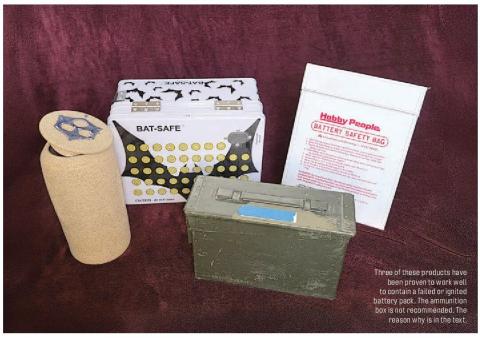
There are several good options for battery containers that will absorb or control the release of heat and gasses. Specially designed commercial boxes and bags are on the market. These products have gotten pretty good and have been tested in the lab and in real-world situations. I have purchased several different ones and use them all.
Hardcase, vented boxes, such as the Bat Safe, are proven solutions. Insulated envelopes are great for transporting batteries, and there are many online videos showing how well they handle a battery failure. I also have a ceramic pot with a loose, locking lid. This strategy has also proven to be effective. It’s funny how the ancient Etruscans came up with such a swell container for our 21st century technology!
One type of container that I do not recommend is the military ammunition box. Sure, it’s made of sturdy steel with a locking lid, but the sides transmit heat too well. If a battery fails, an ammunition box can get so hot that it ignites whatever is nearby.
See Your Way Clear
There is no safety topic more important than eye protection! I recently mentioned my own frequent mishaps with CA glue. I spill CA on my pants, shirt, and hands, so it’s no surprise that sometimes a splash of glue heads for my eyes. This is just one more reason to wear eye protection when working on model aircraft.
Tex Newman sent an email that reads:
“Always enjoy your column. My glasses have three spots of CA on the right lens. I can’t remember how they got there, but the eye was kept safe. I lost an eye when I was 5 years old; that one is plastic. CA wouldn’t have done it any good either. A good warning.”
Tex knows better than most of us how important those safety glasses are! I’ll take his advice anytime. Building and flying our models can result in shards, dust, chemicals, and other bad stuff reaching our eyes. Let it bounce off of a sturdy pair of safety glasses and save your vision. Remember, prescription lenses are easily used with safety glasses or can be built in, similar to the ones that I wear.
Mystery Airplane Is a Weirdo!
Take a guess at the mystery airplane in the photograph and you’ll win two special prizes.
This experimental fighter was intended to ride along with a bomber and drop free to defend it against enemy fighters. I couldn’t believe it was real until I visited the National Museum of the United States Air Force in Dayton, Ohio, and touched the airplane in person. This parasite jet was very successful as a plastic model but not
SAFETY COMES FIRST
so much as a combat airplane. Only two were built. Please send your guess to the email address at the beginning of this column.
Free Plans for Updated Starter Bench
Steve Rogers is the guy who so generously allowed me to give away his drawing for a classic RC field starter bench. That was a decade ago! Who knows how many pilots have avoided an injury because of Steve’s kindness and generosity?
He recently updated the drawings with more economical wood sizes since lumber prices have gone up. The new version 10 comes in two sizes and is a fine piece of safety gear whether you fly gas or electric airplanes. I built a tiny one directly from his plans to use with my Peanut models, just for fun.
Play the mystery airplane game and you’ll get digital plans for both sizes of Steve’s latest starter bench.
Bonus Prize: Wizza

Wizza is a rare, vintage FF Sport model from the U.K. Get free kit parts scans via the mystery airplane game. It can be scaled up for electric RC and foam construction.
Seated comfortably on the reduced-size starter bench is a super rare, vintage Wizza Free Flight (FF) Sport model. My reproduction of this vintage sport airplane from the U.K. flew quite nicely and looks like it would go even better if it is enlarged and given electric power and radio control. I won’t complain if you switch to foam construction, if that’s how you roll. Color scans of the ARF parts will be emailed to all mystery airplane contestants.

Guess the name of this weird, little parasite fighter and win digital plans for a starter bench, plus a Wizza FF model. Use the email address at the beginning of this column.
SOURCES:
Bayou City Flyers
bayoucityflyersrc.com
Bat Safe
bat-safe.com
“Wizza vintage model airplane Reproduction, indoor flight”
YouTube
youtube.com/shorts/Q48YVejk54U
National Museum of the United States Air Force
(937) 255-3286
nationalmuseum.af.mil


