RC SOARING

MOTIVATED
BY A DREAM
By Gordon Buckland | gordon@gatorf3b.com
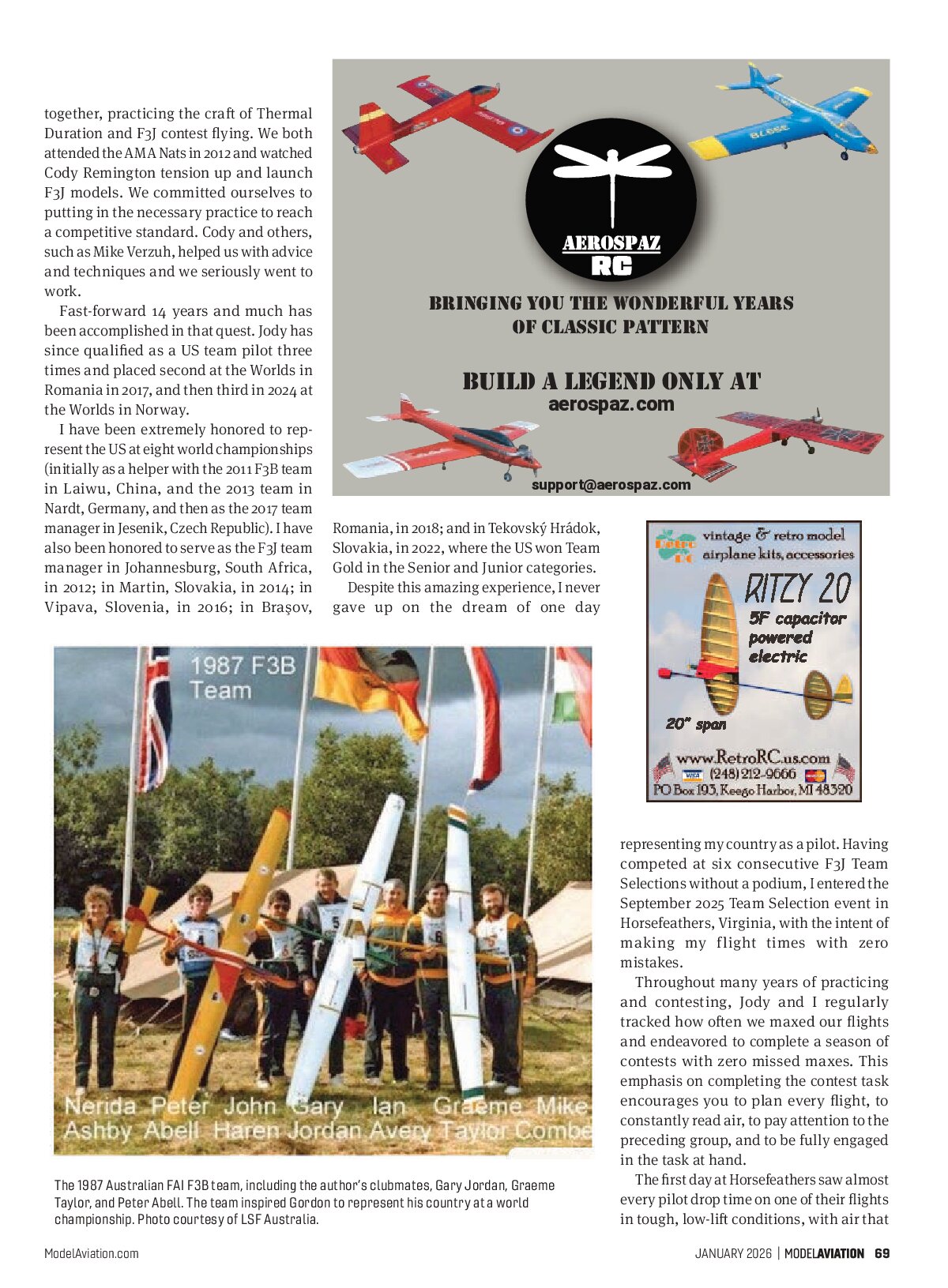
IN 1987, two of my Brisbane, Australia, clubmates represented Australia at the FAI F3B World Championship for Model Gliders, and I was very envious of them. I never forgot that feeling, and I dreamed of the day that I might also represent my country.
As a teenager, I learned to fly RC sailplanes mostly on my own in rural Australia, where there were few other RC pilots. My first time flying against others was in a sailplane contest in 1981 at the Central Queensland Sailplane Championships, and after placing third with a Maestro Mk3, I was hooked on contesting.
I joined the Brisbane Model Soaring Club and was introduced to F3B. Learning the speed and distance tasks was challenging, but I loved it and began competing with my new clubmates. I managed to win the Queensland F3B Championships in 1983 with a Southern Sailplanes Ricochet, and I also placed second in 1987. It was that same year that Gary Jordan and Graeme Taylor qualified for the Australian F3B team and went to Germany for the Worlds—I wished so much that I was with them.
For the next 22 years, I did not participate in RC Soaring because I became engrossed with raising children, and in 1999, I emigrated to the US with my family. It wasn’t until 2009 that I came across a roadside sign in Orlando, Florida, that read “Soaring Contest” and rediscovered Soaring, rekindling my dream to represent my country.
That was 16 years ago, and I quickly began flying regular RC Soaring contests in Florida. I met another keen sailplane pilot, Jody Miller, and for some years, we shared countless weekends at the Orlando Buzzards field
together, practicing the craft of Thermal Duration and F3J contest flying. We both attended the AMA Nats in 2012 and watched Cody Remington toss up and launch F3J models. We committed ourselves to putting in the necessary practice to reach a competitive standard. Cody and others, such as Mike Verzuh, helped us with advice and techniques and we seriously went to work.
Fast-forward 14 years and much has been accomplished in that quest. Jody has since qualified as a US team pilot three times and placed second at the Worlds in Romania in 2017, and then third in 2024 at the Worlds in Norway.
I have been extremely honored to represent the US at eight world championships (initially as a helper with the 2011 F3B team in Laiwu, China, and the 2013 team in Nardt, Germany, and then as the 2017 team manager in Jesenik, Czech Republic). I have also been honored to serve as the F3J team manager in Johannesburg, South Africa, in 2012; in Martin, Slovakia, in 2014; in Vipava, Slovenia, in 2016; in Brașov, Romania, in 2018; and in Těkovský Hrádok, Slovakia, in 2022, where the US won Team Gold in the Senior and Junior categories.

Despite this amazing experience, I never gave up on the dream of one day representing my country as a pilot. Having competed at six consecutive F3J Team Selections without a podium, I entered the September 2025 Team Selection event in Horsefeathers, Virginia, with the intent of making my flight times with zero mistakes.
Throughout many years of practicing and contesting, Jody and I regularly tracked how often we maxed our flights and endeavored to complete a season of contests with zero missed maxes. This emphasis on completing the contest task encourages you to plan every flight, to constantly read air, to pay attention to the preceding group, and to be fully engaged in the task at hand.
The first day at Horsefeathers saw almost every pilot drop time on one of their flights in tough, low-lift conditions, with air that
RC SOARING

was very fickle at times. I managed to stay clean with moderately accurate landings to finish day one in second place behind David Bradley.
David, his brother, John, and Chris Saunders were putting on an F3J clinic throughout the contest, having mastered rocket launches (and pushing the clock on the back end) to score a series of amazing 9:58- and 9:59-second flights.
I knew entering day two that my slender lead over Jody, who was in third place, and Josh Glaab, who was in fourth place, might not be enough to make the podium if I was unable to lift my landing game. F3J has close margins with landing points that are absolutely crucial to the outcome.
Day two conditions were easier, but maxes were still no gimme. A wind change required reversing the launch direction and, at times, the thermals were so light that numerous flights were saved at just above treetop height for what seemed like an eternity, without gaining any significant altitude.
With the drop taking effect and all 12 10-minute rounds complete, day two ended with Josh leapfrogging me to be 3.4 points ahead in second place. My lead over Jody’s fourth place evaporated to just 3.5 points.
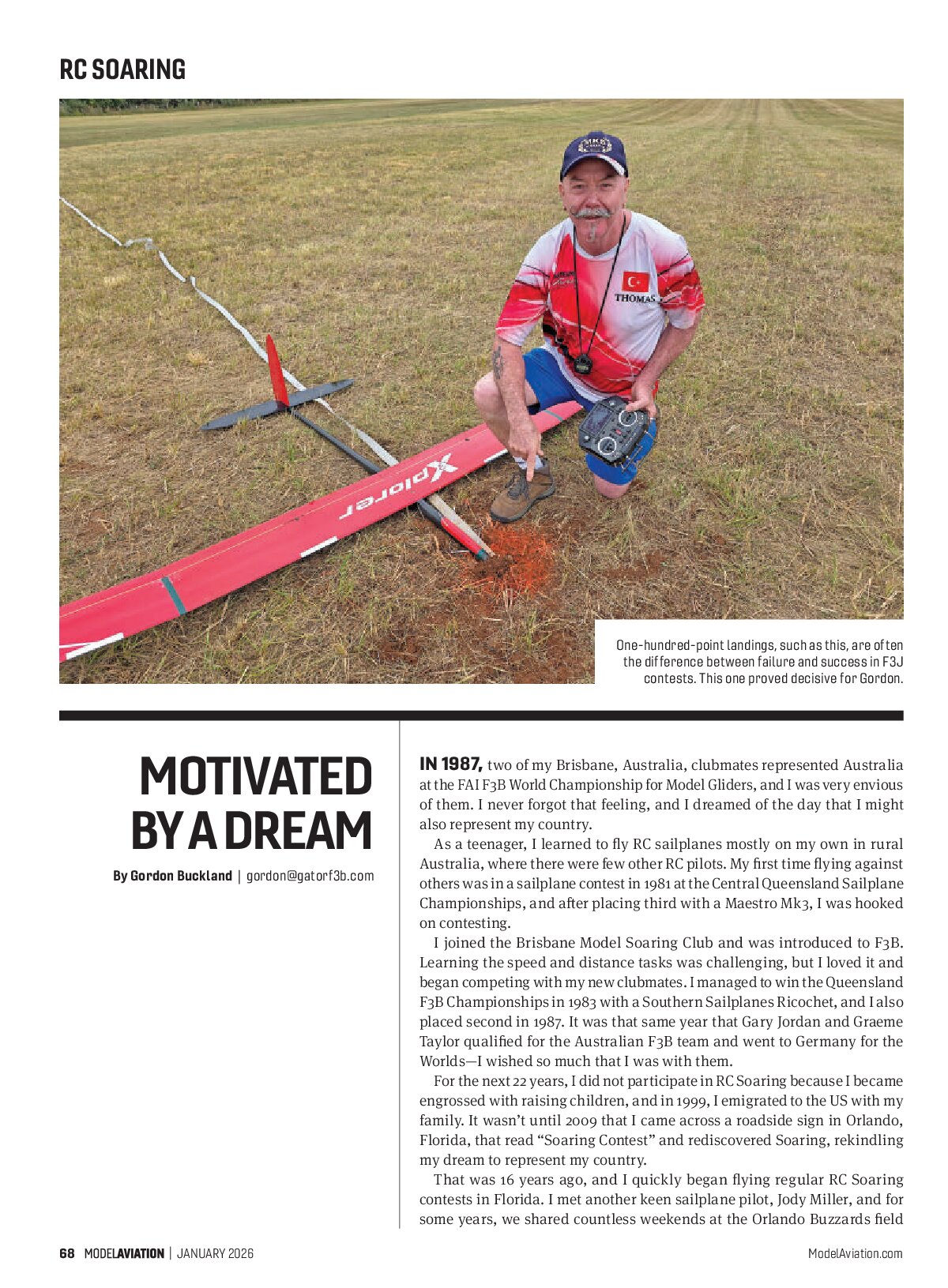
On Sunday, 15-minute rounds were the order of the day, and with a determined attitude, I took full tows to ensure my chances to max. I did my best to concentrate hard in the landing zone. Starting round 15 in third place, I was four points behind Josh and held a 2.1-point slender lead over Jody, who was in fourth place. My round 15 97-point landing was not enough against David; I dropped to fourth and .6 points behind Jody with just one round to fly.
It seemed like my conquest was over unless I could achieve the impossible. Flying in the first group in round 16, I stuck to my game plan and executed another solid max, but another mediocre 97 landing let me down again to drop another 1.2 points. My fate was now left up to the others to complete their round 16 flights.
Josh flew in group two and, inexplicably after an uneventful thermal flight, his extremely reliable landing routine went astray and he landed seconds early, only hitting a 95 landing to drop 8.1 points below the 1,000.
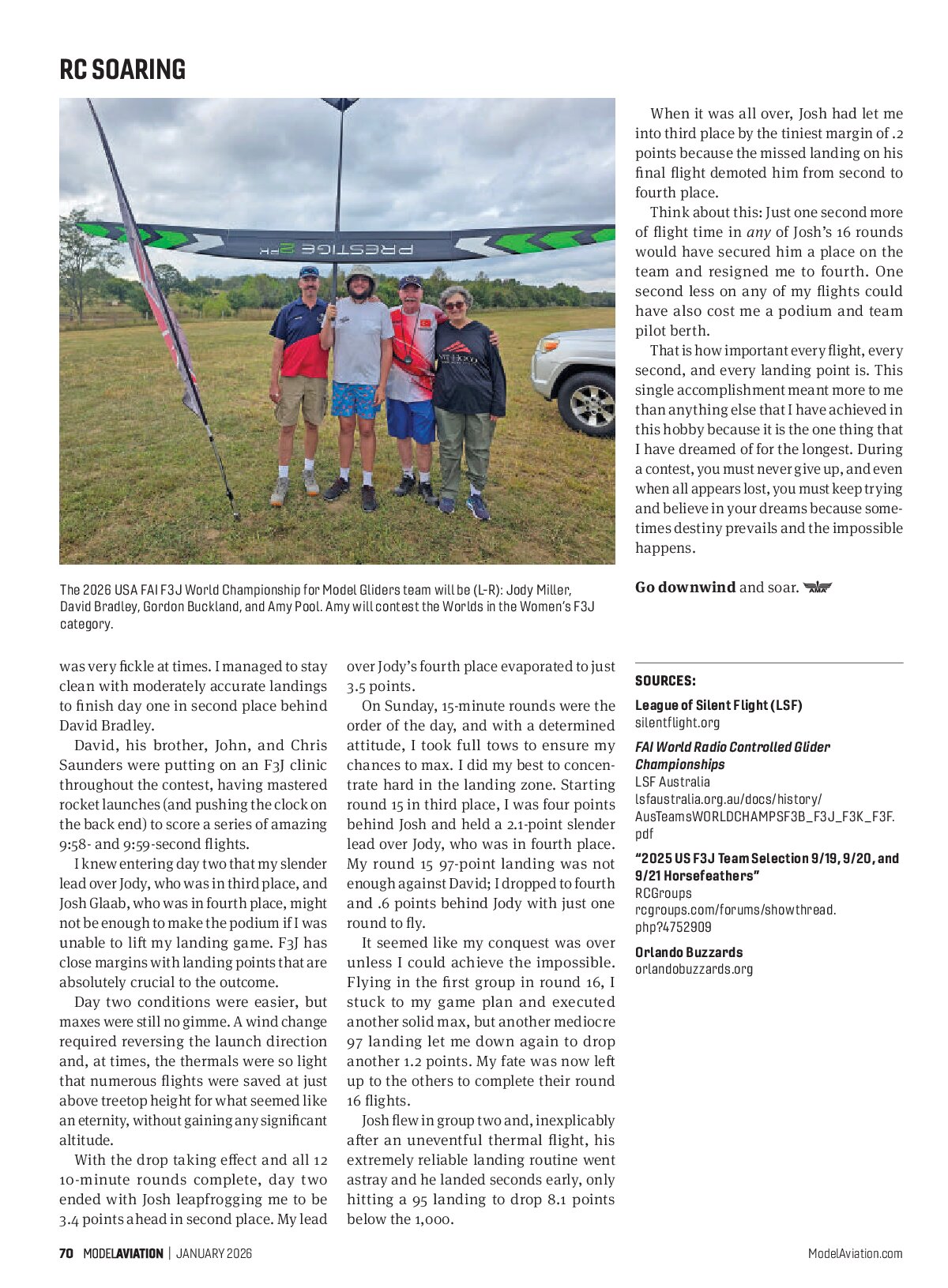
When it was all over, Josh had let me into third place by the tiniest margin of .2 points because the missed landing on his final flight demoted him from second to fourth place.
Think about this: Just one second more of flight time in any of Josh’s 16 rounds would have secured him a place on the team and resigned me to fourth. One second less on any of my flights could have also cost me a podium and team pilot berth.
That is how important every flight, every second, and every landing point is. This single accomplishment meant more to me than anything else that I have achieved in this hobby because it is the one thing that I have dreamed of for the longest. During a contest, you must never give up, and even when all appears lost, you must keep trying and believe in your dreams because sometimes destiny prevails and the impossible happens.
Go downwind and soar.
SOURCES:
League of Silent Flight (LSF)
silentflight.org
FAI World Radio Controlled Glider Championships
LSF Australia
faiaustralia.org.au/docs/history/AusTeamsWORLDCHAMPSF3B_F3J_F3K_F3F.pdf
“2025 US F3J Team Selection 9/19, 9/20, and 9/21 Horsefeathers”
RCGroups
rcgroups.com/forums/showthread.php?4752909
Orlando Buzzards
orlandobuzzards.org