
MEMORIES OF MIKE LANGLOIS
By Tim Lampe | tim.lampe@hotmail.com

MIKE LANGLOIS had a massive effect on RC Pylon Racing and the people in it. The hole created by his passing in 2022 has only continued to expand. Mike affected so many people in so many positive ways that I cannot possibly even know, let alone describe it. I spoke with a few of the people who were especially close to Mike and will do my best to share their thoughts and memories.
For those who are reading along and might not know Mike, the quickest way to describe him would be to say that he was the guy who made the Nelson engine, one of the two engines specified to compete in Quarter 40 (Q-40), the pinnacle of three-pole RC Pylon Racing in the US.
Outside of family ties, Jim Katz was probably Mike’s closest friend. I got into Pylon Racing about the same time Jim was stepping back, but I know him and have spoken with him several times throughout the years. While talking with Jim over the phone, he had to pause a few times to compose himself, but there was laughter too.
Mike and Jim first met at the Lake Charles, Illinois, Nats around 1974 while competing in the various Control Line (CL) Speed events against the likes of Bob Violett and Bob Brogdon. As Jim explained, Mike was just a new kid on the scene, but even as a young teenager, it was obvious that his knowledge and skills were exceptional because he was already beginning to win contests.
Jim and Mike got to know each other well and were competing in Formula 1 (F1) by the end of the 1980s. They eventually took up Q-40, venturing into FAI Pylon Racing as well. By that time, Mike was getting his first machine
shop running. With their skills on the Pylon Racing scene and Mike’s machining capabilities, they got in with Henry Nelson, testing and developing parts for his racing engines. They flew Henry’s early engines that were made with the very first crankcase castings.
Coming out of North Carolina State University, Mike worked for Haynes Hosiery Mills Company designing packaging and folding equipment, and then at Volvo White GMC Trucking building fixtures and cradles for packaging and production. Mike faded from the Pylon scene as he was starting his family with his wife, Mabel, and became more involved with building up the machine shop business after his nine-to-five day job. Mike and Jim continued to stay in contact over the phone and enjoyed racing homemade, foamie airplanes around a makeshift Pylon course outside of the fledgling shop.
Around the 2000s, Mike got back into Pylon Racing, while Jim worked with Henry Nelson performing various jobs, including the arduous task of chroming cylinder liners. Initially, they got back into racing Quickies but were eventually all-in with Q-40 racing again.
At this time, Henry decided to get out of the model engine business. With Mike’s vast Pylon Racing knowledge, his history with Henry, and his machine skills and capabilities with his shop, it was only natural that he take over, buying the rights

to the Nelson N-40 engine, which, I presume, was the impetus for his Aero Racing Engines company, a subdivision of Aero Precision Machine (APM).
It should be noted that APM was no ordinary machine shop. Because of Mike’s outstanding attention to detail and extraordinary eye for tight tolerances, the business thrived on jobs that other machine shops could not handle.
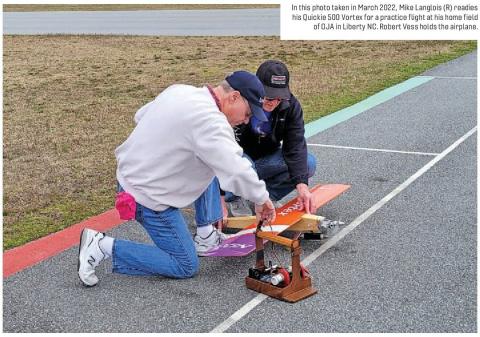
You can’t mention Mike without talking about Old Julian Airport, the Pylon Racing facility also known as OJA. When Mike was getting back into Pylon, he developed some properly on an old oil field, adding a runway and some pylons then naming it after a nearby defunct, full-scale landing strip of the same name. Maintaining the grass runway became cumbersome, so he invested more and had a 60- x 60-foot asphalt takeoff pad laid. Races were held at OJA after Mike met Charles Long, who developed timing and lap-counting equipment, including circuit boards with LED lights, computers, etc., which were all funded by Mike. Just about the time OJA was starting, the state of North Carolina and local
RC PYLON RACING

developers were on a mission to attract more businesses, working with Toyota to build a battery facility and targeting Mike’s property as an ideal location because of railroad access and other desirable features. Mike’s business prowess and the developer’s eagerness to accommodate Toyota led to a sweet trade, where he got a nicer piece of land that included a home, large, metal pole barns, and a big chunk of property. In addition, the developers paid for new bathroom/shower facilities and an extended runway and takeoff pad built to the standards of an interstate highway, which is the OJA we know today.
While much of what I got from Jim was Mike’s history, Jim also reassured me that, while he was known as the joker, Mike had

a great sense of humor as well. There was mention of a longstanding burp competition, but I’ll leave it at that. In later years, Mike and Jim would chat over the phone during their morning walks at 6 a.m. every Monday, Wednesday, and Friday.
Robert Vess first saw Jim during a Pylon Racing demonstration. He always looked up to Jim and, at some point, Jim even gave Robert a Pylon airplane.
In approximately 2004, Robert got into Giant Scale Pylon Racing. Jim helped him work on his engines and introduced him to Mike, who continued to help Robert with engine tuning. Robert had a first-row seat to Jim and Mike’s relationship and confided that Mike basically subsidized Pylon Racing in North Carolina, possibly even saving it on the Q-40 level by taking over Nelson engine production.
Talking with Robert, he emphasized Mike’s calm, cool demeanor. As the Nelson engine continued to flourish and Mike established his presence on the Pylon Racing circuit, Jim began to back away, making more room for Robert. Mike and Robert were always a pair during my frequent visits to OJA for practice.
As I wrote in my opening statement, Mike’s effect on Pylon Racing and the people in it cannot be adequately described here. Suffice it to say, Robert saw Mike give engines, airplanes, parts, time, and advice to many people just to get them going. Mike was most interested in seeing others succeed, and his passion for Pylon Racing cannot be overstated.
Robert and Jim both emphasized that one of Mike’s favorite pastimes was working on his crown jewel, the Nelson N-40 engine, spending hours alone in the shop perfectly matching and fitting pistons to cylinder liners.
Dub Jett had known Mike since he was 16 years old, when they were flying CL Speed in approximately the late 1960s to early ’70s. Even as a teenager, Mike’s stuff was as fast as the adults’. They worked together tuning engines, making propellers, and building tuned pipes.
Dub also told me that Mike was the first person to get a pulsejet engine to run on nitromethane; until then, they had been using anything that would burn, including paint thinner and benzine! Mike’s advancements pushed pulsejets well over the 200 mph barrier.
Dub recalled that Mike would appear—and just as quickly disappear—from Pylon Racing, likely because of his business and family commitments. Around 1983, Mike showed up to the Nats and won Best of Show with a Little Tony that he had built for F1 against models who had excelled in this endeavor most of their lives!
Among all of the stories that Dub had about Mike, he ended with, “The main thing about Mike was that he was a fantastic human being.”
SOURCES:
National Miniature Pylon Racing Association (NMPRA)
nmpra.net


