
JET PRECISION AEROBATICS NATS
By Jim Hiller | jetmodeler@earthlink.net
THE JET PRECISION Aerobatics National Championships was held at Logan County Airport in Russellville, Kentucky, in August 2025 and was a very successful competition for precision flying of jet and EDF models. Five classes of competition were flown, including FAI F3S, Silver, and F3S Basic for sport turbine-powered aircraft. A Scale jet class was flown with the appropriate flight sequences for Scale jets, and an EDF class had shortened aerobatic sequences for electric flight duration.
The contest director for this event was Archie Stafford, who was assisted by Wayne Matthews, along with Toby Silhavy, who served as the scorekeeper. On Saturday, Archie executed a candy drop for kids from his CARF-Models B-2 Bomber; you know the kids loved it!
The event was well attended by some serious competitors. It was great fun flying against peers at a wonderful flying site. Many of the competitors have years of experience, not just in jet competition but also in many other forms of model aircraft competition. These pilots are welcoming of new participants and jump in to help them out, so give it a try.
Next year’s event planning is underway. Check out the Jet Precision Aerobatics website, listed in “Sources.”
The event results are as follows:
F3S
- Mike McConville
- Craig Baker
- Wayne Matthews
Silver
- Bob Pannell
- Ric Musselman
- Rod Snyder
F3S Basic
- Frederick Mursch
- Deryck Taylor
- Al Davis
Scale Jet
- Mike McConville
- Archie Stafford
- Dan Baker
EDF
- Deryck Taylor
- Frederick Mursch
Jets Over Kentucky Scale Judging
Let’s move on to the Scale judging that took place during Jets Over Kentucky. For the last two years, Rod Snyder and I have been asked to static-judge the Scale aircraft. We stepped forward to formalize the judging process, which was quite a task. We only had about an hour and a half to judge 35 to 40 gorgeous models that were lined up during the break between the daytime and evening flying.
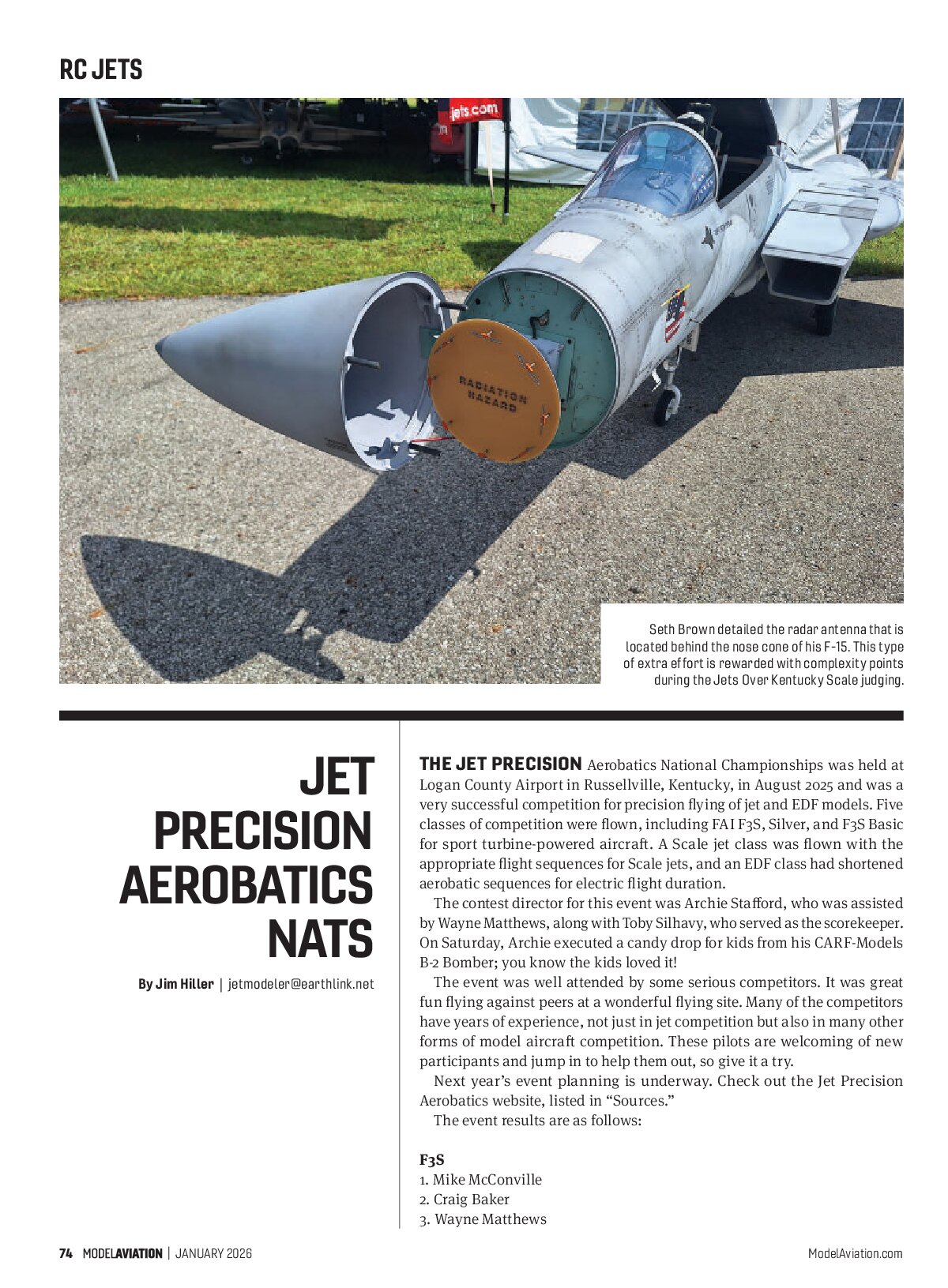
Rod and I have adopted our own judging categories based on our competition experiences. He has competed at numerous World Jet Masters, and I have judging experience from being the US judge during the World Jet Masters that was held in Dayton, Ohio, many years ago. The accuracy of the outline, color and markings, and craftsmanship are judged, along with additional categories, such as the cockpit and complexity. Complexity is unusual because it rewards the extra effort in the details that many builders have added to their models. It even includes judging the internal aircraft details found behind hatches and doors.
One basic requirement is that the model must have flown at the event prior to being submitted for judging. This has always been required at Jets Over Kentucky to be eligible for a trophy—airplanes are meant to fly.
This year during the Scale judging, many competitors had a picture of the full-scale aircraft of which their model had been built. This was a great aid in judging. Going forward, we will require a picture or two of the full-scale aircraft. Additional pictures to highlight extremely detailed items, such as landing gear, and areas behind hatches that have been replicated, will also be accepted. We are not asking for full-blown documentation books because we do not have the time to complete that level of Scale judging.
Items that hurt scores but are commonly seen include external control horns—this is a big way to lose points in any Scale event. Look at a flight picture of a full-scale aircraft; the control linkages are either hidden or very tight against the airframe, not hanging outside of the surface of the aircraft.
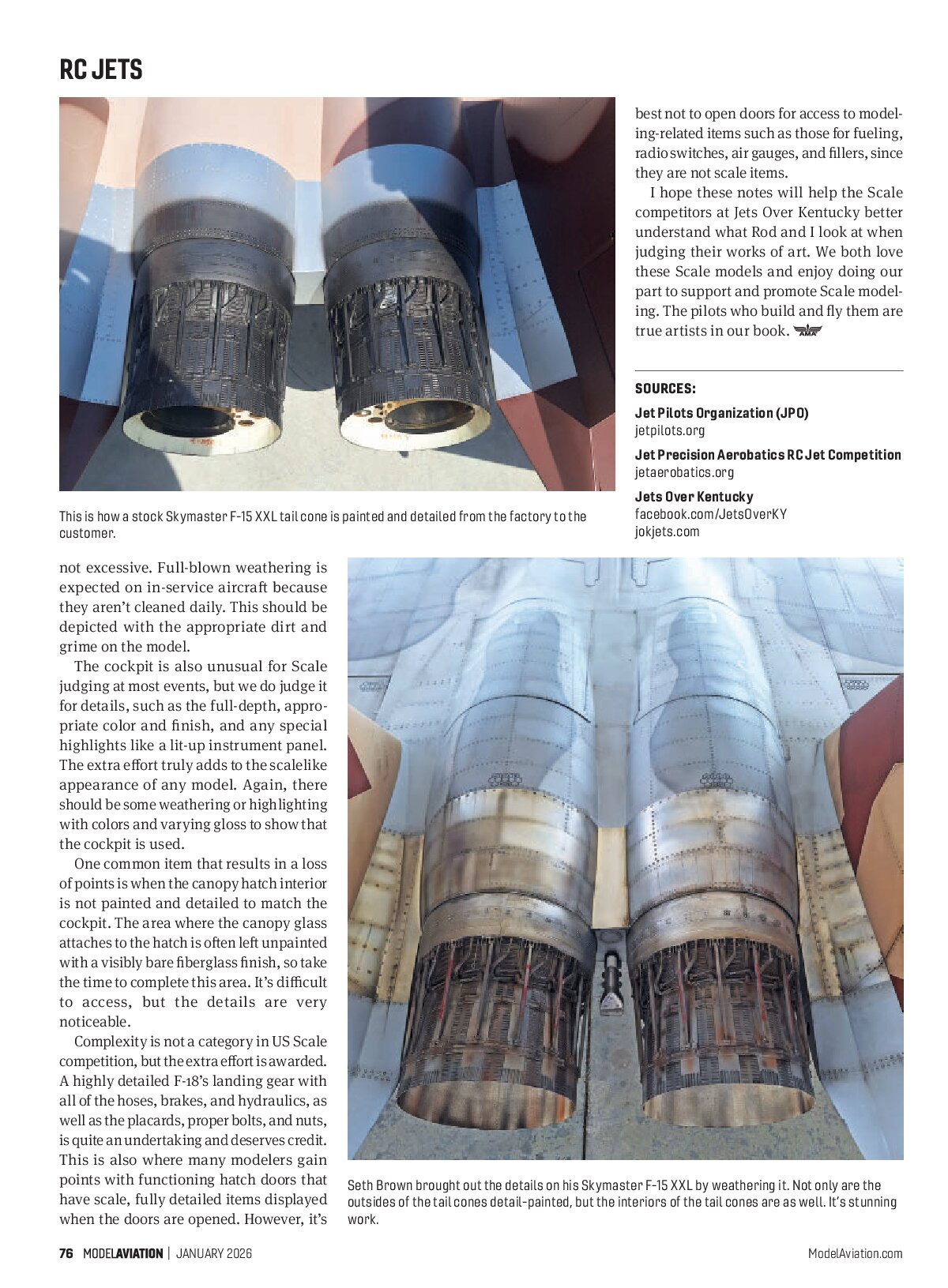
We judged many ARF prepainted airframes, along with models that were painted and finished by the builder. The criteria for both are the same when it comes to color and markings: Are they correct? This is where the pictures of the full-scale model will help the judges immensely in awarding the points that are so richly deserve. A pre-painted model might also require additional weathering to attain the look.
An example would be a replica of a show airplane, such as the Thunderbirds or Blue Angels. It might have a couple of rivets and door edges highlighted using a suitable color to attract the eye to the detail, but it’s
best not to open doors for access to model-ing-related items such as those for fueling, radio switches, air gauges, and fillers, since they are not scale items.
I hope these notes will help the Scale competitors at Jets Over Kentucky better understand what Rod and I look at when judging their works of art. We both love these Scale models and enjoy doing our part to support and promote Scale modeling. The pilots who build and fly them are true artists in our book.

not excessive. Full-blown weathering is expected on in-service aircraft because they aren’t cleaned daily. This should be depicted with the appropriate dirt and grime on the model.
The cockpit is also unusual for Scale judging at most events, but we do judge it for details, such as the full-depth, appropriate color and finish, and any special highlights like a lit-up instrument panel. The extra effort truly adds to the scalelike appearance of any model. Again, there should be some weathering or highlighting with colors and varying gloss to show that the cockpit is used.
One common item that results in a loss of points is when the canopy hatch interior is not painted and detailed to match the cockpit. The area where the canopy glass attaches to the hatch is often left unpainted with a visibly bare fiberglass finish, so take the time to complete this area. It’s difficult to access, but the details are very noticeable.
Complexity is not a category in US Scale competition, but the extra effort is awarded. A highly detailed F-18’s landing gear with all of the hoses, brakes, and hydraulics, as well as the placards, proper bolts, and nuts, is quite an undertaking and deserves credit. This is also where many modelers gain points with functioning hatch doors that have scale, fully detailed items displayed when the doors are opened. However, it’s best not to open doors for access to model-related items such as those for fueling, radio switches, air gauges, and fillers, since they are not scale items.

SOURCES:
Jet Pilots Organization (JPO)
jetpilots.org
Jet Precision Aerobatics RC Jet Competition
jetaerobatics.org
Jets Over Kentucky
facebook.com/JetsOverKY
jokjets.com