FOCAL POINT
Interested in sharing your handiwork? Visit ModelAviation.com for submission guidelines.

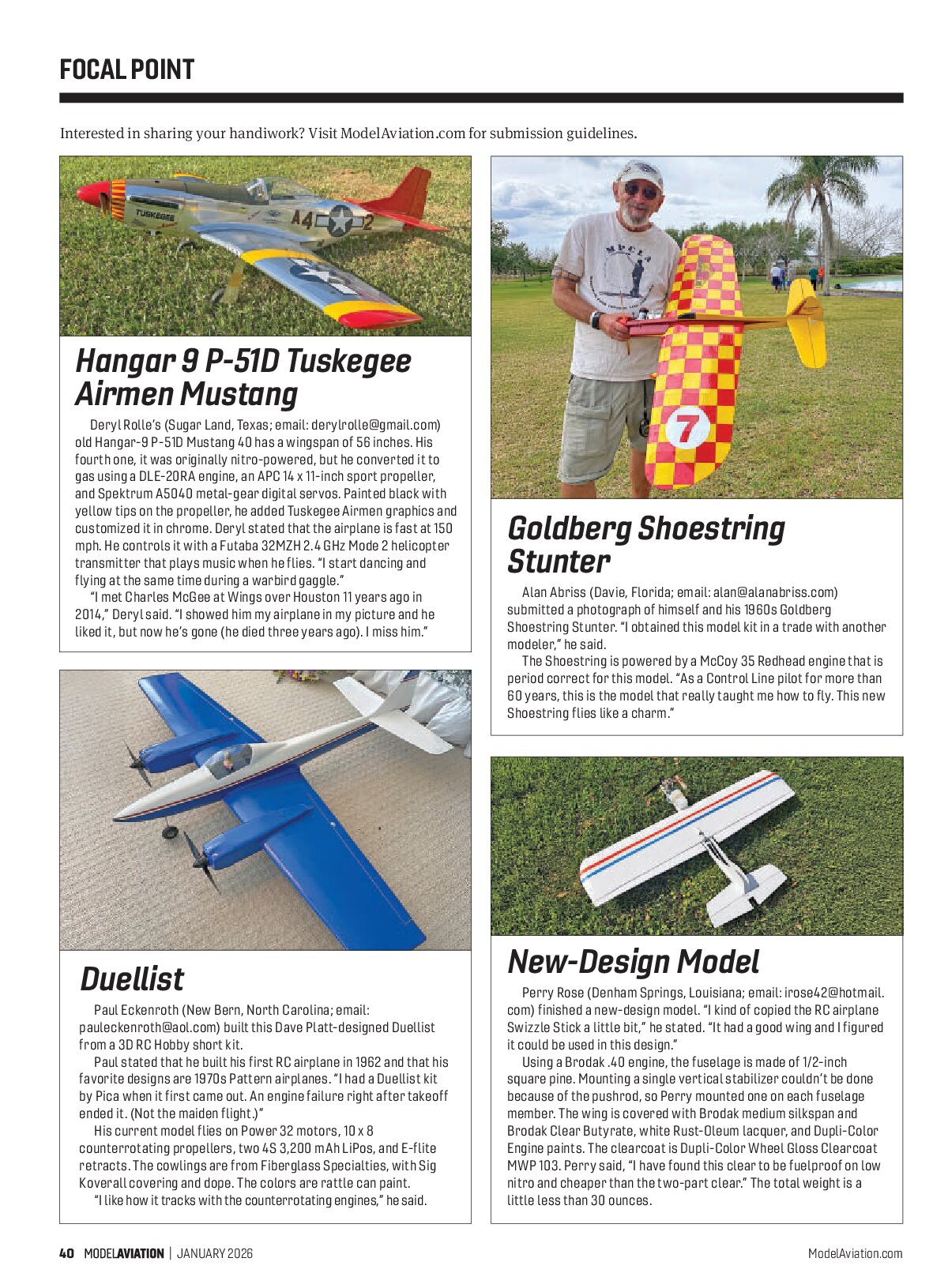
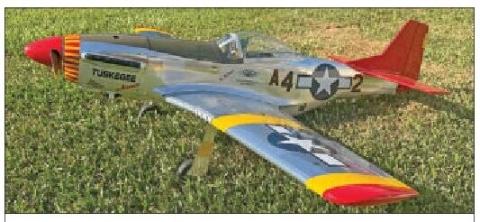
Hangar 9 P-51D Tuskegee Airmen Mustang
Deryl Rolle’s (Sugar Land, Texas; email: derylrolle@gmail.com) old Hangar-9 P-51D Mustang 40 has a wingspan of 56 inches. His fourth one, it was originally nitro-powered, but he converted it to gas using a DLE-20RA engine, an APC 14 x 11-inch sport propeller, and Spektrum A5040 metal-gear digital servos. Painted black with yellow tips on the propeller, he added Tuskegee Airmen graphics and customized it in chrome. Deryl stated that the airplane is fast at 150 mph. He controls it with a Futaba 32MZ 2.4 GHz Mode 2 helicopter transmitter that plays music when he flies. “I start dancing and flying at the same time during a warbird gaggIe.”
“I met Charles McGee at Wings over Houston 11 years ago in 2014,” Deryl said. “I showed him my airplane in my picture and he liked it, but now he’s gone (he died three years ago). I miss him.”

Goldberg Shoestring Stunter
Alan Abriss (Davie, Florida; email: alan@alanabriss.com) submitted a photograph of himself and his 1960s Goldberg Shoestring Stunter. “I obtained this model kit in a trade with another modeler,” he said.
The Shoestring is powered by a McCoy 35 Redhead engine that is period correct for this model. “As a Control Line pilot for more than 60 years, this is the model that really taught me how to fly. This new Shoestring flies like a charm.”

Duellist
Paul Eckenroth (New Bern, North Carolina; email: pauleckenroth@aol.com) built this Dave Platt-designed Duellist from a 3D RC Hobby short kit.
Paul stated that he built his first RC airplane in 1962 and that his favorite designs are 1970s Pattern airplanes. “I had a Duellist kit by Pica when it first came out. An engine failure right after takeoff ended it. (Not the maiden flight.)”
His current model flies on Power 32 motors, 10 x 8 counterrotating propellers, two 4S 3,200 mAh LiPos, and E-flite retracts. The cowlings are from Fiberglass Specialties, with Sig KoverAll covering and dope. The colors are rattle can paint.
“I like how it tracks with the counterrotating engines,” he said.

New-Design Model
Perry Rose (Denham Springs, Louisiana; email: irose42@hotmail.com) finished a new-design model. “I kind of copied the RC airplane Swizzle Stick a little bit,” he stated. “It had a good wing and I figured it could be used in this design.”
Using a Brodak .40 engine, the fuselage is made of 1/2-inch square pine. Mounting a single vertical stabilizer couldn’t be done because of the pushrod, so Perry mounted one on each fuselage member. The wing is covered with Brodak medium silkspan and Brodak Clear Butyrate, with Rust-Oleum lacquer, and Dupli-Color Engine paints. The clearcoat is Dupli-Color Wheel Gloss Clearcoat MWP 103. Perry said, “I have found this clear to be fuelproof on low nitro and cheaper than the two-part clear.” The total weight is a little less than 30 ounces.

Skybench Big Bird XL
Harjit Singh (Redmond, Washington; email: zeetahhs@hotmail.com) built his Skybench Big Bird XL in spurts over a period of eight years. It has a wingspan of 140 inches, is an all-balsa kit, and weighs approximately 1,200 grams.
The color scheme was selected to maximize visibility, including being able to tell which way it is pointed. “I am happy to report that the color scheme works quite well,” Harjit said. To make it convenient to fly, it has an electric motor that can get it to a cruising altitude in about 25 seconds. It does a good job of indicating lift by raising its wing, and despite the large wingspan, it will turn on a dime and easily stay within a thermal. The wing halves slide onto a main carbon-fiber rod and a secondary metal rod, and are retained using plastic bolts. The wing has spoilers that are deployed during landing to reduce lift; otherwise, it will just keep floating!
“My father introduced us kids to model aviation, among other hobbies,” Harjit noted. “I have been involved with model cars/helicopters/airplanes (chuck, rubber band-powered, Control Line—whip and powered—Free Flight, and RC) since I was around seven years old—close to 50 years ago!”

Turboprop B-17 Fire Bomber
Stan Burak (Lake Saint Louis, Missouri; email: stblurak1@gmail.com) sent in a photo of his model of a turboprop B-17 fire bomber that flew in 1970. He modified it from Pat Tritle’s “Build the B-17F” construction article that was featured in the March 2024 issue of Model Aviation. “The full-scale aircraft was powered by Rolls-Royce Dart engines from a parked Vickers Viscount. It was done for reliability, but the additional 400 horsepower and it being 500 pounds lighter for each engine could not have hurt,” he said. “I had to build the model because I designed the 48-inch engine mounts in 1969. It was a fun and interesting project.”
With a wingspan of 60 inches, the motors are BadAss BA-2305-1050s using 20-amp Lite ESCs, with a 3S 2,200 mAh LiPo battery. The total weight is 4 pounds, 6 ounces. The tapered mount cover cowling is fiberglass, while the Dart cowlings are made from Park Flyer Plastics 2 x 14 fuel tanks. The model was covered in silkspan.
Stan said, “After a lot of years thinking about it, it is finally finished, and I hope to fly it soon.”

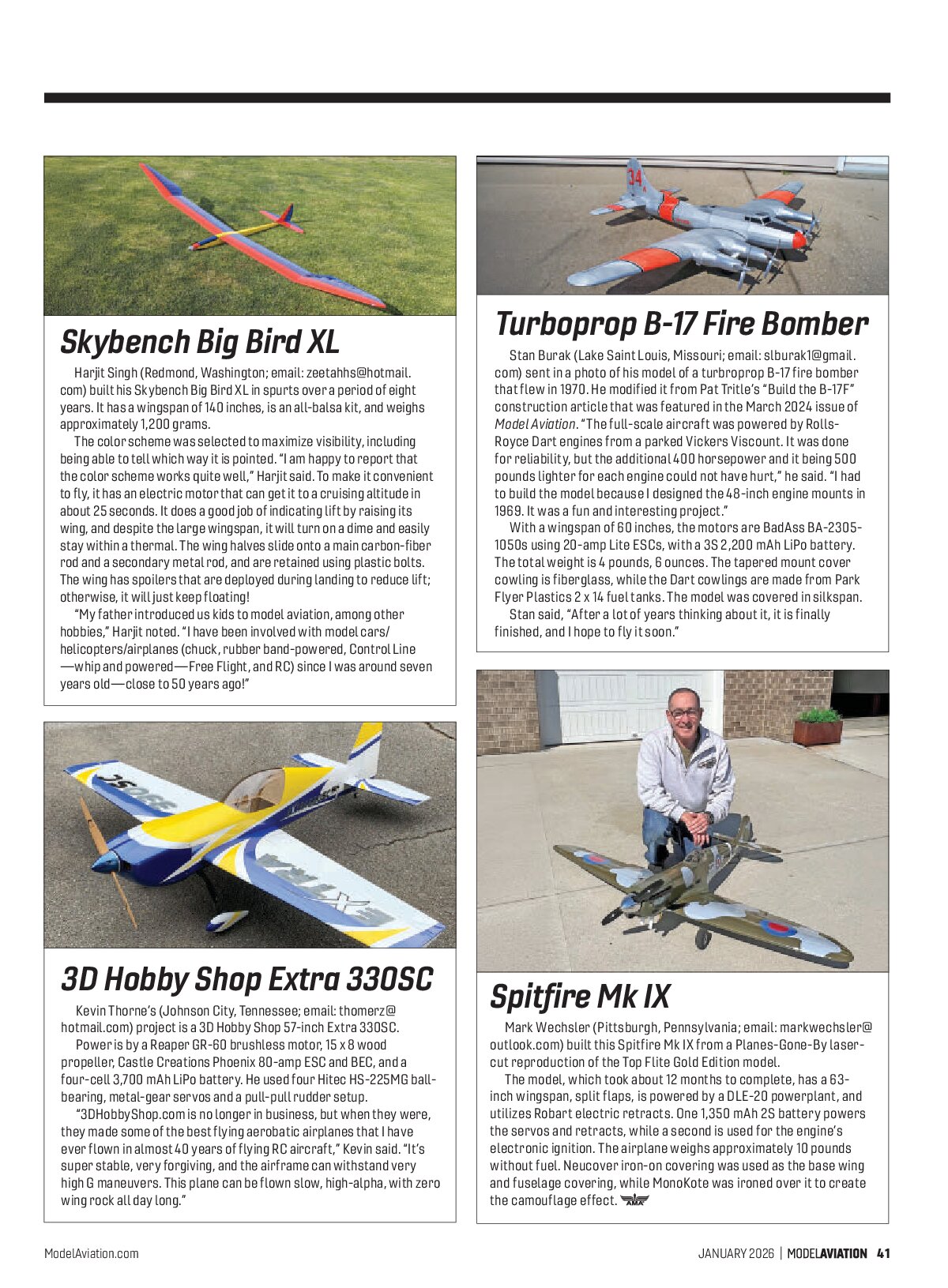
3D Hobby Shop Extra 330SC
Kevin Thorne’s (Johnson City, Tennessee; email: thomenz@hotmail.com) project is a 3D Hobby Shop 57-inch Extra 330SC. Power is by a Reaper GR-60 brushless motor, 15 x 8 wood propeller, Castle Creations Phoenix 80-amp ESC and BEC, and a four-cell 3,700 mAh LiPo battery. He used four Hitec HS-225MG ball-bearing, metal-gear servos and a pull-pull rudder setup.
“3DHobbyShop.com is no longer in business, but when they were, they made some of the best flying aerobatic airplanes that I have ever flown in almost 40 years of flying RC aircraft,” Kevin said. “It’s super stable, very forgiving, and the airframe can withstand very high G maneuvers. This plane can be flown slow, high-alpha, with zero wing rock all day long.”

Spitfire Mk IX
Mark Wechsler (Pittsburgh, Pennsylvania; email: markwechsler@outlook.com) built this Spitfire Mk IX from a Planes-Gone-By laser-cut reproduction of the Top Flite Gold Edition model. The model, which took about 12 months to complete, has a 63-inch wingspan, split flaps, is powered by a DLE-20 powerplant, and utilizes Robart electric retracts. One 1,350 mAh 2S battery powers the servos and retracts, while a second is used for the engine’s electronic ignition. The airplane weighs approximately 10 pounds without fuel. Neucor iron-on covering was used as the base wing and fuselage covering, while MonoKote was ironed over it to create the camouflage effect.