AROUND THE PATCH

NEAT
FAIR 2025
HIGHLIGHTS
By Thayer Syme | thayer@flying-models.com
REGULAR READERS ARE likely well aware of the NEAT Fair. Known more formally as the Northeast Electric Aircraft Technology Fair, this annual gathering is held the second full week of September in New York’s famed Catskill Mountains.
The NEAT Fair is presented by the Silent Electric Flyers of Long Island (SEFLI) and hosted at the Peaceful Valley Campground in Downsville, New York. The site is nearly ideal for model flying—especially so with a week of spectacular weather.
Typical of most annual modeling events, the NEAT Fair is a proxy family reunion for many, and more than 260 pilots came in 2025 to enjoy the camaraderie of friends, both old and new.
It is impossible to cover the entire NEAT Fair in a single column, so I’ll present a different tack this month and talk about a couple of personal highlights that gave the larger event an extra boost for me this year.
First and foremost, NEAT is about friendships. This year had an extra layer of frosting because several friends traveled from as far away as Wisconsin, Texas, and Colorado. That’s a significant commitment of time, energy, and expense. I hope it was more than worth the effort, and you will all be back again soon. Block out September 14-20, 2026, if you want to start planning now!
A Tale of Two Models
This year also saw the culmination for a pair of projects near and dear to my heart, with roots stretching back decades.
Grand Daddy-O
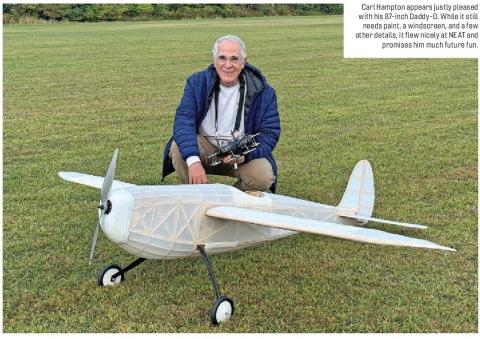
First up is Carl Hampton’s giant-scale Daddy-O. Dripping with Golden Age charm, the Daddy-O is not—as some have believed—a Scale design. It was originally sketched by Jason McGuire in the mid-1990s as a rubber-powered Embryo-class Free Flight (FF) model after a long evening pouring through The Golden Age of Air Racing.
As an aside, The Golden Age of Air Racing, by S.H. “Wes” Schmid and Major Truman Weaver, is an epic volume with more than 550 pages. It’s a must-have library addition for any fan of prewar air racers. Now out of print, it remains available on the secondary market.
I was immediately mesmerized when Jason first introduced the bare Daddy-O bones at the field one day, and all the more so a couple of weeks later when he had it ready to fly. I immediately knew I would build one someday.
That day finally arrived in the early 2000s when I doubled the size for my version and published it as an RC park flyer spanning 32 inches. A few years later, I enlarged it again to 52-1/2 inches.
My larger Daddy-O has remained a favorite flyer on both wheels and floats, so I was more than happy to advise when Carl initially mentioned that he wanted to build a Daddy-O as his first giant-scale model.
Carl’s new Daddy-O spans 87-1/2 inches and weighs 10-1/2 pounds with a little more than 1,200 sq. in. of wing area to carry it all. Carl is flying with Hitec’s D645MW servos and an Aurora 9 transmitter. A Cobra 4130/20 motor from Innov8tive Designs does the honors, spinning an APC 20 x 8 or 18 x 10 propeller, with 5S and 6S 5,000 mAh battery packs, respectively. He reports little difference between the two power setups.
Carl graciously shared the transmitter at NEAT, and this latest Daddy-O proved to be everything we both expected.
While airworthy, it is not yet done. There is still some weight to add with paint, a windscreen, and a few additional finishing details. We have no doubt that it will carry it all with ease. Look for additional photos and information in the future once it’s completed.
Revisiting the Drake
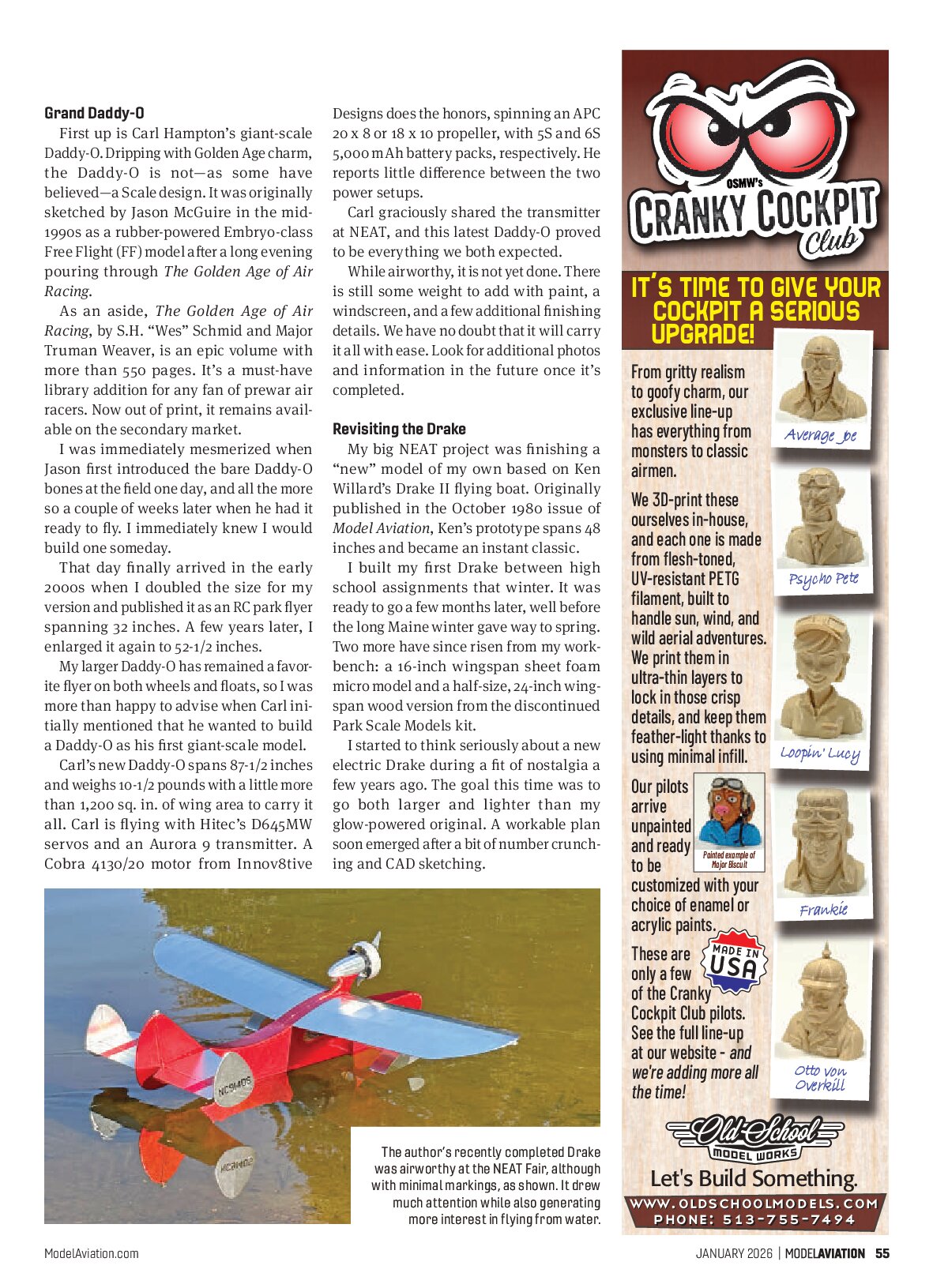
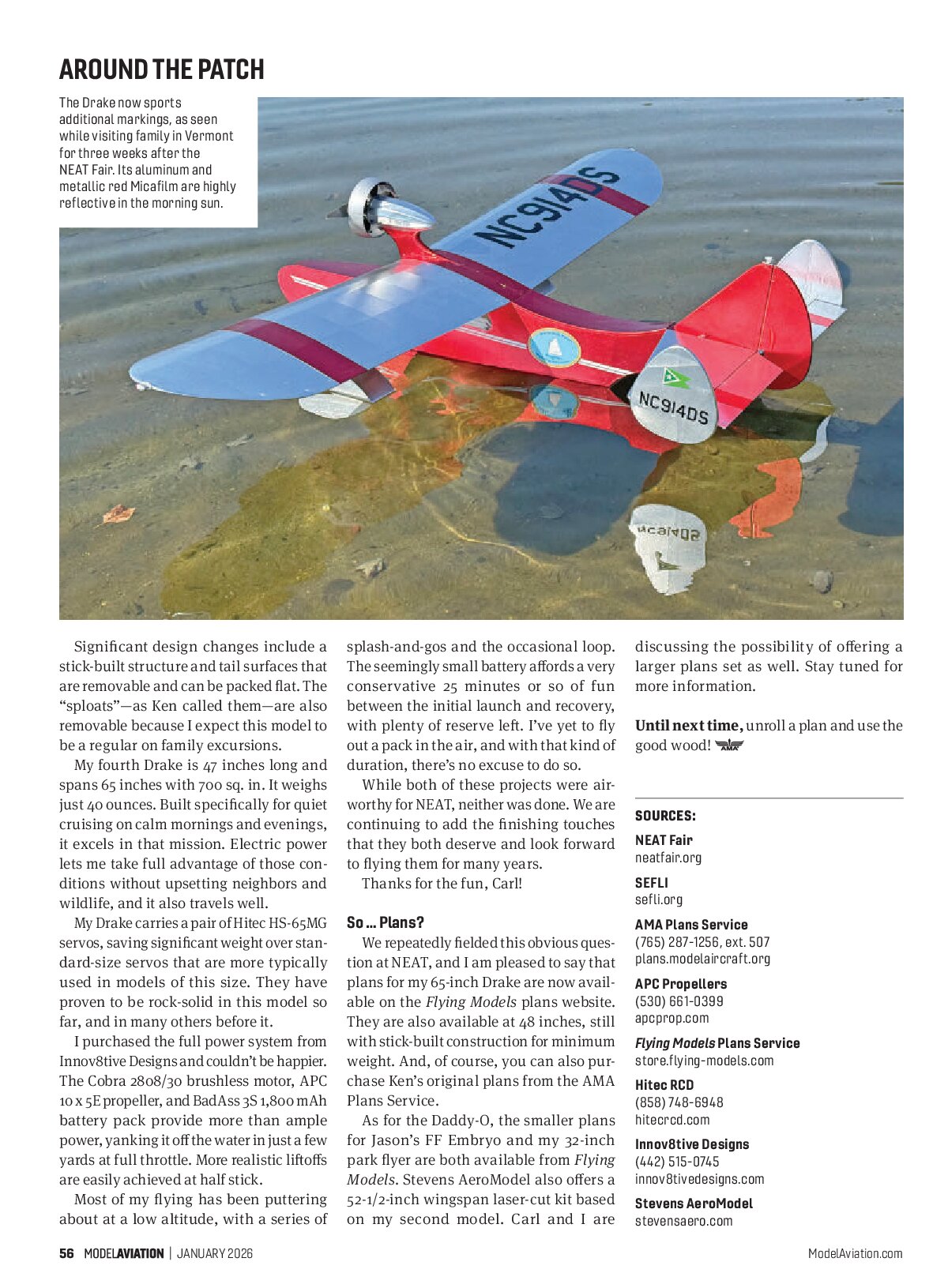
My big NEAT project was finishing a “new” model of my own based on Ken Willard’s Drake II flying boat. Originally published in the October 1980 issue of Model Aviation, Ken’s prototype spans 48 inches and became an instant classic.
I built my first Drake between high school assignments that winter. It was ready to go a few months later, well before the long Maine winter gave way to spring. Two more have since risen from my workbench: a 16-inch wingspan sheet foam micro model and a half-size, 24-inch wingspan wood version from the discontinued Park Scale Models kit.
I started to think seriously about a new electric Drake during a fit of nostalgia a few years ago. The goal this time was to go both larger and lighter than my glow-powered original. A workable plan soon emerged after a bit of number crunching and CAD sketching.

AROUND THE PATCH

Significant design changes include a stick-built structure and tail surfaces that are removable and can be packed flat. The “sploats”—as Ken called them—are also removable because I expect this model to be a regular on family excursions.
My fourth Drake is 47 inches long and spans 65 inches with 700 sq. in. It weighs just 40 ounces. Built specifically for quiet cruising on calm mornings and evenings, it excels in that mission. Electric power lets me take full advantage of those conditions without upsetting neighbors and wildlife, and it also travels well.
My Drake carries a pair of Hitec HS-65MG servos, saving significant weight over standard-size servos that are more typically used in models of this size. They have proven to be rock-solid in this model so far, and in many others before it.
I purchased the full power system from Innov8tive Designs and couldn’t be happier. The Cobra 28/08/30 brushless motor, APC 10 x 5E propeller, and BadAss 3S 1,800 mAh battery pack provide more than ample power, yanking it off the water in just a few yards at full throttle. More realistic liftoffs are easily achieved at half stick.
Most of my flying has been puttering about at a low altitude, with a series of splash-and-gos and the occasional loop. The seemingly small battery affords a very conservative 25 minutes or so of fun between the initial launch and recovery, with plenty of reserve left. I’ve yet to fly out a pack in the air, and with that kind of duration, there’s no excuse to do so.
While both of these projects were airworthy for NEAT, neither was done. We are continuing to add the finishing touches that they both deserve and look forward to flying them for many years.
Thanks for the fun, Carl!
So … Plans?
We repeatedly fielded this obvious question at NEAT, and I am pleased to say that plans for my 65-inch Drake are now available on the Flying Models plans website. They are also available at 48 inches, still with stick-built construction for minimum weight. And, of course, you can also purchase Ken’s original plans from the AMA Plans Service.
As for the Daddy-O, the smaller plans for Jason’s FF Embryo and my 32-inch park flyer are both available from Flying Models. Stevens AeroModel also offers a 52-1/2-inch wingspan laser-cut kit based on my second model. Carl and I are discussing the possibility of offering a larger plans set as well. Stay tuned for more information.
Until next time, unroll a plan and use the good wood!
SOURCES:
NEAT Fair
neatfair.org
SEFLI
sefl i.org
AMA Plans Service
(765) 287-1256, ext. 507
plans.modelaircraft.org
APC Propellers
(530) 661-0399
apcprop.com
Flying Models Plans Service
store.flying-models.com
Hitec RCD
(858) 784-6948
hitecrcd.com
Innov8tive Designs
(442) 515-0745
innov8tivedesigns.com
Stevens AeroModel
stevensaero.com