SMALL-FIELD FLYING
A USEFUL
BUILDING
TECHNIQUE
By Pat Tritle | patscustommodels@gmail.com

WITH WINTER UPON us and the holiday season fast approaching, it means that building season is in full swing for many of us. That being said, it might be a good time to touch on a building technique that I’ve found to be extremely useful throughout the years when scratch-building—making up paper patterns for things such as windshields, fairings, cowling sections, and various other items found on Scale models. The technique is the same for non-Scale models as well, although many of the aforementioned items are not as common on non-Scale models as they might be on those that are Scale.
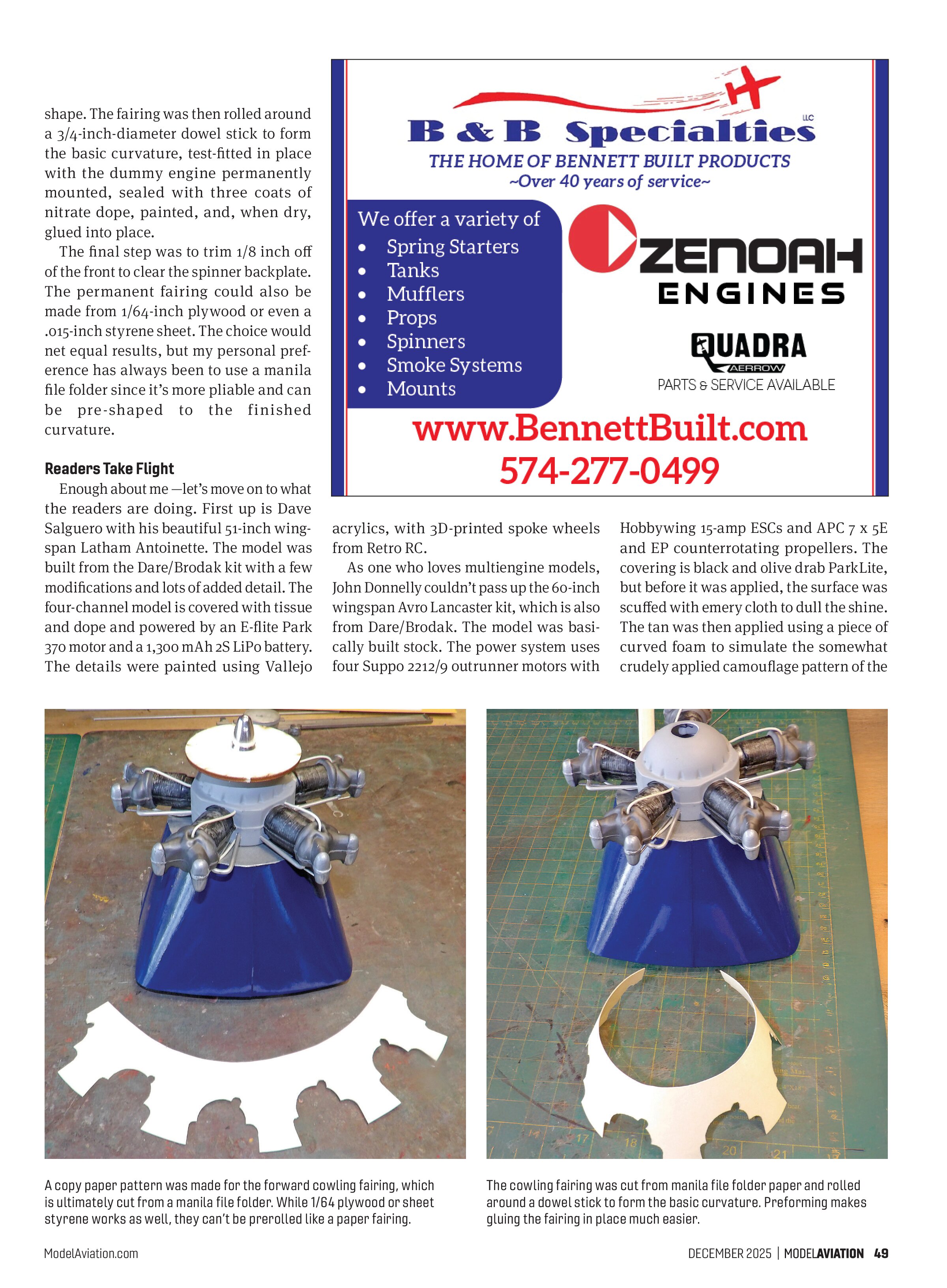
My most recent project is the Taylor B-2 Chummy. The aircraft is powered with a five-cylinder Anzani radial engine with a fully-cowled crankcase. The cylinders are exposed, so cutouts had to be made for the cylinders, exhaust, and intake manifolds, as well as the ignition leads in the forward cowling fairing. The larger diameter is at the firewall rather than at the spinner, so the basic pattern took on a more circular shape. With the dummy engine removed, the basic shape was determined by taping a piece of typing paper over the cowling and spinner backplate, tracing the front and rear outlines, and cutting them out. Some minor trimming was then done to get the shape just right.
Next, using the dummy engine, the location of each cylinder was marked on the cowling, transferred to the paper pattern, and then large cutouts were made for each cylinder. The smaller cuts were made next, with frequent test-fitting to complete the pattern. The pattern outline was then transferred to manila file folder paper, and the actual fairing was cut to shape. The fairing was then rolled around a 3/4-inch-diameter dowel stick to form the basic curvature, test-fitted in place with the dummy engine permanently mounted, sealed with three coats of nitrate dope, painted, and, when dry, glued into place.
The final step was to trim 1/8 inch off of the front to clear the spinner backplate. The permanent fairing could also be made from 1/64-inch plywood or even a .015-inch styrene sheet. The choice would net equal results, but my personal preference has always been to use a manila file folder since it’s more pliable and can be pre-shaped to the finished curvature.
Readers Take Flight
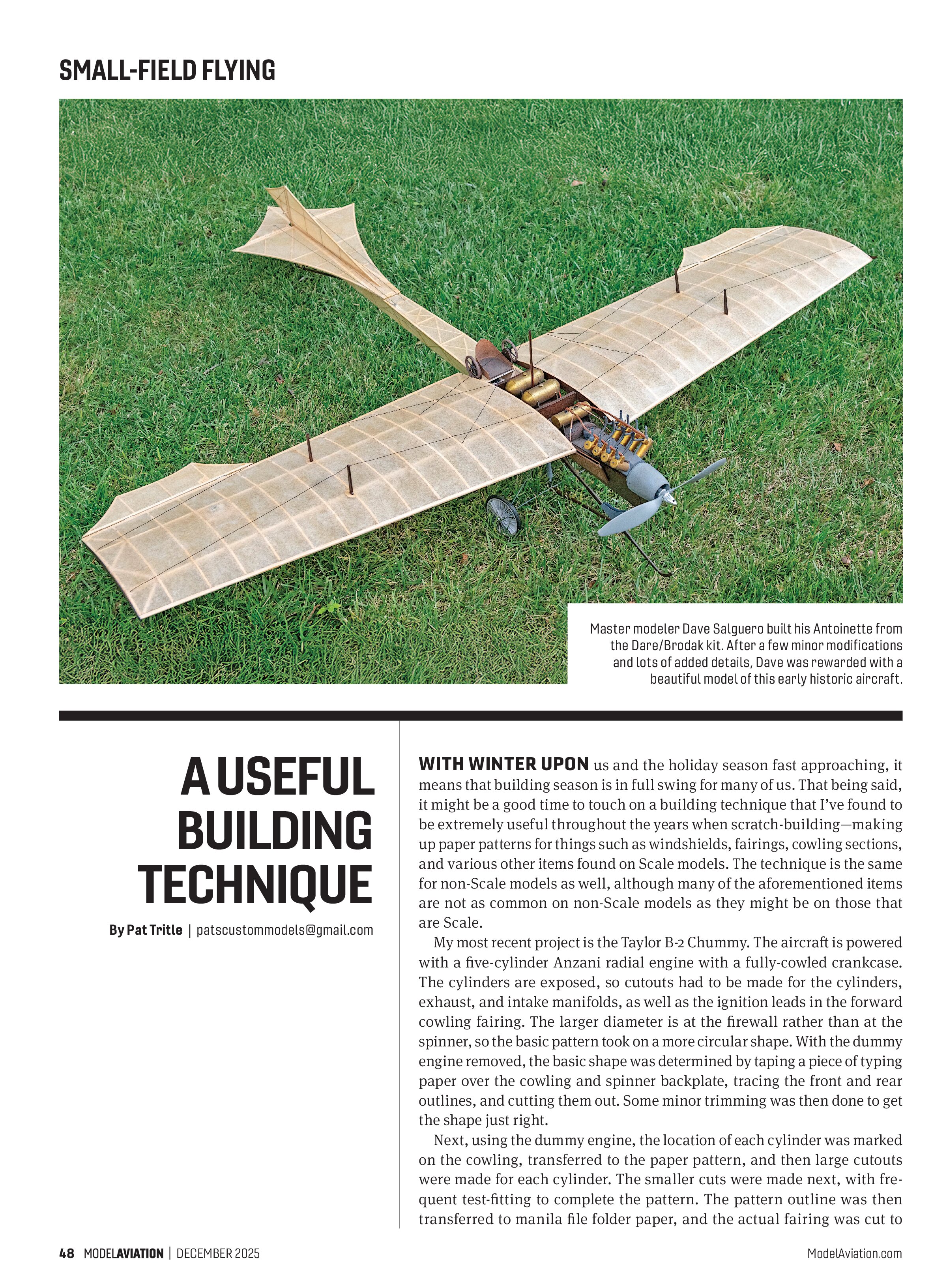
Enough about me—let’s move on to what the readers are doing. First up is Dave Salguero with his beautiful 51-inch wingspan Latham Antoinette. The model was built from the Dare/Brodak kit with a few modifications and lots of added detail. The four-channel model is covered with tissue and dope and powered by an E-flite Park 370 motor and a 1,300 mAh 2S LiPo battery. The details were painted using Vallejo acrylics, with 3D-printed spoke wheels from Retro RC.
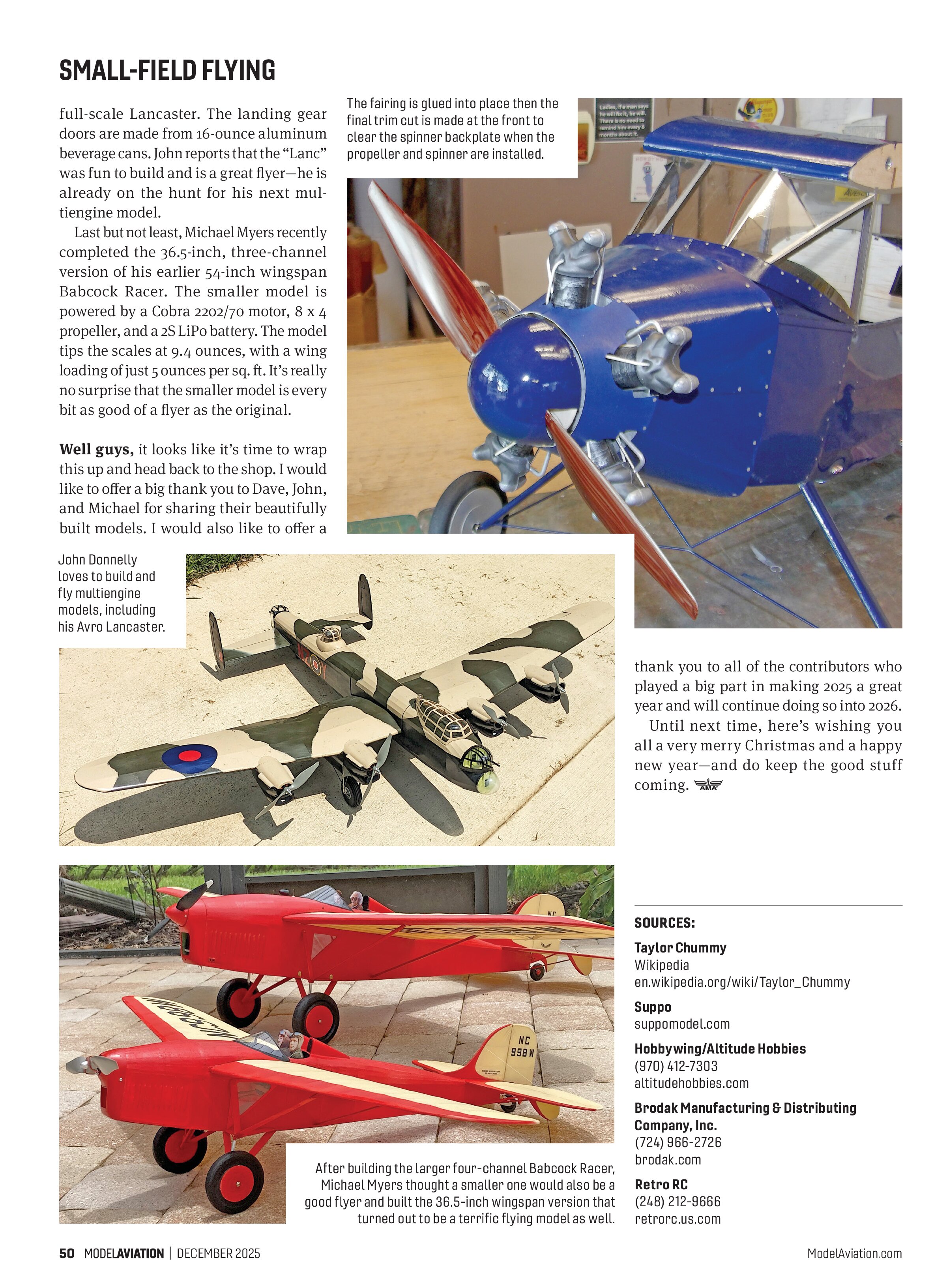
As one who loves multiengine models, John Donnelly couldn’t pass up the 60-inch wingspan Avro Lancaster kit, which is also from Dare/Brodak. The model was basically built stock. The power system uses four Suppo 2212/9 outrunner motors with Hobbywing 15-amp ESCs and APC 7 x 5E and EP counterrotating propellers. The covering is black and olive drab ParkLite, but before it was applied, the surface was scuffed with emery cloth to dull the shine. The tan was then applied using a piece of curved foam to simulate the somewhat crudely applied camouflage pattern of the


full-scale Lancaster. The landing gear doors are made from 16-ounce aluminum beverage cans. John reports that the “Lanc” was fun to build and is a great flyer—he is already on the hunt for his next multiengine model.
Last but not least, Michael Myers recently completed the 36.5-inch, three-channel version of his earlier 54-inch wingspan Babcock Racer. The smaller model is powered by a Cobra 2202/70 motor, 8 x 4 propeller, and a 2S LiPo battery. The model tips the scales at 9.4 ounces, with a wing loading of just 5 ounces per sq. ft. It’s really no surprise that the smaller model is every bit as good of a flyer as the original.
Well guys, it looks like it’s time to wrap this up and head back to the shop. I would like to offer a big thank you to Dave, John, and Michael for sharing their beautifully built models. I would also like to offer a

thank you to all of the contributors who played a big part in making 2025 a great year and will continue doing so into 2026. Until next time, here’s wishing you all a very merry Christmas and a happy new year—and do keep the good stuff coming.


SOURCES:
Taylor Chummy
Wikipedia
en.wikipedia.org/wiki/Taylor_Chummy
Suppo
suppomodel.com
Hobbywing/Altitude Hobbies
(970) 412-7303
altitudehobbies.com
Brodak Manufacturing & Distributing Company, Inc.
(724) 966-2726
broडक.com
Retro RC
(248) 212-9666
retrorc.us.com