RC SCALE AEROBATICS
PURSUING
THE
PERFECTLY
EXECUTED
ROUTINE
By John Glezellis | jglezellis@gmail.com
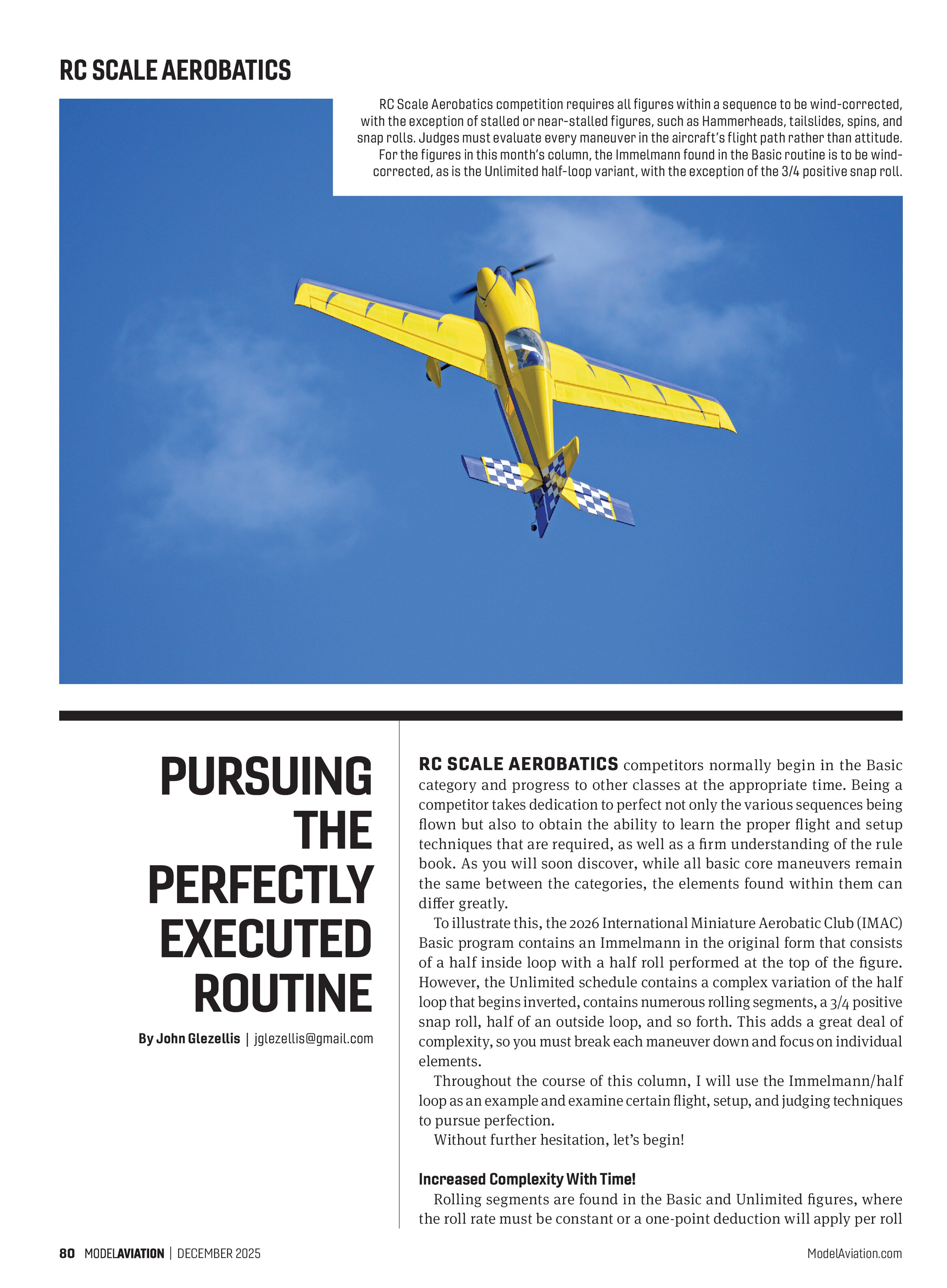
RC Scale Aerobatics competition requires all figures within a sequence to be wind-corrected, with the exception of stalled or near-stalled figures, such as Hammerheads, tailslides, spins, and snap rolls. Judges must evaluate every maneuver in the aircraft’s flight path rather than attitude.
For the figures in this month’s column, the Immelmann found in the Basic routine is to be wind-corrected, as is the Unlimited half-loop variant, with the exception of the 3/4 positive snap roll.
RC SCALE AEROBATICS competitors normally begin in the Basic category and progress to other classes at the appropriate time. Being a competitor takes dedication to perfect not only the various sequences being flown but also to obtain the ability to learn the proper flight and setup techniques that are required, as well as a firm understanding of the rule book. As you will soon discover, while all basic core maneuvers remain the same between the categories, the elements found within them can differ greatly.
To illustrate this, the 2026 International Miniature Aerobatic Club (IMAC) Basic program contains an Immelmann in the original form that consists of a half inside loop with a half roll performed at the top of the figure. However, the Unlimited schedule contains a complex variation of the half loop that begins inverted, contains numerous rolling segments, a 3/4 positive snap roll, half of an outside loop, and so forth. This adds a great deal of complexity, so you must break each maneuver down and focus on individual elements.
Throughout the course of this column, I will use the Immelmann/half loop as an example and examine certain flight, setup, and judging techniques to pursue perfection.
Without further hesitation, let’s begin!
Increased Complexity With Time!
Rolling segments are found in the Basic and Unlimited figures, where the roll rate must be constant or a one-point deduction will apply per roll
rate change. Additionally, the model must stop after exactly the stated number of rotations, or a half point per 5° deduction will apply. For the variant found in the Unlimited program, starting from inverted, you will perform a 1-3/4 roll segment. In the Basic class, the half-roll segment is not performed until the end, but, again, the criteria are unchanged in how you will be judged.
For the Unlimited maneuver, the 1-3/4 roll is followed by a 3/4 positive snap roll, where the nose of the model must pitch in the correct direction. A zero will occur if no pitch is observed or if it pitches in the wrong direction. For the positive snap roll, it must be induced with up-elevator. The departure and autorotation might occur simultaneously or sequentially, but pitch must occur first if it’s sequential.
The timing of the autorotation is essential; if a line segment is drawn after the pitch departure and a delay exists in the snap-roll element, a zero will occur. If no autorotation occurs or the snap-roll segment appears to be a tumble, a simple roll, or is barreled, a zero will occur for the entire figure. Any rotation or roll that is observed prior to the required pitch movement is to be downgraded half of a point for each 5° of such rotation, and the same downgrade will exist for exiting the autorotation earlier.
The challenge with snap rolls under a complete rotation is the timing. The 3/4 snap roll will occur quickly; I often prefer to note the direction that I will snap in my call sheet, such that my caller will state, “3/4 positive snap left. See canopy.” The aircraft orientation and roll direction might differ, but the language should be concise because the elements of each maneuver will occur quickly. As soon as the snap segment is complete, you must immediately begin the outside loop.
Ensuring that no line segment exists, you must immediately push half of an outside loop and perform two rolls in opposite directions at the top. Should a line segment exist between the 3/4 positive snap roll, the looping element (or similar), the top of the figure, and the start of the two rolls in opposite directions, a two-point deduction will occur and a zero could occur

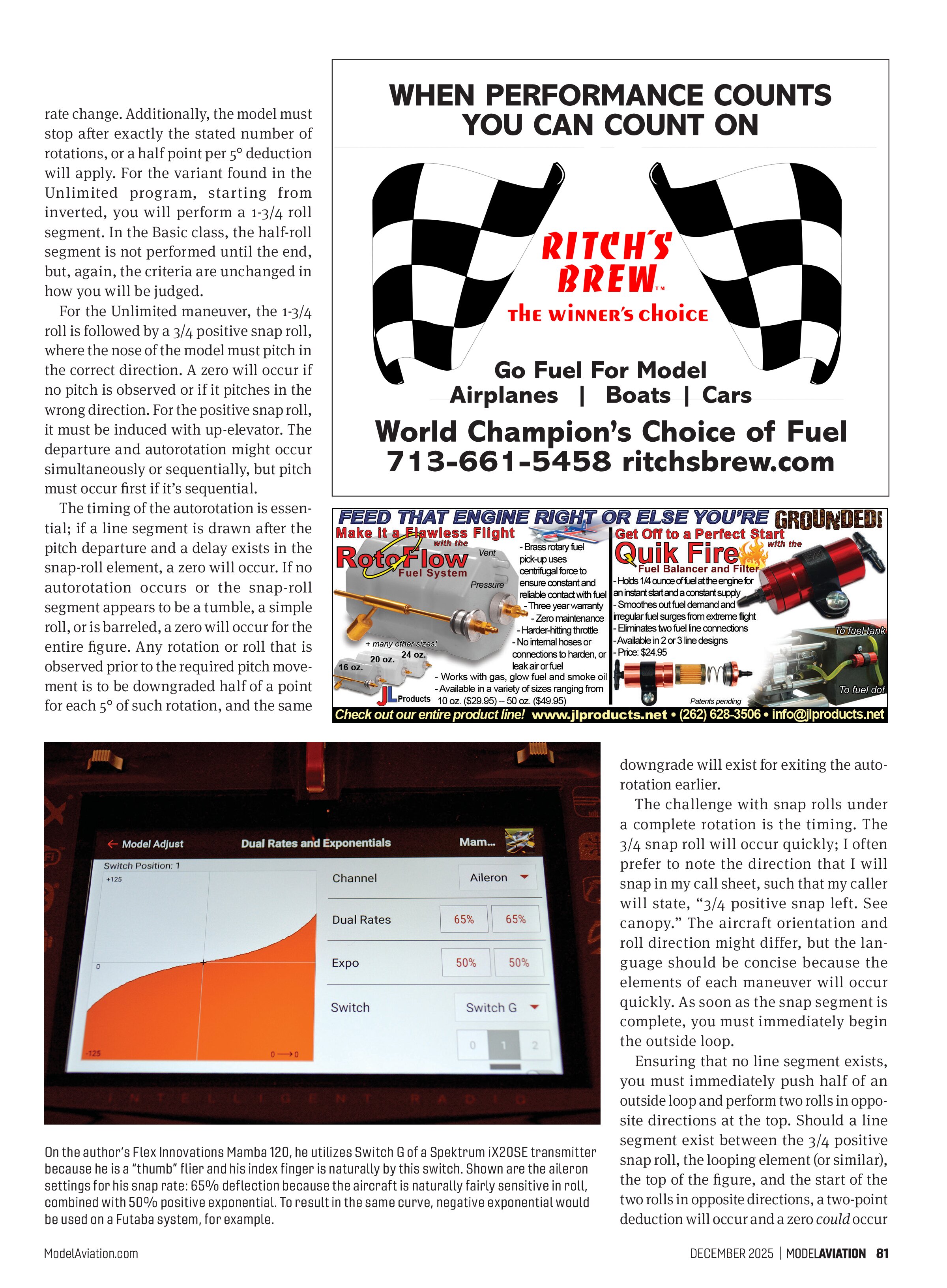
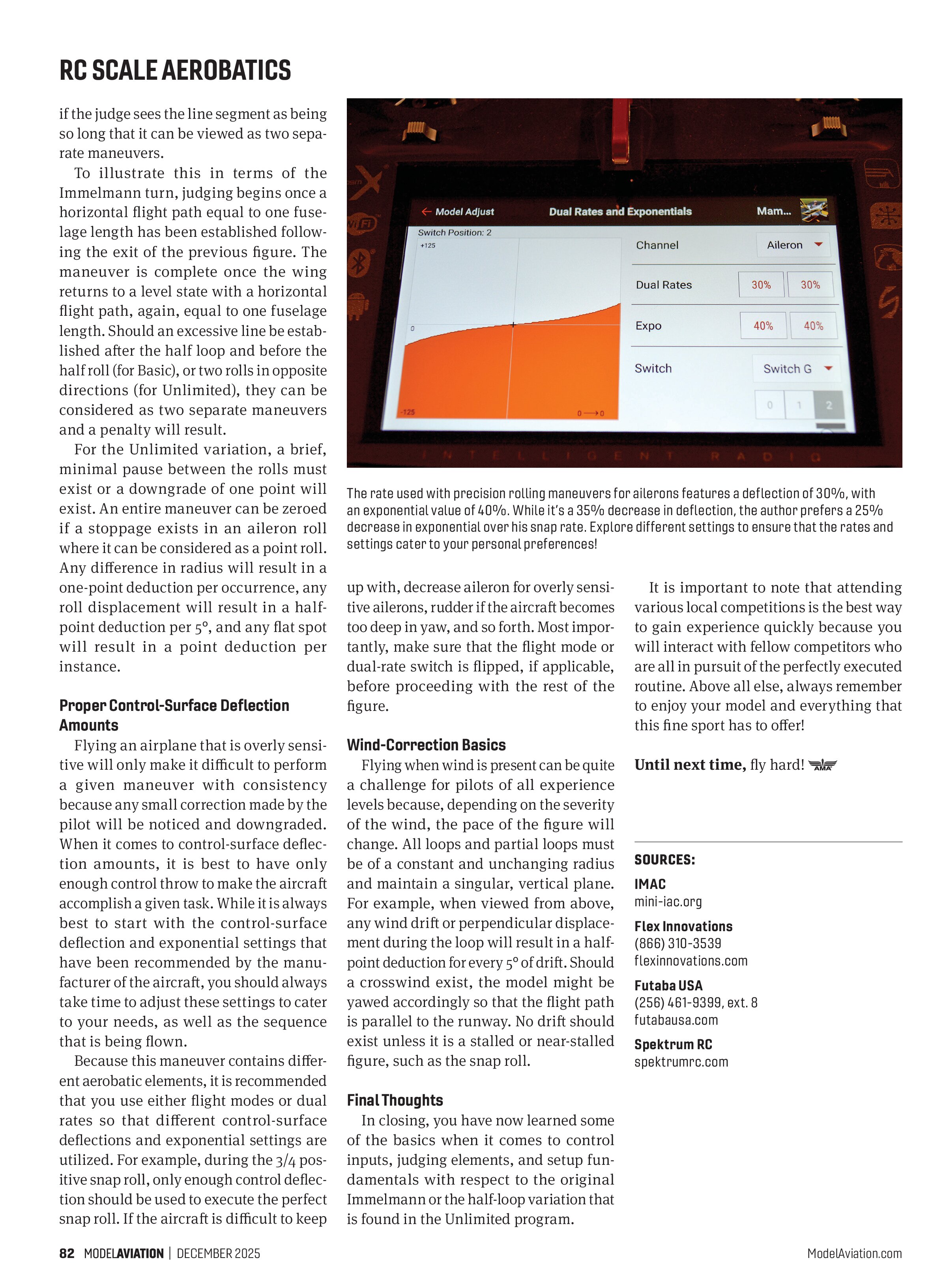
On the author’s Flex Innovations Mamba 120, he utilizes Switch G of a Spektrum iX20SE transmitter because he is a “thumb” flier and his index finger is naturally by this switch. Shown are the aileron settings for his snap rate: 65% deflection because the aircraft is naturally fairly sensitive in roll, combined with 50% positive exponential. To result in the same curve, negative exponential would be used on a Futaba system, for example.

if the judge sees the line segment as being so long that it can be viewed as two separate maneuvers.
To illustrate this in terms of the Immelmann turn, judging begins once a horizontal flight path equal to one fuselage length has been established following the exit of the previous figure. The maneuver is complete once the wing returns to a level state with a horizontal flight path, again, equal to one fuselage length. Should an excessive line be established after the half loop and before the half roll (for Basic), or two rolls in opposite directions (for Unlimited), they can be considered as two separate maneuvers and a penalty will result.
For the Unlimited variation, a brief, minimal pause between the rolls must exist or a downgrade of one point will exist. An entire maneuver can be zeroed if a stoppage exists in an aileron roll where it can be considered as a point roll. Any difference in radius will result in a one-point deduction per occurrence, any roll displacement will result in a half-point deduction per 5°, and any flat spot will result in a point deduction per instance.
Proper Control-Surface Deflection Amounts
Flying an airplane that is overly sensitive will only make it difficult to perform a given maneuver with consistency because any small correction made by the pilot will be noticed and downgraded. When it comes to control-surface deflection amounts, it is best to have only enough control throw to make the aircraft accomplish a given task. While it is always best to start with the control-surface deflection and exponential settings that have been recommended by the manufacturer of the aircraft, you should always take time to adjust these settings to cater to your needs, as well as the sequence that is being flown.
Because this maneuver contains different aerobatic elements, it is recommended that you use either flight modes or dual rates so that different control-surface deflections and exponential settings are utilized. For example, during the 3/4 positive snap roll, only enough control deflection should be used to execute the perfect snap roll. If the aircraft is difficult to keep

up with, decrease aileron for overly sensitive ailerons, rudder if the aircraft becomes too deep in yaw, and so forth. Most importantly, make sure that the flight mode or dual-rate switch is flipped, if applicable, before proceeding with the rest of the figure.
Wind-Correction Basics
Flying when wind is present can be quite a challenge for pilots of all experience levels because, depending on the severity of the wind, the pace of the figure will change. All loops and partial loops must be of a constant and unchanging radius and maintain a singular, vertical plane. For example, when viewed from above, any wind drift or perpendicular displacement during the loop will result in a half-point deduction for every 5° of drift. Should a crosswind exist, the model might be yawed accordingly so that the flight path is parallel to the runway. No drift should exist unless it is a stalled or near-stalled figure, such as the snap roll.
Final Thoughts
In closing, you have now learned some of the basics when it comes to control inputs, judging elements, and setup fundamentals with respect to the original Immelmann or the half-loop variation that is found in the Unlimited program.
It is important to note that attending various local competitions is the best way to gain experience quickly because you will interact with fellow competitors who are all in pursuit of the perfectly executed routine. Above all else, always remember to enjoy your model and everything that this fine sport has to offer!
Until next time, fly hard!
SOURCES:
IMAC
mini-iac.org
Flex Innovations
(866) 310-3539
flexinnovations.com
Futaba USA
(256) 461-9399, ext. 8
futabausa.com
Spektrum RC
spektrumrc.com