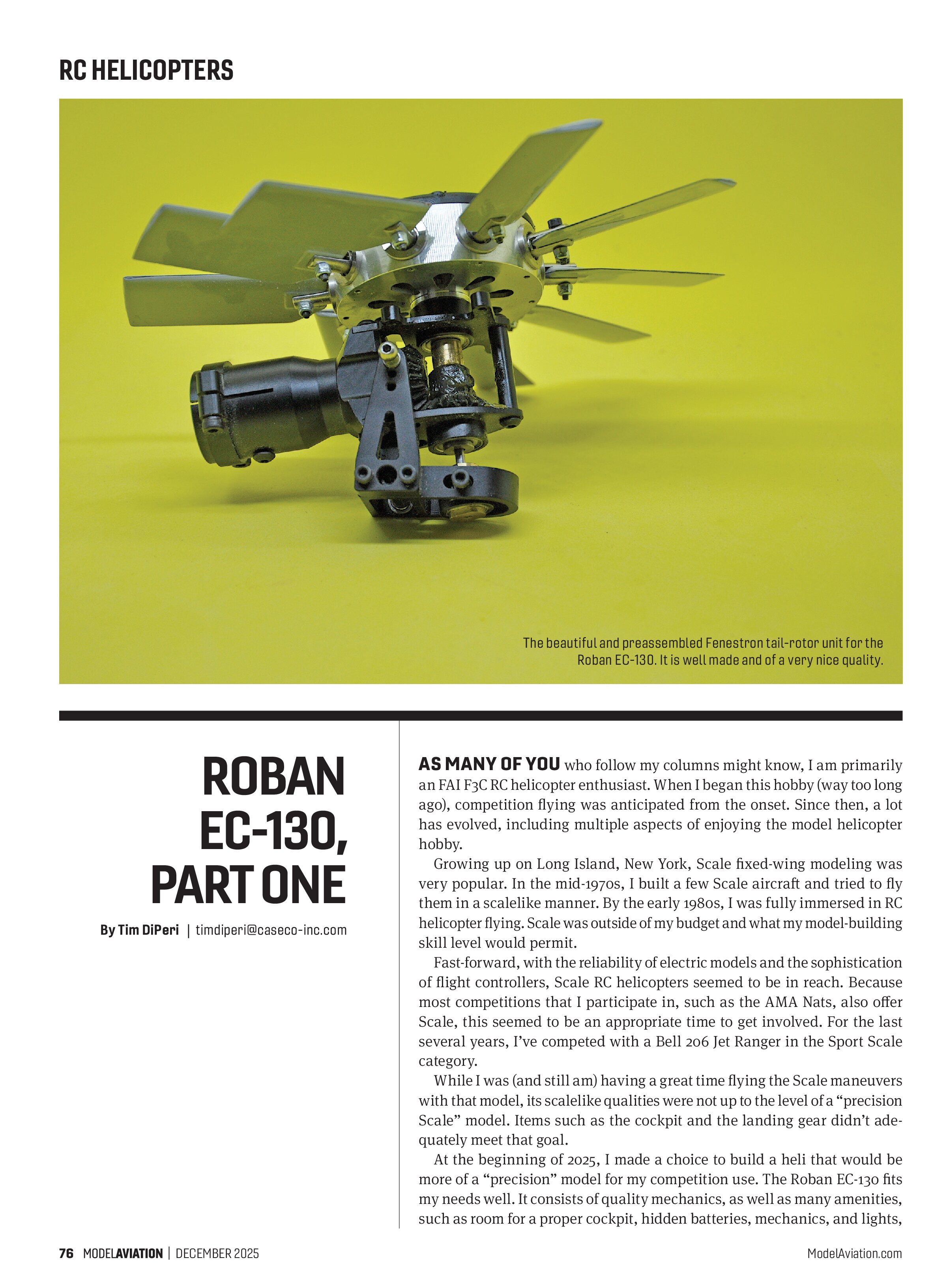
ROBAN EC-130, PART ONE
By Tim DiPeri | timdperi@caseco-inc.com

AS MANY OF YOU who follow my columns might know, I am primarily an FAI F3C RC helicopter enthusiast. When I began this hobby (way too long ago), competition flying was anticipated from the onset. Since then, a lot has evolved, including multiple aspects of enjoying the model helicopter hobby.
Growing up on Long Island, New York, Scale fixed-wing modeling was very popular. In the mid-1970s, I built a few Scale aircraft and tried to fly them in a scalelike manner. By the early 1980s, I was fully immersed in RC helicopter flying. Scale was outside of my budget and what my model-building skill level would permit.
Fast-forward, with the reliability of electric models and the sophistication of flight controllers, Scale RC helicopters seemed to be in reach. Because most competitions that I participate in, such as the AMA Nats, also offer Scale, this seemed to be an appropriate time to get involved. For the last several years, I’ve competed with a Bell 206 Jet Ranger in the Sport Scale category.
While I was (and still am) having a great time flying the Scale maneuvers with that model, its scalelike qualities were not up to the level of a “precision Scale” model. Items such as the cockpit and the landing gear didn’t adequately meet that goal.
At the beginning of 2025, I made a choice to build a heli that would be more of a “precision” model for my competition use. The Roban EC-130 fits my needs well. It consists of quality mechanics, as well as many amenities, such as room for a proper cockpit, hidden batteries, mechanics, and lights,

in addition to a fiberglass fuselage that will allow me to start from a clean canvas.
I specifically wanted to build a model after a full-scale helicopter that I could have regular, physical access to. Vanderbilt University Medical Center, in Nashville, has HC-130s that are used for life flights. I know that many Scale modelers do not have local access to the aircraft that they build, but it seemed like a good option for me.
I also wanted a model that is relatively close in size to my F3C competition models (for transportation) and utilizes the same

12S 5,000 mAh batteries. If this sounds like I’m a little “needy” on my requirements, I just know, from experience, that if I have a model that is different from what I normally fly, that model will likely be flown less.
Because I wanted to paint the model myself, I was able to order a white, primed fuselage from Roban. While this took a little longer to receive than in-stock products, it was easier for me than sanding the color off of a painted model.
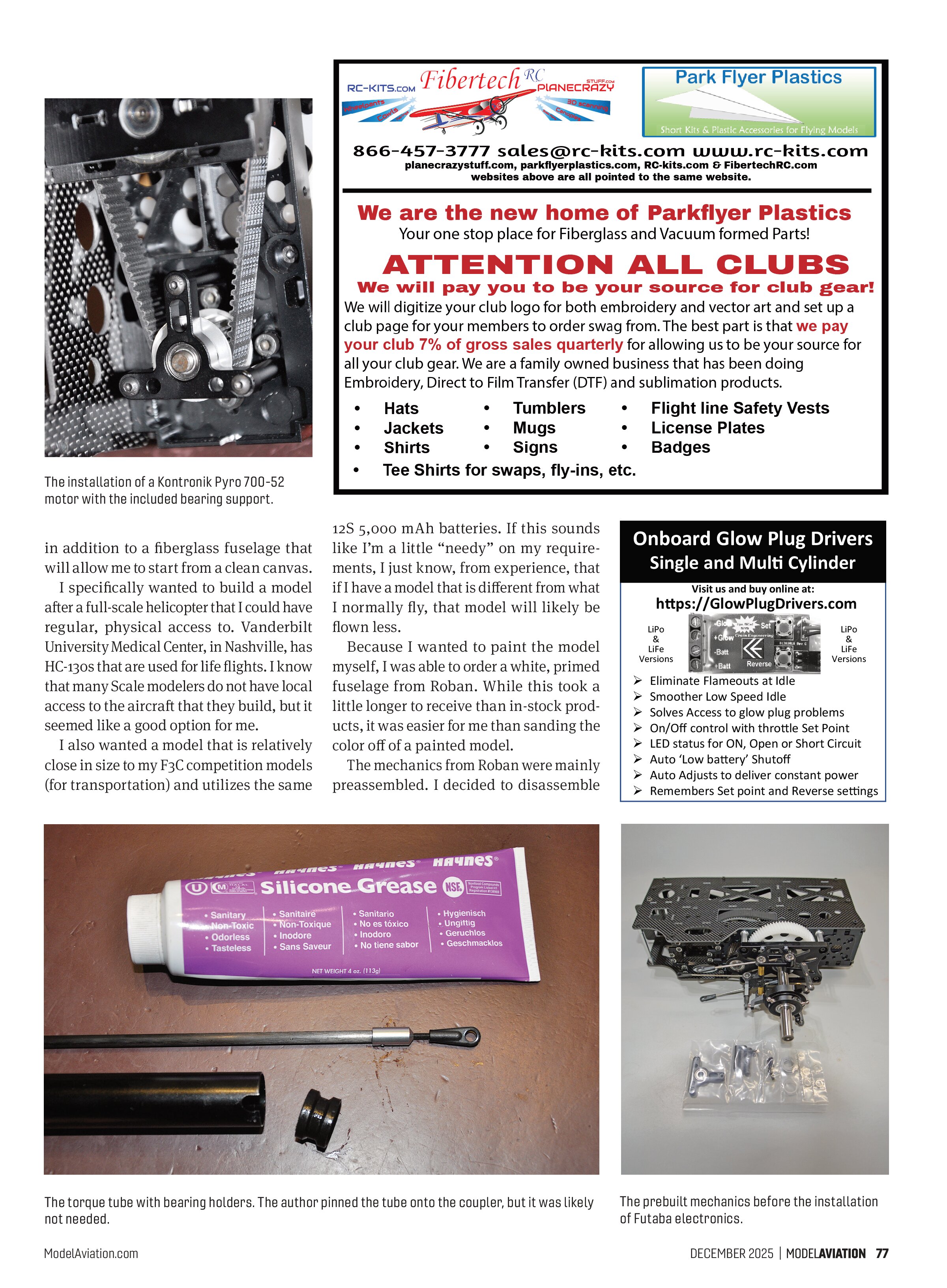
The mechanics from Roban were mainly preassembled. I decided to disassemble


it to check to see whether the factory missed adding Loctite on some of the bolts. I am happy to report that I found every bolt to be properly torqued and with Loctite!
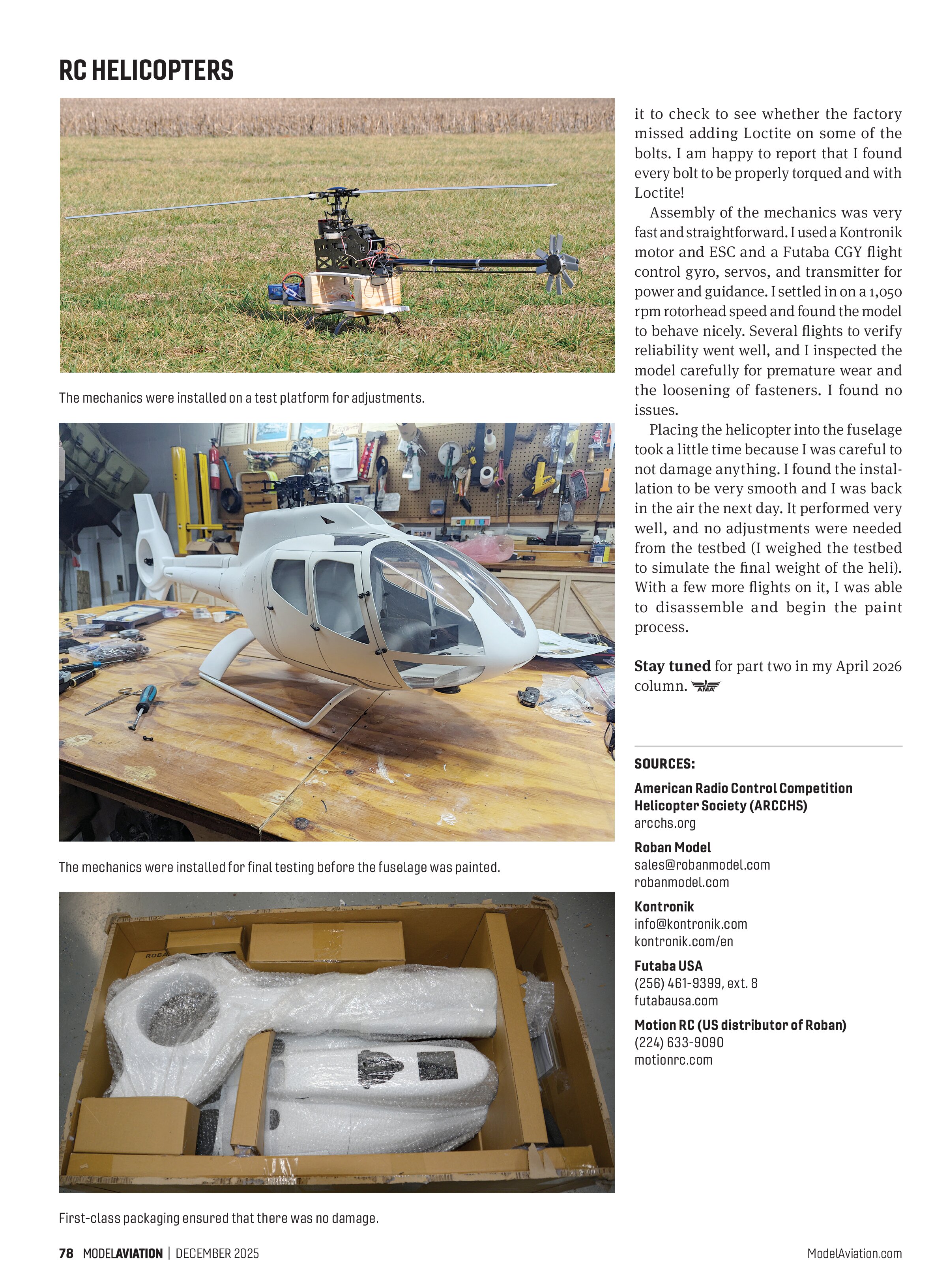
Assembly of the mechanics was very fast and straightforward. I used a Kontronik motor and ESC and a Futaba CGY flight control gyro, servos, and transmitter for power and guidance. I settled in on a 1,050 rpm rotorhead speed and found the model to behave nicely. Several flights to verify reliability went well, and I inspected the model carefully for premature wear and the loosening of fasteners. I found no issues.
Placing the helicopter into the fuselage took a little time because I was careful to not damage anything. I found the installation to be very smooth and I was back in the air the next day. It performed very well, and no adjustments were needed from the testbed (I weighed the testbed to simulate the final weight of the heli). With a few more flights on it, I was able to disassemble and begin the paint process.
Stay tuned for part two in my April 2026 column.
SOURCES:
American Radio Control Competition Helicopter Society (ARCCHS)
arcchs.org
Roban Model
sales@robanmodel.com
robanmodel.com
Kontronik
info@kontronik.com
kontronik.com/en
Futaba USA
(256) 461-9399, ext. 8
futabausa.com
Motion RC (US distributor of Roban)
(224) 633-9090
motionrc.com