FEW THINGS
LAST FOREVER
By Bob Angel | samrcflier@verizon.net

THE POPULARITY of certain models, as well as competition events, rules, and even established clubs and supporting organizations, are a few of the things that don’t last forever. Almost everything seems to have a shelf life. If you plotted a graph of activity versus time for most of the items mentioned, you’d probably see an almost bell-shaped curve. I say “almost” because one definition of a bell curve is that it’s symmetrical.
In our case, the curve would often be nonsymmetrical, in which the right end (time) would not usually end as abruptly as the left began, but it might stretch the descending curve much farther to the right. That’s because of the lasting nostalgic value of model building and flying. I’ll cite a couple of examples of such events that have hung on well past their peak of activity.
Twin-Pusher Models
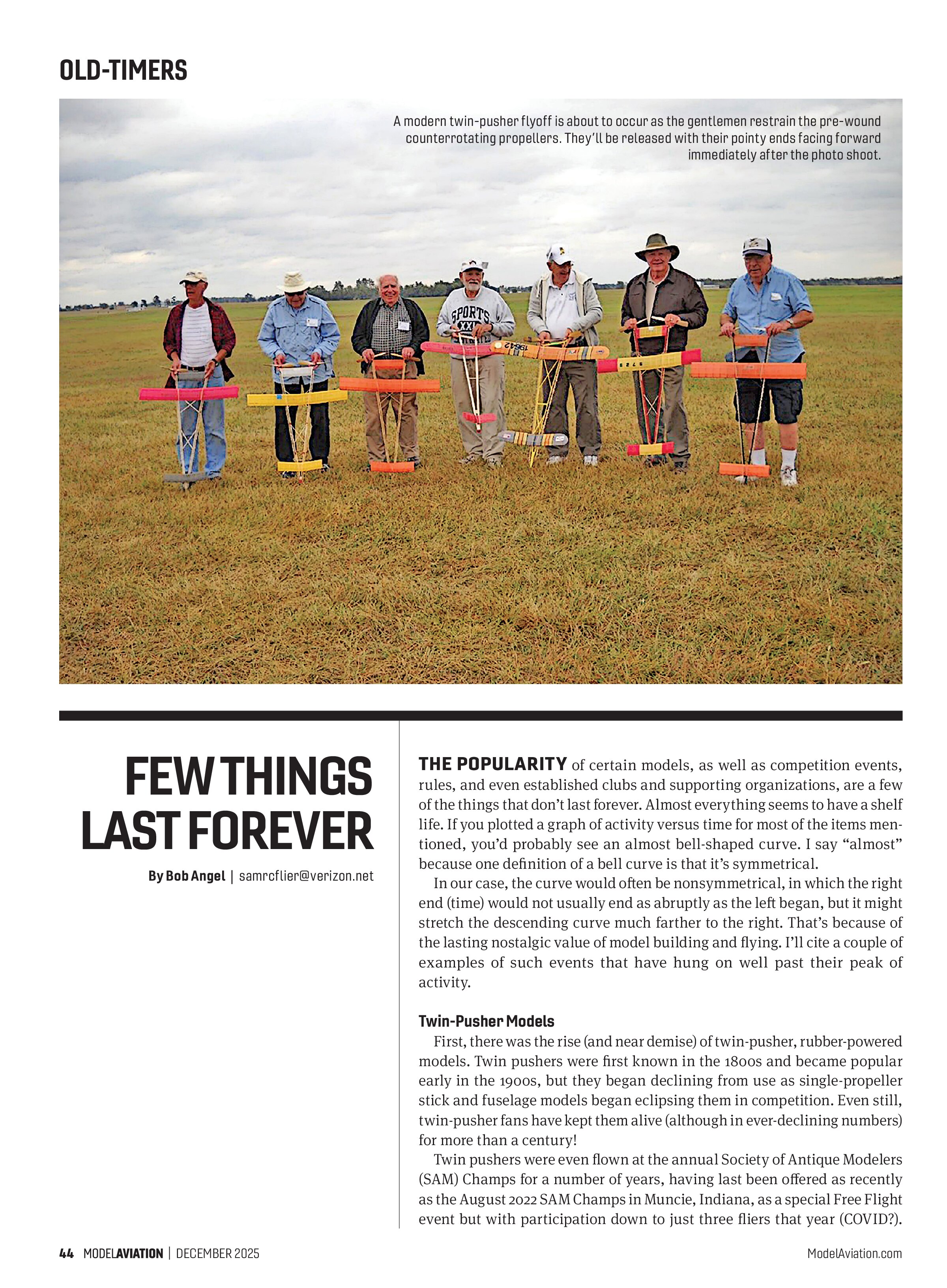
First, there was the rise (and near demise) of twin-pusher, rubber-powered models. Twin pushers were first known in the 1800s and became popular early in the 1900s, but they began declining from use as single-propeller stick and fuselage models began eclipsing them in competition. Even still, twin-pusher fans have kept them alive (although in ever-declining numbers) for more than a century!
Twin pushers were even flown at the annual Society of Antique Modelers (SAM) Champs for a number of years, having last been offered as recently as the August 2022 SAM Champs in Muncie, Indiana, as a special Free Flight event but with participation down to just three fliers that year (COVID?).

Balloon Bust
In my February 2022 and April 2022 columns, I described some of the many fun-fly events that have come and gone in the past. One was the Control Line (CL) Balloon Bust, which was very popular in club competition in its day. I often flew and enjoyed the event, and I believe it became popular for the following reasons.
First, most of us have a bit of competitive spirit, but few are interested, nor do we have the time or ambition, in pursuing an extremely high level of competition in any sport. Instead, many of us enjoy light competition, which matches us against reasonably similar skill levels. It was also a low-cost event with a low attrition rate for the models.
I don’t recall whether the Balloon Bust was even in the AMA competition rule book during the years in which it became popular; however, it attracted one of the highest participation rates among the general CL membership.
Preparation for the event was easy since most of us just flew what we’d brought. Those were usually simple kit-built models, such as Ringmasters or other profile airplanes, that were finished with a few coats of brushed-on dope and would not normally collect a high score for appearance points (had such points even been awarded). However, the event wasn’t particularly punishing for the few more nicely constructed airplanes that also showed up.
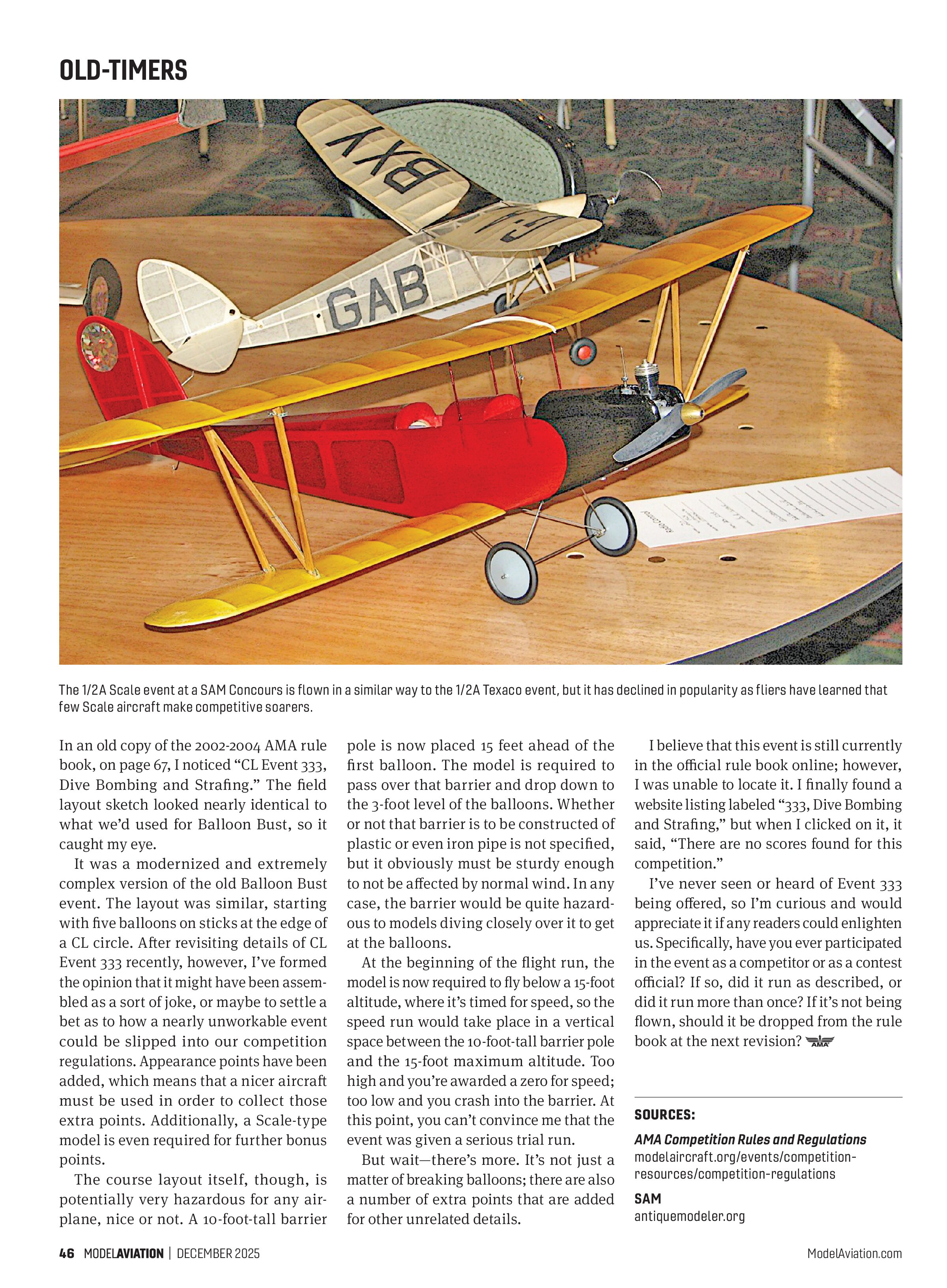
Running the event was also quite simple, consisting mostly of providing five inflated party balloons rubber-banded to five 1/4- x 36-inch balsa strips that were pushed into the ground at 10-foot intervals along the circle. The balloons were freshly restored for each competitor’s flight. The event could also be run over a paved circle by supplying wooden plug-in bases for the support sticks.
CL Event 333
I don’t recall when the Balloon Bust event began to decline, but several years later, I spotted the final nail in the coffin.

In an old copy of the 2002-2004 AMA rule book, on page 67, I noticed “CL Event 333, Dive Bombing and Strafing.” The field layout sketch looked nearly identical to what we’d used for Balloon Bust, so it caught my eye.
It was a modernized and extremely complex version of the old Balloon Bust event. The layout was similar, starting with five balloons on sticks at the edge of a CL circle. After revisiting details of CL Event 333 recently, however, I’ve formed the opinion that it might have been assembled as a sort of joke, or maybe to settle a bet as to how a nearly unworkable event could be slipped into our competition regulations. Appearance points have been added, which means that a nicer aircraft must be used in order to collect those extra points. Additionally, a Scale-type model is even required for further bonus points.
The course layout itself, though, is potentially very hazardous for any airplane, nice or not. A 10-foot-tall barrier pole is now placed 15 feet ahead of the first balloon. The model is required to pass over that barrier and drop down to the 3-foot level of the balloons. Whether or not that barrier is to be constructed of plastic or even iron pipe is not specified, but it obviously must be sturdy enough to not be affected by normal wind. In any case, the barrier would be quite hazardous to models diving closely over it to get at the balloons.
At the beginning of the flight run, the model is now required to fly below a 15-foot altitude, where it’s timed for speed, so the speed run would take place in a vertical space between the 10-foot-tall barrier pole and the 15-foot maximum altitude. Too high and you’re awarded a zero for speed; too low and you crash into the barrier. At this point, you can’t convince me that the event was given a serious trial run.
But wait—there’s more. It’s not just a matter of breaking balloons; there are also a number of extra points that are added for other unrelated details.
I believe that this event is still currently in the official rule book online; however, I was unable to locate it. I finally found a website listing labeled “333, Dive Bombing and Strafing,” but when I clicked on it, it said, “There are no scores found for this competition.”
I’ve never seen or heard of Event 333 being offered, so I’m curious and would appreciate it if any readers could enlighten us. Specifically, have you ever participated in the event as a competitor or as a contest official? If so, did it run as described, or did it run more than once? If it’s not being flown, should it be dropped from the rule book at the next revision?
SOURCES:
AMA Competition Rules and Regulations
modelaircraft.org/events/competition-resources/competition-regulations
SAM
antiquemodeler.org