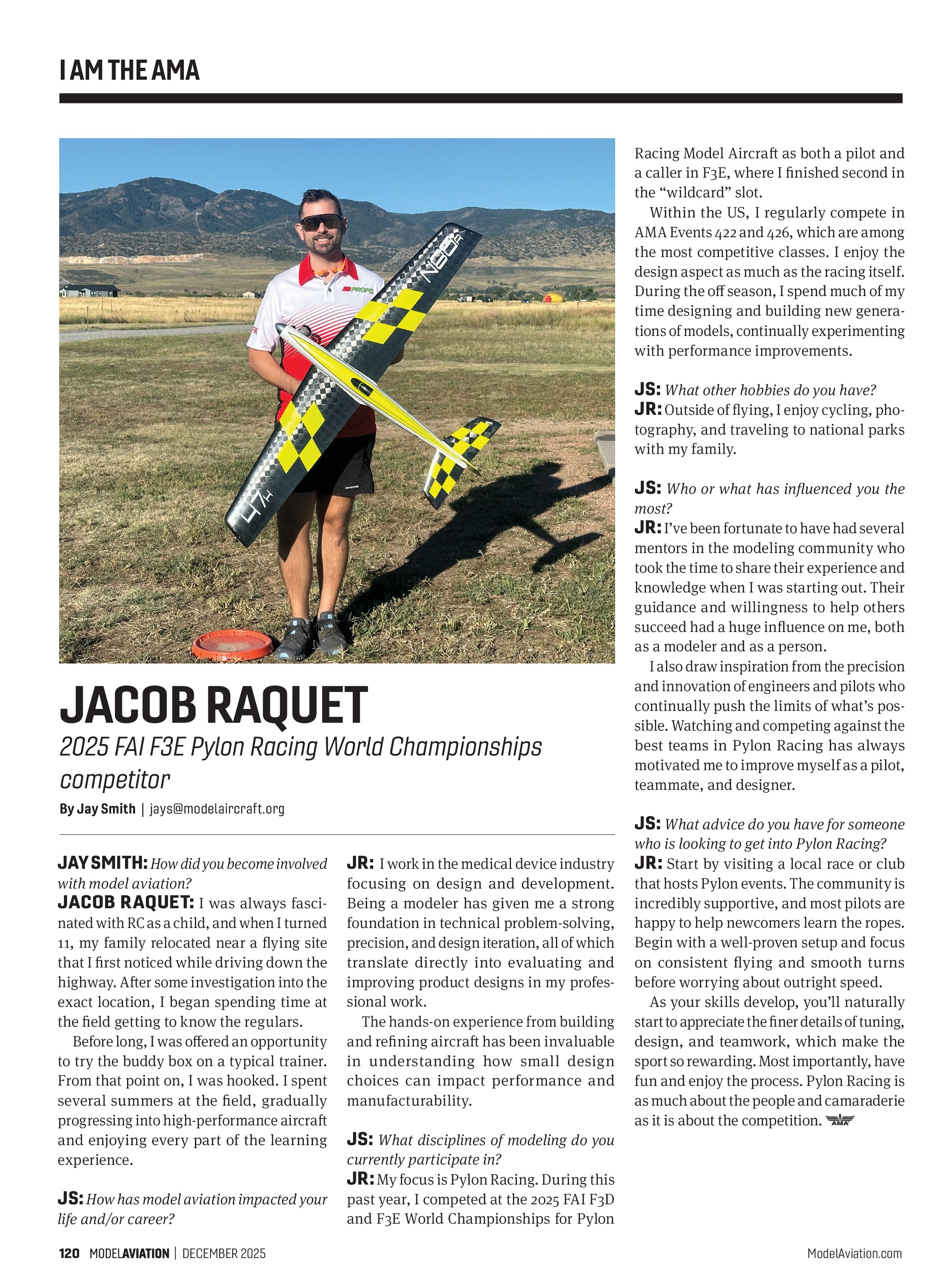

JACOB RAQUET
2025 FAI F3E Pylon Racing World Championships competitor
By Jay Smith | jays@modelaircraft.org
JAY SMITH: How did you become involved with model aviation?
JACOB RAQUET: I was always fascinated with RC as a child, and when I turned 11, my family relocated near a flying site that I first noticed while driving down the highway. After some investigation into the exact location, I began spending time at the field getting to know the regulars.
Before long, I was offered an opportunity to try the buddy box on a typical trainer. From that point on, I was hooked. I spent several summers at the field, gradually progressing into high-performance aircraft and enjoying every part of the learning experience.
JS: How has model aviation impacted your life and/or career?
JR: I work in the medical device industry focusing on design and development. Being a modeler has given me a strong foundation in technical problem-solving, precision, and design iteration, all of which translate directly into evaluating and improving product designs in my professional work.
The hands-on experience from building and refining aircraft has been invaluable in understanding how small design choices can impact performance and manufacturability.
JS: What disciplines of modeling do you currently participate in?
JR: My focus is Pylon Racing. During this past year, I competed at the 2025 FAI F3D and F3E World Championships for Pylon Racing Model Aircraft as both a pilot and a caller in F3E, where I finished second in the “wildcard” slot.
Within the US, I regularly compete in AMA Events 422 and 426, which are among the most competitive classes. I enjoy the design aspect as much as the racing itself. During the off season, I spend much of my time designing and building new generations of models, continually experimenting with performance improvements.
JS: What other hobbies do you have?
JR: Outside of flying, I enjoy cycling, photography, and traveling to national parks with my family.
JS: Who or what has influenced you the most?
JR: I’ve been fortunate to have had several mentors in the modeling community who took the time to share their experience and knowledge when I was starting out. Their guidance and willingness to help others succeed had a huge influence on me, both as a modeler and as a person.
I also draw inspiration from the precision and innovation of engineers and pilots who continually push the limits of what’s possible. Watching and competing against the best teams in Pylon Racing has always motivated me to improve myself as a pilot, teammate, and designer.
JS: What advice do you have for someone who is looking to get into Pylon Racing?
JR: Start by visiting a local race or club that hosts Pylon events. The community is incredibly supportive, and most pilots are happy to help newcomers learn the ropes. Begin with a well-proven setup and focus on consistent flying and smooth turns before worrying about outright speed.
As your skills develop, you’ll naturally start to appreciate the finer details of tuning, design, and teamwork, which make the sport so rewarding. Most importantly, have fun and enjoy the process. Pylon Racing is as much about the people and camaraderie as it is about the competition.