FOCAL POINT
Interested in sharing your handiwork? Visit ModelAviation.com for submission guidelines.
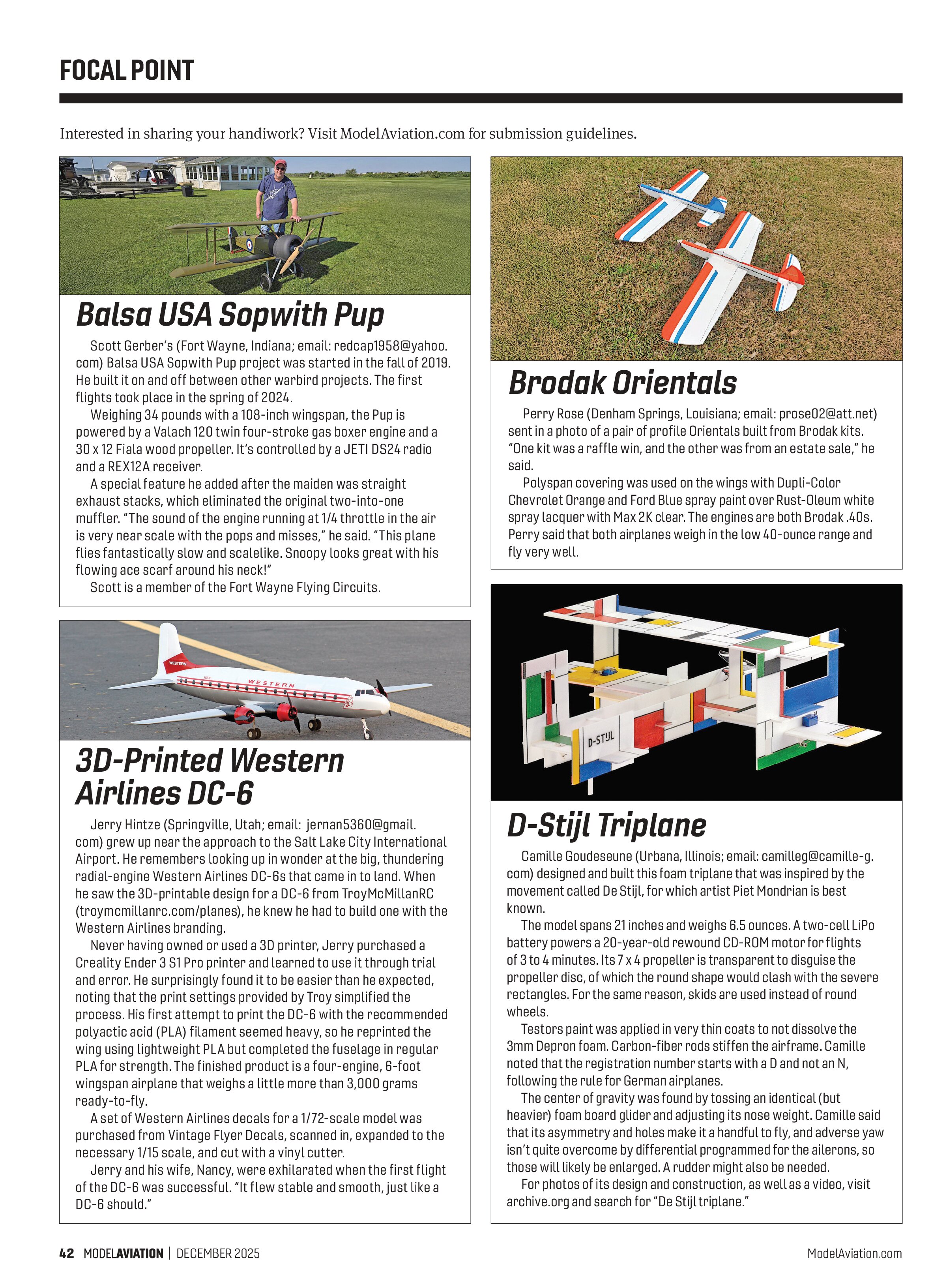
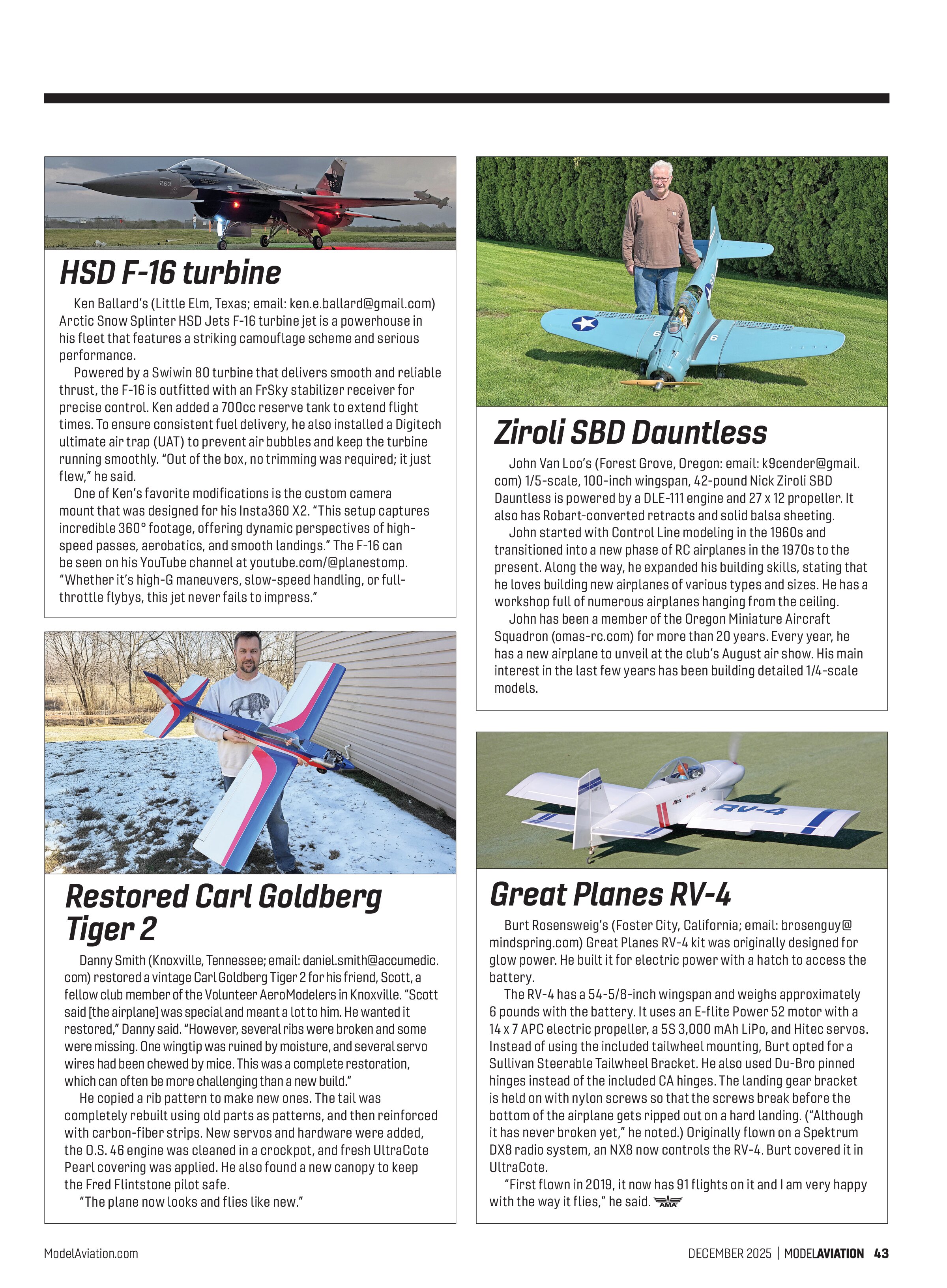
Balsa USA Sopwith Pup
Scott Gerber’s (Fort Wayne, Indiana; email: redcap1958@yahoo.com) Balsa USA Sopwith Pup project was started in the fall of 2019. He built it on and off between other warbird projects. The first flights took place in the spring of 2024.
Weighing 34 pounds with a 108-inch wingspan, the Pup is powered by a Valach 120 twin four-stroke gas boxer engine and a 30 x 12 Fiala wood propeller. It’s controlled by a JETI DS24 radio and a REX12A receiver.
A special feature he added after the maiden was straight exhaust stacks, which eliminated the original two-into-one muffler. “The sound of the engine running at 1/4 throttle in the air is very near scale with the pops and misses,” he said. “This plane flies fantastically slow and scalelike. Snoopy looks great with his flowing ace scarf around his neck!”
Scott is a member of the Fort Wayne Flying Circuits.

3D-Printed Western Airlines DC-6
Jerry Hintze (Springville, Utah; email: jennan5360@gmail.com) grew up near the approach to the Salt Lake City International Airport. He remembers looking up in wonder at the big, thundering radial-engine Western Airlines DC-6s that came in to land. When he saw the 3D-printable design for a DC-6 from TroyMcMillanRC (troymcmillanrc.com/planes), he knew he had to build one with the Western Airlines branding.
Never having owned or used a 3D printer, Jerry purchased a Creality Ender 3 S1 Pro printer and learned to use it through trial and error. He surprisingly found it to be easier than he expected, noting that the print settings provided by Troy simplified the process. His first attempt to print the DC-6 with the recommended polylactic acid (PLA) filament seemed heavy, so he reprinted the wing using lightweight PLA but completed the fuselage in regular PLA for strength. The finished product is a four-engine, 6-foot wingspan airplane that weighs a little more than 3,000 grams ready-to-fly.
A set of Western Airlines decals for a 1/72-scale model was purchased from Vintage Flyer Decals, scanned in, expanded to the necessary 1/15 scale, and cut with a vinyl cutter.
Jerry and his wife, Nancy, were exhilarated when the first flight of the DC-6 was successful. “It flew stable and smooth, just like a DC-6 should.”

Brodak Orientals
Perry Rose (Denham Springs, Louisiana; email: prose02@att.net) sent in a photo of a pair of profile Orientals built from Brodak kits. “One kit was a raffle win, and the other was from an estate sale,” he said.
Polyspan covering was used on the wings with Dupli-Color Chevrolet Orange and Ford Blue spray paint over Rust-Oleum white spray lacquer with Max 2K clear. The engines are both Brodak .40s. Perry said that both airplanes weigh in the low 40-ounce range and fly very well.

D-Stijl Triplane
Camille Goudeseune (Urbana, Illinois; email: camilleg@camille-g.com) designed and built this foam triplane that was inspired by the movement called De Stijl, for which artist Piet Mondrian is best known.
The model spans 21 inches and weighs 6.5 ounces. A two-cell LiPo battery powers a 20-year-old rewound CD-ROM motor for flights of 3 to 4 minutes. Its 7 x 4 propeller is transparent to disguise the propeller disc, of which the round shape would clash with the severe rectangles. For the same reason, skids are used instead of round wheels.
Testors paint was applied in very thin coats to not dissolve the 3mm Depron foam. Carbon-fiber rods stiffen the airframe. Camille noted that the registration number starts with a D and not an N, following the rule for German airplanes.
The center of gravity was found by tossing an identical (but heavier) foam board glider and adjusting its nose weight. Camille said that its asymmetry and holes make it a handful to fly, and adverse yaw isn’t quite overcome by differential programmed for the ailerons, so those will likely be enlarged. A rudder might also be needed.
For photos of its design and construction, as well as a video, visit archive.org and search for “De Stijl triplane.”

HSD F-16 turbine
Ken Ballard’s (Little Elm, Texas; email: ken.e.ballard@gmail.com) Arctic Snow Splinter HSD Jets F-16 turbine jet is a powerhouse in his fleet that features a striking camouflage scheme and serious performance.
Powered by a Swiwin 80 turbine that delivers smooth and reliable thrust, the F-16 is outfitted with an FrSky stabilizer receiver for precise control. Ken added a 700cc reserve tank to extend flight times. To ensure consistent fuel delivery, he also installed a Digitech ultimate air trap (UAT) to prevent air bubbles and keep the turbine running smoothly. “Out of the box, no trimming was required; it just flew,” he said.
One of Ken’s favorite modifications is the custom camera mount that was designed for his Insta360 X2. “This setup captures incredible 360° footage, offering dynamic perspectives of high-speed passes, aerobatics, and smooth landings.” The F-16 can be seen on his YouTube channel at youtube.com/@planestomp. “Whether it’s high-G maneuvers, slow-speed handling, or full-throttle flybys, this jet never fails to impress.”

Restored Carl Goldberg Tiger 2
Danny Smith (Knoxville, Tennessee; email: daniel.smith@accumedic.com) restored a vintage Carl Goldberg Tiger 2 for his friend, Scott, a fellow club member of the Volunteer AeroModelers in Knoxville. “Scott said [the airplane] was special and meant a lot to him. He wanted it restored,” Danny said. “However, several ribs were broken and some were missing. One wingtip was ruined by moisture, and several servo wires had been chewed by mice. This was a complete restoration, which can often be more challenging than a new build.”
He copied a rib pattern to make new ones. The tail was completely rebuilt using old parts as patterns, and then reinforced with carbon-fiber strips. New servos and hardware were added, the O.S. 46 engine was cleaned in a crockpot, and fresh UltraCote Pearl covering was applied. He also found a new canopy to keep the Fred Flintstone pilot safe.
“The plane now looks and flies like new.”

Zirolli SBD Dauntless
John Van Loo’s (Forest Grove, Oregon; email: k9cender@gmail.com) 1/5-scale, 100-inch wingspan, 42-pound Nick Zirolli SBD Dauntless is powered by a DLE-111 engine and 27 x 12 propeller. It also has Robart-converted retracts and solid balsa sheeting.
John started with Control Line modeling in the 1960s and transitioned into a new phase of RC airplanes in the 1970s to the present. Along the way, he expanded his building skills, stating that he loves building new airplanes of various types and sizes. He has a workshop full of numerous airplanes hanging from the ceiling. John has been a member of the Oregon Miniature Aircraft Squadron (omas-rc.com) for more than 20 years. Every year, he has a new airplane to unveil at the club’s August air show. His main interest in the last few years has been building detailed 1/4-scale models.

Great Planes RV-4
Burt Rosensweig’s (Foster City, California; email: brosenguy@mindspring.com) Great Planes RV-4 kit was originally designed for glow power. He built it for electric power with a hatch to access the battery.
The RV-4 has a 54-5/8-inch wingspan and weighs approximately 6 pounds with the battery. It uses an E-flite Power 52 motor with a 14 x 7 APC electric propeller, a 5S 3,000 mAh LiPo, and Hitec servos. Instead of using the included tailwheel mounting, Burt opted for a Sullivan Steerable Tailwheel Bracket. He also used Du-Bro pinned hinges instead of the included CA hinges. The landing gear bracket is held on with nylon screws so that the screws break before the bottom of the airplane gets ripped out on a hard landing. (“Although it has never broken yet,” he noted.) Originally flown on a Spektrum DX8 radio system, an NX8 now controls the RV-4. Burt covered it in UltraCote.
“First flown in 2019, it now has 91 flights on it and I am very happy with the way it flies,” he said.