F3A World Championship for Aerobatic Model Aircraft
Competition returns
to the USA
By Tony Stillman
tony@radiosouthrc.com
Photos by the Dan Winship

The FAI F3A World Championship for Aerobatic Model Aircraft was held August 7-16, 2025, at the International Aeromodeling Center (IAC) in Muncie, Indiana. F3A, or perhaps better known as Pattern, is the international aerobatic competition for RC Aerobatics. The rules and regulations are adopted by countries all over the world, with pilots and teams coming together every other year to determine who is the best in the world.
The journey toward this event began back in 2019, when the FAI, the international governing body for all things aviation related, awarded the US the bid to host the 2021 World Championship. It was not to be because COVID had other plans to wreck the event, as well as virtually anything else involving international travel. After many discussions with the FAI, the US was eventually awarded the 2025 World Championship because the 2023 event had already been awarded to another country.
Much of the planning for this event in 2021 had to be scrapped, and a new group of dedicated and enthusiastic members of the National Society of Radio Controlled Aerobatics (NSRCA), an official Special Interest Group of AMA, began the long and tedious process of planning and eventually executing the event.


I was approached by Tim Jesky of the AMA FAI Committee to be the contest director (CD) of the event since I had been the co-CD of the 1983 and 1999 F3A World Championships. I agreed to do so.
I can’t emphasize enough the amount of work that goes into planning such a major event! Monroe Michaelis, NSRCA’s president, gathered a core group who pushed through many hurdles to make it all happen. Justin Wells, Scott Pavlock, Joe Walker, and Jessy Symmes were also instrumental is getting everything organized and completed.
Several gave hundreds of hours of their time, but some also put tens of thousands of dollars of their own money up front to get things done! That’s dedication and commitment! With a budget of more than $150,000, NSRCA would need to work hard to get sponsors and support to meet the financial obligations.
AMA’s contributions were limited for the World Championship. As a result, NSRCA reached out to its membership to help. Many responded positively with financial support, and it was greatly appreciated! Others volunteered their time to come to Muncie and work the event. Some of the ways they helped were


with model processing, as site and flightline directors, sound and technical testers, timers, scoring and technical services, opening and closing ceremonies directors, judge and jury concierges, special event coordinators (for the full-scale airshow), judges for training pilots, and as Preliminary (P-25) sequence warmup pilots.
I also want to thank the area AMA chartered clubs that volunteered to host teams from around the world to use their flying sites for several days of practice. Your hospitality to these teams was a great contribution to the success of this event and continues to show the world how model aviation brings everyone together!
My club, the Indy RC Modelers, hosted the Japanese, Israeli, Chinese, and Brazilian teams. We enjoyed spending time with them, and our members definitely enjoyed watching the flying and getting to know them. I am confident that this same scenario played out at all of the other club fields that hosted teams. Thanks!
Thursday and Friday, August 7-8
The event began with model processing and official practice. The models had to be inspected, labeled, and checked for weight, size, and equipment to make sure that they met the rule requirements. Volunteers Ed White and Ron Ellis helped pilots fill out the required paperwork, and then go through the process.
Each country and team had a designated time to bring in their models for processing, and then they traveled out to one of the two contest flying sites for official practice. This was the only time that they were able to fly at the IAC until the first round of the competition.
Saturday, August 9
The judges and jury met to do some training for the difficult task ahead. FAI Jury President Peter Uhlig directed the training for the 10 judges (and one alternate). These judges were selected from all over the world to come to this world championship.
The goal of the training was to help everyone with the error standards and to get used to working with each other. They have a lot of individual experience, but for some, this was their first time judging in a world championship. Assisting everyone to get into a groove and judge consistently, the process helped to fairly determine the winners.
The three-person jury was selected from different countries within the FAI member countries. They spent time in the classroom environment to go over individual maneuvers and the rules on how those are judged. After the class was finished, they traveled to the flying site and used the knowledge gained to perfect their skills by judging a volunteer pilot, who went through the P-25 sequence for the judges to grade.
Three flights were flown, and after each flight, Peter initiated a discussion between the judges on what they saw and how they graded each maneuver, detailing the errors that were found in each one. Once this process was finished, the judges had completed their training.
Later in the day, the opening ceremony to officially begin the competition was held at Site 1 of the IAC. All of the teams came dressed in their team uniforms. Each one was organized alphabetically by country and included a team member who carried a banner with the country name, while another carried the country’s flag.
The ceremony began with the USA national anthem, and then all of the teams marched by the stage, where the judges and jury, as well as the jury president and FAI president, were standing. As each team marched by, its country’s anthem was played, much like the Olympics.
It was a wonderful sight to see indeed! All of these countries assembled to share the love of RC Aerobatics and competition, and each had a story to tell about the friends that they have made all over the world. Model aviation truly brings us all together as one family! After remarks by the FAI president, the jury president officially opened the 2025 F3A World Championship!
The day was not over yet, however! Jessy Symmes organized a full-scale airshow for the teams at the IAC! First, the Indy Biplane Team demonstrated its skills in formation by flying over the site. This team flew a Christen Eagle and two home-built biplanes, making multiple passes, with everyone enjoying their presentation.
After the biplanes cleared the airspace, R.J. Gritter and his red, white, and blue Decathlon airplane took over and thrilled the crowd with precise and extreme aerobatics! Slow rolls, snaps, loops, stalls, and spins were flown with perfection by R.J. He made several low passes over the cornfield in front of the flightline to the excitement of the crowd! This was, in my opinion, one of R.J.’s best performances that I have ever witnessed! Fantastic!
Later, R.J. joined the teams in person for a fun mixer event that was held at the National Model Aviation Museum. What a perfect way to end a perfect day!
Sunday to Wednesday, August 10-13
The flying competition finally began! Round one was the first of four rounds of preliminary competition that would be held throughout the next four days. All pilots flew a P-25 schedule. A strict flight schedule was adhered to, and each pilot got their first of four flights of the competition. Three out of four flights would count toward a total score for each pilot. The score would then be used to determine who moved on to the semifinal round.

After the flying was completed on Wednesday, the results of the preliminary rounds were posted. The top 30 pilots moved on to fly in the semifinals that would start on Friday morning. With the beautiful weather we had for the preliminaries, we did not have to use the rain date of Thursday, so after a good night’s sleep, the pilots headed out to their respective practice fields to brush up on the Final (F-25) schedule that would be flown in the semifinal rounds.
Friday, August 15
The semifinal rounds began. Each pilot flew two flights, with one in front of each set of judges. The results of the preliminary rounds would be normalized, and each pilot would carry over this score. The best two scores would count. The top 10 pilots then moved on to the finals that would be held on Saturday, the last day of competition.
Once the results of the semifinals were posted, there was another team managers’ meeting, where the pilots drew for flight order, as well as the two Unknown sequences that would be used in the finals, known as


Unknown 1 and Unknown 2. No carry-over scores would be brought to the finals; all three scores would count.
Each pilot flew three flights in front of all 10 judges. The first round was Unknown 1, the second round was F-25, and the third round was Unknown 2.
Saturday, August 16
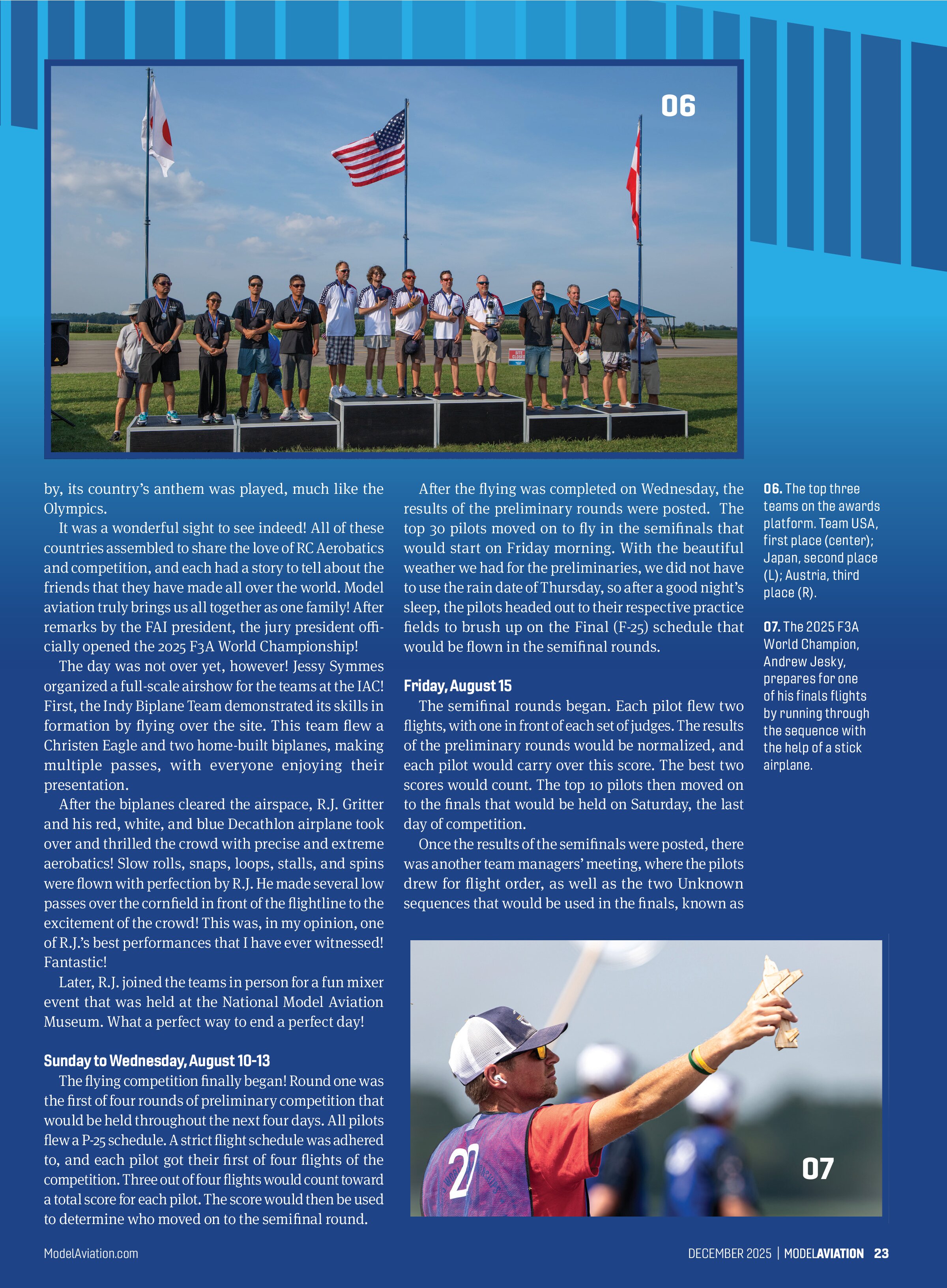
This was the big day! Everyone was ready and eager to fly. It had been a battle throughout the entire World Championship, with reigning World Champion Nurila Lassi, of Finland, flying very well and really pressing to retain his title. However, Andrew Jesky, of the US, was determined to make this his year to win it all! Tetsuo Onda, of Japan, was also in the mix and flew really well. Jason Shulman, of the US, and Yuhei Suzuki, of Japan, were also right there with the leaders.
Round one results had Tetsuo winning the round, with Nurila in second, Jason in third, and Andrew in fourth. Round two would go back to flying the F-25 schedule. Andrew put in a great flight and won the round, followed by Tetsuo in second place and Nurila in third; Yuhei was in fourth, and Jason was in fifth.
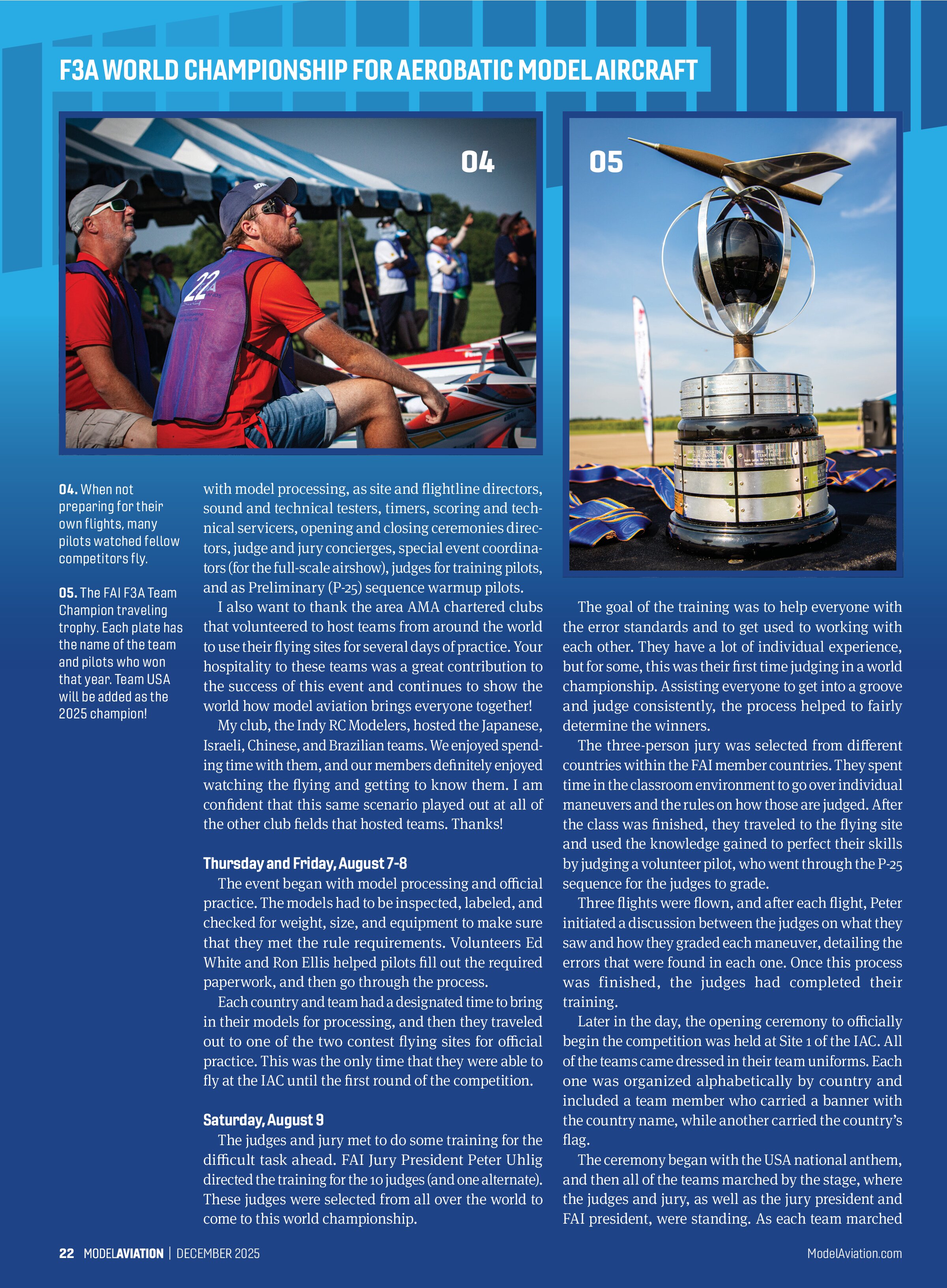
It would all come down to the final deciding third round of flying Unknown 2. When the dust settled, Andrew won the round and claimed the title of World Champion! Jason was second in the round, and Nurila was third, with Tetsuo coming in fourth. The final individual standings were Andrew as the world champion, Nurila in second place, and Tetsuo in third place. The highest placing Junior was Seth Huntingford of Australia. The final team standings put Team USA in first, Japan in second, and Finland in third.
Congratulations to all of the pilots who participated, and especially to the winners! Personally, I know how hard Andrew worked for the past several years to achieve being the world champion, so a very special congratulations to him! It was fantastic to see the US take the Team championship again as well. Jason has been part of this team for many world championships, and he was instrumental in this win. Peter Collinson has been on the team before and is consistently improving; I suspect he will continue to be a force on this team for many more years!
Congratulations to Andrew and Team USA! Well done! You all made us proud!
No country had put in a bid with the FAI to host the 2027 F3A World Championship
as of this writing in October 2025, but you can bet that, when it is announced, Team USA will again be ready for the challenge!
SOURCES:
2025 F3A World Championship for Aerobatic Model Aircraft
2025wch.usaf3a.org