ELECTRICS

READER PROJECTS
By Terry Dunn | terrydunn74@gmail.com
I WANT TO start this column with a great project that was sent in by Ted Smith. I’ll let Ted describe it to you:
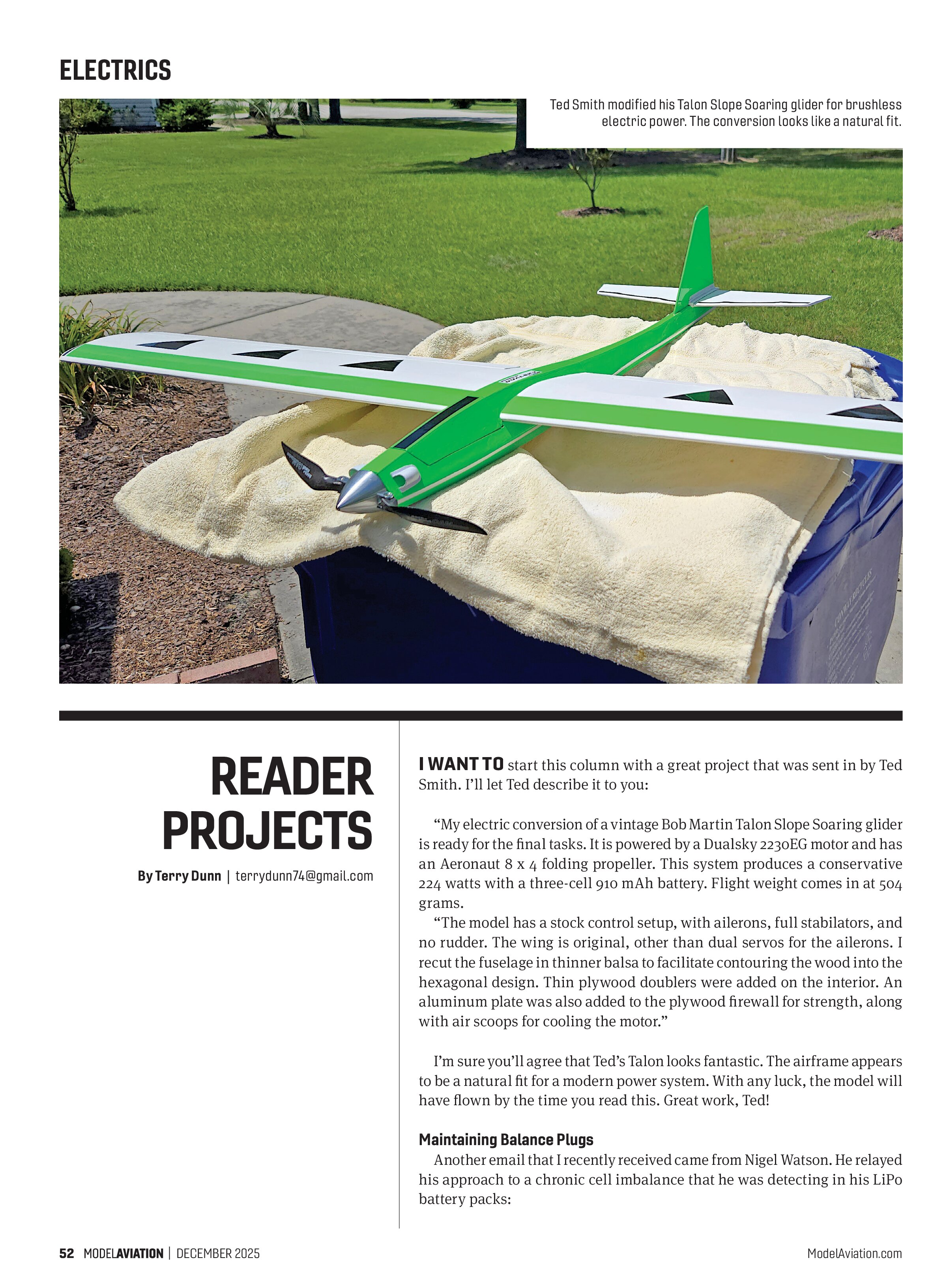
“My electric conversion of a vintage Bob Martin Talon Slope Soaring glider is ready for the final tasks. It is powered by a Dualsky 2230EG motor and has an Aeronaut 8 x 4 folding propeller. This system produces a conservative 224 watts with a three-cell 910 mAh battery. Flight weight comes in at 504 grams.
“The model has a stock control setup, with ailerons, full stabilators, and no rudder. The wing is original, other than dual servos for the ailerons. I recut the fuselage in thinner balsa to facilitate contouring the wood into the hexagonal design. Thin plywood doublers were added on the interior. An aluminum plate was also added to the plywood firewall for strength, along with air scoops for cooling the motor.”
I’m sure you’ll agree that Ted’s Talon looks fantastic. The airframe appears to be a natural fit for a modern power system. With any luck, the model will have flown by the time you read this. Great work, Ted!
Maintaining Balance Plugs
Another email that I recently received came from Nigel Watson. He relayed his approach to a chronic cell imbalance that he was detecting in his LiPo battery packs:

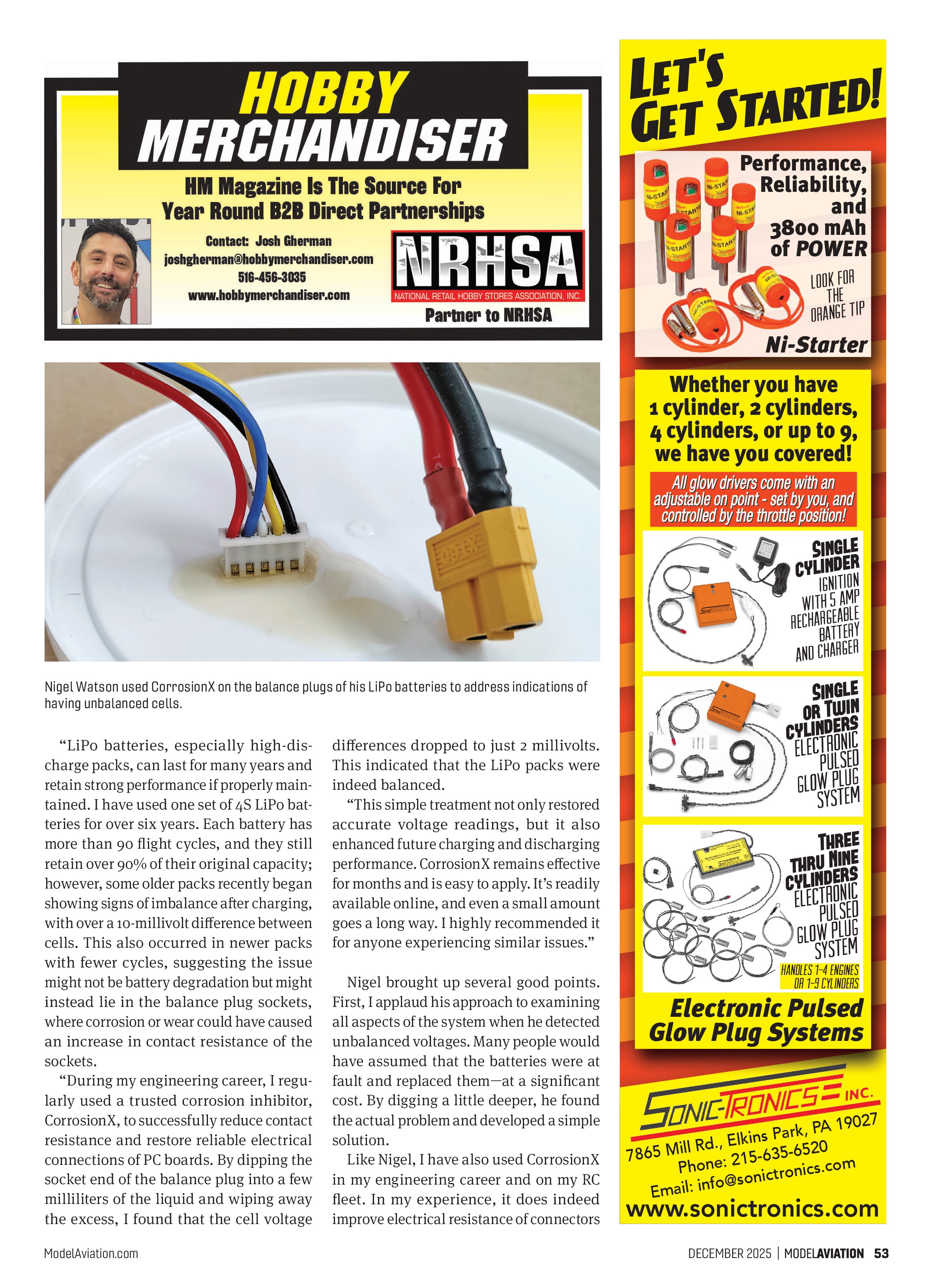
“LiPo batteries, especially high-discharge packs, can last for many years and retain strong performance if properly maintained. I have used one set of 4S LiPo batteries for over six years. Each battery has more than 90 flight cycles, and they still retain over 90% of their original capacity; however, some older packs recently began showing signs of imbalance after charging, with over a 10-millivolt difference between cells. This also occurred in newer packs with fewer cycles, suggesting the issue might not be battery degradation but might instead lie in the balance plug sockets, where corrosion or wear could have caused an increase in contact resistance of the sockets.
“During my engineering career, I regularly used a trusted corrosion inhibitor, CorrosionX, to successfully reduce contact resistance and restore reliable electrical connections of PC boards. By dipping the socket end of the balance plug into a few milliliters of the liquid and wiping away the excess, I found that the cell voltage differences dropped to just 2 millivolts. This indicated that the LiPo packs were indeed balanced.
“This simple treatment not only restored accurate voltage readings, but it also enhanced future charging and discharging performance. CorrosionX remains effective for months and is easy to apply. It’s readily available online, and even a small amount goes a long way. I highly recommended it for anyone experiencing similar issues.”
Nigel brought up several good points. First, I applaud his approach to examining all aspects of the system when he detected unbalanced voltages. Many people would have assumed that the batteries were at fault and replaced them—at a significant cost. By digging a little deeper, he found the actual problem and developed a simple solution.
Like Nigel, I have also used CorrosionX in my engineering career and on my RC fleet. In my experience, it does indeed improve electrical resistance of connectors

and helps to prevent any further degradation of the contacts. Another useful benefit of CorrosionX is that it acts as a sort of conformal coating to make electronics more water resistant (but not waterproof). I spray CorrosionX on the ESC circuit boards in all of my RC aircraft that might come into contact with water, including my seaplanes, floatplanes, and anything that I fly off of the snow.
Be aware that CorrosionX is stinky, greasy stuff. It could mar some foams or paint finishes. Apply it very carefully and sparingly—especially if you use the spray can option. I usually remove the ESCs from the model before applying CorrosionX. This allows me to clean any drips or overspray that could make a mess inside the airplane.
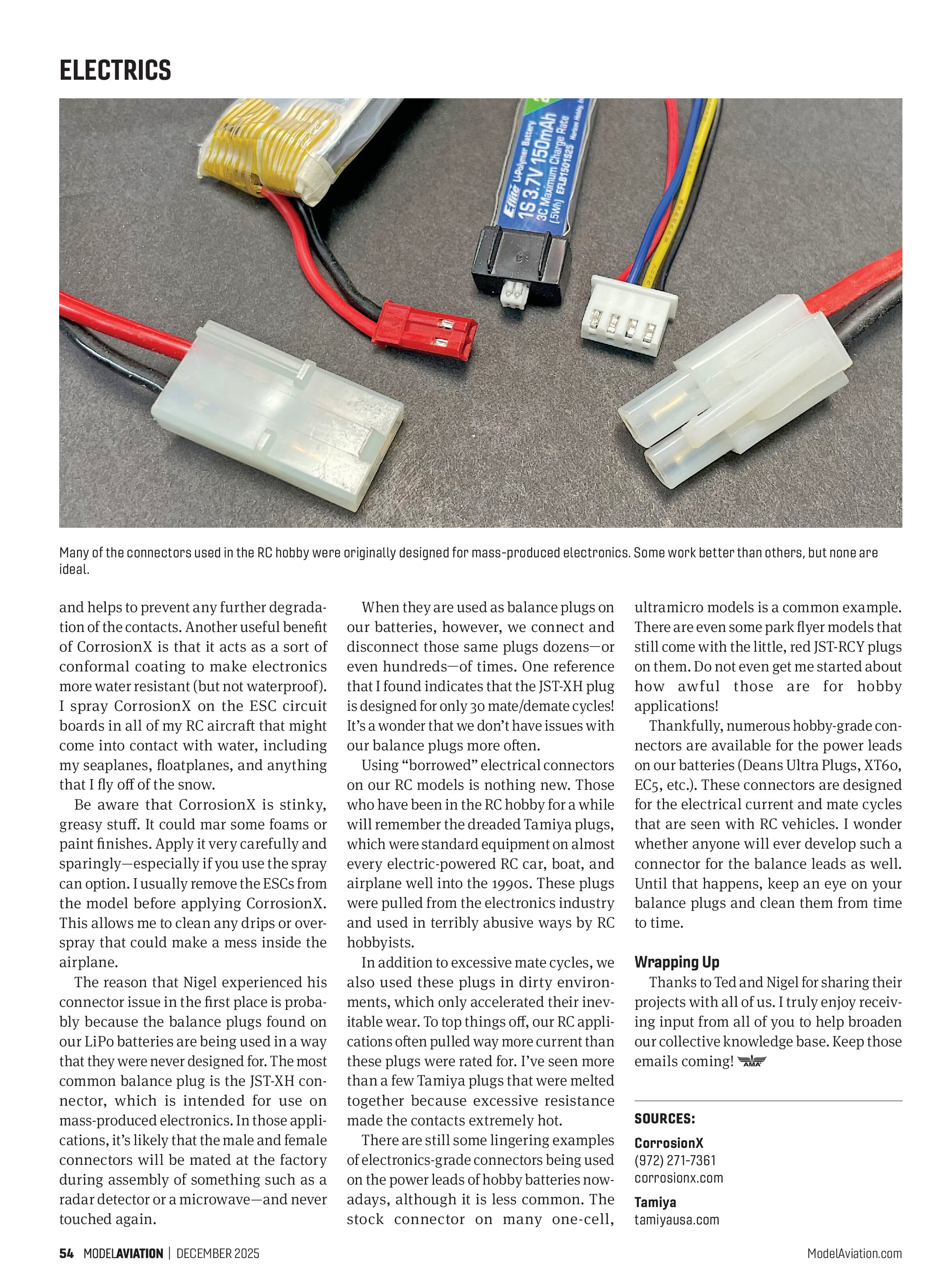
The reason that Nigel experienced his connector issue in the first place is probably because the balance plugs found on our LiPo batteries are being used in a way that they were never designed for. The most common balance plug is the JST-XH connector, which is intended for use on mass-produced electronics. In those applications, it’s likely that the male and female connectors will be mated at the factory during assembly of something such as a radar detector or a microwave—and never touched again.
When they are used as balance plugs on our batteries, however, we connect and disconnect those same plugs dozens—or even hundreds—of times. One reference that I found indicates that the JST-XH plug is designed for only 30 mate/demate cycles! It’s a wonder that we don’t have issues with our balance plugs more often.
Using “borrowed” electrical connectors on our RC models is nothing new. Those who have been in the RC hobby for a while will remember the dreaded Tamiya plugs, which were standard equipment on almost every electric-powered RC car, boat, and airplane well into the 1990s. These plugs were pulled from the electronics industry and used in terribly abusive ways by RC hobbyists.
In addition to excessive mate cycles, we also used these plugs in dirty environments, which only accelerated their inevitable wear. To top things off, our RC applications often pulled way more current than these plugs were rated for. I’ve seen more than a few Tamiya plugs that were melted together because excessive resistance made the contacts extremely hot.
There are still some lingering examples of electronics-grade connectors being used on the power leads of hobby batteries nowadays, although it is less common. The stock connector on many one-cell, ultramicro models is a common example. There are even some park flyer models that still come with the little, red JST-RCY plugs on them. Do not even get me started about how awful those are for hobby applications!
Thankfully, numerous hobby-grade connectors are available for the power leads on our batteries (Deans Ultra Plugs, XT60, EC5, etc.). These connectors are designed for the electrical current and mate cycles that are seen with RC vehicles. I wonder whether anyone will ever develop such a connector for the balance leads as well. Until that happens, keep an eye on your balance plugs and clean them from time to time.
Wrapping Up
Thanks to Ted and Nigel for sharing their projects with all of us. I truly enjoy receiving input from all of you to help broaden our collective knowledge base. Keep those emails coming!
Sources:
CorrosionX
(972) 271-7361
corrosionx.com
Tamiya
tamiyausa.com