CONTROL LINE NAVY CARRIER


Bob had built that Seamew in the 1970s. It was the third one after two prior Seamews were destroyed in unfortunate crashes. It had never been flown. It disappeared during a move and went through a few other hands until it finally ended up with Mike in Oregon. Mike sent the Seamew to me in Albuquerque, and I took it to the 2024 Nats, where Dave Heinzman met me at the Carrier circles and took it back to Ohio for its reunion with Bob. It now resides in its rightful place with Bob after a journey of 20 years and a few thousand miles.
Onboard Voltage Monitoring
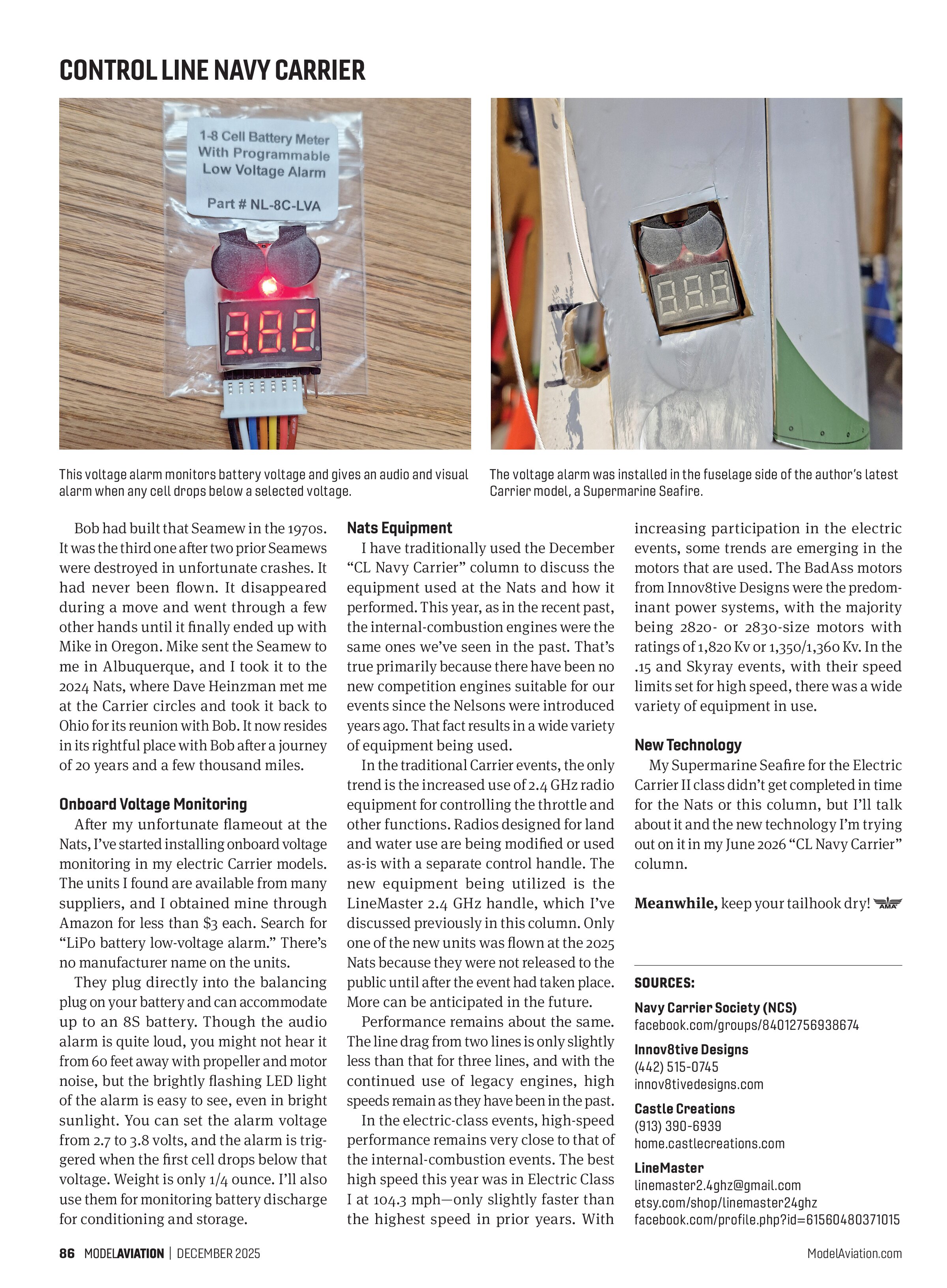
After my unfortunate flameout at the Nats, I’ve started installing onboard voltage monitoring in my electric Carrier models. The units I found are available from many suppliers, and I obtained mine through Amazon for less than $3 each. Search for “LiPo battery low-voltage alarm.” There’s no manufacturer name on the units.
They plug directly into the balancing plug on your battery and can accommodate up to an 8S battery. Though the audio alarm is quite loud, you might not hear it from 60 feet away with propeller and motor noise, but the brightly flashing LED light of the alarm is easy to see, even in bright sunlight. You can set the alarm voltage from 2.7 to 3.8 volts, and the alarm is triggered when the first cell drops below that voltage. Weight is only 1/4 ounce. I’ll also use them for monitoring battery discharge for conditioning and storage.
Nats Equipment
I have traditionally used the December “CL Navy Carrier” column to discuss the equipment used at the Nats and how it performed. This year, as in the recent past, the internal-combustion engines were the same ones we’ve seen in the past. That’s true primarily because there have been no new competition engines suitable for our events since the Nelsons were introduced years ago. That fact results in a wide variety of equipment being used.
In the traditional Carrier events, the only trend is the increased use of 2.4 GHz radio equipment for controlling the throttle and other functions. Radios designed for land and water use are being modified or used as-is with a separate control handle. The new equipment being utilized is the LineMaster 2.4 GHz handle, which I’ve discussed previously in this column. Only one of the new units was flown at the 2025 Nats because they were not released to the public until after the event had taken place. More can be anticipated in the future.
Performance remains about the same. The line drag from two lines is only slightly less than that for three lines, and with the continued use of legacy engines, high speeds remain as they have been in the past.
In the electric-class events, high-speed performance remains very close to that of the internal-combustion events. The best high speed this year was in Electric Class I at 104.3 mph—only slightly faster than the highest speed in prior years. With increasing participation in the electric events, some trends are emerging in the motors that are used. The BadAss motors from Innov8tive Designs were the predominant power systems, with the majority being 2820- or 2830-size motors with ratings of 1,820 Kv or 1,350/1,360 Kv. In the .15 and Skyray events, with their speed limits set for high speed, there was a wide variety of equipment in use.
New Technology
My Supermarine Seafire for the Electric Carrier II class didn’t get completed in time for the Nats or this column, but I’ll talk about it and the new technology I’m trying out on it in my June 2026 “CL Navy Carrier” column.
Meanwhile, keep your tailhook dry!
SOURCES:
Navy Carrier Society (NCS)
facebook.com/groups/84012756938674/
Innov8tive Designs
(442) 515-0745
innov8tivedesigns.com
Castle Creations
(913) 390-6939
home.castlecreations.com
LineMaster
linemaster2.4ghz@gmail.com
etsy.com/shop/linemaster24ghz
facebook.com/profile.php?id=61560480371015