NIRIS AND PEPPERMINT PATTIE
Photos provided by W “Nic” Damuck | wdamuck@gmail.com

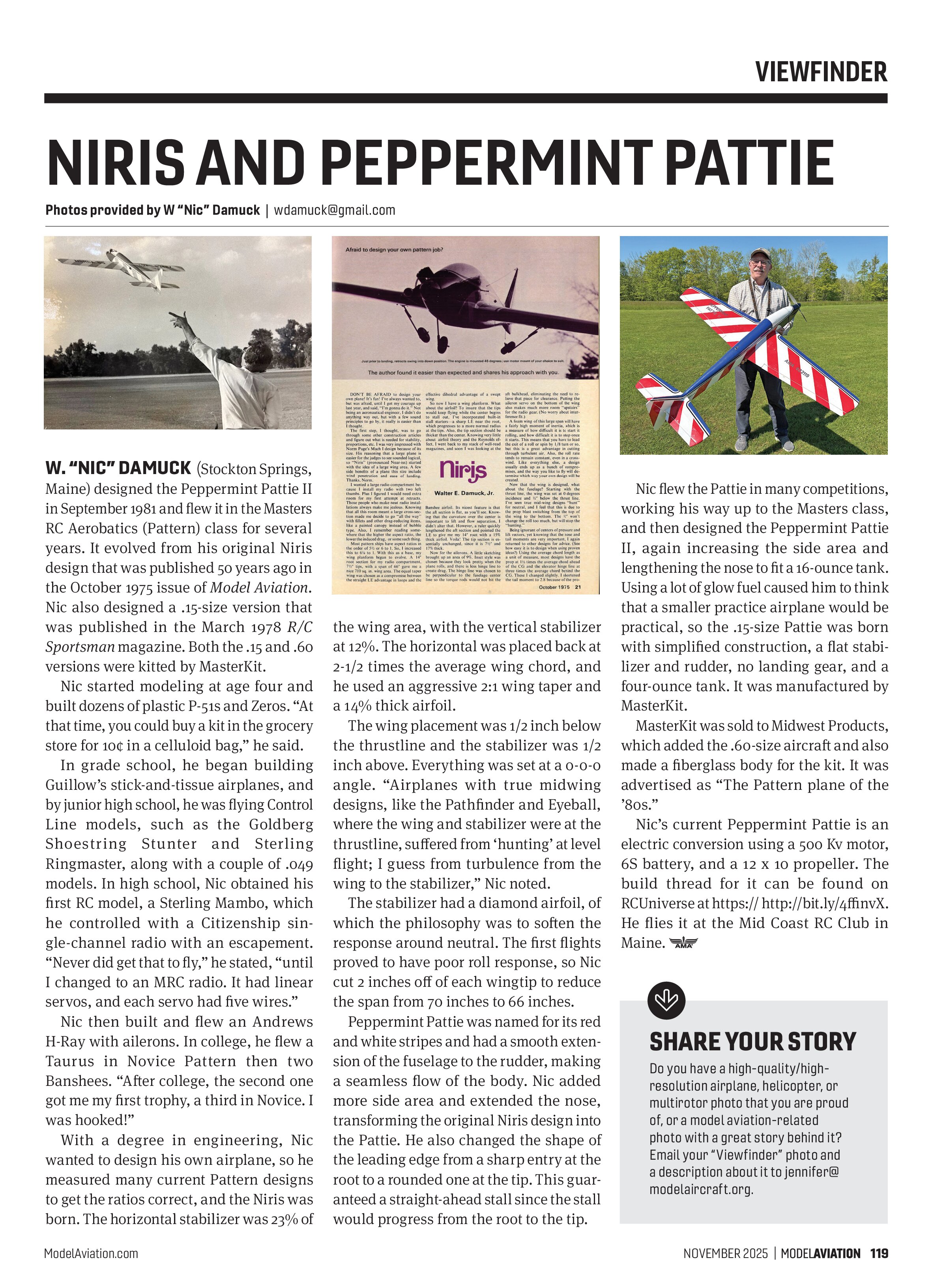
W. “NIC” DAMUCK (Stockton Springs, Maine) designed the Peppermint Pattie II in September 1981 and flew it in the Masters RC Aerobatics (Pattern) class for several years. It evolved from his original Niris design that was published 50 years ago in the October 1975 issue of Model Aviation. Nic also designed a .15-size version that was published in the March 1978 R/C Sportsman magazine. Both the .15 and .60 versions were kitted by MasterKit.
Nic started modeling at age four and built dozens of plastic P-51s and Zeros. “At that time, you could buy a kit in the grocery store for 10¢ in a celluloid bag,” he said.
In grade school, he began building Guillow’s stick-and-tissue airplanes, and by junior high school, he was flying Control Line models, such as the Goldberg Shoestring Stunter and Sterling Ringmaster, along with a couple of .049 models. In high school, Nic obtained his first RC model, a Sterling Mambo, which he controlled with a Citizenship single-channel radio with an escapement. “Never did get that to fly,” he stated, “until I changed to an MRC radio. It had linear servos, and each servo had five wires.”
Nic then built and flew an Andrews H-Ray with ailerons. In college, he flew a Taurus in Novice Pattern then two Banshees. “After college, the second one got me my first trophy, a third in Novice. I was hooked!”
With a degree in engineering, Nic wanted to design his own airplane, so he measured many current Pattern designs to get the ratios correct, and the Niris was born. The horizontal stabilizer was 23% of the wing area, with the vertical stabilizer at 12%. The horizontal was placed back at 2-1/2 times the average wing chord, and he used an aggressive 2:1 wing taper and a 14% thick airfoil.

The wing placement was 1/2 inch below the thrustline and the stabilizer was 1/2 inch above. Everything was set at a 0-0-0 angle. “Airplanes with true midwing designs, like the Pathfinder and Eyeball, where the wing and stabilizer were at the thrustline, suffered from ‘hunting’ at level flight; I guess from turbulence from the wing to the stabilizer,” Nic noted.
The stabilizer had a diamond airfoil, of which the philosophy was to soften the response around neutral. The first flights proved to have poor roll response, so Nic cut 2 inches off of each wingtip to reduce the span from 70 inches to 66 inches.
Peppermint Pattie was named for its red and white stripes and had a smooth extension of the fuselage to the rudder, making a seamless flow of the body. Nic added more side area and extended the nose, transforming the original Niris design into the Pattie. He also changed the shape of the leading edge from a sharp entry at the root to a rounded one at the tip. This guaranteed a straight-ahead stall since the stall would progress from the root to the tip.

Nic flew the Pattie in many competitions, working his way up to the Masters class, and then designed the Peppermint Pattie II, again increasing the side area and lengthening the nose to fit a 16-ounce tank. Using a lot of glow fuel caused him to think that a smaller practice airplane would be practical, so the .15-size Pattie was born with simplified construction, a flat stabilizer and rudder, no landing gear, and a four-ounce tank. It was manufactured by MasterKit.
MasterKit was sold to Midwest Products, which added the .60-size aircraft and also made a fiberglass body for the kit. It was advertised as “The Pattern plane of the ’80s.”
Nic’s current Peppermint Pattie is an electric conversion using a 500 Kv motor, 6S battery, and a 12 x 10 propeller. The build thread for it can be found on RCUniverse at https:// http://bit.ly/4ffmnvX. He flies it at the Mid Coast RC Club in Maine.