SAFETY COMES FIRST

ETERNAL
FLAME
DESPITE ALL
EFFORTS
By Dave Gee | safetycolumn@cs.com
I’VE RECEIVED TWO SEPARATE REPORTS about flying field fire extinguishers not working when they were needed. Both units were several years old and supposedly had a test dial “in the green.” These extinguishers were stored at the field; one was outside and one was in a shed. Each was exposed to normal temperature and weather changes, of which they were designed to withstand. It’s frustrating that further details were not available.
According to the reports, each unit simply failed to operate when a fire broke out, and in both cases, they were disposed of afterward without an autopsy. I can understand that part. Nobody wants to disassemble a high-pressure device that has unknown problems!
This raises so many questions! Were the nozzles obstructed? Did they freeze during the winter? Most, but not all, extinguishers are built to endure freezing weather. What age, type, and rating were the two bottles? We just don’t know.
Single-use, residential-type fire extinguishers have a pressure dial, but no other tests can be done except to verify that the needle is in the green. Other problems might be present, and, of course, they were present in these cases.
Home fire extinguishers can be expected to last for 10 to 12 years. The manufacturers’ warranties on these products range from three to 12 years, but I’ll bet few users can locate the receipt after so long.
What do you think about this matter? Hearing how some extinguishers don’t work when they are needed makes me nervous! Still, I’ve never personally seen them fail to operate, even when they were quite old.
My suggestion is to have plenty of fire extinguishers around, both at home and at the field. I keep one in each room of my house, just in case. Inspect them regularly, and if they don’t come with a date stamp, write the purchase date on the bottle. Replace them after approximately seven years, and let someone who has never used one discharge the old bottles as practice.
Time to Hang Up the Transmitter?
Aeromodeling is famous for being a hobby for the young and old. Even so, we must eventually face the fact that our ability to fly models tapers off as we get older. Al Burman wrote:
“I’ve been in RC for quite a while. My first plane was a Goldberg Falcon 56 back in 1975. In the years of reading the ‘Safety’ columns, I’ve seen many different topics covered. One thing I’ve never seen, though, is ‘How do I know when it’s time to quit?’
“At today’s date, I am just shy of 92 years of age. Like many, I started with Control Line (CL) at an early age, progressed to Free Flight (FF), and then to gas RC. A while ago, I noticed that I was slowing down in response time, so I started flying powered gliders to give more response time. After I crashed the last three gliders, I realized that it was time for me to give it up. Fortunately, I was able to recognize it before I hurt anyone.”

Al is right about how I’ve never addressed that issue in this column. It’s not a happy subject, of course. Having control of an RC aircraft is a bit like driving a car. You are responsible for a machine that could possibly cause harm, and your skill and judgment are what keep things safe.
Using that judgment to decide when to stop flying can be tough. Unlike full-scale flying, there are no government standards to say that you are no longer qualified. The final choice is left up to the modeler. Is it the duty of our friends to say something when things become obvious? I’d dread being on either end of that conversation!
As with most things, people are different, and some should retire their

transmitters earlier than others. The problem is that everyone hopes and thinks that their vision and reaction time are above average. I wonder if I will have the good judgement to make the proper choice at the proper time like Al did.
On the bright side, builders and pilots can enjoy themselves with model aircraft long after cross-country surfers or skateboard judo experts must stop—and you don’t need to hold a transmitter to enjoy our sport. I’ve noticed that, in many clubs, a substantial percentage of members never build or fly an aircraft. They just have a deep interest in modeling and enjoy associating with likeminded people. I have many such friends, and they can be the heart of a model club.
It seems to me that a modeler who chooses FF or Indoor models can keep at it the longest, all things being equal. My father was an active Indoor Scale builder into his mid-90s, and last month, I lost two contest events to a good pal who is 94.
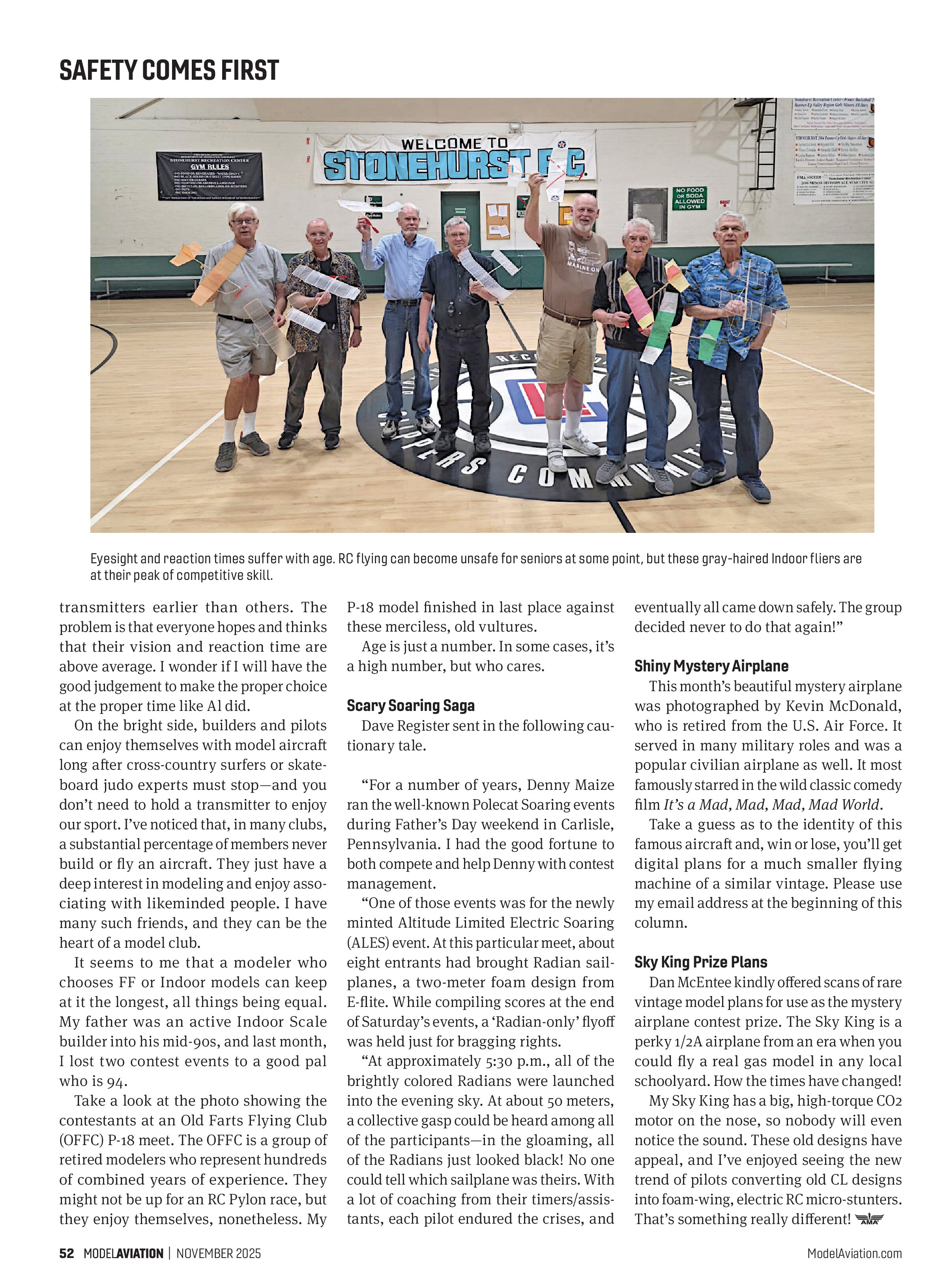
Take a look at the photo showing the contestants at an Old Farts Flying Club (OFFC) P-18 meet. The OFFC is a group of retired modelers who represent hundreds of combined years of experience. They might not be up for an RC Pylon race, but they enjoy themselves, nonetheless. My P-18 model finished in last place against these merciless, old vultures.
Age is just a number. In some cases, it’s a high number, but who cares.
Scary Soaring Saga
Dave Register sent in the following cautionary tale.
“For a number of years, Denny Maize ran the well-known Polecat Soaring events during Father’s Day weekend in Carlisle, Pennsylvania. I had the good fortune to both compete and help Denny with contest management.
“One of those events was for the newly minted Altitude Limited Electric Soaring (ALES) event. At this particular meet, about eight entrants had brought Radian sailplanes, a two-meter foam design from E-flite. While compiling scores at the end of Saturday’s events, a ‘Radian-only’ flyoff was held just for bragging rights.
“At approximately 5:30 p.m., all of the brightly colored Radians were launched into the evening sky. At about 50 meters, a collective gasp could be heard among all of the participants—in the gloaming, all of the Radians just looked black! No one could tell which sailplane was theirs. With a lot of coaching from their timers/assistants, each pilot endured the crises, and eventually all came down safely. The group decided never to do that again!”
Shiny Mystery Airplane
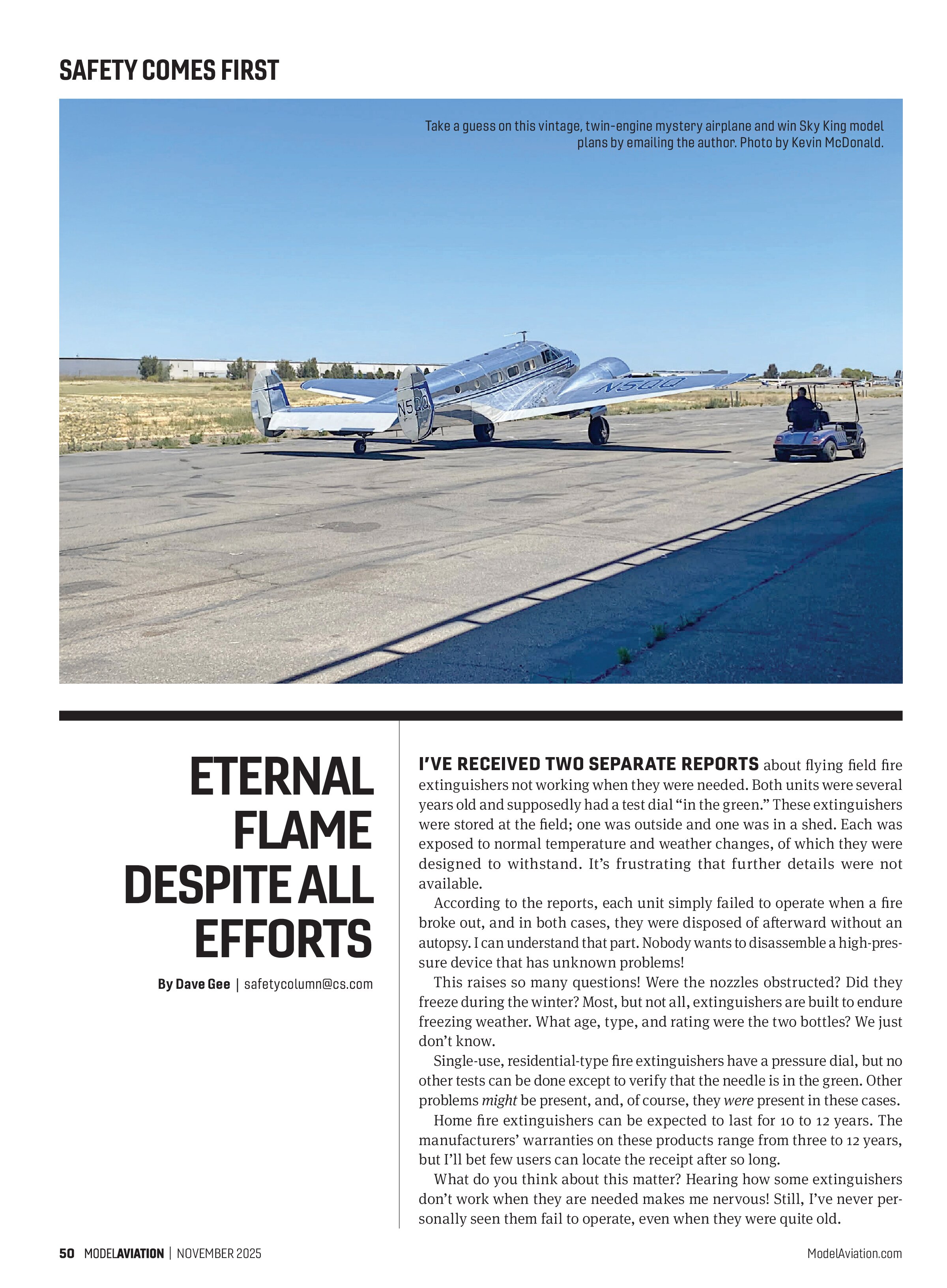
This month’s beautiful mystery airplane was photographed by Kevin McDonald, who is retired from the U.S. Air Force. It served in many military roles and was a popular civilian airplane as well. It most famously starred in the wild classic comedy film It’s a Mad, Mad, Mad, Mad World.
Take a guess as to the identity of this famous aircraft and, win or lose, you’ll get digital plans for a much smaller flying machine of a similar vintage. Please use my email address at the beginning of this column.
Sky King Prize Plans
Dan McEntee kindly offered scans of rare vintage model plans for use as the mystery airplane contest prize. The Sky King is a perky 1/2A airplane from an era when you could fly a real gas model in any local schoolyard. How the times have changed!
My Sky King has a big, high-torque CO2 motor on the nose, so nobody will even notice the sound. These old designs have appeal, and I’ve enjoyed seeing the new trend of pilots converting old CL designs into foam-wing, electric RC micro-stunters. That’s something really different!