RC PYLON RACING
Pylon Racing From a Bygone Era
By Tim Lampe | tim.lampe@hotmail.com

I ASKED MATT FEHLING whether his appreciation for the extraordinary effort that is used to build and prepare RC Pylon Racing models of the bygone era is because of his late father, Jack Fehling. Matt replied, “Definitely.” I have my secret list of US Pylon Racing pilots whom I would classify as elite, and Matt’s on it.
If there was any question, the theoretical argument was settled when Matt, guided by his caller, Jacob Raquet, recently broke the unofficial FAI F3E Pylon Racing Model Aircraft world record and took the official US record at the FAI F3E World Championship in Rothenburg, Germany, with a time of 54.07. But that’s a story for another time.
During our telephone conversation for this column, Matt reminisced about times with his father when he was a big shot on the circuit as well.
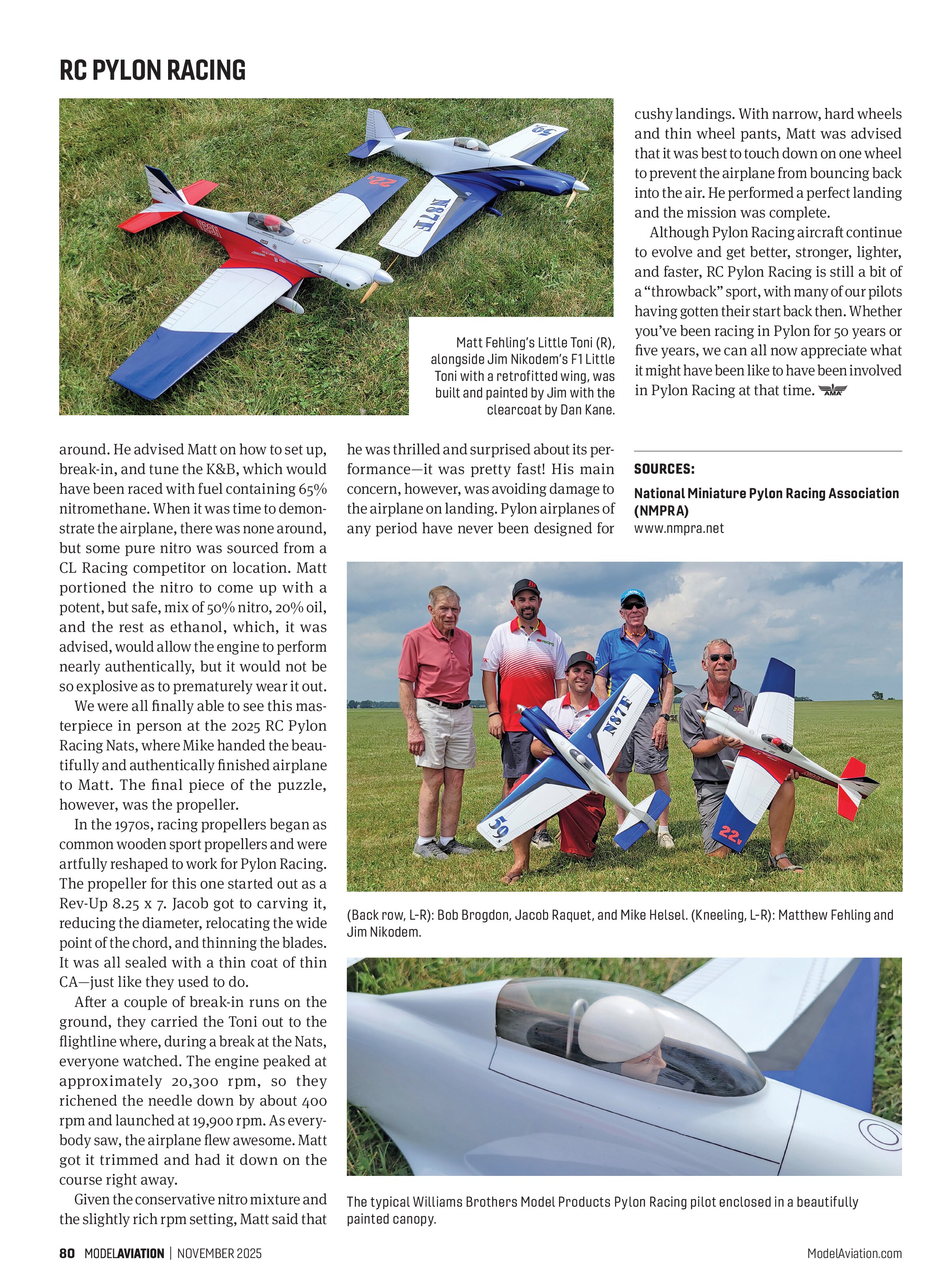
Another friend of mine, and a world-class Pylon Racing pilot himself, Mike Helsel, had been giving me updates about a Formula 1 (F1) airplane he was finishing for Matt. As told to me by Matt, he purchased a Prather Products Little Toni in its original kit form from Harold Sattler, who is in Canada. Upon receipt, Matt forwarded the airplane to another friend, who started the build then returned it to Matt after taking the project up to the point of finishing. At this moment, Matt realized that, to have an airplane with a perfect finish truly representative of the era, he had better solicit a professional to do the dirty work. This is where Mike came in.
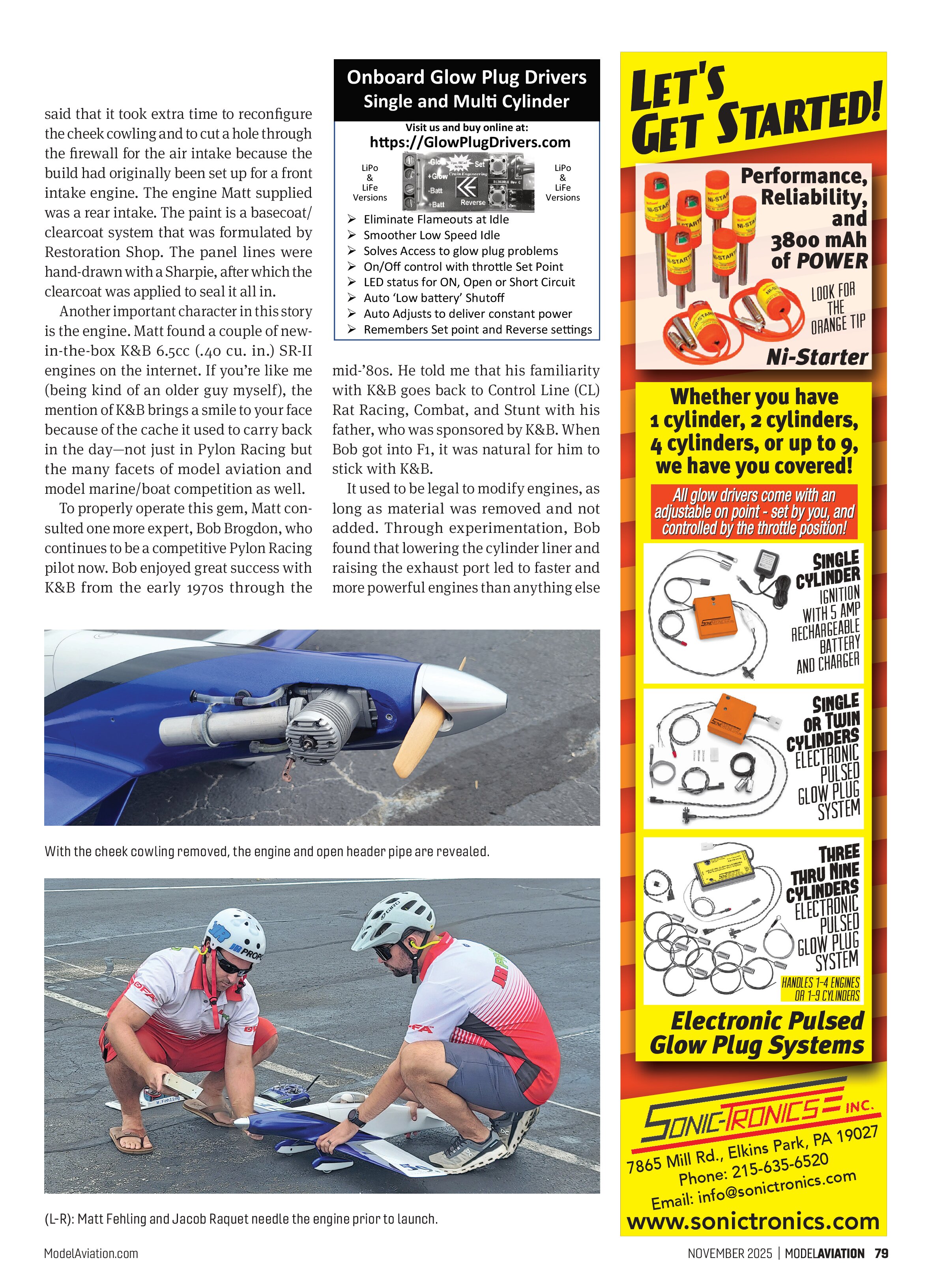
Mike has vast experience building, finishing, and racing airplanes from back then, and he is still regarded as one of the best builders on the circuit. He did the radio, firewall, engine installation, body work, primer, and paint. Mike said that it took extra time to reconfigure the cheek cowling and to cut a hole through the firewall for the air intake because the build had originally been set up for a front intake engine. The engine Matt supplied was a rear intake. The paint is a basecoat/clearcoat system that was formulated by Restoration Shop. The panel lines were hand-drawn with a Sharpie, after which the clearcoat was applied to seal it all in.
Another important character in this story is the engine. Matt found a couple of new-in-the-box K&B 6.5cc (.40 cu. in.) SR-II engines on the internet. If you’re like me (being kind of an older guy myself), the mention of K&B brings a smile to your face because of the cache it used to carry back in the day—not just in Pylon Racing but the many facets of model aviation and model marine/boat competition as well.
To properly operate this gem, Matt consulted one more expert, Bob Brogdon, who continues to be a competitive Pylon Racing pilot now. Bob enjoyed great success with K&B from the early 1970s through the mid-’80s. He told me that his familiarity with K&B goes back to Control Line (CL) Rat Racing, Combat, and Stunt with his father, who was sponsored by K&B. When Bob got into F1, it was natural for him to stick with K&B.
It used to be legal to modify engines, as long as material was removed and not added. Through experimentation, Bob found that lowering the cylinder liner and raising the exhaust port led to faster and more powerful engines than anything else.


cushy landings. With narrow, hard wheels and thin wheel pants, Matt was advised that it was best to touch down on one wheel to prevent the airplane from bouncing back into the air. He performed a perfect landing and the mission was complete.
Although Pylon Racing aircraft continue to evolve and get better, stronger, lighter, and faster, RC Pylon Racing is still a bit of a “throwback” sport, with many of our pilots having gotten their start back then. Whether you’ve been racing in Pylon for 50 years or five years, we can all now appreciate what it might have been like to have been involved in Pylon Racing at that time.
around. He advised Matt on how to set up, break-in, and tune the K&B, which would have been raced with fuel containing 65% nitromethane. When it was time to demonstrate the airplane, there was none around, but some pure nitro was sourced from a CL Racing competitor on location. Matt portioned the nitro to come up with a potent, but safe, mix of 50% nitro, 20% oil, and the rest as ethanol, which, it was advised, would allow the engine to perform nearly authentically, but it would not be so explosive as to prematurely wear it out.
We were all finally able to see this masterpiece in person at the 2025 RC Pylon Racing Nats, where Mike handed the beautifully and authentically finished airplane to Matt. The final piece of the puzzle, however, was the propeller.
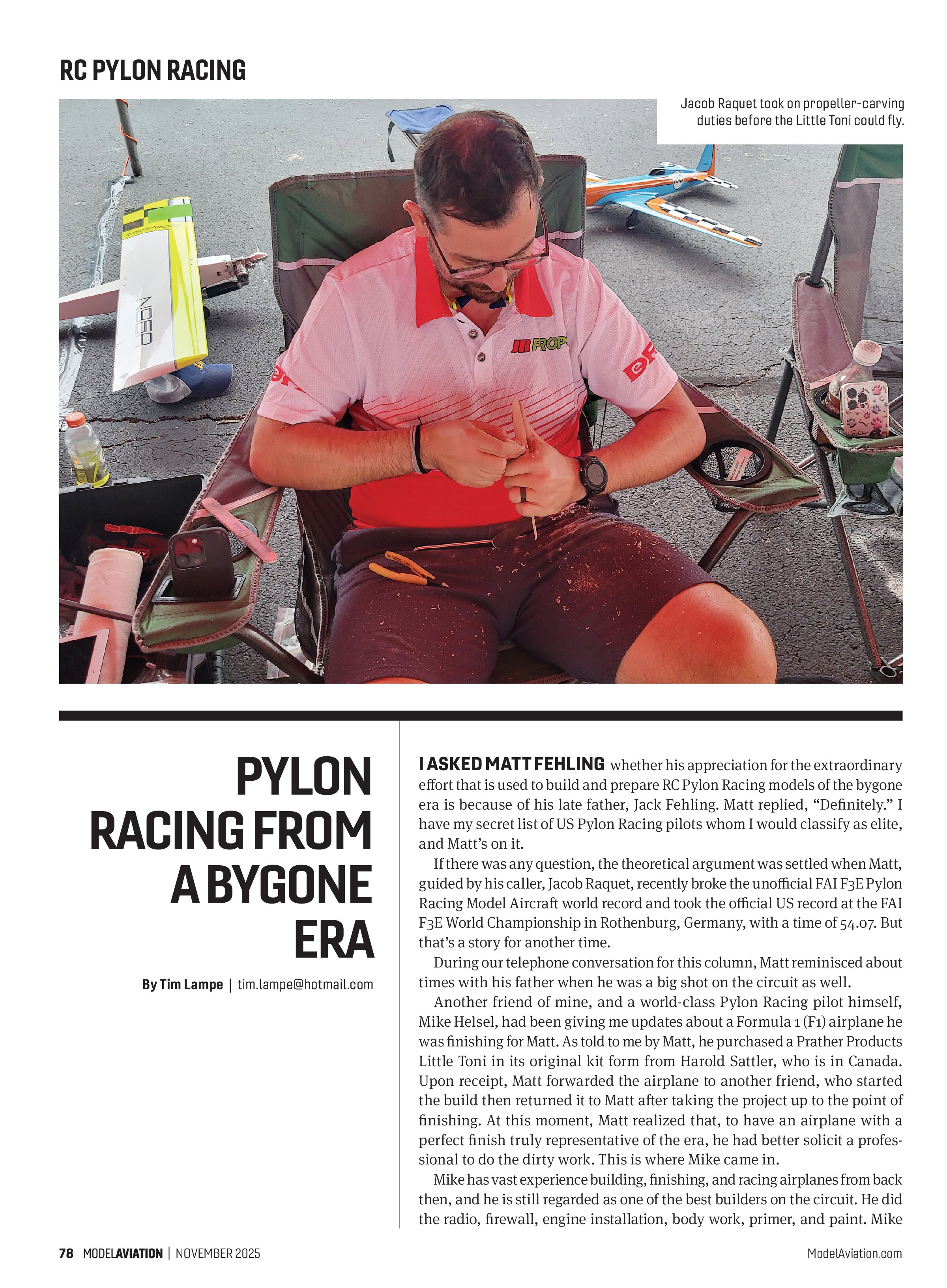
In the 1970s, racing propellers began as common wooden sport propellers and were artfully reshaped to work for Pylon Racing. The propeller for this one started out as a Rev-Up 8.25 x 7. Jacob got to carving it, reducing the diameter, relocating the wide point of the chord, and thinning the blades. It was all sealed with a thin coat of thin CA—just like they used to do.
After a couple of break-in runs on the ground, they carried the Toni out to the flightline where, during a break at the Nats, everyone watched. The engine peaked at approximately 20,300 rpm, so they richened the needle down by about 400 rpm and launched at 19,900 rpm. As everybody saw, the airplane flew awesome. Matt got it trimmed and had it down on the course right away.
Given the conservative nitro mixture and the slightly rich rpm setting, Matt said that he was thrilled and surprised about its performance—it was pretty fast! His main concern, however, was avoiding damage to the airplane on landing. Pylon airplanes of any period have never been designed for
SOURCES:
National Miniature Pylon Racing Association (NMPRA)
www.nmpra.net