RC AEROBATICS

GEOMETRY
IS KEY
By Justin Wells | justinwells@mac.com
LET’S CONTINUE reviewing some fundamentals of flying RC Aerobatics (Pattern). In my last column, I covered distances, the challenges that we face, and how to judge them. In this article, I want to touch on geometric accuracy, something that is often skewed and misinterpreted by pilots and judges but carries significant weight in scoring.
It is my opinion that geometry is what makes Pattern fun. Putting your airplane where you want it and drawing the correct lines are where everything comes together. These fundamentals start in the lowest class (Sportsman) and take you up to the top classes (Masters and FAI). As you progress through the classes, you will notice that the maneuvers are similar but other elements are introduced. Sometimes a maneuver is executed in a different location; instead of being in the center, it might be at the end of the box. Learning to fly the maneuvers in their most basic form (in the lower classes) helps you add the additional difficulty elements as you progress. This is by design and builds your confidence.
If I find myself struggling with a maneuver, I will often step back and work on just the geometry of it. I do this until I feel that it is closer to what it should be and that I have the basics down and remembered. I will then go and try the maneuvers again with the added elements.
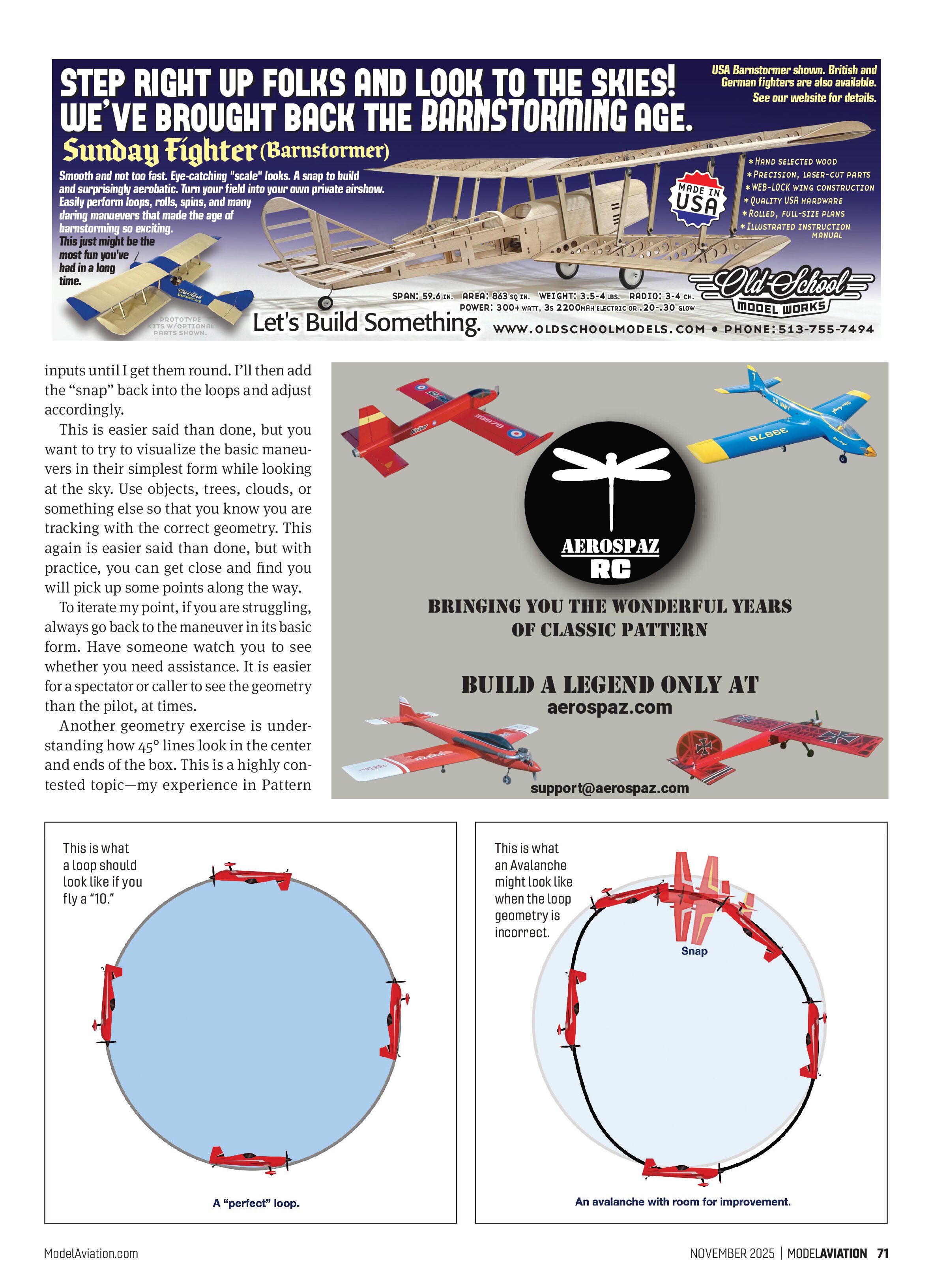
Let’s look at the Avalanche as an example. In its basic form, it is a loop with a snap at the top. I might not have flown a loop in a few of the sequence cycles, so I find that my Avalanche looks good up until I finish the snap, and then the loop turns into an egg or, worse, a misshaped half circle. I’ll pull away from this and just do some loops to practice my rudder and throttle inputs until I get them round. I’ll then add the “snap” back into the loops and adjust accordingly.
This is easier said than done, but you want to try to visualize the basic maneuvers in their simplest form while looking at the sky. Use objects, trees, clouds, or something else so that you know you are tracking with the correct geometry. This again is easier said than done, but with practice, you can get close and find you will pick up some points along the way.
To iterate my point, if you are struggling, always go back to the maneuver in its basic form. Have someone watch you to see whether you need assistance. It is easier for a spectator or caller to see the geometry than the pilot, at times.
Another geometry exercise is understanding how 45° lines look in the center and ends of the box. This is a highly contested topic—my experience in Pattern


and my opinion might differ based on what a 45° line looks like. Some say it should be steep and some say it should be softer. If you lean toward soft, you are told that you are below 45° and lose points.
I spend a lot of my time practicing maneuvers that have a 45° line for this reason but also partly for confidence and because I seem to not know myself how a 45° line should look.
A 45° line at the end of the box might look like a 20° line; instead, you can fly a 60° line—now you have what is perceived as a 45° line. It is amazing how this detail plays into competition and flying the maneuvers correctly.
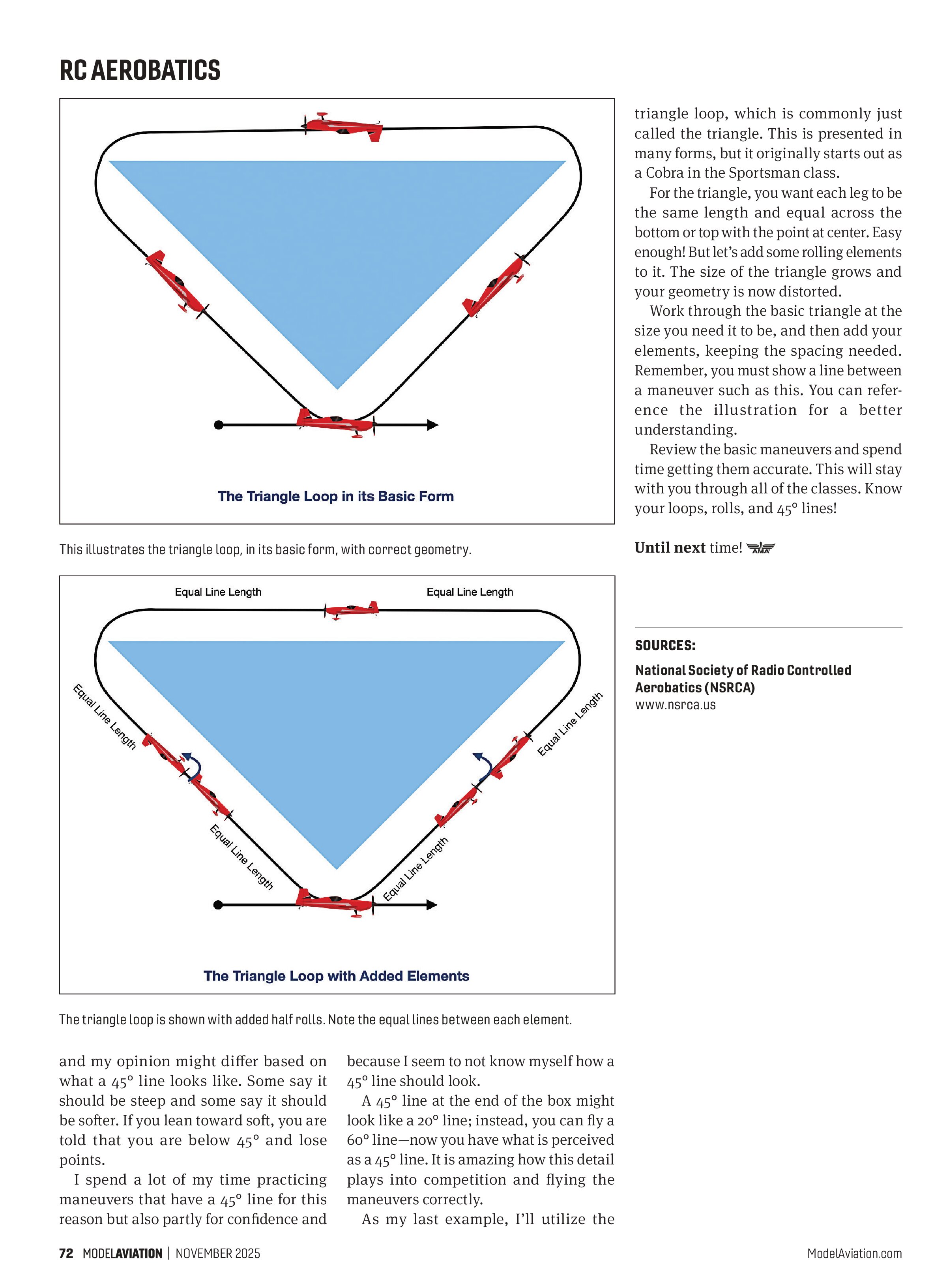
As my last example, I’ll utilize the triangle loop, which is commonly just called the triangle. This is presented in many forms, but it originally starts out as a Cobra in the Sportsman class.
For the triangle, you want each leg to be the same length and equal across the bottom or top with the point at center. Easy enough! But let’s add some rolling elements to it. The size of the triangle grows and your geometry is now distorted.
Work through the basic triangle at the size you need it to be, and then add your elements, keeping the spacing needed. Remember, you must show a line between a maneuver such as this. You can reference the illustration for a better understanding.
Review the basic maneuvers and spend time getting them accurate. This will stay with you through all of the classes. Know your loops, rolls, and 45° lines!
Until next time!
SOURCES:
National Society of Radio Controlled Aerobatics (NSRCA)
www.nsrca.us