FREE FLIGHT SCALE

THAT MODEL
LOOKS LIKE A
BUG!
By Tom Hallman | maxfliart@hallmanstudio.com
HAVING ATTENDED the Flying Aces Club (FAC) annual contest in Geneseo, New York, every July for the past 35 years, I expect to see a large variety of mostly rubber-powered models. Sure, there are plenty of the classic designs by Piper, Cessna, and Fairchild, along with the full array of fighter aircraft from World War I and World War II, some of the common modern designs, or the occasional Pioneer aircraft from the early 1900s thrown in. Quite a few twin-powered models appear as well, and maybe even a quad. Hopefully a pusher canard or two will be there.
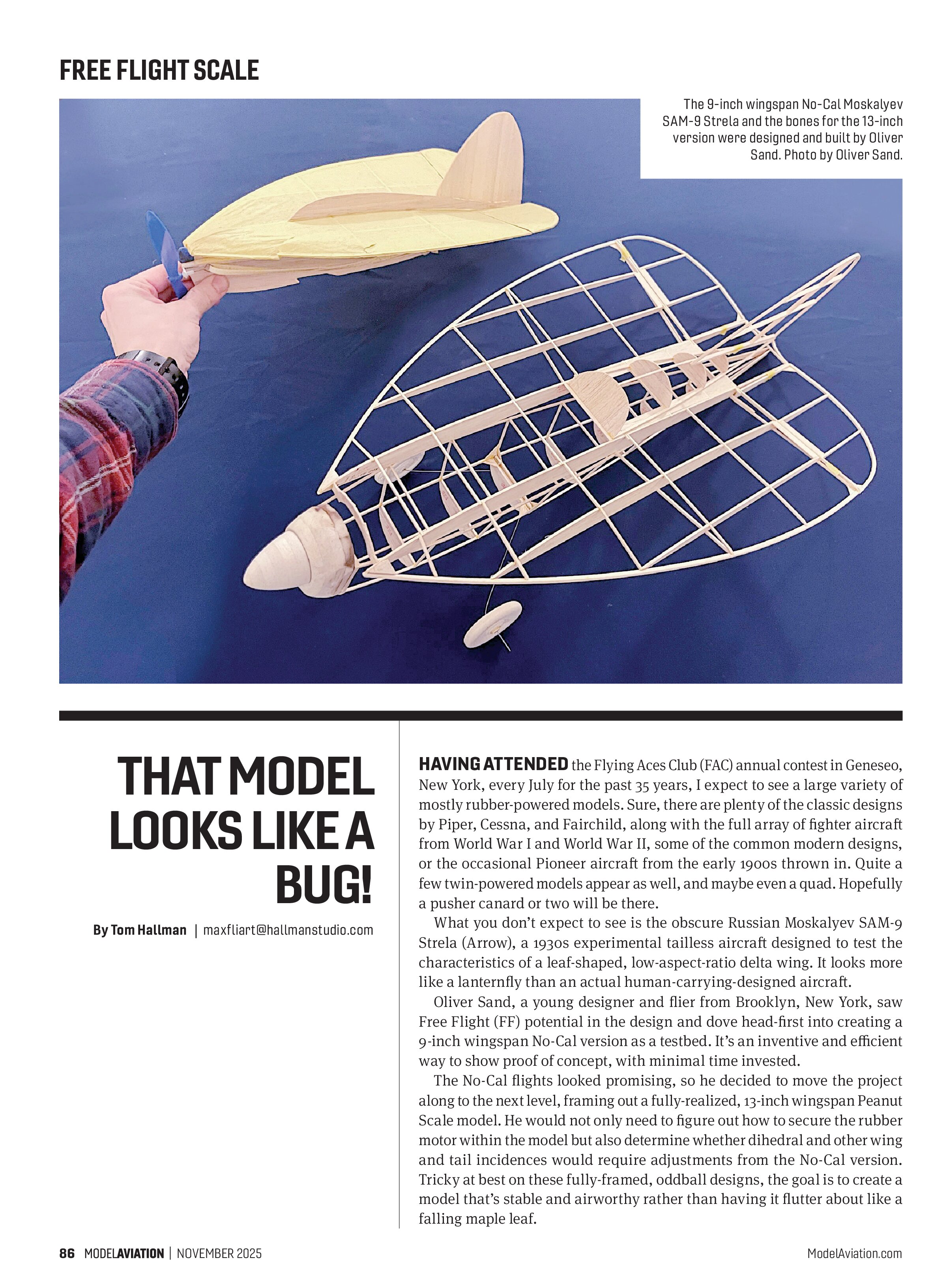
What you don’t expect to see is the obscure Russian Moskalyev SAM-9 Strela (Arrow), a 1930s experimental tailless aircraft designed to test the characteristics of a leaf-shaped, low-aspect-ratio delta wing. It looks more like a lanternfly than an actual human-carrying-designed aircraft.
Oliver Sand, a young designer and flier from Brooklyn, New York, saw Free Flight (FF) potential in the design and dove head-first into creating a 9-inch wingspan No-Cal version as a testbed. It’s an inventive and efficient way to show proof of concept, with minimal time invested.
The No-Cal flights looked promising, so he decided to move the project along to the next level, framing out a fully-realized, 13-inch wingspan Peanut Scale model. He would not only need to figure out how to secure the rubber motor within the model but also determine whether dihedral and other wing and tail incidences would require adjustments from the No-Cal version. Tricky at best on these fully-framed, oddball designs, the goal is to create a model that’s stable and airworthy rather than having it flutter about like a falling maple leaf.
Even though the model could be confused for a colorful, oblong serving plate with a rudder, I’m pleased to report that the model is a success! I filmed a few flights one evening during the golden hour when, much to the delight of the growing crowd, Oliver’s Strela impressed the onlookers with a few surprisingly smooth and stable flights as he went up the trimming ladder, increasing turns, torque, and the rubber cross-section. None of us saw any bad tendencies. In fact, the Strela was more stable than many Peanut Scale high-wing models that I’ve seen during their first trim sessions.
Most of the construction is 1/16-inch balsa. The 9-inch-diameter propeller is made of blades from a ricotta cheese container that are attached to a bamboo skewer propeller spar. The model has flown for more than a minute on two loops of 3/16-inch rubber, each loop 30 inches long. A 1/16-inch kicker loop was added to increase torque, which the model handled easily. Oliver adds that plans should become available before the end of 2025.
The full-scale Strela was built in 1937 and was flown for only a few months, although, for me, the model still fits loosely into the area of concept designs since it had so little airtime and future development ended quickly.

With a wing area of 200 sq. in. and a 9-inch propeller, it’s not a surprise that the 50-gram Strela can handle the weight, along with an extra 17 grams for the motor.
As a model designer, continuing on with that development can lead to a satisfying experience of discovery, as it has for Oliver. Other designers of full-scale aircraft might eventually see their dream aircraft realized via modelers, long after their designs were scrapped. While there might not be a wave of rubber-powered Strelas in the air, surely a few of us are left to ponder

the possibilities of building a larger version. As a modern-day builder of models, there’s nothing more rewarding than seeing an aircraft design that’s nearing 90 years old fly with ease as a FF model.
Beechcraft Model M20 Staggerwing Twin Update
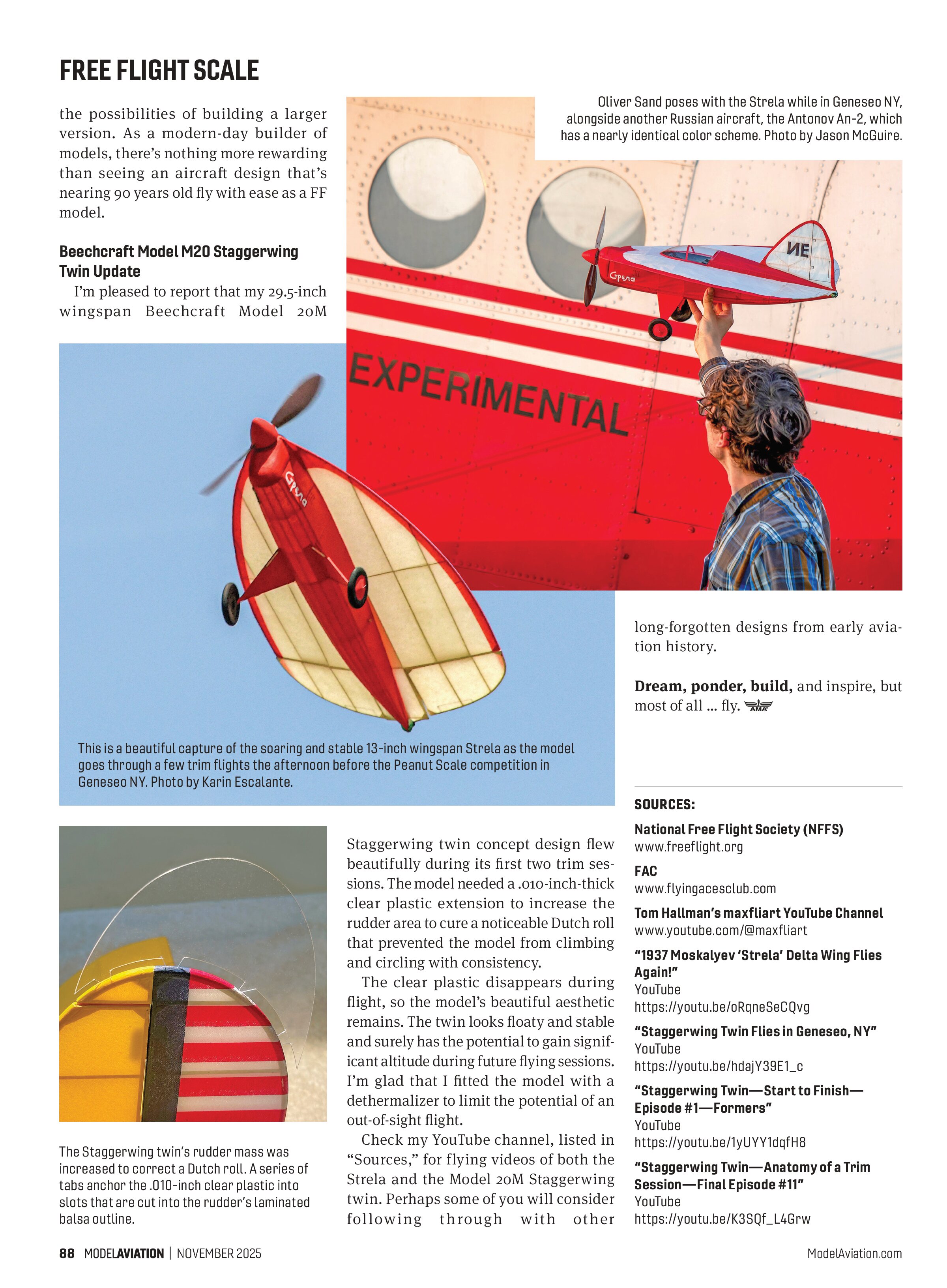
I’m pleased to report that my 29.5-inch wingspan Beechcraft Model 20M

long-forgotten designs from early aviation history.
Dream, ponder, build, and inspire, but most of all ... fly.

Staggerwing twin concept design flew beautifully during its first two trim sessions. The model needed a .010-inch-thick clear plastic extension to increase the rudder area to cure a noticeable Dutch roll that prevented the model from climbing and circling with consistency.
The clear plastic disappears during flight, so the model’s beautiful aesthetic remains. The twin looks floaty and stable and surely has the potential to gain significant altitude during future flying sessions. I’m glad that I fitted the model with a dethermalizer to limit the potential of an out-of-sight flight.
Check my YouTube channel, listed in “Sources,” for flying videos of both the Strela and the Model 20M Staggerwing twin. Perhaps some of you will consider following through with other

SOURCES:
National Free Flight Society (NFFS)
www.freeflight.org
Tom Hallman’s maxfl iart YouTube Channel
www.youtube.com/@maxfliart
“1937 Mosk alyev ‘Strela’ Delta Wing Flies Again!”
YouTube
https://youtu.be/0RqneSeCQvg
“Staggerwing Twin Flies in Geneseo, NY”
YouTube
https://youtu.be/hdajY39E1_c
“Staggerwing Twin—Start to Finish—Episode #1—Formers”
YouTube
https://youtu.be/1vUYY1dqfH8
“Staggerwing Twin—Anatomy of a Trim Session—Final Episode #11”
YouTube
https://youtu.be/K3SQf_L4Grw