
WHERE DID SUMMER GO?
By Thayer Syme | thayer@flying-models.com
IF YOU WOULD, please indulge me for just a moment before I dive into the modeling content this month. I’ve got a pressing question for all of you readers. It’s not 100% modeling related, but I do feel that it is safe to call it “modeling adjacent.”
Are all of the seasons really the same length?
Seriously, doesn’t summer seem to be shorter than all of the rest? Maybe my perception is skewed by a late spring here in New England, coupled with that one cold August morning that inevitably reminds us that school buses are about to rejoin the morning commute.
What I do know is that summer seems to be about two months long, at most. This is despite pretty much everyone treating Memorial Day weekend as the official start to summer, at least three weeks before it actually begins!
Sorry for my rant. It’s just that summer seems to have nearly escaped me again, and I am not happy about it. Let me know what you think and I’ll report back in a future issue if any interesting responses or trends emerge.
Creative, Unusual, and Rare Models
I am highlighting three exceptional models for you this month, along with some more building thoughts, so let’s get started before I run out of space again.
First up are two models that exemplify the creativity and quest for the unusual that many find so compelling about our hobby. Both are rubber-powered Free Flight models that their designer-builders entered in the Flying Aces Club (FAC) non-Nats competition, which was held in Geneseo, New York, in mid-July.
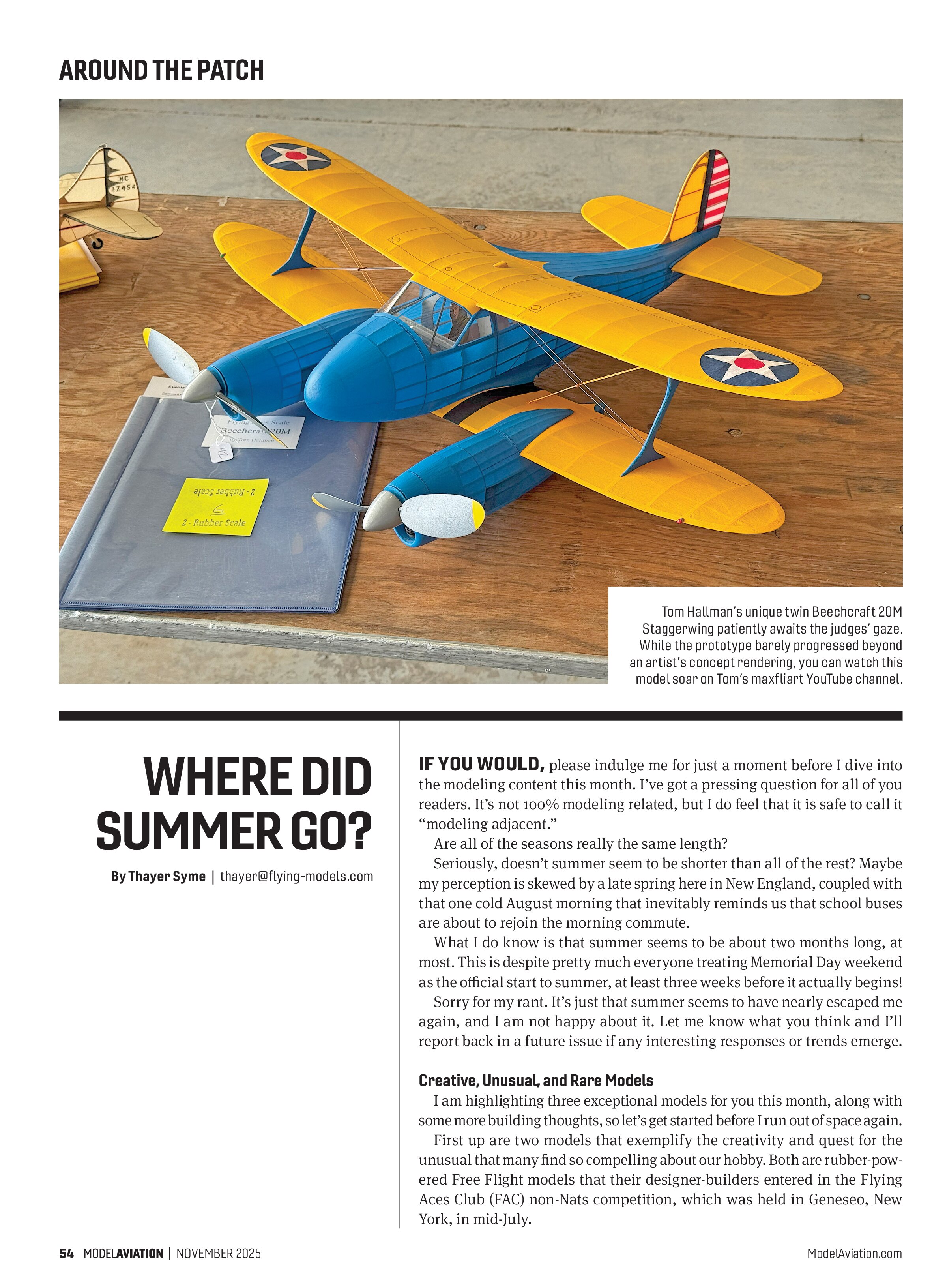
The lead photo this month showcases Tom Hallman’s realization of his first muse for 2025, the beautiful—but widely unknown—1937 Beechcraft Model 20M Staggerwing twin. Inspired by a vintage artist’s rendering from the Beechcraft archives, Tom’s model is truly stunning to behold. The full-scale design was canceled during initial developmental studies when Beechcraft opted to focus on the now-iconic Beech 18 instead. Fortunately, the 20M rendering was not purged from the files, but Tom had little else to go on. That was enough, though, and he jumped in with both feet.
His resulting model was unquestionably the most anticipated entry at Geneseo this summer. Starting just after the first of the year, he documented the entire design and construction process on his popular YouTube channel, maxfliart (listed in “Sources”). The 11 videos of its gestation are well worth watching and make up a true master class for aspiring stick-and-tissue modelers.
There isn’t much more that I can say about the model that isn’t covered within his videos. While I do realize that not everyone will want to sit through all of them, I strongly recommend that you at least watch his additional 12th video that shows it flying at Geneseo. The same attention to craft and detail that goes into his models is also in his video production quality, as evidenced by nearly 7.5 million cumulative views of his videos.
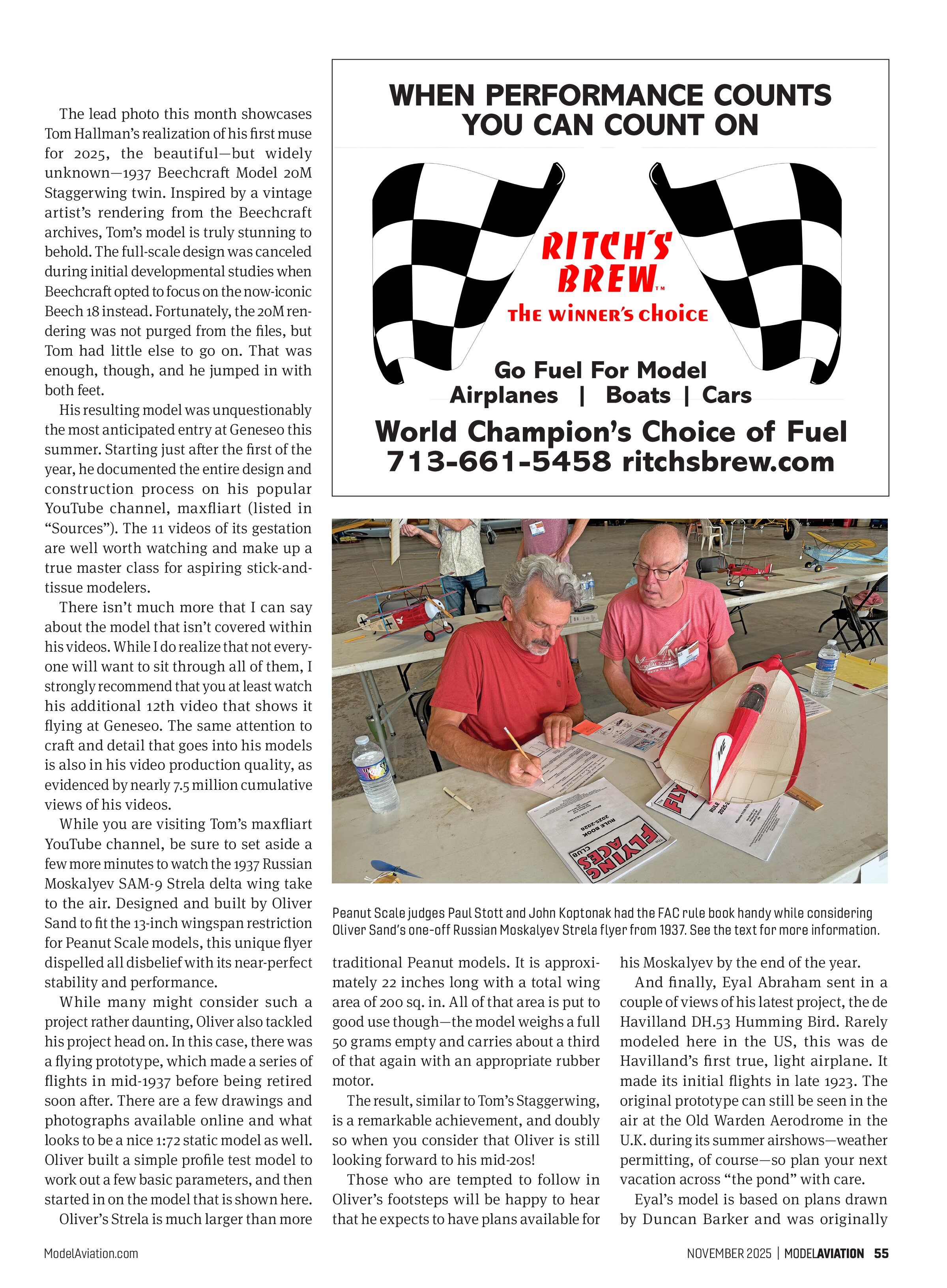
While you are visiting Tom’s maxfliart YouTube channel, be sure to set aside a few more minutes to watch the 1937 Russian Moskalyov SAM-9 Strela delta wing take to the air. Designed and built by Oliver Sand to fit the 13-inch wingspan restriction for Peanut Scale models, this unique flyer dispelled all disbelief with its near-perfect stability and performance.
While many might consider such a project rather daunting, Oliver also tackled his project head on. In this case, there was a flying prototype, which made a series of flights in mid-1937 before being retired soon after. There are a few drawings and photographs available online and what looks to be a nice 1:72 static model as well. Oliver built a simple profile test model to work out a few basic parameters, and then started in on the model that is shown here.
Oliver’s Strela is much larger than more traditional Peanut models. It is approximately 22 inches long with a total wing area of 200 sq. in. All of that area is put to good use though—the model weighs a full 50 grams empty and carries about a third of that again with an appropriate rubber motor.
The result, similar to Tom’s Staggerwing, is a remarkable achievement, and doubly so when you consider that Oliver is still looking forward to his mid-20s!
Those who are tempted to follow in Oliver’s footsteps will be happy to hear that he expects to have plans available for his Moskalyov by the end of the year.

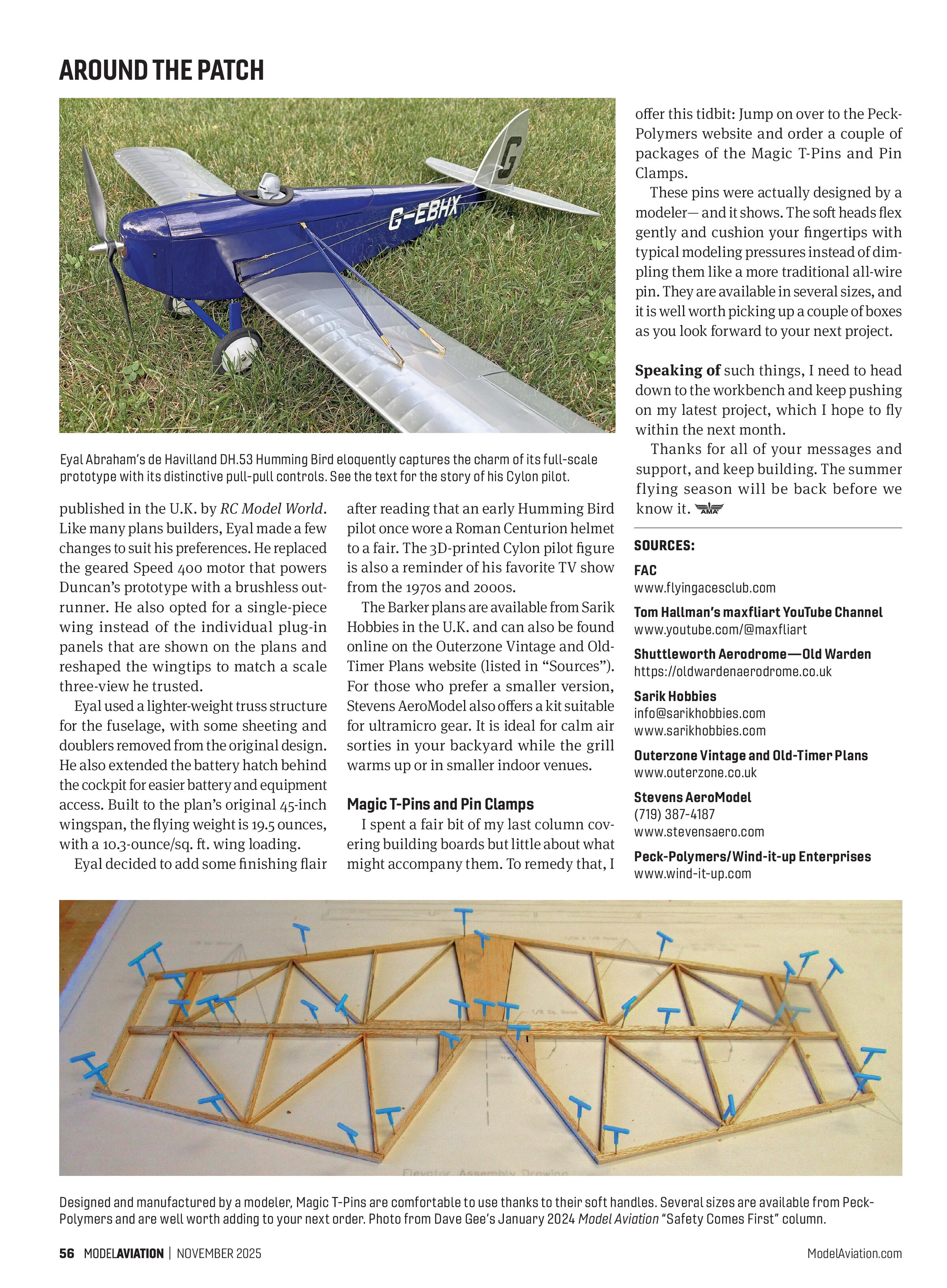
And finally, Eyal Abraham sent in a couple of views of his latest project, the de Havilland DH.53 Humming Bird. Rarely modeled here in the US, this was de Havilland’s first true, light airplane. It made its initial flights in late 1923. The original prototype can still be seen in the air at the Old Warden Aerodrome in the U.K. during its summer airshows—weather permitting, of course—so plan your next vacation across “the pond” with care.
Eyal’s model is based on plans drawn by Duncan Barker and was originally

Eyal Abraham’s de Havilland DH.53 Humming Bird elegantly captures the charm of its full-scale prototype with its distinctive pull-pull controls. See the text for the story of his Cylon pilot.
published in the U.K. by RC Model World. Like many plans builders, Eyal made a few changes to suit his preferences. He replaced the geared Speed 400 motor that powers Duncan’s prototype with a brushless outrunner. He also opted for a single-piece wing instead of the individual plug-in panels that are shown on the plans and reshaped the wingtips to match a scale three-view he trusted.
Eyal used a lighter-weight truss structure for the fuselage, with some sheeting and doublers removed from the original design. He also extended the battery hatch behind the cockpit for easier battery and equipment access. Built to the plan’s original 45-inch wingspan, the flying weight is 19.5 ounces, with a 10.3-ounce/sq. ft. wing loading.
Eyal decided to add some finishing flair after reading that an early Humming Bird pilot once wore a Roman Centurion helmet to a fair. The 3D-printed Cylon pilot figure is also a reminder of his favorite TV show from the 1970s and 2000s.
The Barker plans are available from Sarik Hobbies in the U.K. and can also be found online on the Outerzone Vintage and Old-Timer Plans website (listed in “Sources”). For those who prefer a smaller version, Stevens AeroModel also offers a kit suitable for ultramicro gear. It is ideal for calm air sorties in your backyard while the grill warms up or in smaller indoor venues.
Magic T-Pins and Pin Clamps
I spent a fair bit of my last column covering building boards but little about what might accompany them. To remedy that, I offer this tidbit: Jump on over to the Peck-Polymers website and order a couple of packages of the Magic T-Pins and Pin Clamps.
These pins were actually designed by a modeler—and it shows. The soft heads flex gently and cushion your fingertips with typical modeling pressures instead of dimpling them like a more traditional all-wire pin. They are available in several sizes, and it is well worth picking up a couple of boxes as you look forward to your next project.
Speaking of such things, I need to head down to the workbench and keep pushing on my latest project, which I hope to fly within the next month.
Thanks for all of your messages and support, and keep building. The summer flying season will be back before we know it.
SOURCES:
Tom Hallman’s maxflIart YouTube Channel
www.youtube.com/@maxfliart
Shuttleworth Aerodrome—Old Warden
https://oldwardenaerodrome.co.uk
Sarik Hobbies
info@sarikhobbies.com
www.sarikhobbies.com
Outerzone Vintage and Old-Timer Plans
www.outerzone.co.uk
Stevens AeroModel
(719) 387-4187
www.stevensaero.com
Peck-Polymers/Wind-it-up Enterprises
www.wind-it-up.com