REIMAGINED SHOESTRING
Photos provided by Joe Hass | joehass@gmail.com


JOE HASS (Rochester Hills, Michigan) had the distinct privilege of meeting Carl Goldberg on multiple occasions at the Weak Signals Toledo Show: R/C Model Expo, the Hobby Manufacturers Association conventions, and at Carl’s manufacturing facility.
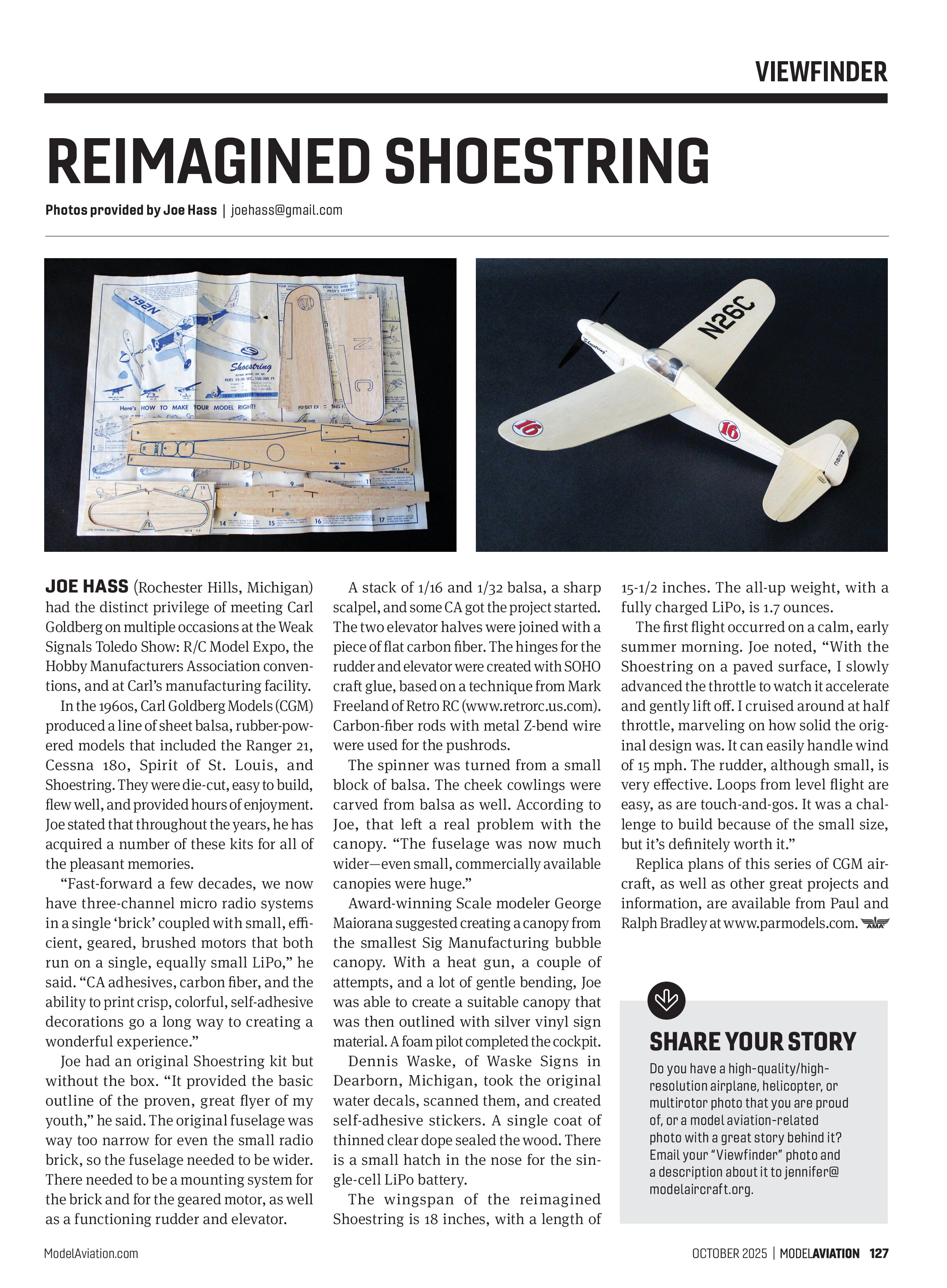
In the 1960s, Carl Goldberg Models (CGM) produced a line of sheet balsa, rubber-powered models that included the Ranger 21, Cessna 180, Spirit of St. Louis, and Shoestring. They were die-cut, easy to build, flew well, and provided hours of enjoyment. Joe stated that throughout the years, he has acquired a number of these kits for all of the pleasant memories.
“Fast-forward a few decades, we now have three-channel micro radio systems in a single ‘brick’ coupled with small, efficient, geared, brushed motors that both run on a single, equally small LiPo,” he said. “CA adhesives, carbon fiber, and the ability to print crisp, colorful, self-adhesive decorations go a long way to creating a wonderful experience.”
Joe had an original Shoestring kit but without the box. “It provided the basic outline of the proven, great flyer of my youth,” he said. The original fuselage was way too narrow for even the small radio brick, so the fuselage needed to be wider. There needed to be a mounting system for the brick and for the geared motor, as well as a functioning rudder and elevator.
A stack of 1/16 and 1/32 balsa, a sharp scalpel, and some CA got the project started. The two elevator halves were joined with a piece of flat carbon fiber. The hinges for the rudder and elevator were created with SOHO craft glue, based on a technique from Mark Freeland of Retro RC (www.retrorc.us.com). Carbon-fiber rods with metal Z-bend wire were used for the pushrods.
The spinner was turned from a small block of balsa. The cheek cowlings were carved from balsa as well. According to Joe, that left a real problem with the canopy. “The fuselage was now much wider—even small, commercially available canopies were huge.”
Award-winning Scale modeler George Maiorana suggested creating a canopy from the smallest Sig Manufacturing bubble canopy. With a heat gun, a couple of attempts, and a lot of gentle bending, Joe was able to create a suitable canopy that was then outlined with silver vinyl sign material. A foam pilot completed the cockpit.
Dennis Waske, of Waske Signs in Dearborn, Michigan, took the original water decals, scanned them, and created self-adhesive stickers. A single coat of thinned clear dope sealed the wood. There is a small hatch in the nose for the single-cell LiPo battery.
The wingspan of the reimagined Shoestring is 18 inches, with a length of 15-1/2 inches. The all-up weight, with a fully charged LiPo, is 1.7 ounces.
The first flight occurred on a calm, early summer morning. Joe noted, “With the Shoestring on a paved surface, I slowly advanced the throttle to watch it accelerate and gently lift off. I cruised around at half throttle, marveling on how solid the original design was. It can easily handle wind of 15 mph. The rudder, although small, is very effective. Loops from level flight are easy, as are touch-and-gos. It was a challenge to build because of the small size, but it’s definitely worth it.”
Replica plans of this series of CGM aircraft, as well as other great projects and information, are available from Paul and Ralph Bradley at www.parmodels.com.
SHARE YOUR STORY
Do you have a high-quality/high-resolution airplane, helicopter, or multirotor photo that you are proud of, or a model aviation-related photo with a great story behind it? Email your “Viewfinder” photo and a description about it to jennifer@modelaircraft.org.