SMALL-FIELD FLYING

BUILDING WITH NON-MODELING “THINGS THAT WORK”
By Pat Tritle | patscustommodels@gmail.com
ONE OF MY FAVORITE THINGS about modeling is the variety of non-modeling-related materials that we use. We “old schoolers” cut our teeth using what we had and made it work simply because it was there and filled the need at hand. As a kid, I always carefully removed and saved the Christmas and birthday wrapping tissue because that was the mainstay of my Free Flight model covering stash for the year. Other things, such as old computer punch cards, came in handy as well and are what eventually evolved into the materials used today.
Without a doubt, one item that falls nicely into the “things that work” category is the good, old-fashioned file folder. While 1/32-inch balsa and 1/64-inch plywood work too, I’ve found places where the grain would not allow 1/32 sheet balsa to conform well to the curves. Because there was no grain, file folder paper worked better. It also conforms well for skinning boot cowlings, scale hatch covers, and door skins, and it glues easily to balsa using canopy glue or aliphatic resin (aka “white glue”).
These folders are available in different colors, but I personally prefer the tan-colored manila folders because they are close to the color of balsa. Once in place, they are sealed with two or three coats of thinned dope to saturate and harden the paper and prevent rippling in humid conditions. Manila folders also take iron-on covering just like sheet balsa or plywood.
For those of us on a budget, 100 folders are approximately equal to the cost of a 12- x 24-inch sheet of 1/64-inch plywood or four sheets of 1/32- x 4- x 36-inch balsa. That said, I don’t think I’d be tempted to fully sheet a model using file folders, but to represent smaller areas, such as sheet-metal skins and fairings, nothing I’ve used works better or is as easy to cut and apply.
Variety: The Spice of Life
There is definitely a good variety of projects coming to us this time that range from an enlarged, scratch-built Peanut to vintage RC to modern kit-built models and even a modified version of an already modified classic design. Rather than prolonging the mystery, let’s dive right in.
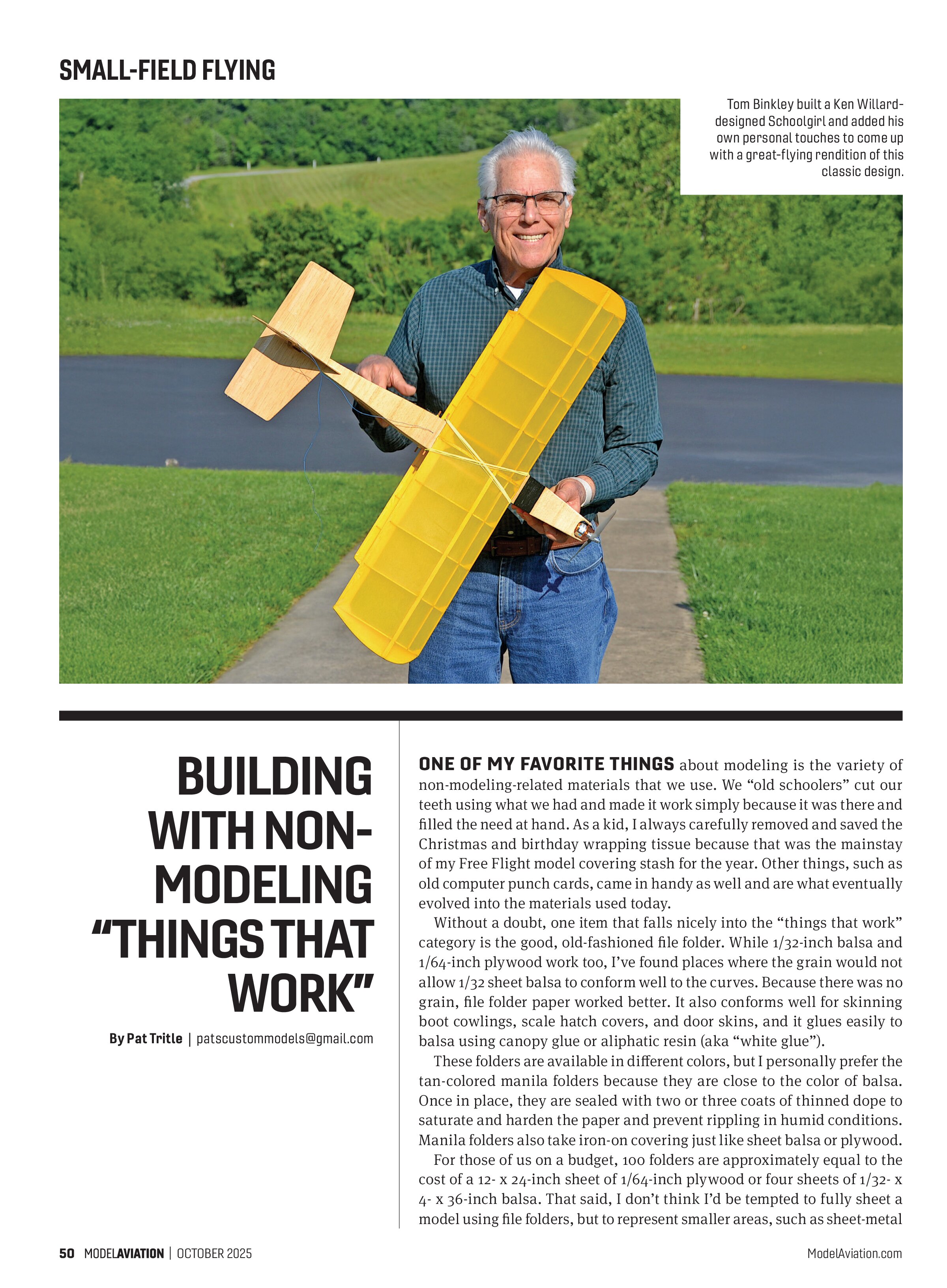
First up is our old friend, Tom Binkley, who built a somewhat modified electric-powered version of Ken Willard’s Schoolgirl. Not being a fan of fully-sheeted wings, Tom reduced the plans to 92% to fit wing kits from Stevens AeroModel. The wing halves were clipped one bay at each tip, which resulted in a 31-1/2-inch top and 23-1/2-inch bottom wingspan, with a total area of 340 sq. in. Powered with a Suppo 2212/6 motor, a 7 x 6 propeller, and a 900 mAh 3S LiPo battery, the 11-ounce, three-channel model, in Tom’s words, “is probably the most aerobatic RET [rudder-elevator-throttle] model I’ve flown.”
Throttled back, it is more like a lazy, stable park flyer.
Hat’s off to Ken as well. He is one of the pioneers in what we today call park flyers. He did it with Cox glow engines before all of the fine electric power components and readily available micro-RC gear were common.
Another prolific builder—and certainly no stranger here—is John Donnelly. John


is not only a big fan of multiengine models, but he also recognizes a great lightweight airplane when he sees one. John’s latest is the 55-inch wingspan Aeronca LB that was built from a Dare/Brodak kit.
The LB was built basically unmodified and “straight from the box.” It’s powered using a Suppo 2217/9 outrunner motor swinging an APC 10 x 6E propeller. A pair of 9-gram servos controls the rudder and elevator, with 6-gram servos swinging the ailerons. A 2,200 mAh 2S LiPo flies the model nicely, but John prefers the added power of a 3S battery for a more aggressive climb and big, beautiful loops. All in all, John describes the LB as “looking nice in the air and fun to fly.”
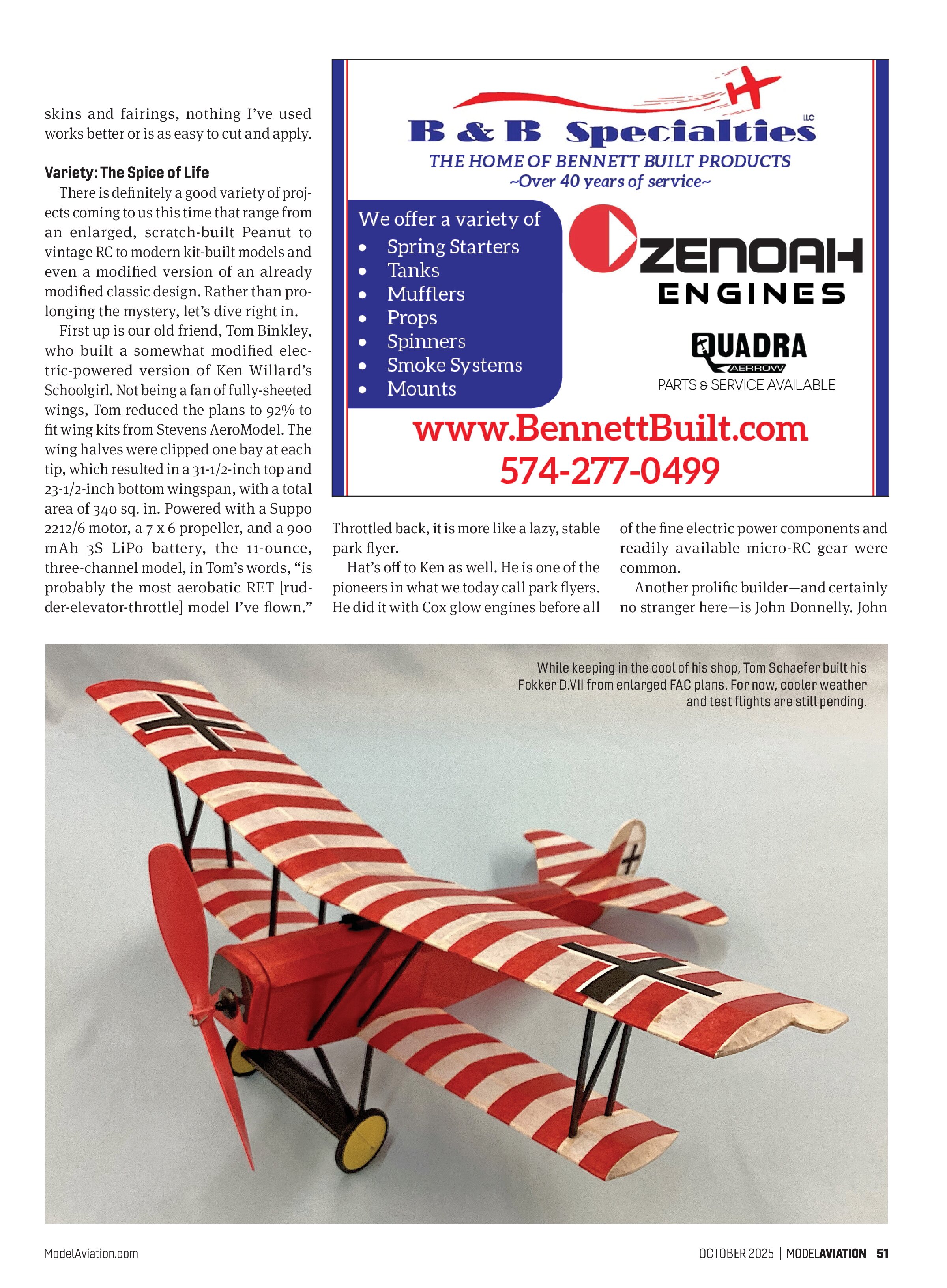
While Tom Schaefer waited out the triple-digit temperatures in Tucson, Arizona, he whipped up his Fokker D.VII using Peanut plans from the Flying Aces Club (FAC) magazine that were enlarged to a 16-inch wingspan. The beautiful, little model probably won’t be flown until things cool down some, but I’m guessing it will be a good flyer when the time comes.
How can you not love a de Havilland Tiger Moth? Alan Muetzenberg does and sent photos of his 55-inch wingspan Tiggie that was built from a Dare/Brodak kit. The 32.7-ounce model is powered with a Suppo 2217/8 outrunner motor on a 2S 2,200 mAh battery. The four-channel Tiger Moth is a very solid, stable flyer and practically lands itself.
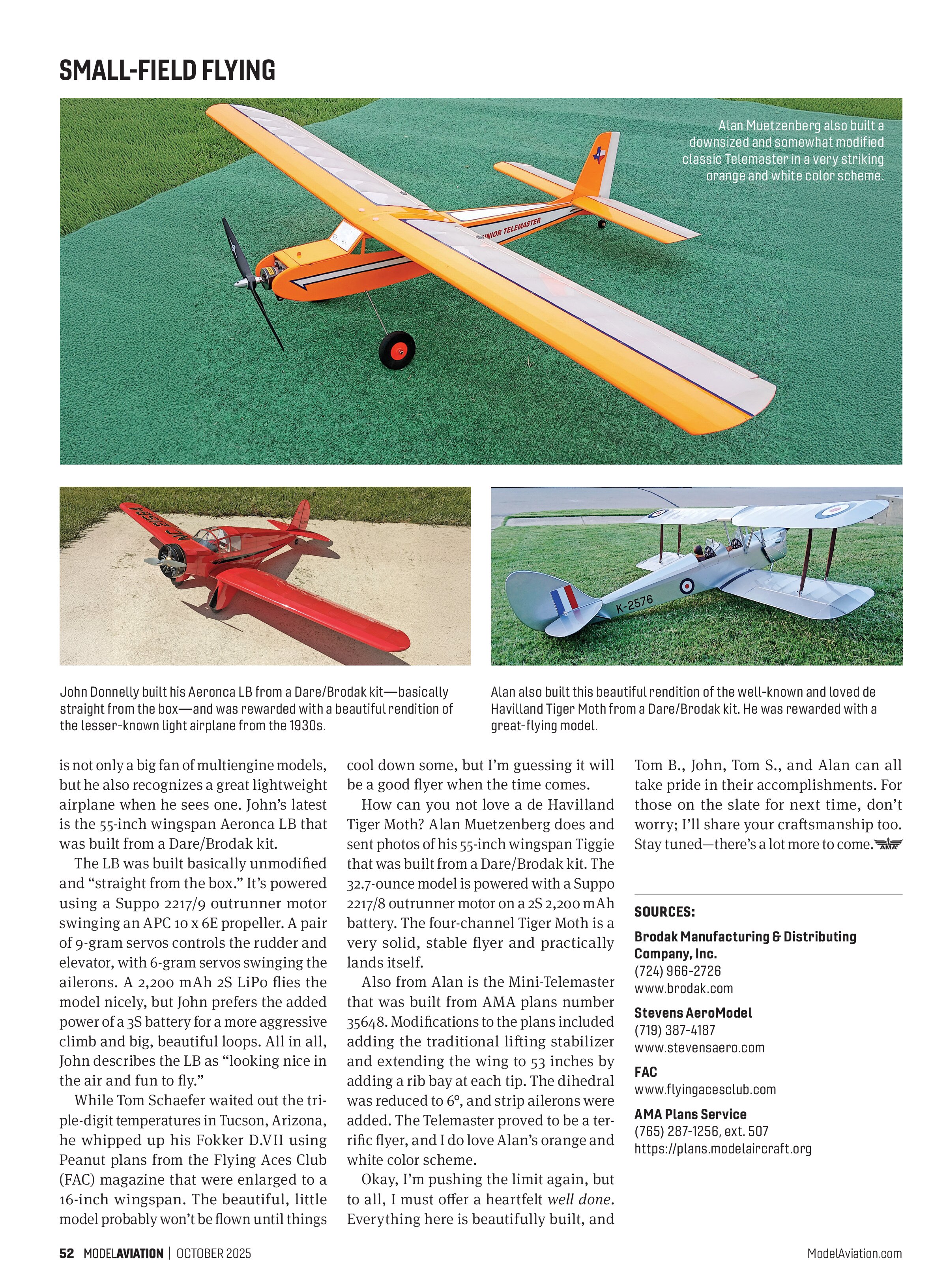
Also from Alan is the Mini-Telemaster that was built from AMA plans number 35648. Modifications to the plans included adding the traditional lifting stabilizer and extending the wing to 53 inches by adding a rib bay at each tip. The dihedral was reduced to 6°, and strip ailerons were added. The Telemaster proved to be a terrific flyer, and I do love Alan’s orange and white color scheme.
Okay, I’m pushing the limit again, but to all, I must offer a heartfelt well done. Everything here is beautifully built, and
Tom B., John, Tom S., and Alan can all take pride in their accomplishments. For those on the slate for next time, don’t worry; I’ll share your craftsmanship too. Stay tuned—there’s a lot more to come.
SOURCES:
Brodak Manufacturing & Distributing Company, Inc.
(724) 966-2726
www.brodak.com
Stevens AeroModel
(719) 387-4187
www.stevensaero.com
AMA Plans Service
(765) 287-1256, ext. 507
https://plans.modelaircraft.org