RC SCALE AEROBATICS

FORMS OF PREPARATION
By John Glezellis | jglezellis@gmail.com
IN MY LAST DISCUSSION, I touched on the topic of preparation and a few of the different forms it can take for the serious International Miniature Aerobatic Club (IMAC) competitor. Troubleshooting any mechanical or electrical item can be quite a challenge in a short period of time. In some instances, the use of a backup transmitter or aircraft might quickly become necessary. Should this occur during an event, the second aircraft or radio must be configured so that it is similar to the primary.
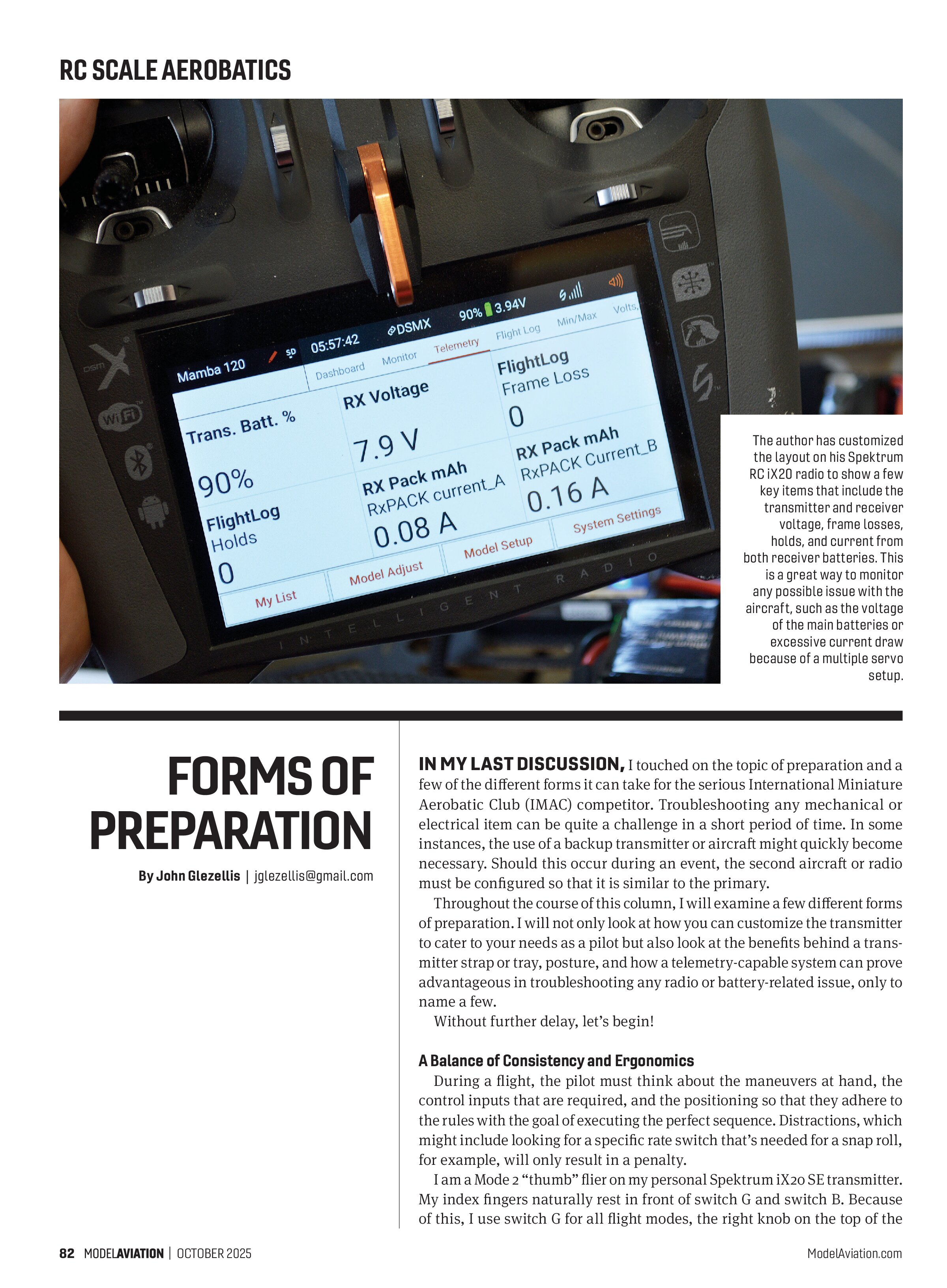
Throughout the course of this column, I will examine a few different forms of preparation. I will not only look at how you can customize the transmitter to cater to your needs as a pilot but also look at the benefits behind a transmitter strap or tray, posture, and how a telemetry-capable system can prove advantageous in troubleshooting any radio or battery-related issue, only to name a few.
Without further delay, let’s begin!
A Balance of Consistency and Ergonomics
During a flight, the pilot must think about the maneuvers at hand, the control inputs that are required, and the positioning so that they adhere to the rules with the goal of executing the perfect sequence. Distractions, which might include looking for a specific rate switch that’s needed for a snap roll, for example, will only result in a penalty.
I am a Mode 2 “thumb” flier on my personal Spektrum iX20 SE transmitter. My index fingers naturally rest in front of switch G and switch B. Because of this, I use switch G for all flight modes, the right knob on the top of the transmitter for the ignition battery eliminator circuit (IBEC) system, and use switch I to activate the timer.
While I might use other switches for other models (i.e., a three-position switch for flaps, a two-position switch for retractable landing gear, etc.), the switches I noted above are standard across all aircraft to ensure that no uncertainty exists when I change from one aircraft to the next. To minimize confusion, in recent years, I have added the use of audio events when a switch is moved. Both my primary and backup transmitters contain the same aircraft files to avoid confusion and minimize time if the backup transmitter is needed.
Now that I have touched on the ergonomics of switch selection and consistent practices between different types of models, let’s transition to holding the transmitter for positioning and comfort, as well as posture.
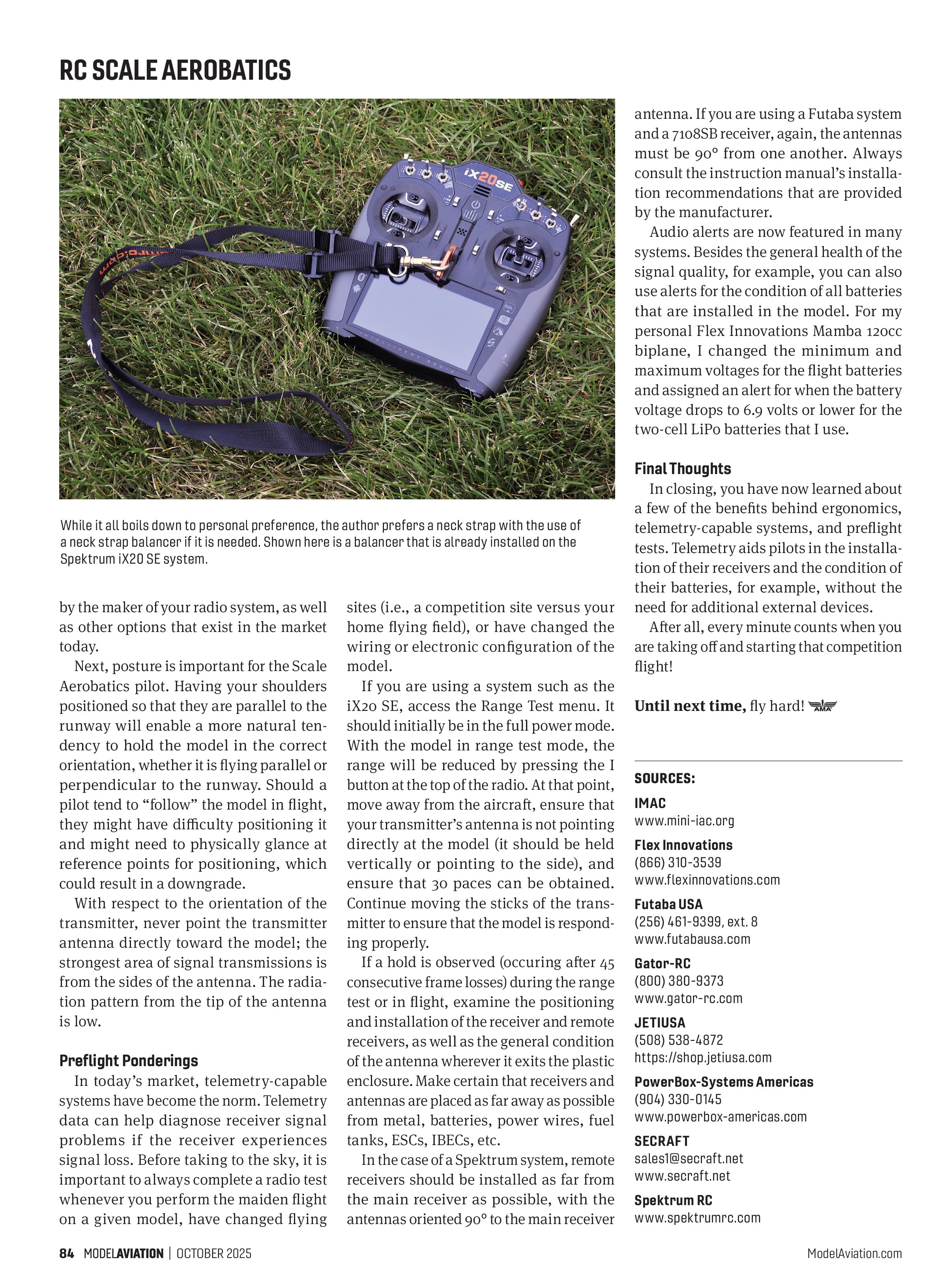
The use of a neck strap or transmitter tray maintains consistent transmitter positioning, minimizes any undesired movements, supports the weight of the transmitter, and makes your fingers available for changing switch positions, adjusting the trims of the model, and so forth. Throughout the past decade or so, a neck strap has been my personal preference, and quite a few offerings exist.

Regardless, ensure that you have a spare neck strap if one is misplaced, and make certain that they are both the same length. You should use the buckles at the attachment end of the strap to adjust the length so that it adheres to your personal preferences.
Others prefer the use of a transmitter tray. Gator-RC offers a few options, one being the Pro Grip Transmitter Tray and another from SECRAFT. Some tray offerings that do not feature hand rests work well for all pilots and can be used across most, if not all, transmitter systems.
For those who prefer flying with their fingers instead their thumbs, JETI offers a few different tray and harness options, including transmitter hand rests for its DS-14, DS-16, and DS-24 radios. PowerBox-Systems Americas offers accessories to convert its system to a tray radio (i.e., hand rests, a neck strap for the tray version, stick extensions, etc.). Explore the offerings first
by the maker of your radio system, as well as other options that exist in the market today.
Next, posture is important for the Scale Aerobatics pilot. Having your shoulders positioned so that they are parallel to the runway will enable a more natural tendency to hold the model in the correct orientation, whether it is flying parallel or perpendicular to the runway. Should a pilot tend to “follow” the model in flight, they might have difficulty positioning it and might need to physically glance at reference points for positioning, which could result in a downgrade.
With respect to the orientation of the transmitter, never point the transmitter antenna directly toward the model; the strongest area of signal transmissions is from the sides of the antenna. The radiation pattern from the tip of the antenna is low.
Preflight Ponderings
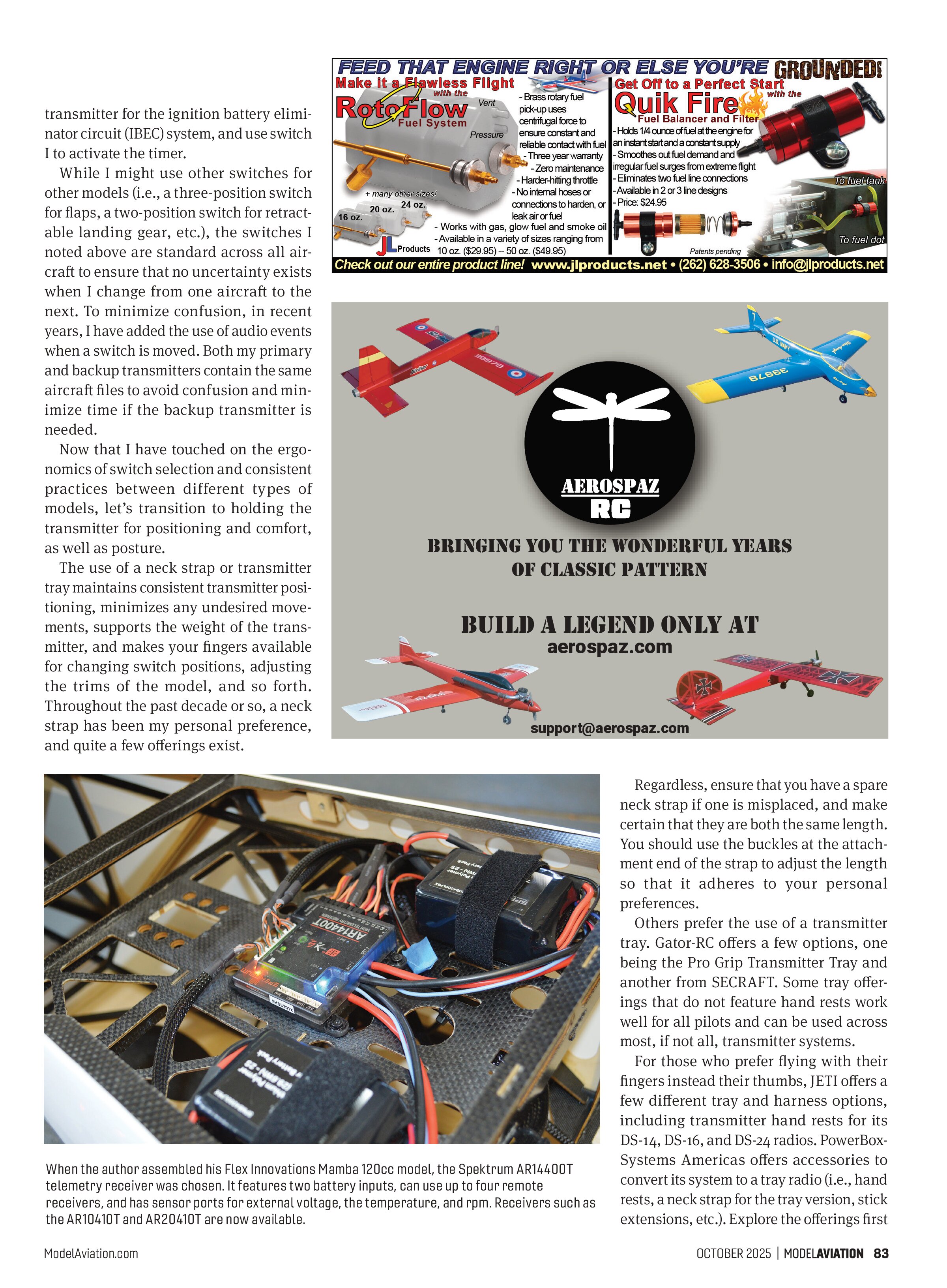
In today’s market, telemetry-capable systems have become the norm. Telemetry data can help diagnose receiver signal problems if the receiver experiences signal loss. Before taking to the sky, it is important to always complete a radio test whenever you perform the maiden flight on a given model, have changed flying sites (i.e., a competition site versus your home flying field), or have changed the wiring or electronic configuration of the model.
If you are using a system such as the iX20 SE, access the Range Test menu. It should initially be in the full power mode. With the model in range test mode, the range will be reduced by pressing the I button at the top of the radio. At that point, move away from the aircraft, ensure that your transmitter’s antenna is not pointing directly at the model (it should be held vertically or pointing to the side), and ensure that 30 paces can be obtained. Continue moving the sticks of the transmitter to ensure that the model is responding properly.
If a hold is observed (occurring after 45 consecutive frame losses) during the range test or in flight, examine the positioning and installation of the receiver and remote receivers, as well as the general condition of the antenna wherever it exits the plastic enclosure. Make certain that receivers and antennas are placed as far away as possible from metal, batteries, power wires, fuel tanks, ESCs, IBECs, etc.
In the case of a Spektrum system, remote receivers should be installed as far from the main receiver as possible, with the antennas oriented 90° to the main receiver antenna. If you are using a Futaba system and a 7108SB receiver, again, the antennas must be 90° from one another. Always consult the instruction manual’s installation recommendations that are provided by the manufacturer.
Audio alerts are now featured in many systems. Besides the general health of the signal quality, for example, you can also use alerts for the condition of all batteries that are installed in the model. For my personal Flex Innovations Mamba 120cc biplane, I changed the minimum and maximum voltages for the flight batteries and assigned an alert for when the battery voltage drops to 6.9 volts or lower for the two-cell LiPo batteries that I use.
Final Thoughts
In closing, you have now learned about a few of the benefits behind ergonomics, telemetry-capable systems, and preflight tests. Telemetry aids pilots in the installation of their receivers and the condition of their batteries, for example, without the need for additional external devices.
After all, every minute counts when you are taking off and starting that competition flight!
Until next time, fly hard!
SOURCES:
IMAC
www.mini-iac.org
Flex Innovations
(866) 310-3539
www.flexinnovations.com
Futaba USA
(256) 461-9399, ext. 8
www.futabausa.com
Gator-RC
(800) 380-9373
www.gator-rc.com
JETI USA
(508) 538-4872
https://shop.jetiusa.com
PowerBox-Systems Americas
(904) 330-0145
www.powerbox-americas.com
SECRAFT
sales1@secraft.net
www.secraft.net
Spektrum RC
www.spektrumrc.com